
Over 18,000 private sector companies in the UAE are subject to mandatory Emiratisation quotas under the Nafis programme, with MOHRE issuing penalties totalling AED 1.2 billion in non-compliance fines since the p.
In 2026, over 18,000 private sector companies in the UAE are subject to mandatory Emiratisation quotas under the Nafis programme, with MOHRE issuing penalties totalling AED 1.2 billion in non-compliance fines since the programme launched in October 2021 (MOHRE, 2026). Private sector Emirati employment has grown by 34% since Nafis was introduced (UAE Government, 2026). More than 75,000 Emiratis have been placed in private sector roles through the programme (UAE Government, 2026). The e-quota system now tracks compliance in real time across all registered companies, updated 2026. If your company has 20 or more employees, this guide is for you.
This guide explains exactly what the Nafis programme UAE requires, who must comply, how to check your e-quota status by company number, what salary support you can claim, and what penalties apply if your company misses its Emiratisation targets in 2026. Need hands-on help? The Dubai South Business Hub Free Zone business support team manages MOHRE and Nafis compliance on your behalf.
What is the Nafis Programme in UAE
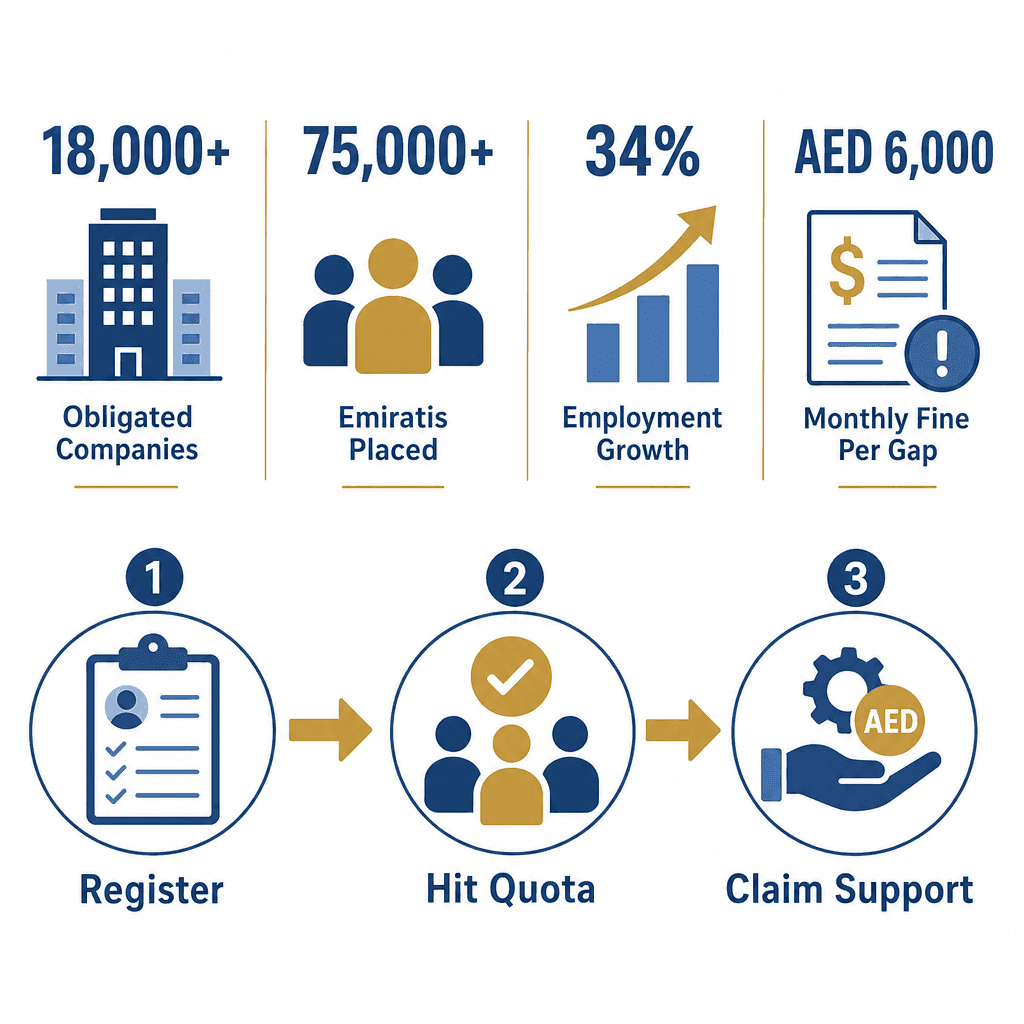
The Nafis programme UAE is the National Programme for Emiratisation, launched in October 2021 and managed by MOHRE. It mandates private sector companies with 50 or more employees to hire a set percentage of Emiratis annually, backed by government salary subsidies of AED 8,000-10,000 per month per qualifying hire.
Definition and Purpose of the Nafis Programme
Nafis stands for the National Programme for Emiratisation. The UAE Federal Government launched it in October 2021 with one clear goal: increase Emirati participation in the private sector significantly and sustainably (UAE Government, 2026). The programme is managed jointly by MOHRE and the Nafis secretariat, with the employer-facing portal at nafis.gov.ae.
The core objective was to place 75,000+ Emiratis in private sector roles by end of 2025, a target that has since been exceeded (UAE Government, 2026). The Emiratisation program is not voluntary. Failure to meet your quota triggers AED 6,000 per month in fines for each unfilled position, accruing from the date the shortfall is recorded.
Take a practical example: a logistics company with 80 employees in Dubai must register on nafis.gov.ae and meet a 2% annual Emiratisation target, meaning at least 2 Emiratis in skilled roles by the end of the compliance year. Miss that mark, and the fines start immediately.
Which Government Bodies Oversee Emiratisation UAE
MOHRE is the primary regulator for mainland private sector companies and oversees more than 18,000 obligated businesses in 2026 (MOHRE, 2026). The e-quota system is administered through the MOHRE digital platform at mohre.gov.ae. For strategic sectors in Abu Dhabi, ADNOC and the Abu Dhabi government carry additional oversight responsibilities.
The Nafis secretariat coordinates salary support disbursements and training incentives separately from MOHRE's enforcement role. A financial services firm in DIFC, for instance, coordinates with MOHRE for e-quota registration but receives Nafis salary support directly through the nafis.gov.ae employer portal. Both registrations are required, you can't claim salary support without completing both. For a detailed breakdown of MOHRE processes, see our MOHRE inquiry system UAE guide.
Who Must Comply with Emiratisation Requirements
All private sector companies in the UAE mainland with 50 or more employees must comply with Emiratisation requirements under MOHRE regulations. Companies with 20-49 employees face a separate one-Emirati hiring obligation. Free zone companies are currently exempt from mandatory quotas except in certain strategic sectors designated by the UAE Cabinet.
Company Size Thresholds and Sector Rules
The Emiratisation requirements UAE applies in three tiers based on headcount:
50+ employees: Subject to Skilled Emiratisation, a 2% annual increase in Emirati skilled workforce, calculated at the start of each compliance year (MOHRE, 2026).
20-49 employees: Must hire at least one Emirati in a skilled role per year (MOHRE, 2026).
Fewer than 20 employees: Currently not subject to mandatory Emiratisation quotas.
Skilled roles are defined by MOHRE as positions requiring a diploma or higher qualification. A retail chain with 120 employees across three Dubai branches must employ at least 3 Emiratis in skilled roles in 2026, rising to 5 in 2027 under the 2% annual increment rule. That progression is automatic, MOHRE calculates it for you via the e-quota dashboard.
Sectors with Accelerated Emiratisation Targets
Nine priority sectors face higher Emiratisation targets than the standard 2% annual increment. These are: financial services, IT, insurance, real estate, education, healthcare, retail, hospitality, and construction. MOHRE publishes updated sector-specific targets annually at mohre.gov.ae, so check the current list at the start of each compliance year.
A mainland UAE bank with 200 staff, for example, faces an accelerated Emiratisation target above the standard 2% because financial services is a MOHRE-designated priority sector for 2026. Companies in these nine sectors that miss targets face compounded monthly penalties. Worth flagging: UAE Cabinet-designated strategic sectors may also pull certain free zone entities into mandatory compliance, so verify your sector status directly on mohre.gov.ae.
Emiratisation 2026 - Company Size, Targets, Penalties and Nafis Support
Criteria | 20-49 Employees | 50-99 Employees | 100-499 Employees | 500+ Employees |
|---|---|---|---|---|
Annual Target | 1 Emirati hire in a skilled role | 2% of skilled workforce per year | 2% of skilled workforce per year | 2% + priority sector uplift if applicable |
Penalty Per Month Per Unfilled Position | AED 6,000 | AED 6,000 | AED 6,000 | AED 6,000 |
Nafis Salary Support Per Emirati Per Month | AED 8,000-10,000 | AED 8,000-10,000 | AED 8,000-10,000 | AED 8,000-10,000 |
Nafis Support Duration | Up to 5 years per employee | Up to 5 years per employee | Up to 5 years per employee | Up to 5 years per employee |
E-Quota Tracking | Real-time via mohre.gov.ae | Real-time via mohre.gov.ae | Real-time via mohre.gov.ae | Real-time via mohre.gov.ae |
Stay on top of all your annual compliance deadlines with the company compliance calendar UAE.
Emiratisation Targets for 2026 - What Percentage is Required
The Emiratisation target for private sector companies with 50 or more employees is a 2% annual increase in Emirati headcount for 2026. Companies in MOHRE's nine priority sectors face higher sector-specific targets. The cumulative target from 2022 to 2026 means qualifying companies must have grown their Emirati workforce by 10% over five years.
The 2% Annual Increment Rule Explained
Each calendar year from 2022 to 2026, companies must add 2% more Emiratis to their skilled workforce. The baseline is calculated from total headcount registered with MOHRE at the start of each compliance year (UAE Cabinet Resolution, 2021). MOHRE updates e-quota targets automatically on the employer dashboard at mohre.gov.ae, you don't need to recalculate manually.
Here's a concrete progression: a technology company with 100 employees that had zero Emiratis in 2022 was required to hire 2 by end of 2022, 4 by end of 2023, 6 by end of 2024, 8 by end of 2025, and 10 by end of 2026. That's a 10% cumulative target over five years (MOHRE, 2026). One critical nuance: if your company over-achieved in a prior year, that surplus doesn't carry forward to reduce the 2026 requirement. The 2% increment applies fresh each year.
Emiratisation Targets by Company Size
A retail company with 250 employees in a priority sector faces a 2026 target of 5 Emirati hires. Miss 2 of those positions and you're paying AED 12,000 per month in penalties, every month the shortfall persists. The Nafis salary support of AED 8,000-10,000 per qualifying Emirati hire (Nafis, 2026) means compliant hiring is genuinely cost-effective once you factor in the government subsidy against the penalty exposure.
Nafis Programme UAE, Key Numbers 2026 18,000+ Obligated Companies MOHRE, 2026 75,000+ Emiratis Placed UAE Government, 2026 AED 6K Fine/Month/Position MOHRE, 2026 AED 10K Max Salary Support/Month Nafis, 2026
The E-Quota System - How It Works
The e-quota UAE system is MOHRE's real-time online platform that tracks each private sector company's Emiratisation compliance status. It assigns a quota target based on company size and sector, records Emirati hires against that target, and flags shortfalls that trigger AED 6,000 monthly penalties. Access it at mohre.gov.ae under the E-Quota menu.
How E-Quota Calculates Your Company's Emiratisation Obligation
The e-quota UAE system pulls headcount data directly from MOHRE's labour permit records. There's no manual input required for base calculations, the system applies the 2% annual increment rule automatically against your registered skilled workforce count. Any Emirati hired and registered with MOHRE within the compliance year is reflected in the e-quota dashboard within 24-48 hours (MOHRE, 2026).
When a Dubai-based insurance firm hires an Emirati account manager and completes MOHRE registration, the e-quota dashboard at mohre.gov.ae updates the company's fulfilment percentage automatically. No separate reporting step is needed. That real-time update is what makes the system both efficient for compliant companies and unforgiving for those who delay hiring.
What is the E-Quota Status System?
Your equota status falls into one of three categories, each with direct operational consequences:
Green status: Company has met or exceeded its Emiratisation quota for the current year. No penalties. License renewals proceed normally.
Yellow status: Partially compliant, below target but within a MOHRE-defined grace window. Act quickly to avoid red status.
Red status: Non-compliant. Penalties of AED 6,000 per unfilled position per month are actively accruing (MOHRE, 2026).
Red status has real operational consequences beyond the monthly fines. A construction company with red e-quota status discovered during a DED license renewal that MOHRE had blocked the process entirely. Resolving AED 72,000 in accrued fines was required before the license could be renewed. Status is visible to MOHRE inspectors and directly affects your eligibility with the Department of Economic Development (DED).
E-Quota Status Traffic Light System, Employer Quick Reference
Visual guide showing the three e-quota compliance status levels and their consequences for UAE private sector employers in 2026.
Green: Quota met or exceeded, zero penalties, full DED renewal eligibility
Yellow: Partially compliant, grace window active, no fines yet, action required
Red: Non-compliant, AED 6,000/month per unfilled position accruing from date of shortfall
Red status blocks DED license renewal until all fines are cleared (MOHRE, 2026)
Red status suspends new work permit applications, directly impacts hiring capacity
Status checked at mohre.gov.ae using 9-digit establishment card number
Suggested alt text: Traffic light diagram showing green, yellow, and red e-quota compliance status categories for UAE employers under the Nafis programme, with penalty amounts and consequences for each level, 2026.
How to Check Your E-Quota Status
To check your e-quota status by company number, go to mohre.gov.ae, select E-Services, then E-Quota, and enter your company's establishment card number or trade license number. The dashboard shows your current Emiratisation fulfilment percentage, quota target for 2026, and any outstanding penalty balance, no login required for the public status check.
Step-by-Step: Check E-Quota Status by Company Number
Go to mohre.gov.ae on desktop or mobile browser.
Select "E-Services" from the top navigation menu.
Choose "E-Quota" from the dropdown services list.
Enter your company establishment card number or trade license number in the search field.
View your equota status, current fulfilment percentage, target headcount, and penalty balance displayed on screen.
An HR manager at a Dubai healthcare firm checks equota status monthly by entering their 9-digit establishment number at mohre.gov.ae. The dashboard shows they're at 1.8% fulfilment against a 2% target, flagging one additional Emirati hire needed before the December 2026 deadline. That single monthly check prevents a AED 6,000 penalty from accruing unnecessarily (MOHRE, 2026).
What Your E-Quota Dashboard Shows
Your dashboard displays the current Emiratisation target for 2026 as a specific headcount number, not a percentage. You'll see the number of Emiratis currently registered under your establishment with MOHRE, your fulfilment percentage (actual Emiratis divided by target, multiplied by 100), and any outstanding penalty amount in AED.
A company with a 2026 target of 4 Emiratis, currently employing 3, sees a 75% fulfilment rate on the dashboard and a projected AED 6,000 monthly penalty accruing from the date the shortfall began. Critically, penalties accrue from the date of shortfall, not from year-end (MOHRE, 2026). The dashboard is accessible 24/7 at mohre.gov.ae, check it monthly, not just at renewal time.
How to Register on the Nafis Portal
To register as an employer on the Nafis portal, go to nafis.gov.ae, select "Employer Registration", and complete the setup using your MOHRE establishment card number and trade license. Registration takes 3-5 working days for verification. Once approved, you can post Emirati job vacancies and apply for government salary support of AED 8,000-10,000 per qualifying hire.
Step-by-Step: Employer Registration on nafis.gov.ae
Go to nafis.gov.ae and click "Register as Employer".
Enter your trade license number and MOHRE establishment card number.
Upload required documents: trade license copy, MOA, and authorised signatory Emirates ID.
Submit the application; the Nafis secretariat reviews and verifies within 3-5 working days (Nafis, 2026).
Receive approval notification via registered email and SMS.
A newly incorporated mainland IT company in Dubai completed Nafis employer registration in 4 working days in January 2026, then posted two software developer vacancies. Both were filled with Emirati candidates within 30 days through the Nafis matching platform. The employer dashboard at nafis.gov.ae handles both vacancy posting and salary support claims from a single interface (Nafis, 2026).
Documents Required for Nafis Employer Registration
Valid UAE trade license (mainland or qualifying sector).
MOHRE establishment card, confirms your labour registration number.
Memorandum of Association (MOA) or Articles of Association.
Emirates ID of the authorised company signatory.
Company bank account details for salary support disbursement.
A hospitality group registering three separate establishments on nafis.gov.ae must submit separate MOHRE establishment card numbers for each location. Each establishment is treated independently for both quota and salary support purposes (Nafis, 2026). This matters practically: you can't consolidate Emirati hires across establishments to satisfy a quota at just one of them.
Nafis Salary Support for Employers
The Nafis salary support scheme gives UAE employers AED 8,000-10,000 per month for each qualifying Emirati hired in the private sector. The subsidy is paid directly by the Nafis programme to the employer for up to five years per employee. Eligibility requires the Emirati to be registered on the Nafis portal and employed in a skilled role with a minimum salary of AED 4,000 per month from the employer.
Salary Support Tiers and Eligibility Criteria
AED 8,000/month: Emirati with a diploma qualification in a skilled private sector role.
AED 10,000/month: Emirati with a bachelor's degree or higher in a skilled private sector role.
Duration: Up to five years per employee, total potential value of AED 600,000 per hire at the top tier (Nafis, 2026).
Minimum salary: The Emirati must earn at least AED 4,000/month from the employer to qualify.
WPS verification: Salary payments are verified monthly through MOHRE's Wages Protection System records.
A real estate company hiring a university-educated Emirati financial analyst at AED 15,000/month receives AED 10,000/month from Nafis. That effectively reduces the employer's net salary cost to AED 5,000/month for five years, totalling AED 600,000 in government support. It's one of the most financially compelling employer incentives in the region right now.
How to Claim Nafis Salary Support
Register the Emirati employee on nafis.gov.ae under your employer account within 30 days of hire.
Ensure WPS salary payments are made on time each month, Nafis verifies via MOHRE WPS records.
Submit the monthly salary support claim through the nafis.gov.ae employer dashboard.
Nafis processes claims within 15 working days and disburses support directly to your registered company bank account (Nafis, 2026).
Maintain employment records, MOHRE and Nafis conduct periodic audits; terminating an Emirati within 12 months triggers a full support clawback (Nafis, 2026).
An employer who terminates an Emirati employee within 6 months of hiring without valid cause receives a clawback demand from Nafis for all salary support disbursed to that point. This reinforces that Nafis support is tied to genuine long-term employment, not short-term quota-filling. The
References
nafis.gov.ae (nafis.gov.ae)