
Topic Summary
Pay Wages Within 10 Days, No Exceptions
The new MOHRE WPS rule requires all private-sector employers to disburse salaries electronically within 10 days of the contractual due date. Missing this window immediately triggers the violation framework, regardless of whether workers were actually paid through other means.
Three Penalty Tiers Replace the Old Flat Fine
The 2024 update replaced a single AED 1,000-per-worker fine with a graduated three-level system tied to how long the delay runs. Delays beyond 60 days can result in license restrictions and a full block on new work permit applications.
Upload Your Salary Information File Correctly
Employers must submit a Salary Information File through a MOHRE-approved bank or exchange house such as Emirates NBD or Al Ansari Exchange. MOHRE cross-references this file against actual bank transfer records in real time, so any discrepancy triggers an automatic flag.
Larger Employers Face Faster Escalation
Companies with more than 100 workers are subject to accelerated escalation timelines under the 2026 framework. This means the window to correct a violation before penalties intensify is shorter than it is for smaller businesses.
Repeat Violations Carry Automatic Level 3 Consequences
A second Level 2 offence within any 12-month period is automatically treated as a Level 3 violation, bringing license restrictions and blocked work permit applications. Employers should treat the first warning as a serious signal to fix compliance processes immediately.
Free Zone and Mainland Employers Are Both Covered
The WPS obligation applies across all private-sector employers in the UAE, covering more than 4.8 million workers as of 2026. Both mainland companies and free zone entities must register with an approved financial agent and comply with the same payment deadlines.
Enforcement Is Rising Sharply Year on Year
MOHRE enforcement actions increased 34% year-on-year following the launch of the tiered violation framework in 2024. With over 2.3 million WPS salary file submissions processed monthly, the system's automated monitoring leaves little room for undetected non-compliance.
In 2026, MOHRE processed over 2.3 million WPS salary file submissions per month. Non-compliant employers now face fines starting at AED 1,000 per worker per delayed cycle. The UAE Wage Protection System covers more than 4.8 million private-sector workers. Enforcement actions rose 34% year-on-year after the 2024 tiered violation framework launched (Ministry of Human Resources and Emiratisation, 2026). Federal Decree-Law No. 33 of 2021 sets the legal backbone for every wage obligation in this guide.
The new UAE salary rule MOHRE WPS requires all private-sector employers to pay wages electronically through approved channels within 10 days of the contractual salary date. Miss that window and you're in violation territory, with penalties that can escalate to license suspension if the delay crosses 60 days. For more detail, see our guide on MOHRE contract submission and WPS requirements. For more detail, see our guide on salary certificate requirements in the UAE.
This guide covers every element of the new UAE salary rule MOHRE WPS update: penalty tiers, payment deadlines, registration steps, and what both mainland and free zone employers must do right now to stay compliant and avoid license suspension. For more detail, see our guide on UAE WPS registration and compliance.
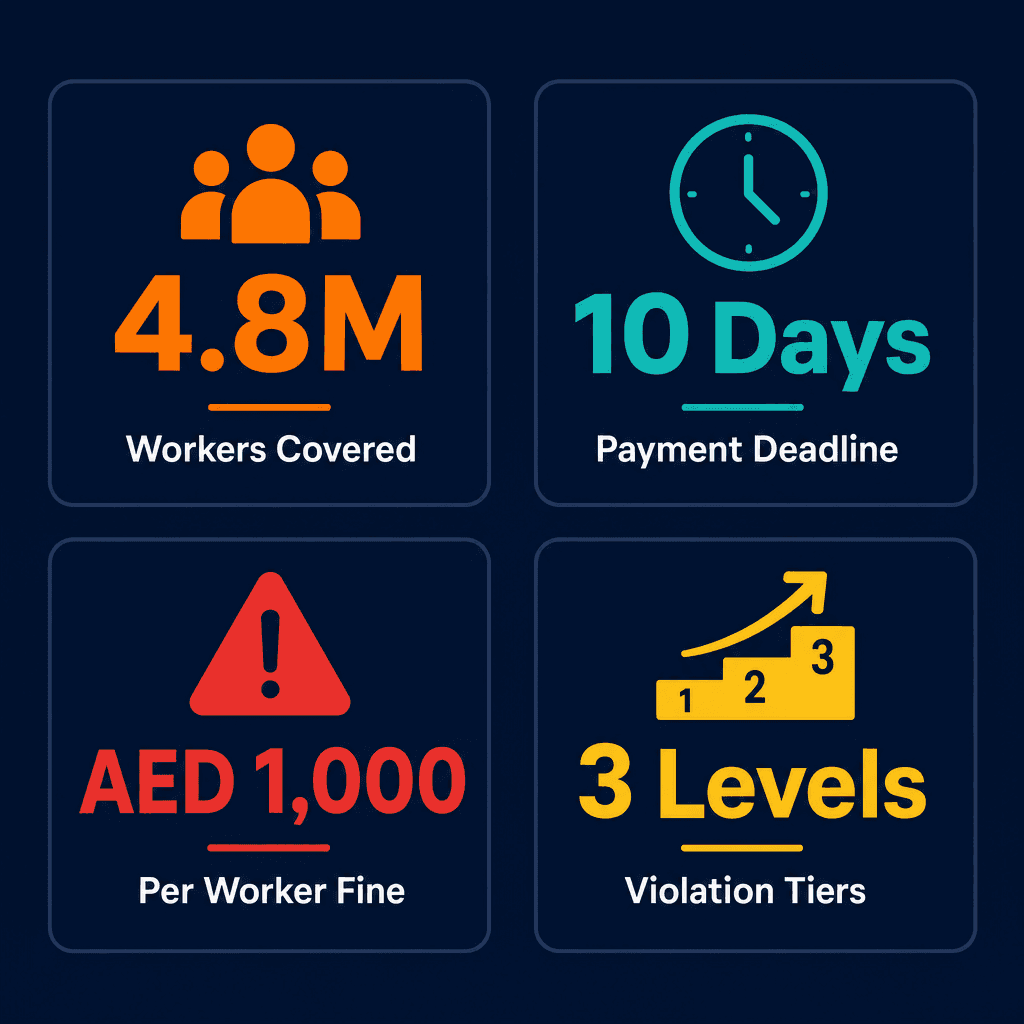
The new UAE salary rule under MOHRE requires all private-sector employers to pay wages electronically through the Wage Protection System within 10 days of the due date. Non-payment triggers a tiered penalty structure starting at AED 1,000 per worker, with license suspension possible after 60 days of non-compliance. For more detail, see our guide on part time work permit and UAE salary rules.
MOHRE WPS Violation Levels and Penalties 2026
Violation Level | Delay Period | Penalty Type | Fine (AED) | License Impact |
|---|---|---|---|---|
Level 1 | 1–10 days late | Official warning | No financial penalty | No license impact |
Level 2 | 10–60 days late | Fine per worker | AED 1,000 per worker (max AED 50,000 per cycle) | No immediate restriction |
Level 3 | 60+ days late | License restriction + work permit ban | Varies; labour court referral possible | Commercial activity restricted; new permits blocked |
Repeat Level 2 | Second offence within 12 months | Auto-escalation to Level 3 treatment | Level 3 consequences apply | Work permit applications blocked |
Definition and Legal Basis of MOHRE WPS
The Wage Protection System was originally established under Ministerial Resolution No. 788 of 2009 and received a significant overhaul through Federal Decree-Law No. 33 of 2021, the current UAE Labour Law. That legislation governs all employment contracts and wage obligations for private-sector workers across the country.
Under the new UAE salary rule MOHRE WPS, employers must disburse salaries exclusively through MOHRE-approved banks, exchange houses, and licensed payment providers. Salary data travels to MOHRE via a Salary Information File (SIF), which the employer's chosen financial agent uploads to the system. MOHRE then cross-references that SIF against actual bank transfer records in real time, so any discrepancy triggers an automatic flag. For more detail, see our guide on average salary information for Dubai.
A Dubai mainland company with 50 employees, for example, must upload its SIF through an approved WPS agent such as Emirates NBD or Al Ansari Exchange before the 10th day after the agreed salary date. Miss that upload and the system flags the account automatically at MOHRE, regardless of whether the workers were actually paid. As of 2026, the mohre salary rule uae covers over 4.8 million private-sector workers.
What Changed in the 2024–2026 MOHRE Salary Rule Update
The biggest shift in the new UAE salary rule MOHRE WPS update is the replacement of a flat-fine model with a graduated, three-tier violation system. Previously, every late payment attracted the same AED 1,000-per-worker fine regardless of how long the delay ran. That changed in 2024.
Now, three defined violation levels carry escalating consequences. Employers with more than 100 workers face accelerated escalation timelines under the 2026 framework. The MOHRE Smart App (available at mohre.gov.ae) now sends real-time compliance alerts to registered employer accounts, so there's no excuse for missing a deadline.
Before 2024, a company paying salaries 20 days late received the same fine as one paying 55 days late. Under the tiered system, the 55-day delay triggers license suspension, a materially different outcome. Enforcement actions increased 34% year-on-year under the new tiered system. If you're setting up a new business and want guidance on your specific obligations, the Dubai South Business Hub Free Zone business support team can walk you through the current framework from day one.
WPS Violation Levels and Penalties in 2026
MOHRE's 2026 WPS penalty framework uses three violation levels. Level 1 is a warning for delays up to 10 days. Level 2 imposes fines of AED 1,000 per worker for delays of 10–60 days. Level 3 triggers license suspension and a ban on new work permits for delays exceeding 60 days.
Level 1, Level 2, and Level 3 Violations Explained
Under the mohre wps new rules, each violation level carries a distinct set of consequences:
Consider this real-world scenario: a logistics company in Dubai with 80 workers pays salaries 45 days late. That's a Level 2 fine of AED 80,000 (80 workers × AED 1,000). If the same company repeats this pattern later in the year, MOHRE treats the second offence as Level 3 and blocks new work permits entirely. For a growing logistics operation that needs to hire seasonally, that's a business-critical constraint.
WPS Violation Penalty Comparison Table
The table above (in Section 1) provides the full penalty breakdown. For the uae salary rule 2026, the key figures to memorise are AED 1,000 per worker at Level 2, the AED 50,000 per-cycle cap, and the 60-day threshold that triggers Level 3. Verify current figures directly at mohre.gov.ae.
Free zone companies under MOHRE jurisdiction face identical penalty tiers. For a full breakdown of how the wage protection system works for different employer types, see the wage protection system UAE employer guide.
Salary Payment Deadlines - What Employers Must Know
Under the new UAE salary rule, employers must pay wages within 10 days of the agreed salary date specified in the employment contract. Monthly-paid workers must receive payment by the last day of each month. Project-based workers must be paid at least once every two weeks.
Monthly, Weekly, and Project-Based Payment Timelines
The mohre salary rule uae sets different payment cycles depending on the nature of employment. Here's how each category works:
Worth flagging: the contract date, not the date work began, determines the payment cycle baseline for WPS monitoring. An HR manager at a construction firm in Abu Dhabi whose contracts specify the 25th of each month must ensure WPS uploads are complete by the 4th of the following month to stay within the 10-day grace window. Federal Decree-Law No. 33 of 2021 Article 18 governs these timelines directly.
What Counts as a Valid Salary Payment Under WPS
Cash payments do not satisfy WPS obligations, even if the worker signs a receipt acknowledging receipt. Payment must be electronic and must flow through a MOHRE-approved financial institution, a bank, exchange house, or licensed payment provider from the official list at mohre.gov.ae. For more detail, see our guide on MOHRE domestic worker obligations.
The SIF must match the exact amounts transferred to the dirham. Partial payments trigger a non-compliance flag automatically. Critically, allowances specified in the employment contract (housing, transport, food) count toward the WPS-reported salary figure. A retail employer who pays base salary via bank transfer but pays housing allowance in cash will receive a WPS mismatch flag, because the SIF total won't match the transferred amount. SIF mismatch is one of the top three triggers for Level 2 violations.
For the full legal text on wage payment obligations, refer to Federal Decree-Law No. 33 of 2021 on the MOHRE portal.
Which Companies Must Follow MOHRE WPS Rules
All private-sector employers in the UAE mainland with one or more employees under MOHRE-issued work permits must comply with WPS. Most general free zone companies also fall under MOHRE jurisdiction. Exceptions include DIFC and ADGM, which operate under independent employment regulations. For more detail, see our guide on UAE WPS status check for companies.
Mainland vs Free Zone vs Offshore WPS Obligations
The mohre wps new rules apply differently depending on where your company is licensed:
Mainland companies: 100% subject to MOHRE WPS regardless of company size, industry, or number of employees.
General free zones (other UAE free zones, Dubai South, TECOM group): Subject to MOHRE WPS unless the free zone operates its own independent labour authority. Over 40 UAE free zones fall under MOHRE jurisdiction.
DIFC and ADGM: Governed by their own employment laws (DIFC Employment Law 2019 and ADGM Employment Regulations 2019, respectively). Standard WPS does not apply, but equivalent wage protection requirements exist.
Offshore companies with no UAE-based employees: WPS does not apply, as no MOHRE work permits are issued.
A technology company licensed in a TECOM free zone operating under MOHRE jurisdiction must register for WPS and upload SIF files monthly, exactly as a mainland DET-licensed company would. The new UAE salary rule MOHRE WPS makes no distinction between free zone and mainland for companies in the MOHRE umbrella. If you're unsure which category your business falls into, the Dubai South Business Hub Free Zone business support team can confirm your obligations at setup. For more detail, see our guide on how to make a MOHRE inquiry in the UAE.
Domestic Workers and Small Employer Exemptions
Domestic workers, housemaids, drivers, nannies, are governed by Federal Law No. 10 of 2017, which is separate from the standard WPS framework. Their wage protection is enforced through a dedicated portal, not the SIF system used by commercial employers.
There is no small-employer exemption under the new UAE salary rule MOHRE WPS. Employers with fewer than 5 workers on mainland licenses are still fully subject to WPS. A small retail shop in Sharjah with 3 employees cannot claim any small-business carve-out. All three workers must receive salaries through WPS-approved channels, or the employer faces the same AED 1,000 per worker penalty as a company with 500 staff.
How to Register for WPS as a New Employer
A new employer registers for WPS by selecting a MOHRE-approved financial agent, signing a WPS agreement, and uploading the first Salary Information File through the agent's portal before the first payroll cycle. The process takes 2–5 business days and requires a valid trade license and MOHRE establishment card.
Step-by-Step WPS Registration for New Employers
Under the new salary law uae, every employer must complete these steps before the first payroll cycle runs:
A new restaurant group opening in Dubai with 25 staff should complete Steps 1 through 3 before signing any employment contracts, so the WPS infrastructure is live on Day 1 of the first payroll cycle. MOHRE charges no registration fee for WPS enrolment.
Documents Required for WPS Registration
Gather these five documents before approaching your WPS agent to avoid back-and-forth delays:
A free zone company that has just received its Dubai South Business Hub Free Zone license should prepare all five documents simultaneously to avoid any gap between license issuance and first payroll. Processing time with a major bank agent runs 2–5 business
Citations
Ministry of Human Resources and Emiratisation.. mohre.gov.ae. MOHRE UAE, 2024.
UAE Cabinet.. uaecabinet.ae. UAE Cabinet, 2023.
Dubai Economy and Tourism.. dubaidet.gov.ae. DET Dubai, 2024.
UAE Ministry of Economy and Tourism.. moet.gov.ae. MOET UAE, 2024.
UAE Government Portal.. u.ae. UAE Government, 2024.
Frequently Asked Questions