Topic Summary
UAE E-Commerce Revenue Is Growing Fast
UAE online retail revenue jumped from USD 5.6 billion in 2022 to USD 9.2 billion in 2026, a 64% rise in just four years. The market is projected to reach USD 17 billion by 2030, driven by mobile shopping and same-day delivery.
Smartphones and Demographics Fuel Digital Shopping
With smartphone penetration above 98% and a population that skews younger than most Western markets, the UAE is primed for rapid digital retail adoption. Expats make up 89% of the population, creating a diverse consumer base with varied but digitally savvy shopping habits.
Four Product Categories Dominate Online Sales
Fashion, electronics, food delivery, and health and beauty together account for the bulk of UAE e-commerce revenue. Health and beauty was the fastest-growing category in 2025, up 35% year on year, making it a strong entry point for new online sellers.
Physical Retail Still Draws Enormous Foot Traffic
Dubai Mall alone attracts over 100 million visitors per year, and physical stores across the UAE continue to draw millions of shoppers weekly. High disposable income, zero personal income tax, and a thriving tourism sector keep in-store spending robust.
Online and Physical Channels Work Best Together
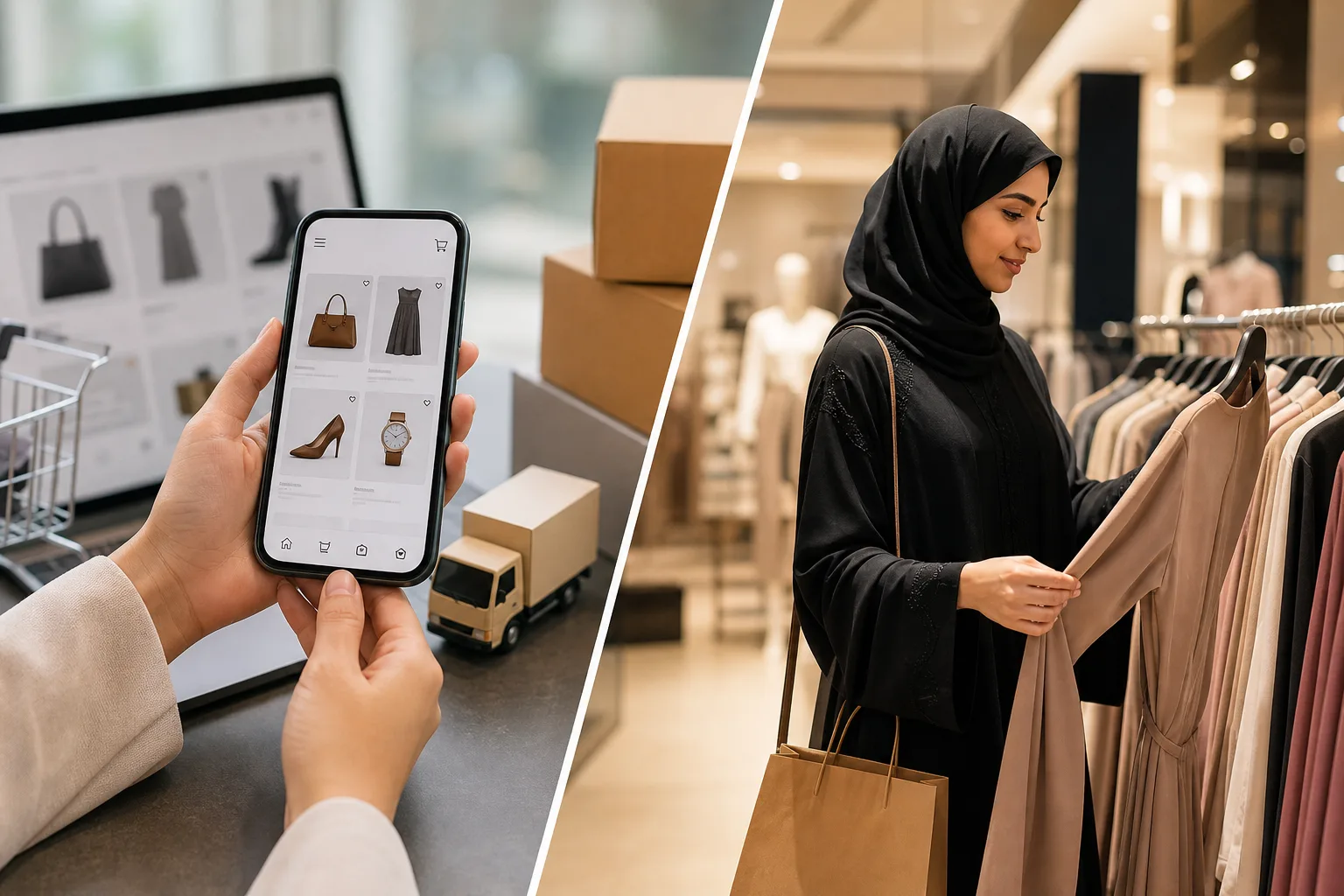
Cross-channel shopping is now the norm in the UAE, with consumers routinely browsing online before buying in store. Many businesses run both channels simultaneously, such as listing products on noon.com while also operating a flagship mall location.
Returns and Trust Remain Key Online Challenges
UAE consumers return roughly 18% of online fashion orders, which can quickly erode margins for retailers. Trust in unfamiliar brands is also lower online, as many shoppers still prefer to see and feel products before committing to a purchase.
Delivery Speed Expectations Are Rising Sharply
Next-day delivery is now the baseline expectation in Dubai, and same-day delivery is rapidly becoming the new standard. Retailers entering the UAE online market must factor fast logistics into their cost and operations planning from day one.
In 2026, UAE e-commerce revenue hit USD 9.2 billion, up from USD 5.6 billion in 2022 (Statista, 2026). That is a 64% rise in four years. Smartphone penetration sits above 98%. Expats make up 89% of the UAE population. Dubai alone welcomed 17.15 million international tourists in 2024 (Dubai DET, 2025). Yet physical stores still draw millions of visitors every week. The gap between online and in-store shopping is closing, but it is not gone.
This guide breaks down the online vs physical retail split in the UAE, shows you what the consumer data says, and helps you decide where your business should compete. By the end, you will know which channel fits your product, what it costs to enter each one, and how to get your UAE trade license in as little as 3 to 5 working days.
What Is Online vs Physical Retail in the UAE and Why It Matters
Online retail means selling goods through websites or apps. Physical retail means selling from a store. In the UAE, both channels are growing, but at different speeds. Consumers switch between the two depending on what they buy, how much it costs, and how fast they need it. Understanding the online vs physical retail split in the UAE is the first step to building a retail strategy that actually works here.
Defining the Two Retail Channels
Online retail covers all goods sold through websites, apps, and social commerce platforms such as Instagram and TikTok Shop. Physical retail covers any sale made face to face in a store, mall, market, or pop-up.
Cross-channel models are now the norm. A shopper browses online, then buys in store. Many UAE businesses run both channels at once. A Dubai electronics retailer may list products on noon.com and also run a flagship store in Mall of the Emirates. That is one business using both channels at the same time.
UAE smartphone penetration is above 98%. Dubai Mall alone receives over 100 million visitors per year. Both numbers matter. They tell you that digital and physical are not rivals here. They are partners.
Why the UAE Is a Unique Retail Market
The UAE is different from most markets. Here is why:
High disposable income and zero personal income tax push average order values above the global norm
Expats make up 89% of the population, creating a diverse consumer base with varied shopping habits
The UAE government invests in digital trade infrastructure, lowering the cost of running an online store
Consumers here are younger on average than in Western markets, which drives faster adoption of digital shopping
A fashion brand targeting UAE expat professionals can reach them through Instagram ads and convert sales on its own site, all without a physical store. That model works here in a way it simply does not in most other markets.
How Big Is UAE E-Commerce and Where It Is Heading
UAE e-commerce was worth USD 9.2 billion in 2026 and is on track to reach USD 17 billion by 2030. Growth is driven by mobile shopping, same-day delivery, and a young, digitally active population. Fashion, electronics, and food delivery lead all other product categories by revenue.
Categories Growing Fastest Online
Fashion and apparel: the largest online category by order volume. Noon.com reported fashion as its top category in 2025
Electronics and home appliances: driven by price comparison tools and easy return policies
Food delivery: grew 28% in 2025 and has held most of its post-2020 gains
Health and beauty: the fastest-growing category by percentage, up 35% year on year in 2025
These four categories together account for the bulk of UAE e-commerce revenue. If your product sits in any of them, online is your primary growth channel right now.
What Is Slowing Online Growth
Returns are a real cost. UAE consumers return roughly 18% of online fashion orders. That eats into margins fast. Trust in new brands is also lower online. Consumers want to see and feel products before they commit.
Delivery expectations are rising sharply. Next-day is now the baseline in Dubai. Same-day is becoming the norm. If you cannot hit that standard, you will lose sales to platforms that can.
Payment friction is another drag. Cash on delivery still accounts for roughly 22% of UAE online transactions. That limits conversion and creates fulfilment complexity. One mid-range furniture brand found its online conversion rate was 1.2%, while in-store conversion ran at 34%. Big-ticket items still sell better face to face.
What Physical Retail Still Does Well in the UAE
Physical stores in the UAE perform best for high-value goods, luxury items, and categories where touch and experience drive the purchase decision. Mall culture is deeply embedded in UAE life. Retailers with strong in-store experience see higher basket sizes and better brand loyalty than pure online players.
Why UAE Malls Still Draw Crowds
Malls here are social and entertainment destinations, not just shopping venues. Air-conditioned public space is a practical necessity in a country with summer temperatures above 45°C.
Luxury brands maintain strict control over the in-store experience. They rarely compete on price online. Tourism adds another layer: Dubai welcomed 17.15 million international tourists in 2024 (Dubai DET, 2025), many of whom shop in malls as part of their visit. Dubai Mall houses over 1,200 stores and an aquarium. Foot traffic is driven as much by leisure as by shopping intent, and that is a structural advantage no online player can replicate.
Categories That Perform Better In Store
Luxury goods, jewellery, and watches: consumers want expert advice and the full brand experience before spending AED 10,000 or more
Furniture and home goods: size, texture, and colour accuracy matter more than price
Eyewear and footwear: fit is the deciding factor and returns are expensive for both sides
Supermarkets and fresh food: habit, convenience, and freshness still pull consumers to physical stores
A UAE jewellery chain reported that 91% of purchases over AED 10,000 were made in store, even when the customer had browsed online first. Grocery accounts for over 30% of all UAE retail spending. Both numbers confirm that in-store shopping remains the dominant channel for certain categories.
How UAE Shoppers Decide Where to Buy
UAE consumers make purchase decisions based on price, convenience, speed, and trust. Most research online before buying in store. Mobile is the primary research tool. Younger consumers aged 18 to 34 are more likely to buy online, while older shoppers prefer the in-store experience for considered purchases.
The Research-Online-Buy-Anywhere Pattern
Over 70% of UAE shoppers research a product online before making any purchase, whether online or in store. This pattern is called ROPO: Research Online, Purchase Offline. It is the dominant consumer behaviour in the UAE right now.
Retailers who ignore their online presence lose sales even in their physical stores. Google and Instagram are the two most used research tools for UAE product discovery. Instagram is used by 72% of UAE consumers for this purpose.
A consumer electronics shopper in Abu Dhabi might spend two hours comparing specs on YouTube, read reviews on noon.com, then walk into a store to buy the item at the same price. That journey starts online. If your brand is not visible at the start, you are not in the running.
How Age and Income Shape Channel Choice
Shopper profile | Preferred channel | Key driver |
|---|---|---|
18–34, Millennial or Gen Z | Online first | Speed and price |
High-income, any age | Both channels | Higher spend in store |
Low-to-mid income | Online for deals | Price comparison |
South Asian expat | WhatsApp commerce | Trust and familiarity |
Western expat | Established apps | Convenience |
The 18–34 age group accounts for 58% of UAE online retail spend. Average online basket size runs at AED 320, versus AED 480 in store for comparable categories. A premium UAE skincare brand targeting women aged 25–40 found that 60% of its sales came through its website, but its highest-value customers still preferred buying at its Dubai Mall concession. Both channels mattered. Neither was optional.
Is online retail growing faster than physical retail in the UAE?
Yes. UAE e-commerce grew 64% between 2022 and 2026, reaching USD 9.2 billion. Physical retail is also growing, but more slowly. The strongest businesses operate in both channels. Online dominates for fashion, electronics, and beauty. Physical stores lead for luxury, fresh food, and high-value considered purchases.
5 Key Trends Shaping UAE Retail in 2026
The five biggest trends shaping UAE retail in 2026 are: the rise of social commerce, same-day delivery becoming standard, AI-driven personalisation, the comeback of experiential physical stores, and the growth of cross-border e-commerce. Businesses that adapt to all five will outperform those focused on a single channel.
Trend One Through Five at a Glance
Social commerce: TikTok Shop UAE user base grew 180% in 2025. Instagram Shopping is growing faster than traditional platforms
Same-day delivery: now available across all 7 Emirates for major platforms. Noon.com cut average delivery time from 2 days to under 4 hours across Dubai in 2024
AI-driven personalisation: retailers using AI for product recommendations see 20–30% higher conversion rates
Experiential physical stores: brands are turning stores into showrooms, event spaces, and community hubs to justify the rent
Cross-border e-commerce: UAE sellers are targeting Saudi Arabia, Egypt, and India. UAE consumers buy freely from international sites
Online vs Physical Retail in the UAE: Key Differences at a Glance
Feature | Online Retail | Physical Retail |
|---|---|---|
Setup cost | AED 25,000–60,000 first year (license, site, fulfilment) | AED 100,000–500,000+ (license, rent, fit-out, staff) |
License type needed | Free zone e-commerce license from AED 12,500/year | Mainland trade license plus tenancy contract |
Who can own it | 100% foreign ownership permitted in free zones | 100% foreign ownership now permitted on mainland too |
Best product categories | Fashion, electronics, health and beauty, books, hobby products | Luxury goods, fresh food, furniture, eyewear, footwear |
Customer reach | UAE-wide and international via platforms and social commerce | Local catchment area; boosted by mall foot traffic and tourism |
Average conversion rate | 1–3% for most categories; higher with AI personalisation | 20–40% for considered purchases; lower for impulse buys |
What Omnichannel Means in Practice
Omnichannel means giving the consumer the same experience whether they shop online, in store, or on a phone. It is not a strategy for big brands only. Most small UAE retailers can start with Shopify and a WhatsApp Business account.
Carrefour UAE lets customers order on its app, collect from any store within 2 hours, and return online purchases at the customer service desk. Retailers with 3 or more active channels see 30% higher customer retention than single-channel players. WhatsApp Business is used by 64% of UAE SME retailers to take orders. Start there if you are not sure where to begin.
Online vs Physical Retail in the UAE: Costs Compared
Starting an online retail business in the UAE costs less than opening a physical store. A free zone e-commerce license starts from around AED 12,500 per year. A physical retail setup in Dubai requires a trade license, physical premises, and fit-out costs that can run from AED 100,000 to over AED 500,000 depending on location and size.
Cost of Setting Up Online
Free zone e-commerce license: from AED 12,500 per year at DSBH
Website and payment gateway: AED 3,000–8,000 to set up
Third-party fulfilment or warehouse: AED 5,000–15,000 per year depending on volume
Platform fees: noon.com and Amazon.ae charge 8–15% per sale depending on category
Total first-year cost: AED 25,000–60,000 for a lean online-only operation
A UAE-based fashion entrepreneur launched an online store in 2025 using a DSBH free zone license and a Shopify storefront. Her first-year total cost was AED 38,000, including stock. She was trading within a week of applying. You can calculate your business setup cost before you commit to anything.
Cost of Opening a Physical Store
Cost item | Online retail | Physical retail (Dubai mall) |
|---|---|---|
Trade license | From AED 12,500/year | From AED 15,000/year (mainland) |
Premises | None required | AED 500–3,500 per sq ft/year |
Fit-out | None | AED 50,000–200,000 |
Staff (year 1) | Optional |
Frequently Asked Questions