
Topic Summary
What Is Opening a UAE Corporate Bank Account as a Thai Entrepreneur and Why It Matters
Opening a UAE corporate bank account as a Thai entrepreneur means getting a licensed UAE bank to onboard your free zone company after full due diligence. The account lets you receive client payments, pay staff and suppliers, and settle VAT and corporate tax.
Preparing Your Dubai South Free Zone Company for Bank Approval
Preparing Your Dubai South Free Zone Company for Bank Approval
Documents and Attestation Thai Entrepreneurs Need Before Applying
A Thai entrepreneur usually needs a passport, residency status, the trade license, incorporation papers, proof of address and source-of-funds evidence. Thai-issued documents typically need Thai Ministry of Foreign Affairs legalization, then UAE attestation.
Step-by-Step Guide to Opening a UAE Corporate Bank Account as a Thai Entrepreneur
Form your company, secure the license, obtain residency, assemble attested documents, shortlist banks, apply, pass the interview and fund the account. A free zone provider offering banking introductions typically shortens this.
Tax, Treaty and Compliance Points That Affect Your Corporate Bank Account
UAE corporate tax is 9% above AED 375,000 and VAT is 5%, both administered by the Federal Tax Authority. The UAE and Thailand have a double taxation agreement, which helps avoid taxing the same income twice.
Common Reasons Thai Applications Get Delayed or Declined
Applications stall because of unattested documents, vague activities, unexplained funds and inconsistent answers. Fix these before submission and your odds improve noticeably.
Relocating to Dubai With Your Company and Account in Place
Once licensed and banked, a Thai entrepreneur completes residency, Emirates ID and medical steps through GDRFA and ICP. Sequencing formation, visas and banking keeps the timeline predictable.
The UAE has more than 50 licensed banks supervised by the Central Bank of the UAE (Central Bank of the UAE, 2026), yet roughly 40% of first-time founders hit a delay or decline. This guide to opening a UAE corporate bank account as a Thai entrepreneur is for founders relocating from Thailand. You'll learn what banks check, which documents need attestation, and the exact steps to approval.
What Is Opening a UAE Corporate Bank Account as a Thai Entrepreneur and Why It Matters
Opening a UAE corporate bank account as a Thai entrepreneur means getting a licensed UAE bank to onboard your free zone company after full due diligence. The account lets you receive client payments, pay staff and suppliers, and settle VAT and corporate tax.
How UAE Banks View Thai-Owned Companies
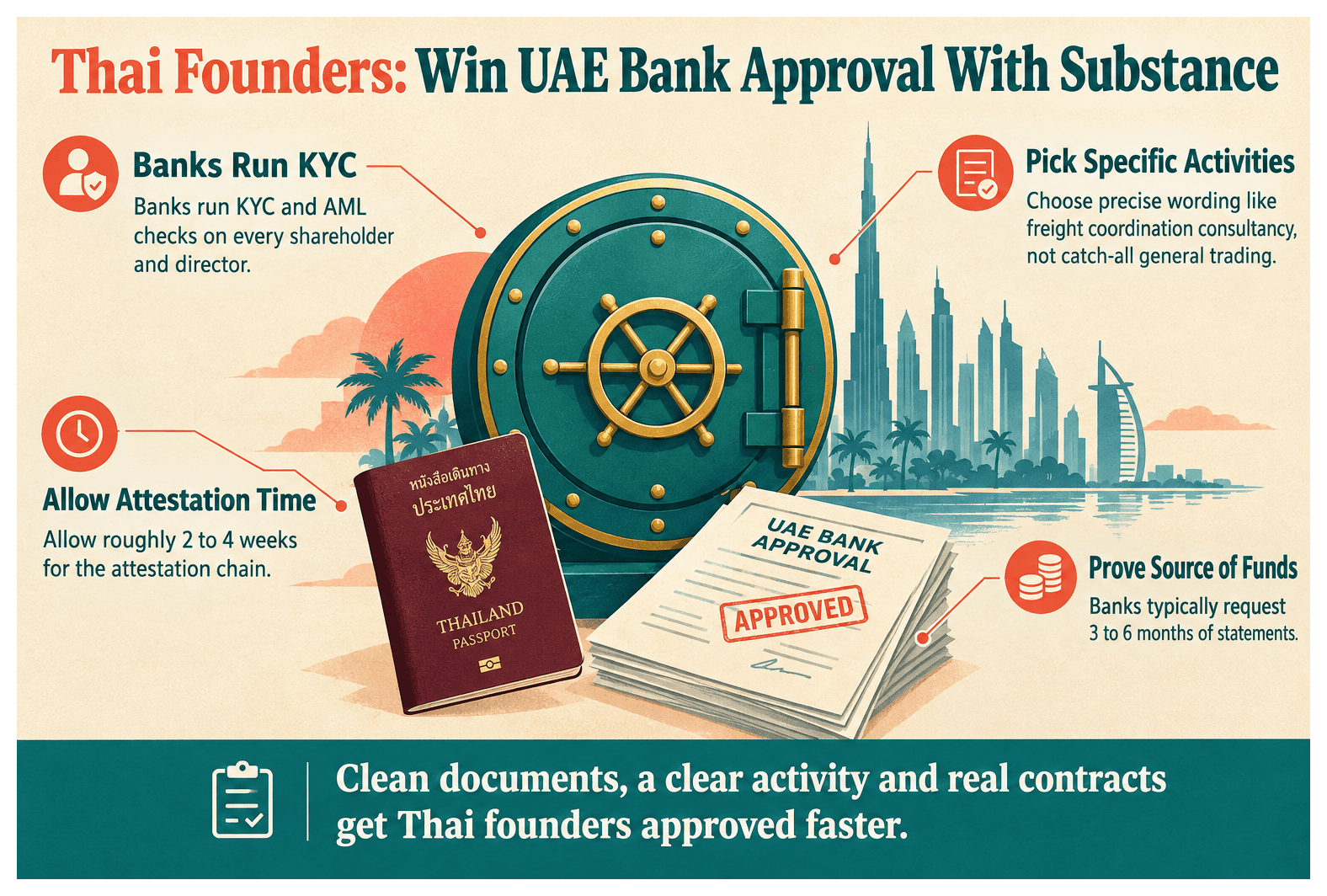
Banks run KYC (know your customer) and AML (anti-money laundering) checks on every shareholder and director. Thai passport holders are generally low-friction applicants when documents are clean. What matters most is substance: contracts, clients and a real operating plan.
Picture two Bangkok marketing founders. One brings a signed client contract and a Dubai South license. The other offers a vague "general trading" plan. The first gets approved faster, every time.
Why the Account Matters Beyond Day-to-Day Payments
Corporate tax, VAT and payroll all depend on an active account. A Thai e-commerce founder paying UAE suppliers in AED avoids repeated international transfer fees. Corporate tax is 9% above AED 375,000 (Ministry of Finance), and VAT is 5% (Federal Tax Authority).
Preparing Your Dubai South Free Zone Company for Bank Approval
Banks approve free zone companies with a valid trade license, a clear activity, a registered office and transparent ownership. A Dubai South Business Hub license with a well-documented activity gives you a strong start.
Choose a License Activity Banks Understand
Pick specific activities, not catch-all wording.
Match them to your invoices and website.
Ask our team to review the wording at formation.
A Thai logistics consultant who lists "freight coordination consultancy" gets a simpler review than one listing "general trading".
Document Checklist for Thai Entrepreneurs Applying for a UAE Corporate Account
Feature | Document | Notes for Thai Applicants |
|---|---|---|
Passport and photos | Valid passport copies for every shareholder and director | Name spelling must match Thai company papers exactly. |
UAE residence visa and Emirates ID | Residence visa and Emirates ID, issued via ICP | An application receipt often works while processing continues. |
Trade license and incorporation documents | License, incorporation certificate, articles, share certificate | Collect these from your free zone before approaching any bank. |
Attested Thai corporate or personal documents | Company affidavits, bank, with certified English translations | Allow roughly 2 to 4 weeks for the attestation chain. |
Source of funds evidence and bank statements | Thai statements, tax filings or sale agreements | Banks typically request 3 to 6 months of statements. |
Build a Business Profile That Passes Due Diligence
Write a one-to-two page plan with revenue model and monthly flows.
Add proof of funds and any Thai company track record.
Have a UAE address, phone and professional email ready.
A Phuket hospitality-tech founder submitted a company profile, two client contracts and statements. That pack explained everything. Compare this with how a Singaporean entrepreneur prepares.
Documents and Attestation Thai Entrepreneurs Need Before Applying
A Thai entrepreneur usually needs a passport, residency status, the trade license, incorporation papers, proof of address and source-of-funds evidence. Thai-issued documents typically need Thai Ministry of Foreign Affairs legalization, then UAE attestation.
Core Personal and Company Documents
Certified passport copies and photos.
Residence visa and Emirates ID via ICP, or proof of progress.
License, certificate, articles and share certificate.
Utility or tenancy proof for UAE and Thai addresses.
Thai Document Legalization and UAE Attestation
Thai corporate records go through Thai Ministry of Foreign Affairs legalization first. Next, the UAE Embassy in Bangkok attests them, followed by UAE Ministry of Foreign Affairs attestation. Use certified English translations, and confirm requirements with your bank, since they vary. A Bangkok investor legalized a company affidavit this way as proof of prior activity.
Source of Funds and Thai Banking References
Show statements, tax filings or sale agreements.
Add a Thai bank reference letter.
Keep transfers traceable.
One founder who sold a Thai restaurant showed the sale agreement and matching credits. The Japanese entrepreneur route follows similar logic.
Step-by-Step Guide to Opening a UAE Corporate Bank Account as a Thai Entrepreneur
Form your company, secure the license, obtain residency, assemble attested documents, shortlist banks, apply, pass the interview and fund the account. A free zone provider offering banking introductions typically shortens this.
Step 1: Set Up the Company and Secure Your License
Register with Dubai South Business Hub.
Confirm shareholders and visa allocation.
Collect the license, certificate and lease.
Step 2: Shortlist Banks and Submit the Application
Compare minimum balance, fees and digital tools.
Consider digital business accounts for early-stage firms.
Submit the full pack at once.
Step 3: Pass the Compliance Interview and Fund the Account
Explain clients, suppliers and expected volumes.
Stay consistent with your documents.
Deposit funds and activate online banking.
Approval commonly takes a few days to several weeks. Founders from Chinese founders can open a UAE corporate bank account pages face the same sequence.
Tax, Treaty and Compliance Points That Affect Your Corporate Bank Account
UAE corporate tax is 9% above AED 375,000 and VAT is 5%, both administered by the Federal Tax Authority. The UAE and Thailand have a double taxation agreement, which helps avoid taxing the same income twice.
UAE-Thailand Double Taxation Agreement Basics
The treaty allocates taxing rights on dividends, interest and royalties. You may need a UAE tax residency certificate to claim benefits. Check current terms with the Ministry of Finance and an adviser before remitting dividends.
Corporate Tax, VAT and Substance Considerations
Register when thresholds apply (VAT: AED 375,000).
Keep invoices and ledgers organized.
Never call the UAE fully tax-free.
Thai Reporting and Remittance Considerations
Thai residents should check foreign income reporting rules with the Thai Revenue Department. Document every remittance between Thailand and the UAE, and consult a Thai tax professional for your case.
Common Reasons Thai Applications Get Delayed or Declined
Applications stall because of unattested documents, vague activities, unexplained funds and inconsistent answers. Fix these before submission and your odds improve noticeably.
Missing legalization stamps or untranslated Thai papers.
Expired passports or mismatched surname spellings.
Inflated volume projections.
Unclear counterparties, which trigger enhanced due diligence.
One surname spelled differently across papers cost a founder two weeks. A trading startup turned a questioned file into an approval with two supplier invoices and a client letter of intent. Similar pitfalls hit a Filipino entrepreneur.
Relocating to Dubai With Your Company and Account in Place
Once licensed and banked, a Thai entrepreneur completes residency, Emirates ID and medical steps through GDRFA and ICP. Sequencing formation, visas and banking keeps the timeline predictable.
Plan visa processing early, as some banks prefer an Emirates ID.
Open AED and multi-currency accounts to manage THB conversions.
Line up housing, schooling and healthcare with visa approval.
Remember free zone licenses and visas generally renew annually.
Your Next Step
Opening a UAE corporate bank account as a Thai entrepreneur comes down to a clean license, attested documents, a credible story and consistent compliance. Contact Dubai South Business Hub for a free consultation on company formation, residency visa packages and banking introductions.
References
Frequently Asked Questions