
Topic Summary
Understand What the Permit Actually Covers
A part-time work permit UAE is an official MOHRE authorisation required for every secondary role a worker holds, not just the first. It applies to both UAE nationals and expatriates on valid residency under Federal Decree-Law No. 33 of 2021.
Know the Real Cost and Processing Time
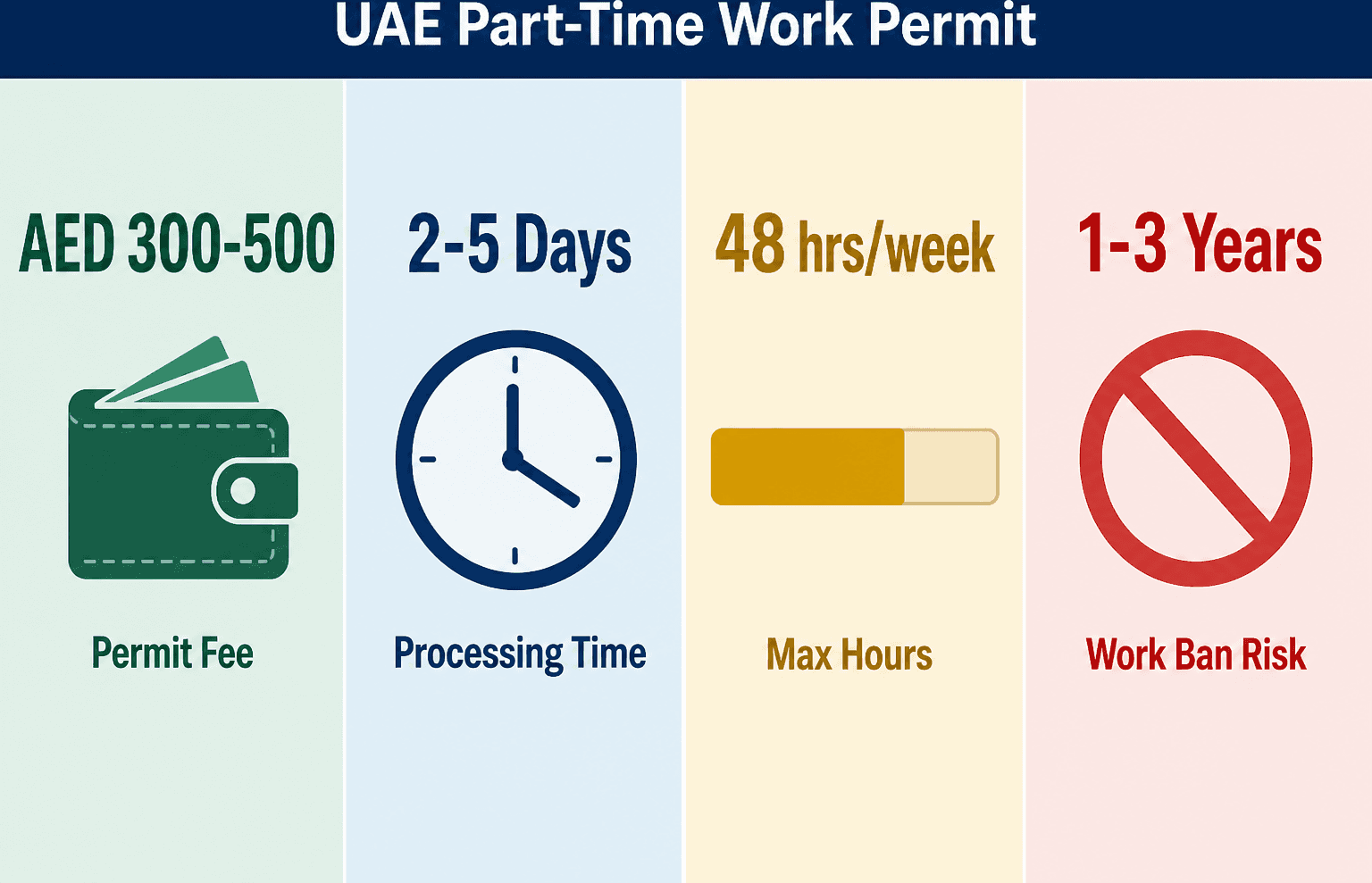
Each permit application costs approximately AED 300 to AED 500 and takes 2 to 5 working days to process. Budget and plan accordingly before a new part-time role begins, since work cannot legally start beforehand.
Respect the 48-Hour Weekly Ceiling
The combined working hours across all roles — full-time and part-time combined — must not exceed 48 hours per week. Exceeding this limit puts both the worker and the secondary employer in breach of UAE labour law.
Always Secure Primary Employer Consent First
The sponsoring employer must provide written consent before a worker can legally take on any part-time role with a second employer. Skipping this step invalidates the arrangement regardless of whether the permit is obtained.
Check Eligibility Before Applying
Workers on probation with their primary employer are generally ineligible for part-time permits without explicit approval. Domestic workers and those in regulated sectors like healthcare may also face additional restrictions beyond standard MOHRE rules.
Gratuity and Leave Still Accrue Part-Time
Part-time workers are entitled to gratuity and leave under UAE labour law, calculated proportionally based on their contracted hours. These entitlements must be reflected in the MOHRE-registered part-time contract.
Never Skip the Permit — Penalties Are Severe
Working without a valid part-time permit can result in a work ban of 1 to 3 years for the employee. Employers who bypass the requirement also face legal exposure, making compliance a shared responsibility.
In 2026, the UAE's private sector employs more than 5 million workers under Federal Decree-Law No. 33 of 2021 (u.ae, 2021). A growing share hold more than one role simultaneously. Yet the majority of employers don't realise that each secondary role requires its own part time work permit UAE before a single hour is worked. The permit fee sits at approximately AED 300 to AED 500 per application (MOHRE, 2024). Processing takes 2 to 5 working days. The combined working-hour ceiling across all roles is 48 hours per week. Skipping the permit exposes the worker to a work ban of 1 to 3 years. These are not minor administrative details. They are hard compliance lines with real consequences.
This guide explains the MOHRE part-time permit framework in plain terms: who qualifies, whether primary-employer consent is required, hour limits, how many concurrent part-time roles are permitted, the employer application process with costs and documents, how gratuity and leave accrue on a part-time contract, and the legal risks of skipping the permit altogether.
What Is a Part-Time Work Permit UAE and Who Does It Cover
A part time work permit UAE is an official MOHRE authorisation that allows a private-sector worker to be employed by one or more employers for fewer than the standard 48 hours per week. It is governed by Federal Decree-Law No. 33 of 2021 and applies to both UAE nationals and expatriates on valid residency.
How UAE Labour Law Defines Part-Time Employment
Federal Decree-Law No. 33 of 2021 formally recognised part-time work as a distinct employment category for the first time in UAE labour history. Before this law, there was no clear statutory framework separating part-time arrangements from full-time contracts. That gap created significant ambiguity for HR managers and workers alike.
Under the law, a part-time worker is someone engaged for a specified number of hours or days per week that falls below the standard full-time threshold of 48 hours per week. The arrangement must be documented in a MOHRE-registered part-time contract. Verbal agreements carry no legal weight whatsoever.
It's worth being precise about categories here:
Part-time employment: a formal labour relationship with a registered MOHRE contract and a separate permit per employer
Freelance work: covered by a separate freelance permit category, not the part-time permit framework
Occasional work: not covered by either category unless properly registered
Take a practical example. A Dubai retail company hires a graphic designer for 20 hours per week. Because the designer already holds a full-time visa under a marketing agency, the retail company must obtain a separate part time work permit UAE. The designer's existing visa does not authorise the second role. Full stop.
Which Workers Are Eligible for a Part-Time Permit
Eligibility is broader than many employers assume. The following categories can apply:
Expatriates holding a valid UAE residence visa sponsored by a primary employer (sponsorship remains unchanged)
UAE nationals and GCC nationals
Workers on a full-time employment visa with an active MOHRE labour card
Two groups face restrictions worth flagging. Workers currently on a probation period with their primary employer are generally not eligible to take on additional part-time roles without explicit consent. Check the probation-period rules before proceeding. Domestic workers and employees in regulated professions such as healthcare may also face sector-specific restrictions on top of the standard MOHRE rules.
An accountant sponsored by a mainland trading company in Sharjah, for instance, can apply to work part-time for a second employer in Dubai, provided neither employer operates in a restricted sector and all permit conditions are met.
Does the Primary Employer Need to Give Consent for a Part-Time Work Permit UAE?
Yes. Under MOHRE rules, the primary (sponsoring) employer must give written consent before a worker can take on a part-time role with a second employer. Without that no-objection confirmation, the secondary employer cannot register the part-time contract, and the worker risks being in breach of their primary employment contract.
What the No-Objection Requirement Means in Practice
The primary employer issues a No-Objection Certificate (NOC) confirming they approve the worker taking on additional part-time employment. This is a mandatory document in the MOHRE part-time permit application submitted by the secondary employer. You can't work around it.
Some employment contracts include a clause explicitly prohibiting secondary work. Employers should review the worker's existing contract before issuing an NOC. If the primary employer refuses consent, the worker cannot legally take the part-time role regardless of how willing the secondary employer is to hire them.
Consider this scenario: a hospital in Abu Dhabi wants to hire a part-time nurse already sponsored by a private clinic. The clinic must issue a formal NOC before MOHRE will register the hospital's part-time permit application. There's no route around that requirement.
How Many Part-Time Roles Can One Worker Hold at Once?
This is one of the most misunderstood aspects of the framework. MOHRE permits a worker to hold part-time contracts with more than one employer simultaneously, making multiple jobs UAE legal under the right conditions.
There is no fixed statutory cap on the number of concurrent part-time employers
Total working hours across all roles must not exceed 48 hours per week
MOHRE scrutinises applications where combined hours approach or exceed the ceiling
Each additional employer must obtain its own separate part time work permit UAE
A translator holds a full-time role with a law firm for 30 hours per week and wants to add two part-time clients. Each client must apply for their own permit, and the total across all roles must stay within the legal working-hour ceiling. One permit does not cover multiple secondary employers.
How to Apply for a Part-Time Work Permit UAE: Employer Steps, Costs and Documents
The secondary employer applies for the part time work permit UAE through the MOHRE online portal or smart app. The process requires the worker's Emirates ID, a copy of their primary labour contract, the primary employer's NOC, and payment of the applicable MOHRE fees. Processing typically takes 2 to 5 working days.
Step 1: Gather the Required Documents
Before logging into the MOHRE portal, compile all required documents. Incomplete submissions are rejected at the first review stage, which adds unnecessary delay. Here's what you need:
An HR manager at a Dubai South-based logistics firm preparing to hire a part-time IT consultant should compile all six documents before logging in. That single preparation step is the most common point of failure for first-time applicants.
Step 2: Submit the Application and Pay the Fees
Most mainland employers report approval within 3 working days when the NOC and contract are correctly formatted. Free zone employers follow the same MOHRE portal process for part-time permits covering work performed on the mainland.
Minimum and Maximum Hours in a MOHRE Part-Time Contract
There is no prescribed minimum number of hours under a MOHRE part-time contract, which gives employers genuine flexibility to structure roles around actual business needs. A 5-hour-per-week arrangement is as valid as a 30-hour one, provided it's documented.
The maximum hours under a single part-time permit must keep the worker below the 48-hour full-time ceiling when combined with all other permits. Contracts must state the agreed weekly hours explicitly. Vague or open-ended hour commitments are not accepted by MOHRE.
A restaurant in Dubai, for example, registers a part-time permit for a pastry chef for 15 hours per week. The contract states "15 hours per week, Tuesday to Thursday, 09:00 to 14:00". MOHRE requires exactly that level of specificity. Overtime on part-time contracts is calculated against the hours stipulated in that specific contract, not against the standard 48-hour baseline.
How Gratuity, Leave and Health Insurance Work on a Part-Time Contract UAE
Gratuity, annual leave and health insurance all accrue on a mohre part time contract, but they are calculated proportionally based on the hours or days specified in the contract rather than the full-time baseline. Each employer is independently liable for the entitlements that arise from their own part-time contract. This is one of the most searched aspects of the part time work permit UAE framework, and the answer is clear: entitlements do apply.
Gratuity Calculation on a Part-Time Basis
End-of-service gratuity applies to part-time workers once they complete one year of continuous service with that employer. The formula is straightforward: (daily basic wage under the part-time contract) x 21 days for the first 5 years of service, then 30 days per year thereafter.
Critically, gratuity is calculated on the basic wage stipulated in the part-time contract itself. Each employer calculates and pays gratuity independently. The primary employer's gratuity obligation is completely unaffected by any part-time arrangements the worker holds elsewhere.
Here's a concrete example. A part-time marketing coordinator earns AED 4,000 per month basic under a 20-hour-per-week contract. After 3 years, the secondary employer owes gratuity based on that AED 4,000 figure, not on a pro-rated fraction of a hypothetical full-time salary. Workers should retain copies of each MOHRE-registered part-time contract to evidence their service period if a dispute arises.
Annual Leave and Sick Leave Entitlements
Annual leave accrues proportionally to the hours worked under the part-time contract
A worker on a 20-hour contract (half a standard week) accrues leave at roughly half the rate of a full-time worker
Sick leave entitlements under Federal Decree-Law No. 33 of 2021 apply on a pro-rata basis
Public holidays are paid in proportion to the worker's scheduled hours on that day
The specific leave calculation must be stated in the MOHRE-registered contract
A part-time teacher contracted for 3 days per week accrues approximately 17 days of annual leave per year (pro-rated from the 30-day full-time entitlement), as specified in their MOHRE-registered part-time contract.
Health Insurance Obligations for Part-Time Employees
In Dubai, the employer is legally required to provide health insurance to all employees, including part-time workers, under the Dubai Health Authority (DHA) mandatory insurance scheme (DHA, 2023). In Abu Dhabi, the same obligation applies under the Daman scheme.
Where a worker holds both a primary full-time role and a part-time role, the primary employer's insurance typically provides the main cover. But the secondary employer should confirm in writing that adequate cover exists before relying on this. Don't assume.
A small consultancy in Business Bay hires a part-time finance officer already insured by her full-time employer. The consultancy should obtain a copy of the active insurance certificate and document it in the worker's file. Relying on an assumption without verification is a compliance risk, and fines apply to both Dubai and Abu Dhabi employers who fail to ensure cover exists, regardless of whether the role is full-time or part-time.
What Happens If You Work Part Time in the UAE Without a Permit
Working part time in the UAE without a valid MOHRE permit is an immigration and labour violation. The worker risks visa cancellation and a work ban; the employer faces fines, permit suspension and potential blacklisting from MOHRE services. Neither party is protected by labour law for the unregistered arrangement. Making multiple jobs UAE legal requires the permit. There's no shortcut.
Full-Time vs Part-Time Work Permit UAE: Key Differences at a Glance
Feature | Full-Time Work Permit | Part-Time Work Permit UAE |
|---|---|---|
Visa sponsorship | Employer becomes the visa sponsor; worker's residency is tied to this employer | No change to visa sponsorship; primary employer retains full sponsorship throughout |
Maximum weekly hours | Up to 48 hours per week under one employer | Below 48 hours per week; combined total across all permits must not exceed 48 hours |
Employer NOC required | Not applicable; this is the primary employment arrangement | Mandatory; primary employer must issue a signed, stamped NOC before MOHRE will register the permit |
MOHRE labour card issued | One labour card issued; linked to the sponsoring employer | A separate labour card issued per part-time employer; worker may hold multiple active cards simultaneously |
Gratuity entitlement | Based on full basic wage after 1 year of continuous service; 21 days per year for first 5 years | Based on the basic wage in the part-time contract after 1 year of service; each employer liable independently |
Health insurance obligation | Employer must provide mandatory health insurance under DHA (Dubai) or Daman (Abu Dhabi) schemes | Secondary employer must confirm adequate cover exists; cannot assume primary employer's policy suffices without written verification |
Risks for the Worker
Working for a second employer without a registered MOHRE part-time permit constitutes an immigration violation. The worker's residence visa is sponsored by the primary employer and does not authorise work elsewhere
Penalties include deportation, a UAE work ban of 1 to 3 years, and cancellation of the primary visa
The worker has no legal recourse to claim unpaid wages, gratuity or leave from the unauthorised secondary employer. Unregistered arrangements fall entirely outside UAE labour law protection
MOHRE inspections, tip-offs from competitors, and payroll audits are the most common ways violations are detected
MOHRE compliance sweeps across hospitality and retail sectors in Dubai have identified workers drawing wages from multiple employers without part-time permits, resulting in immediate visa cancellation notices for those found in violation (MOHRE, 2023).
Risks for the Employer
An employer who takes on a worker without obtaining the required part time work permit UAE faces a fine per worker under MOHRE's administrative penalty schedule
Repeat violations can result in suspension of the employer's ability to issue new work permits, a serious operational risk for any business relying on flexible staffing
The employer cannot enforce the employment arrangement in a labour court if it was never registered with MOHRE
MOHRE classifies hiring a worker without the correct permit as illegal recruitment, which carries heavier penalties than other administrative violations
A retail chain that informally pays a part-time stockroom assistant in cash without a permit has no legal basis to recover training costs or enforce a notice period if the worker leaves immediately. The arrangement is simply unenforceable.
Part-Time Work Permit UAE vs Full-Time Permit: Key Differences for HR Managers
A full-time work permit sponsors the worker's UAE residence visa and covers up to 48 hours per week under one employer. A part time work visa UAE arrangement does not transfer visa sponsorship. It simply authorises additional work for a secondary employer within the hours left under the worker's existing visa arrangement. This distinction has significant practical consequences for HR managers.
Visa Sponsorship Stays With the Primary Employer
The secondary employer does not become a visa sponsor. The worker's residence visa remains under the primary employer throughout the entire part-time arrangement. That's a hard rule with no exceptions.
This means if the primary employment ends, the worker's visa is cancelled regardless of any active part-time permits. The secondary employer has no obligation to transfer sponsorship. HR managers at secondary employers should include a clause in the part-time contract requiring the worker to notify them immediately if their primary employment is terminated. The part-time work permit is cancelled automatically when the primary visa lapses.
A technology consultancy in Abu Dhabi holds part-time permits for three contractors. When one contractor's primary employer goes into liquidation, all of that employer's sponsored
References
Citations
Ministry of Human Resources and Emiratisation.. mohre.gov.ae. MOHRE UAE, 2025.
UAE Government Portal.. u.ae. UAE Government, 2025.
Federal Authority for Identity, Citizenship, Customs and Port Security.. icp.gov.ae. ICP UAE, 2025.
For related guidance, see our page on part time work permit UAE.
For related guidance, see our page on part time work permit UAE.
Frequently Asked Questions