
Topic Summary
Understand What a Share Pledge Actually Is
A share pledge is a legal security interest granted to a lender over your company shares without transferring ownership. You keep voting rights and dividends unless you default on the underlying debt.
Know the Governing Laws Before You Proceed
Mainland UAE share pledges fall under Federal Decree-Law No. 32 of 2021 and Federal Law No. 18 of 1993. Free zone companies operate under their own authority's regulations, which can differ significantly from the mainland framework.
Mainland vs Free Zone Rules Differ Significantly
Mainland DET pledges generally require no prior approval and complete registration in 3–5 working days. Many free zones, including Dubai South, require written authority approval before the pledge is even executed.
Budget Realistically for Fees and Legal Costs
Free zone registration fees typically run AED 500–2,000 depending on the authority. Professional legal drafting of a pledge agreement adds another AED 3,000–10,000 to your upfront costs.
Expect Banks to Apply a Valuation Haircut
UAE banks commonly discount share collateral by 30–50% when calculating how much they will lend against it. This means pledging a 40% stake does not guarantee a loan equal to 40% of the company's full market value.
Registration Is What Makes a Pledge Enforceable
An unregistered pledge is a common and costly procedural error that can render the security interest unenforceable. Both the DET and free zone authorities annotate the share register to formally record the pledge.
Operations Continue Normally During the Loan Term
A registered pledge does not disrupt day-to-day business — the pledging founder can still sign contracts, manage staff, and receive dividends. The lender only acts on the shares if the borrower defaults.
By Editorial Team, UAE business setup specialists with experience across mainland and free zone corporate structuring, financing, and regulatory compliance. Full bio →
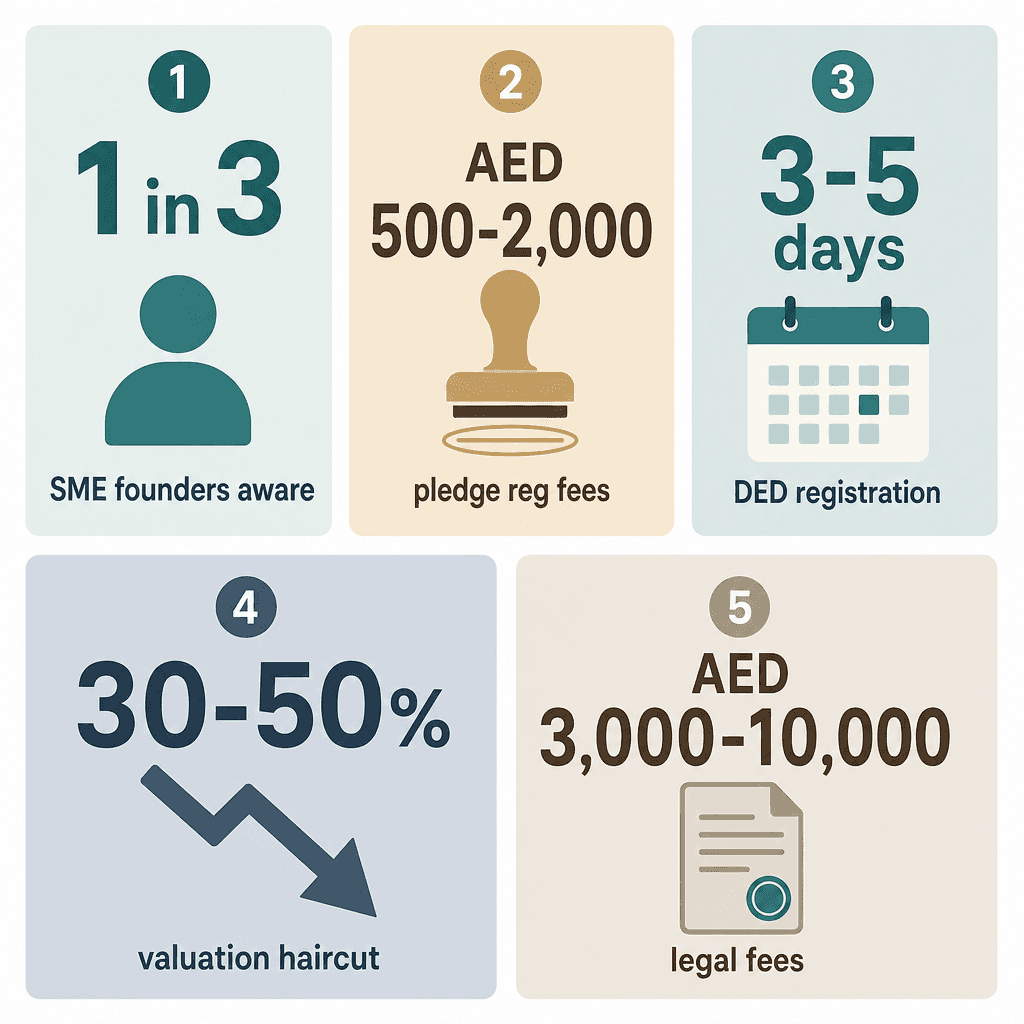
Fewer than one in three UAE SME founders fully understands how a share pledge UAE works, yet it's one of the most practical financing tools available to company shareholders. UAE banking penetration among SMEs is growing steadily in 2026, with free zone companies increasingly using equity-based security instruments alongside traditional property collateral. Federal Decree-Law No. 32 of 2021 governs share pledges for mainland companies (UAE Government, 2021). Free zone pledge registration fees range from AED 500 to AED 2,000 per authority. DET mainland registration typically completes in 3–5 working days. UAE banks applying share collateral commonly apply a 30–50% valuation haircut. Legal fees for a professionally drafted pledge agreement typically run AED 3,000–AED 10,000.
This guide explains what a share pledge is under UAE law, how the Share Pledge Agreement UAE functions, where registration is required, which free zones allow it, and how pledging your shares affects your rights as a shareholder, so you can use this tool confidently and avoid the procedural errors that make pledges unenforceable.
What Is a Share Pledge UAE and Why It Matters for Business Owners
A share pledge UAE is a legal security mechanism in which a shareholder grants a lender or creditor a security interest over their company shares as collateral for a loan or obligation. The shareholder retains ownership and typically keeps voting and dividend rights unless they default on the underlying debt. It's a way of using shares as collateral UAE without actually selling them, the equity stays yours unless something goes wrong.
Share Pledge UAE: Mainland (DET) vs Free Zone, Key Differences
Feature | Mainland (DET) Company | Free Zone Company |
|---|---|---|
Governing Law | Federal Decree-Law No. 32 of 2021 (Commercial Companies Law) | Each free zone's own authority regulations (e.g. DIFC Security Law, Dubai South rules) |
Registration Authority | Dubai Economic Department (DET) | Relevant free zone authority (Dubai South, DIFC Registrar, etc.) |
Prior Approval Required | Generally not required before execution; registration follows signing | Often required before execution, Dubai South and other free zone authorities require prior written approval |
Permitted Pledgees | Licensed UAE banks, financial institutions, and private parties | Many free zones restrict pledgees to licensed UAE financial institutions only |
Registration Timeline | 3–5 working days via DET | 3–10 working days depending on free zone authority |
Enforcement Process | DET processes share transfer on enforcement; UAE courts oversee disputes | Free zone authority processes share register transfer; DIFC/ADGM have own courts |
Share Register Update | DET updates the commercial register to note the pledge | Free zone authority annotates the company's share register with the pledge details |
The Legal Mechanism Behind Using Shares as Collateral UAE
A share pledge creates a security interest, the pledgee (lender) has a right to enforce against the shares if the pledgor (borrower) defaults. It doesn't transfer ownership. That distinction matters enormously for corporate structuring in Dubai: a pledge is conditional, a share transfer is absolute.
On the mainland, share pledges are governed primarily by Federal Law No. 18 of 1993 (Commercial Transactions Law) and Federal Decree-Law No. 32 of 2021 (Commercial Companies Law) (UAE Government, 2021). Free zone companies fall under their own authority's regulations, which can differ substantially from the mainland framework.
Consider a practical example: a founder of a Dubai South Business Hub free zone company pledges a 40% stake to a UAE bank to secure an AED 2 million working capital facility. The founder still runs the company, signs contracts, and receives dividends throughout the loan term. Nothing changes operationally, the bank simply holds a registered security interest over those shares.
Why UAE SME Owners and Investors Are Using Share Pledges More Often
UAE commercial banks, including Emirates NBD, FAB, and Mashreq, now accept share pledges as part of a broader security package, not just real estate or personal guarantees.
A share pledge lets you access liquidity from your equity without selling shares or diluting your ownership stake.
Milestone-linked investor agreements increasingly use share pledges as a backstop: if you miss a product launch deadline, the investor can enforce the pledge rather than pursue litigation.
Lenders require a formal business valuation in Dubai before accepting shares as collateral, typically valid for 12 months.
An investor backing a logistics startup at a UAE free zone, for instance, might require the founder to pledge their remaining 60% shareholding as security against a milestone payment. If the founder misses the agreed launch deadline, the investor can enforce the pledge, no court battle required, provided the pledge is properly registered.
How a Share Pledge Agreement UAE Works in Practice
A Share Pledge Agreement UAE is a formal contract between the pledgor (shareholder) and pledgee (lender or secured party) that documents the security interest over specific shares. It must be registered with the relevant authority, DET for mainland companies or the specific free zone, to be legally enforceable against third parties. A private, unregistered agreement between two parties simply doesn't cut it when a liquidator or competing creditor enters the picture.
Key Clauses in a Share Pledge Agreement UAE
Identification of pledged shares: exact share certificate numbers, class, and percentage of total issued capital.
Secured obligation: the loan amount, facility terms, or specific obligation being secured.
Enforcement rights: the conditions triggering enforcement, typically written notice of default plus a cure period of 14–30 days.
Shareholder rights during the pledge period: confirms the pledgor retains voting rights and dividend entitlement unless a default occurs.
Release clause: the pledge is discharged automatically once the underlying obligation is fully repaid.
A company share pledge Dubai transaction with Emirates NBD, for example, would specify exact share certificate numbers, the AED loan amount, a 30-day cure period on default, and the bank's right to register a share transfer upon enforcement. Most UAE bank-grade pledge agreements run 8–15 pages and require notarisation before submission to the relevant authority.
Registration Requirements: Why a Private Agreement Is Not Enough
Here's the thing most founders miss: signing the pledge agreement is not enough. You must register it. A share pledge must be recorded with the DET (for mainland companies) or the relevant free zone authority to bind third parties. Without registration, the pledge may be completely unenforceable against a liquidator or a subsequent transferee who buys the shares without notice.
Registration typically involves submitting the signed pledge agreement, share certificates, a share register extract, and the applicable fee. Some free zones require prior written approval before a pledge can be registered, not just a post-signing notification. DIFC companies use the DIFC Security Law framework, and registration with the DIFC Registrar of Companies is mandatory within 30 days of execution (DIFC, 2021).
Registration warning: A shareholder in an LLC company formation UAE who signs a pledge agreement but fails to register it with the DET may discover during a dispute that the bank's security interest is not recognised. The pledge becomes effectively void against other creditors, the bank loses its priority position entirely.
What Happens If the Borrower Defaults on a Pledged Share
On default, the pledgee issues a formal enforcement notice to the pledgor. If the default isn't cured within the agreed period, the pledgee can apply to the relevant authority to transfer ownership of the pledged shares. They become the registered shareholder, acquiring voting rights, economic rights, and operational control.
In some cases, the pledgee sells the shares and applies the proceeds to the outstanding debt rather than taking direct ownership. UAE courts have consistently upheld share pledge enforcement where registration and documentation were properly completed. Enforcement timelines through UAE courts typically range from 2–6 months, though a well-drafted agreement with clear enforcement mechanics can reduce friction significantly.
A UAE-based private equity firm, for example, holds a pledge over 30% of a logistics company's shares as security for a bridge loan. When the borrower defaults after 90 days, the firm enforces the pledge, registers as shareholder, and subsequently sells the stake to a trade buyer to recover the outstanding debt, a clean, court-confirmed outcome.
Where Share Pledges Are Used in the UAE: Three Common Scenarios
Share pledges in the UAE are most commonly used in three scenarios: as collateral for bank loans or credit facilities, as security in shareholder buy-sell arrangements, and as protection for investors in milestone-linked funding agreements. Each use case requires a formal Share Pledge Agreement UAE and proper authority registration, there are no shortcuts.
Bank Loans and Credit Facilities Secured by Pledged Shares
Emirates NBD, FAB, and Mashreq all accept share pledges as part of a security package for SME credit facilities.
Banks require a formal business valuation before accepting shares as collateral, and that valuation report is typically valid for 12 months.
Share pledges are almost always used alongside other security (personal guarantees, property charges) rather than as standalone collateral.
UAE banks apply a 30–50% haircut on share valuations for collateral purposes, reflecting the illiquidity of private company shares.
A tech startup founder at a Dubai free zone, for instance, pledges a 25% shareholding as additional collateral for an AED 500,000 overdraft facility. The bank accepts it alongside a personal guarantee, reducing the founder's personal liability exposure while giving the bank a registered security interest over the equity.
Shareholder Agreements and Investor Protection Structures
In shareholder agreements, a pledge can secure a buy-sell obligation. If one party fails to complete a purchase within the agreed timeframe, the other enforces the pledge rather than pursuing a lengthy court process. Drag-along and tag-along rights are often layered with share pledges in sophisticated UAE shareholder agreements, particularly in holding company structures and joint ventures.
Two co-founders of a Dubai South company, for example, agree in their shareholder agreement that if either party fails to complete a buyout within 60 days of a trigger event, the departing founder's shares are automatically subject to a pre-registered pledge in favour of the remaining founder. It's a clean enforcement path that avoids the uncertainty of litigation.
Four Steps to Register a Share Pledge UAE with the Relevant Authority
To register a share pledge UAE, you must: (1) execute a formal Share Pledge Agreement with legal counsel, (2) obtain any required prior approval from the free zone or DET, (3) submit the agreement and share certificates to the authority with the applicable fee, and (4) receive the official pledge registration confirmation before treating the security as enforceable. Skip any step, and you may have a document that looks official but provides no real protection.
Step 1: Draft and Execute the Share Pledge Agreement
Engage a UAE-qualified commercial lawyer to draft the agreement. Template agreements carry real enforcement risk, if the document doesn't reference the specific authority's regulations (DET, Dubai South Business Hub Free Zone, etc.) or clearly identify the pledged shares, it may not survive a legal challenge. Legal fees typically range from AED 3,000 to AED 10,000 depending on complexity.
Both parties sign the agreement; notarisation may be required depending on the authority. A Dubai South Business Hub Free Zone company owner, for example, would draft their share pledge agreement referencing Dubai South authority regulations specifically, naming the exact share certificate numbers being pledged and the AED facility amount being secured.
Step 2: Obtain Prior Approval and Submit for Registration
Some free zones require the shareholder to apply for approval before the pledge is executed, not after. Getting this sequence wrong invalidates the process.
Submit the signed agreement, share register extract, board resolution (if applicable), and the registration fee (AED 500–AED 2,000 depending on the authority).
The authority updates the share register to note the pledge, this annotation is the legally significant step, not the signing of the agreement.
Retain the registration certificate as evidence of your enforceable security interest.
At Dubai South Business Hub Free Zone, for instance, a company applies for prior approval before signing the pledge agreement. The authority confirms approval within 5 working days, after which the pledge is executed and formally registered. The entire process runs one working day for eligible activities across UAE free zones. Ready to calculate your business setup cost? The authority's share pledge framework is one of the clearer processes available.
Free Zone Share Pledge Requirements in the UAE: What You Need to Know
Free zone share pledge requirements vary by authority in the UAE. Each free zone has its own registration process, approval requirements, and permitted pledgee categories. Not all free zones allow share pledges on their company shares, some restrict pledges to approved financial institutions only, making it essential to check with your specific authority before structuring any deal around a company share pledge Dubai.
How Different UAE Free Zones Handle Share Pledge Registration
Dubai South Business Hub Free Zone: allows share pledges; requires prior board approval and authority registration; well-suited for bank security packages.
DIFC: governed by the DIFC Security Law; registration with the DIFC Registrar of Companies is mandatory within 30 days of execution (DIFC, 2021).
Many UAE free zones: permit share pledges with authority approval; the pledgee must typically be a licensed UAE financial institution.
Dubai South / Dubai South Business Hub Free Zone: share pledges are permitted subject to Dubai South authority prior approval and registration, prior approval comes before the agreement is signed.
Smaller free zones without a clear share pledge framework: legal advice is essential before proceeding, some have no mechanism at all.
A company registered at Dubai South Business Hub Free Zone securing a term loan from a UAE bank by pledging a 50% shareholding would begin the process with a Dubai South authority approval application, before the pledge agreement is signed or the bank releases a single dirham. That sequencing matters. Over 40 free zones operate in the UAE (UAE Ministry of Economy, 2024), each with distinct company law frameworks, there's no universal process.
Limitations: When a Share Pledge UAE Is Not Possible
Some free zones explicitly prohibit share pledges or simply have no mechanism for registering them. Pledges on shares in regulated industries, financial services, healthcare, education, may require additional sector regulator approval on top of the free zone authority sign-off. A pledgee who isn't an approved financial institution may be rejected outright by certain authorities.
Minority share pledges present a practical problem too. A founder attempting to pledge a 15% minority stake at a UAE free zone as collateral will likely find the bank declines, enforcement of that pledge wouldn't give the bank a controlling interest, making recovery uncertain. Lenders generally prefer pledges of majority or controlling stakes (51% or above) for enforcement certainty. Worth flagging: DIFC and ADGM have the most developed security law frameworks for pledge shares Dubai transactions, which is why sophisticated financing structures often route through these jurisdictions.
Is a share pledge the same as a share transfer in the UAE?
No. A share pledge creates a conditional security interest, ownership stays with the pledgor unless they default. A share transfer is an absolute change of ownership with immediate effect. The distinction is critical for tax, governance, and regulatory purposes under Federal Decree-Law No. 32 of 2021.
How a Share Pledge Affects Your Rights as a Shareholder
A share pledge UAE typically does not affect the pledging shareholder's rights during the loan period. The pledgor retains voting rights, receives dividends, and remains the registered owner of the shares. Rights are only affected, and potentially transferred to the pledgee, upon a formal default and enforcement of the pledge. This is one of the key advantages of using shares as collateral UAE rather than selling equity outright.
Voting Rights, Dividends, and Day-to-Day Control During the Pledge Period
The pledgor remains the registered shareholder. They vote at general meetings and receive dividends as normal throughout the pledge period.
The pledge creates a security interest only, not a transfer of ownership or operational control.
Negative covenants are standard in UAE bank share pledge agreements:
Citations
UAE Cabinet.. uaecabinet.ae. UAE Cabinet, 2023.
Dubai Economy and Tourism.. dubaidet.gov.ae. DET Dubai, 2024.
Dubai International Financial Centre.. difc.ae. DIFC, 2024.
Central Bank of the UAE.. centralbank.ae. CBUAE, 2024.
UAE Ministry of Economy and Tourism.. moet.gov.ae. MOET UAE, 2024.
Frequently Asked Questions