Topic Summary
Zero Personal Income Tax Boosts Founder Profits
Dubai founders keep every dirham of personal earnings, compared to top rates of 37% in the US and 45% in the UK. For a profitable founder, this tax advantage compounds significantly over time.
100% Foreign Ownership With No Local Sponsor
Free zone registration gives foreign founders complete equity control from day one, with no requirement to partner with a UAE national. This eliminates a major barrier that exists in many other emerging markets.
Business Setup Completed in 3-5 Days
Most Dubai free zone applications are processed within a single working week, and some zones like Dubai South Business Hub offer same-day issuance for qualifying applications. This speed of entry is nearly unmatched among major global startup hubs.
Access to 57 Million GCC Consumers
Dubai's location places founders within a regional market of 57 million GCC consumers, with over 2.5 billion consumers reachable within a four-hour flight. This geographic midpoint between Europe, Asia, and Africa is a core strategic advantage.
Over $1 Billion in Venture Funding Attracted
UAE startups drew more than $1 billion in venture capital in 2023, according to MAGNiTT, signaling a maturing investor ecosystem. Government-backed programmes like Dubai Future Accelerators and Hub71 add structured early-stage pathways on top of private capital.
40,000+ New Business Licenses Issued Annually
Dubai's Department of Economic Development issued over 40,000 new business licenses in 2026 alone, reflecting the city's sustained momentum as a startup destination. This volume also means a well-developed support infrastructure of accountants, lawyers, and service providers familiar with startup needs.
Careem's Exit Proves the Ecosystem Works
Careem launched in Dubai as a small regional ride-hailing startup and scaled to a $3.1 billion acquisition by Uber, the largest tech exit in MENA history. The accelerators, corporate buyers, and capital networks that supported that growth are even more developed today.
In 2026, over 40,000 new business licenses are issued annually in Dubai (Dubai Department of Economic Development, 2026). Zero personal income tax keeps founders' profits intact (UAE Federal Tax Authority, 2026). Free zone setup takes just 3-5 business days. Foreign founders get 100% ownership, no local sponsor needed. The GCC market spans 57 million consumers. And the UAE's startup ecosystem attracted over $1 billion in venture funding in 2023 (MAGNiTT, 2024). Those six facts explain why a small startup business in Dubai has become the default choice for internationally minded founders from New York to Singapore.
Dubai is genuinely one of the best places in the world to launch a small startup, but the founders who succeed are the ones who know the difference between a good idea and a good business, and build the operational foundations from day one. This guide covers what makes Dubai ideal, the best startup ideas for 2026, the right legal structure, realistic costs in AED, and how to go from idea to first client.
A small startup business in Dubai is a founder-led venture registered under a UAE free zone or mainland license, typically operating with a lean team and focused on rapid market entry. Dubai offers zero personal income tax, 100% foreign ownership, and a 3-5 day setup process that makes it one of the most accessible startup environments globally. For a small startup company UAE-based founders want to scale fast, these structural advantages are hard to match anywhere else.
What Makes Dubai Different From Other Startup Hubs
The structural advantages are real and measurable. Here's what sets Dubai apart:
Zero personal income tax: Founders keep every dirham of personal earnings. Compare that to the US federal rate of up to 37%, or UK's 45% top rate. For a profitable founder, this difference compounds fast (UAE Federal Tax Authority, 2026).
100% foreign ownership in free zones: No local sponsor, no equity dilution, no loss of control. You own your company outright from day one.
3-5 business day setup: Most free zone applications are processed within a working week. Some, like Dubai South Business Hub, offer same-day issuance for qualifying applications.
Market access: Dubai sits at the geographic midpoint of Europe, Asia, and Africa, over 2.5 billion consumers within a 4-hour flight radius. The UAE's local consumer base of 3.5 million is supplemented by the broader GCC market of 57 million.
A US-based SaaS founder who relocated to Dubai in 2023 cited zero personal income tax and same-timezone overlap with European clients as the two deciding factors. That combination, tax efficiency plus geographic reach, is the core of Dubai's appeal for a small startup business in Dubai.
The Growing Investor Ecosystem Around Small Startups in Dubai
The funding environment has matured significantly. UAE startups attracted over $1 billion in venture capital in 2023 (MAGNiTT, 2024), and government-backed programmes are adding structured pathways for early-stage companies. Dubai Future Accelerators connects startups directly with government entities as paying clients. Hub71 in Abu Dhabi offers subsidised office space and investor introductions for qualifying founders.
Careem is the clearest proof point. Founded in Dubai as a small regional ride-hailing startup, it scaled to a $3.1 billion acquisition by Uber, the largest tech exit in MENA history. The ecosystem that supported Careem's trajectory is more developed today, with more capital, more accelerators, and more corporate buyers actively seeking startup partners.
For affordable business setup for entrepreneurs Dubai, free zones remain the fastest entry point, 100% ownership and a credible UAE address without the cost or complexity of mainland licensing.
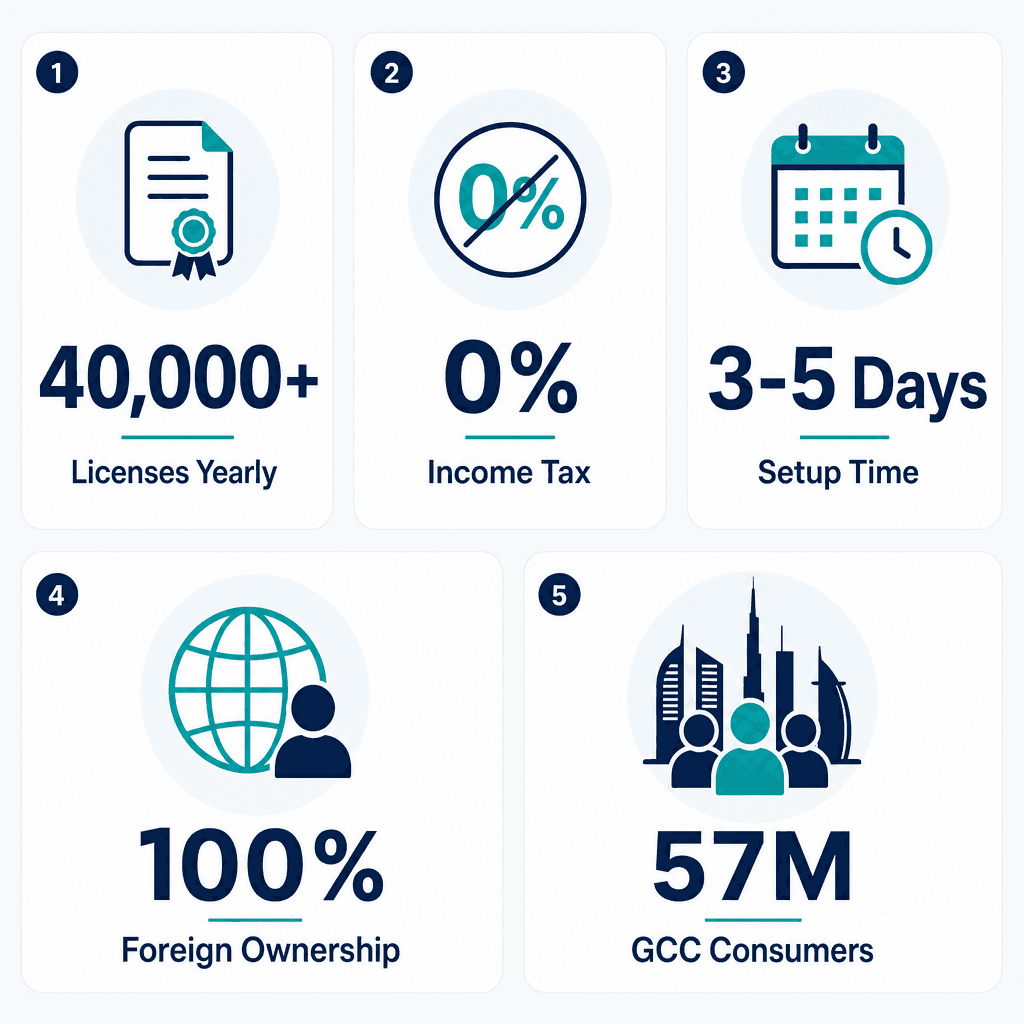
Small Startup Business in Dubai: Key Numbers (2026) 40K+ New licenses/year DET, 2026 3-5 Days to register Free zone average 100% Foreign ownership UAE Free Zones 57M GCC consumers GCC market data
Key metrics for a small startup business in Dubai, compiled from DET, UAE Federal Tax Authority, and GCC market data (2026-2026).
Best Small Startup Ideas for Dubai in 2026
The best small startup ideas in Dubai for 2026 include AI-powered content and marketing services, corporate wellness, sustainable packaging, home services, B2B SaaS for SMEs, and specialty food distribution. Each aligns with a documented gap in the UAE market and can be launched as a lean free zone operation with minimal upfront capital. If you're researching best business ideas in Dubai, these six have the clearest market rationale right now.
Six High-Potential Startup Ideas With Market Rationale
Fetchr, a Dubai-based logistics startup, identified a gap in last-mile delivery for UAE's address-light geography and scaled to regional operations across six countries. The same gap-identification logic applies here: find what the market needs but can't easily get, then build the lean version first.
How to Validate Your Startup Idea Before Registering
Don't spend a dirham on registration until you've tested real buyer interest. Run a 30-day pre-launch test using LinkedIn outreach or a simple landing page. Ten genuine conversations with Dubai-based potential clients will tell you more than any market report.
Worth flagging: your license category must match your actual business activity. UAE free zone licensing authorities use activity codes aligned with ISIC Rev.4 (the UN International Standard Industrial Classification, Revision 4). Under ISIC's top-down method, your principal activity is the one generating the most value added, so choose your classification carefully. A UK founder who ran 15 discovery calls with Dubai SME owners before registering found a pivot opportunity that saved six months of misdirected product development. That's the kind of validation that pays for itself.
The Right Legal Structure for a Small Startup in Dubai
For most small startups in Dubai, a free zone FZE (single shareholder) or FZCO (multiple shareholders) is the default legal structure. It delivers 100% foreign ownership, no personal income tax, fast registration, and a straightforward path to a UAE residence visa, all at a lower cost than mainland licensing. If you want to launch your startup at Dubai South Business Hub Free Zone, you'll choose between these two structures at registration.
Free Zone FZE vs. FZCO: Which One Fits Your Startup
FZE (Free Zone Establishment): Single shareholder. Ideal for solo founders who want full control and the simplest possible structure.
FZCO (Free Zone Company): Two or more shareholders. Right for co-founder teams who need to formalise an equity split at registration.
Both structures offer 100% foreign ownership, zero personal income tax, and the same fast-track setup process.
Neither requires a local sponsor, a significant cost and control advantage over mainland LLC arrangements.
A two-person US founding team launching a B2B SaaS product chose FZCO at Dubai South Business Hub to formalise their 60/40 equity split at registration, avoiding the need for a separate shareholders' agreement drafted after the fact. That's a practical time and legal cost saving most first-timers don't anticipate.
When a Mainland License Makes More Sense
There are specific scenarios where a mainland DET license is the right call. If your small startup company UAE operations require direct trading with government entities, or you need a physical retail presence in Dubai, mainland is necessary. Following the 2021 UAE Companies Law amendments (Federal Decree-Law No. 32 of 2021), 100% foreign ownership is now available in most mainland sectors, but setup typically takes 2-4 weeks and costs more than a free zone equivalent.
A home services startup targeting Dubai municipality contracts opted for a mainland license specifically to qualify for government procurement. That's a deliberate trade-off of speed for access. For most lean startups focused on services, consulting, or digital products, free zone remains the faster and cheaper path.
Free Zone vs. Mainland: Which Structure Suits Your Small Startup?
Feature | Free Zone (FZE/FZCO) | Mainland (DET LLC) |
|---|---|---|
Foreign Ownership | ‚úÖ 100% from day one | ‚úÖ 100% (most sectors, post-2021) |
Setup Timeline | ‚úÖ 3-5 business days | ‚ùå 2-4 weeks |
License Cost (Approx.) | ‚úÖ AED 10,000-15,000 | ‚ùå AED 15,000-25,000+ |
Trade with UAE Government | ‚ùå Limited access | ‚úÖ Full access |
Residence Visa Eligibility | ‚úÖ From day one of registration | ‚úÖ Available |
Local Sponsor Required | ‚úÖ None required | ‚úÖ None (most sectors post-2021) |
Best For | Services, digital, consulting, e-commerce | Retail, government contracts, physical trade |
Small Startup Setup Cost in Dubai: Realistic AED Figures
A realistic first-year budget for a small startup business in Dubai runs AED 30,000-52,000, covering a free zone trade license (AED 10,000-15,000), one UAE residence visa (AED 5,000-7,000), and working capital (AED 15,000-30,000 minimum). Costs vary by free zone, activity type, and whether you need office space. Use the calculate your startup setup cost tool for a line-by-line AED estimate based on your specific situation.
First-Year Cost Breakdown for a Small Startup in Dubai
Trade license: AED 10,000-15,000 depending on free zone and number of activities included
Residence visa (investor/partner category): AED 5,000-7,000 per person, including medical screening and Emirates ID
Working capital buffer: AED 15,000-30,000 minimum to cover first-quarter operating expenses
Flexi-desk or shared office (optional): AED 5,000-10,000/year if your license requires a physical address
Total realistic first-year spend: AED 35,000-62,000 for a solo founder with one visa
A marketing consultant launching a formal free zone company at Dubai South Business Hub budgeted AED 38,000 for year one, covering the license and three months of operating runway. That's a tight but achievable number for a service-based solo founder.
Hidden Costs First-Time Founders Miss
Bank account opening catches many founders off-guard. Some major UAE banks require a minimum deposit of AED 10,000-50,000 for business accounts. A first-time founder from Canada was caught short by a AED 25,000 minimum balance requirement, a cost that was entirely avoidable with the right bank selection advice upfront. Neobanks like Wio Business have lower or no minimum balance requirements for free zone entities.
Two other costs to build in from day one: annual license renewal (similar to initial registration cost) and professional services. If your turnover exceeds AED 375,000 annually, UAE VAT registration becomes mandatory (UAE Federal Tax Authority, 2026). Accounting, VAT filing, and basic legal review typically add AED 3,000-8,000 per year.
Dubai Small Startup: First-Year Cost Snapshot
A visual breakdown of realistic first-year AED costs for a solo founder launching a small startup in Dubai via a free zone.
Trade license: AED 10,000-15,000
Investor residence visa: AED 5,000-7,000 (incl. medical + Emirates ID)
Working capital buffer: AED 15,000-30,000
Flexi-desk/shared office: AED 5,000-10,000/year (optional)
Professional services (accounting, VAT): AED 3,000-8,000/year
Total realistic range: AED 35,000-62,000 year one
Why Dubai South Business Hub Free Zone Suits Your Small Startup
the free zone offers affordable startup packages, same-day license issuance, 100% foreign ownership, and direct access to Dubai South's logistics and aviation ecosystem. For lean founders who want speed, cost efficiency, and a credible UAE address, it's one of the most practical free zone options for a small startup company UAE founders are building in 2026-2026.
Five Reasons to Choose Dubai South Business Hub Free Zone
An e-commerce logistics startup chose Dubai South Business Hub specifically for its Al Maktoum Airport adjacency, cutting last-mile coordination time and winning a regional distribution contract within six months of registration. That's the ecosystem advantage in practice.
What You Get With a Dubai South Business Hub Free Zone License
Trade license with up to three business activities included on a single license
Eligibility for UAE investor residence visa from day one of registration
Access to flexi-desk and shared office facilities within the free zone
Certificate of Incorporation and all founding documents issued digitally
A UK-based consultant registered at Dubai South Business Hub remotely and had her license and visa application submitted within 48 hours, without visiting Dubai until after approval. That's the kind of frictionless process that makes Dubai South Business Hub the right starting point for international founders who want to launch your startup at Dubai South Business Hub Free Zone without unnecessary delays.
From Idea to First Client: Three Steps Every Dubai Startup Founder Should Take in 30 Days
In the first 30 days after registering a small startup in Dubai, founders should open a UAE business bank account, activate their online presence with a UAE-registered domain and LinkedIn company page, and close their first paying client or signed letter of intent. These three actions prove the business is operational, not just licensed. Dubai South Business Hub's same-day license issuance gives you the maximum possible runway inside that 30-day window.
A four-step process timeline showing the key actions a Dubai startup founder should take in the first 30 days after registration. 30-Day Launch Plan: Small Startup in Dubai
Useful Resources
Citations
UAE Ministry of Economy and Tourism.. moet.gov.ae. MOET UAE, 2024.
Federal Tax Authority.. tax.gov.ae. FTA UAE, 2023.
General Directorate of Residency and Foreigners Affairs Dubai.. gdrfad.gov.ae. GDRFA Dubai, 2024.
Dubai Economy and Tourism.. dubaidet.gov.ae. DET Dubai, 2024.
UAE Cabinet.. uaecabinet.ae. UAE Cabinet, 2023.
Frequently Asked Questions