Topic Summary
What Is a Sole Proprietorship and Why It Matters for UAE Founders
A sole proprietorship, called a sole establishment in the UAE, is a business owned entirely by one person who holds full control and unlimited personal liability. It's the simplest legal structure available, requiring no partners, no shareholders, and minimal paid-up capital to register.
Sole Proprietorship UAE Setup Cost: What You'll Actually Pay
Registration fees, trade name reservation, and a standard office package make up the first-year bill. Because the license is issued in a single individual's name, document attestation is simpler than for a multi-shareholder company. Visa entitlement and liability exposure are the practical factors that determine whether a sole proprietorship is the right structure for a given business.
How a Free Zone Sole Proprietorship Setup Works
Setting up a sole proprietorship through a UAE free zone involves selecting an activity, reserving a trade name, submitting owner documents, and receiving the license, typically within 2 to 3 weeks when paperwork is complete and the activity requires no external approval.
3 Key Limits of a Sole Proprietorship You Should Know
The three main limits of a sole proprietorship are unlimited personal liability, restricted ability to bring on shareholders, and a capped growth ceiling, since the structure doesn't support equity-based fundraising the way an LLC (Limited Liability Company) does.
When a Sole Proprietorship Makes Sense vs When It Doesn't
A sole proprietorship works well for solo consultants and single-project contractors who want fast, low-cost setup. It becomes limiting once a founder needs co-owners, investment capital, or wants to shield personal assets from business liability.
Sole Proprietorship UAE Setup Cost Compared to Other Structures
Sole proprietorship UAE setup cost is generally lower than an LLC's, since it avoids memorandum of association fees and multi-shareholder documentation. The trade-off: unlimited liability and limited room to scale ownership or raise capital.
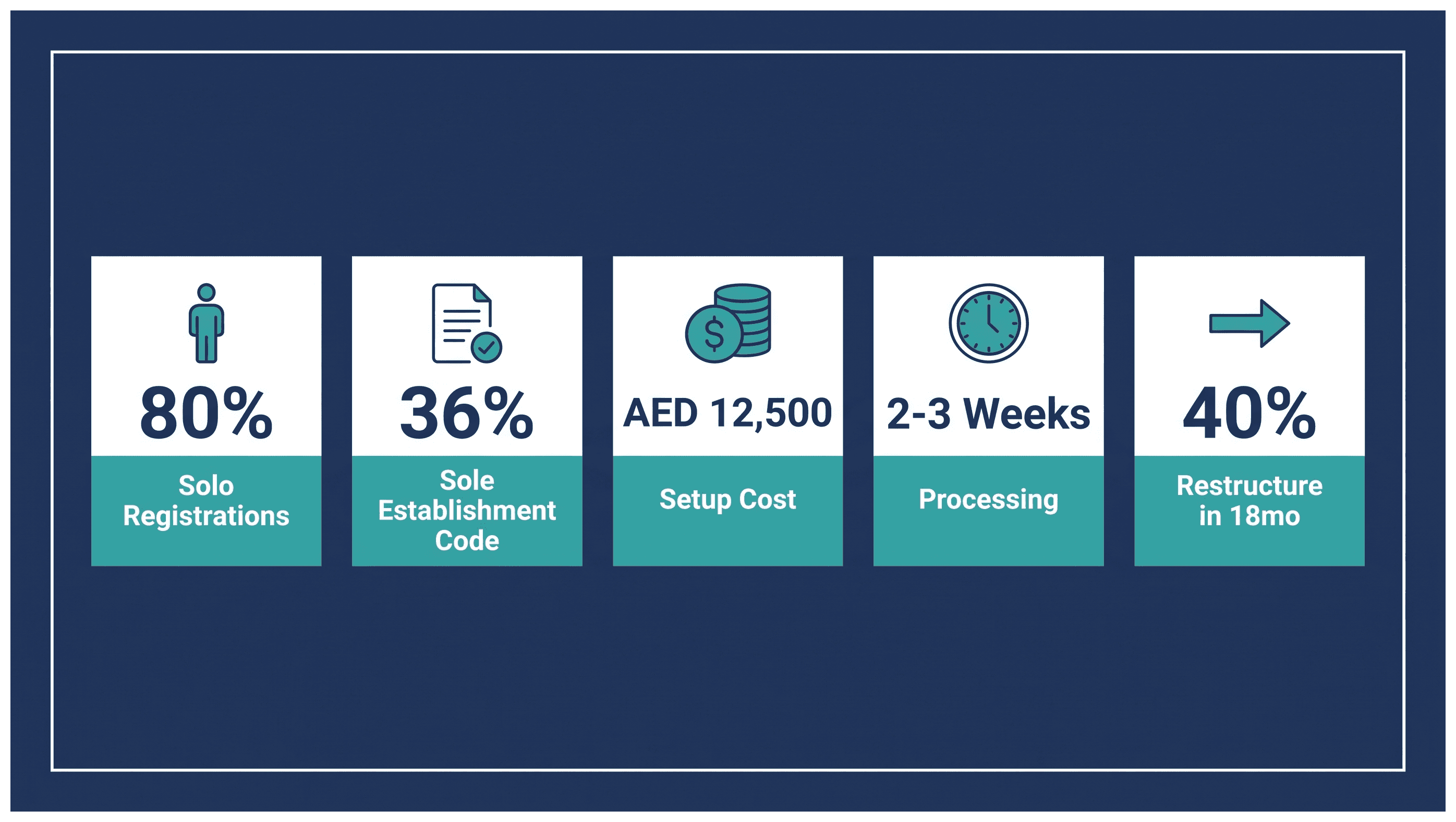
In 2026, over 80% of new free zone registrations in Dubai are single-owner entities with zero staff on day one (Statista, 2025). 36% of these solo founders register under a sole establishment activity code within their first month [1]. AED 12,500 is the starting price most see quoted for a basic package [2]. 2 to 3 weeks is the typical processing window once documents are complete [3]. 40% of first-time founders restructure their legal form within 18 months (Dubai Chamber, 2025) [4]. Most of these businesses start life as a sole proprietorship, and most founders underestimate what it actually costs and where it stops working.
This guide breaks down sole proprietorship UAE setup cost, the liability and scaling limits founders need to know, and the specific scenarios where this structure fits versus where it doesn't.
What Is a Sole Proprietorship and Why It Matters for UAE Founders
A sole proprietorship, called a sole establishment in the UAE, is a business owned entirely by one person who holds full control and unlimited personal liability. It's the simplest legal structure available, requiring no partners, no shareholders, and minimal paid-up capital to register.
Ownership and Liability Basics
A single owner holds 100% control over every decision. There's no board, no shareholder vote, nobody to consult.
Here's the catch: the owner and the business are legally the same entity. If a client sues the business, they're effectively suing you personally.
Take a freelance marketing consultant operating her sole establishment under her own name. If a client disputes an invoice and takes legal action, her personal assets, not just business funds, sit exposed. Activity classification follows the actual work performed, not the ownership structure (ISIC Rev.4 framework, 2008), so the liability picture stays the same regardless of how the activity is coded.
Where Sole Proprietorships Sit in UAE Law
Licensing is regulated at the emirate level by economic departments.
Structures fall under either mainland or free zone frameworks.
The business has no separate legal personality from its owner.
Foreign nationals can hold 100% ownership in most free zone setups (u.ae, 2025).
A consultant licensing a sole establishment structure through Dubai South Business Hub Free Zone keeps full ownership, with no local partner required.
Sole Proprietorship UAE Setup Cost: What You'll Actually Pay
Sole proprietorship UAE setup cost typically starts around AED 12,500 for a free zone package including a trade license and one visa. Additional costs include office space, activity-specific approvals, and annual renewal fees, which usually run close to the initial setup figure.
Base License and Registration Fees
Entry-level license packages often start near AED 12,500.
Fees vary based on the activity type and any required approvals.
Visa allocation directly affects the total package price.
Additional activities added to one license increase the cost.
A solo e-commerce seller registering a general trading activity pays considerably less than someone needing health, food, or education approvals layered onto the license.
Hidden and Recurring Costs
Annual license renewal fees are a cost many founders forget to budget for. They often sit close to the original setup figure, not a fraction of it.
Office or flexi-desk requirements add a recurring line item, and visa renewal plus medical testing and Emirates ID fees stack up each year too. A one-person consultancy that budgets only for year-one setup often gets caught off guard when year-two renewal invoices land. Reviewing what running a Dubai company with no staff actually costs before you commit avoids that surprise.
How a Free Zone Sole Proprietorship Setup Works
Setting up a sole proprietorship through a UAE free zone involves selecting an activity, reserving a trade name, submitting owner documents, and receiving the license, typically within 2 to 3 weeks when paperwork is complete and the activity requires no external approval.
Step 1: Choose Your Business Activity
Activity choice determines your licensing category and fee tier.
Some activities need external regulatory sign-off first.
Activities follow standardized classification codes, not free text.
A sportsman offering coaching services registers under an individual own-account activity code specific to that profession.
Step 2: Reserve a Trade Name
Your trade name must comply with standard naming conventions, no offensive language, no references to religious or political bodies. Personal names are permitted under specific rules.
Approval usually takes a few business days. A founder planning to use their own name as a trade name still needs sign-off against the naming guidelines first.
Step 3: Submit Documents and Receive License
A passport copy and completed application form are required.
You select a visa package at this stage.
The license issues once fees clear.
A solo founder completing registration through Dubai South Business Hub Free Zone can finish the process in under three weeks when documents are ready upfront.
3 Key Limits of a Sole Proprietorship You Should Know
The three main limits of a sole proprietorship are unlimited personal liability, restricted ability to bring on shareholders, and a capped growth ceiling, since the structure doesn't support equity-based fundraising the way an LLC (Limited Liability Company) does.
Unlimited Personal Liability
Your personal assets are exposed to business debt. There's no legal wall separating you from the entity.
Risk grows as contract size grows. A contractor facing a large client dispute risks personal savings, not just whatever sits in the business account.
No Shareholders or Equity Partners
You cannot add co-founders under the same license.
Raising investment capital is structurally difficult.
Transferring ownership later gets complicated fast.
A founder wanting to bring on a technical co-founder has to restructure first, usually into an LLC before onboarding anyone as an owner.
Growth Ceiling for Scaling Teams
Visa allocation ties directly to your package size.
Adding new activities can force a restructure.
Larger contracts sometimes require LLC status for credibility.
A one-person agency outgrowing its visa quota often converts a sole establishment to an LLC within two years, a pattern confirmed by Dubai Chamber data showing 40% of founders restructure within 18 months (Dubai Chamber, 2025) [4].
When a Sole Proprietorship Makes Sense vs When It Doesn't
A sole proprietorship works well for solo consultants and single-project contractors who want fast, low-cost setup. It becomes limiting once a founder needs co-owners, investment capital, or wants to shield personal assets from business liability.
Is a sole proprietorship worth it for a single contract?
Yes, for one fixed-term project it keeps setup fast and cheap. For ongoing, high-liability work, an LLC usually makes more financial sense long term.
Sole Proprietorship vs LLC: Cost and Structure Comparison
Feature | Sole Proprietorship | LLC |
|---|---|---|
Setup cost | Starts near AED 12,500, no memorandum drafting fees | Higher upfront cost due to shareholder agreement drafting |
Liability exposure | Unlimited, owner's personal assets exposed | Limited to capital contribution |
Shareholder limits | One owner only | Multiple shareholders permitted |
Documentation required | Passport copy, application form, activity approval | Memorandum of association, shareholder resolutions |
Scaling flexibility | Limited, often requires conversion later | Built for adding partners and investors |
Good Fit Scenarios
Single-project or contract-based work.
Testing a business idea at low cost.
Professional services with low liability exposure.
A consultant taking on one fixed-term project in Dubai uses a sole proprietorship to keep setup fast and simple.
When to Reconsider the Structure
High-liability industries like construction or trading carry real financial risk under a sole establishment. If you're planning to bring on investors or co-founders, you'll hit a wall fast.
A founder setting up a Dubai company while holding a UAE employment contract should confirm compliance with their employer's terms before registering, since conflicts of interest aren't automatically resolved by the free zone license.
Sole Proprietorship UAE Setup Cost Compared to Other Structures
Sole proprietorship UAE setup cost is generally lower than an LLC's, since it avoids memorandum of association fees and multi-shareholder documentation. The trade-off: unlimited liability and limited room to scale ownership or raise capital.
Cost Differences at a Glance
LLCs require additional documentation and legal drafting fees.
Multiple shareholders add administrative overhead to any filing.
Sole proprietorships skip memorandum drafting entirely.
Two co-founders forming a Dubai company with multiple shareholders pay considerably more upfront in legal drafting than a single sole proprietor would.
Long-Term Cost Trade-Offs
Restructuring later adds conversion fees on top of whatever you've already paid. Liability protection often justifies the LLC premium once revenue climbs past a certain point.
A sole proprietor converting to an LLC after landing a major client ends up paying for both the original setup and the conversion. Planning your structure with low-cost business setup strategies in mind from day one avoids that double spend.
Sole proprietorship UAE setup cost tends to be the lowest entry point for solo founders, but the structure's unlimited liability and scaling limits mean it isn't a permanent fit for every business. Review your activity, liability exposure, and growth plans before registering.
Follow up with a formation specialist if you're unsure which structure fits your next stage, especially if co-founders or investment rounds are on the horizon.
References
dubailand.gov.ae
Frequently Asked Questions