
Topic Summary
What Splitting Licenses Actually Means
Splitting trade license activities means registering unrelated business lines on two separate licenses instead of grouping them under one, which can trigger extra approvals and higher renewal fees if mismatched.
Base Fees and Renewal Costs Add Up
A single license starts at AED 12,500, while two licenses combined cost AED 25,000, meaning grouped activities can save AED 12,500 in year one alone before visa costs are even considered.
Classification Rules Drive the Decision
ISIC Rev.4 framework groups activities into 21 sections, and a top-down method identifies the activity generating the most value to determine whether tasks are ancillary or require separate licensing.
A Simple Process for Choosing
Founders should map out their core activities against classification codes, compare visa and amendment costs under both scenarios, and weigh regulatory complexity before committing to one or two licenses.
Comparing Real Costs Side by Side
A swimming academy paired with a retail sportswear shop could share one license if they fall under the same classification section, though some owners still split them for insurance or branding reasons.
Pitfalls Founders Should Avoid
Common mistakes include splitting activities without checking shared classification sections, ignoring doubled visa quotas and renewal cycles, and underestimating activity amendment fees that lack a shared cap across two licenses.
In 2026, more than 60% of first-time founders applying for a Dubai trade license list at least two business activities on one application, often without checking if splitting them saves money (Dubai Chamber of Commerce, 2025) [1]. A base license starts at AED 12,500 [2]. Activity amendments run AED 2,000 each beyond five [2]. Visa packages attach per license, not per founder [3]. ISIC Rev.4 groups activity into 21 sections [4]. Renewal overhead compounds every year you keep two licenses active. You'll learn when grouping dubai trade license activities under one license beats splitting across two, how classification rules affect cost, and a worked comparison to decide confidently.
What Is Splitting Dubai Trade License Activities and Why It Matters
Splitting dubai trade license activities means registering unrelated business lines on two separate licenses instead of grouping them on one. It matters because regulators classify activities using frameworks similar to ISIC, and mismatched groupings can trigger extra approvals, higher renewal fees, or compliance flags that outweigh any convenience.
Why Founders Consider Two Licenses
Some founders split dubai trade license activities for liability reasons, keeping one risky venture isolated from a stable one. Others want distinct branding: two trade names, two customer perceptions, two separate reputations in the market.
Take a founder running a swimming training academy alongside a retail sportswear shop. Both could sit under one license if they share a classification section, but the owner might still prefer separation for insurance or franchising reasons. The United Nations' ISIC Rev.4 framework defines 21 sections, lettered A through U, covering every type of economic activity worldwide (UN Statistics Division, 2008) [4]. Most consultancy-plus-retail combinations actually fall closer together than founders assume.
How Classification Frameworks Apply
ISIC-based codes decide which category your activity sits under.
A top-down method finds the activity generating most value added.
Ancillary tasks (bookkeeping, internal logistics) don't need separate licensing.
The hierarchy runs section, division, group, class, four levels deep.
A consultancy selling branded merchandise online stays under one license in most cases. The merchandise sales are ancillary to the consulting work, not a separate principal activity.
One License vs Two Licenses: Cost and Compliance Comparison
Feature | One Grouped License | Two Separate Licenses |
|---|---|---|
Base license fee | AED 12,500 total, one payment | AED 25,000 combined, two separate payments |
Visa package allocation | One shared quota, simpler tracking | Separate quota per license, double admin |
Activity amendment fee | AED 2,000 per activity past five, shared cap | AED 2,000 per activity, per license, no shared cap |
Regulator approval complexity | Risky if activities need different regulators | Cleaner when one activity is regulated |
Annual renewal overhead | One renewal cycle, one invoice | Two renewal cycles, two invoices yearly |
Key Cost Drivers Behind One License vs Two
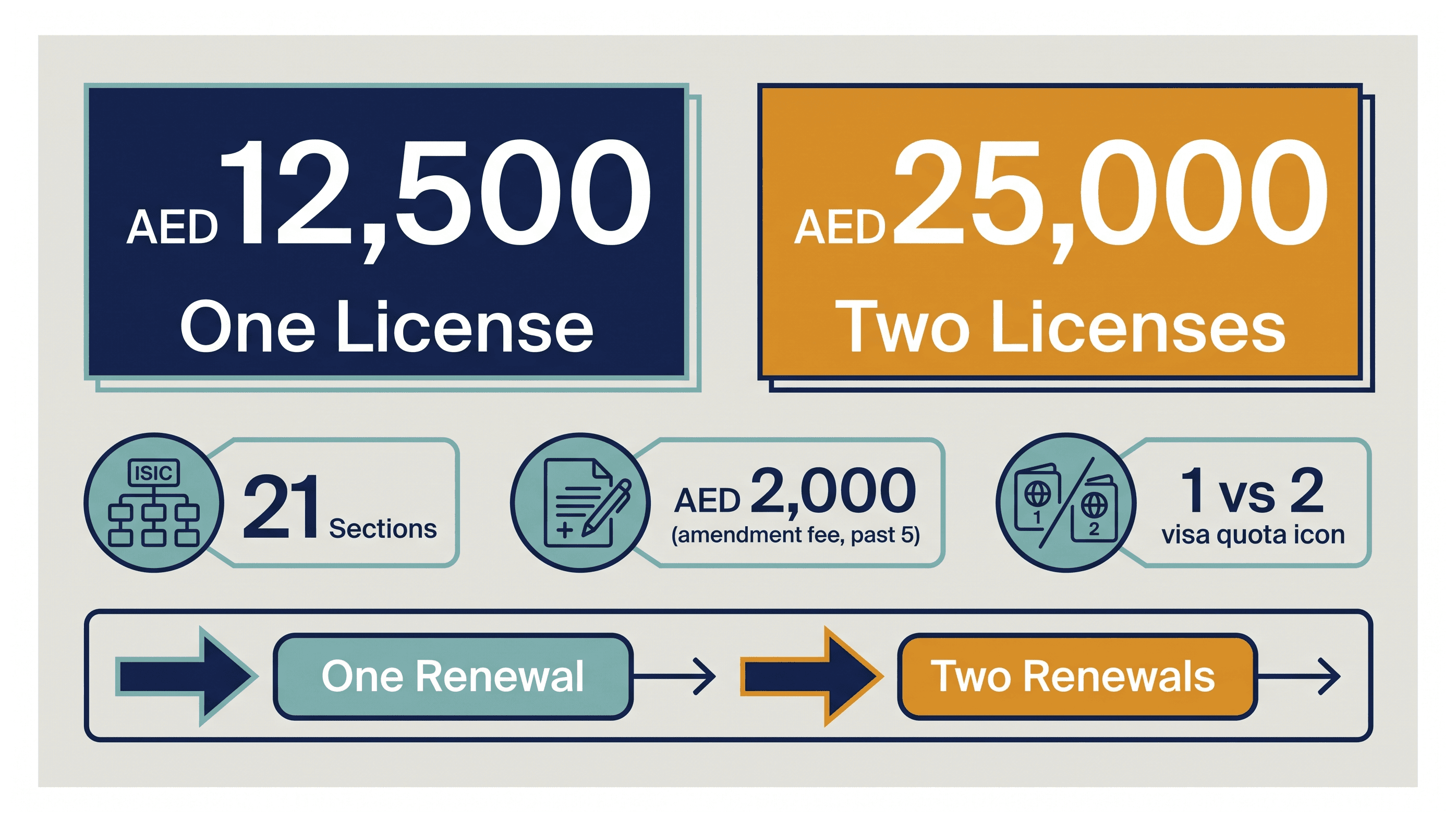
Cost differences come down to license fees, visa allocations, activity-amendment charges, and renewal overhead. A single license with grouped activities usually costs less upfront, but two licenses can lower long-term costs when activities require separate regulators or when one entity risks losing its core classification.
Base License and Renewal Fees
Dubai South Business Hub Free Zone license starts from AED 12,500 [2].
Renewal costs scale with activity count and visa package size.
Bundling avoids a duplicate AED 12,500 registration fee.
Added activities beyond five cost AED 2,000 each [2].
A retail and logistics founder comparing one AED 12,500 license to two licenses at AED 25,000 combined sees the grouped route save AED 12,500 in year one alone, before even counting visa duplication.
Visa Package Allocation Across Licenses
Each license carries its own visa quota tied to the company itself, not the founder personally (MOHRE, 2025) [3]. Splitting activities across two licenses means two separate visa administration cycles, two medical fitness tests per renewal, and two Emirates ID processes if staff rotate between entities.
A two-partner team needing four visas split across two licenses ends up paying visa package costs twice, even if the same two people hold roles in both companies. That duplication rarely makes sense unless a regulatory wall genuinely requires it. Read more on the cost of a Dubai license with multiple activities before committing either way.
How Activity Classification Shapes the Cost Decision
Classification shapes cost because regulators assess the principal activity by value added, not by owner preference. If two activities fall under different sections, like manufacturing and financial services, a single license may trigger added compliance checks, making two licenses the cheaper, cleaner route.
Principal Activity vs Secondary Activity
Principal activity is determined by value added, not total revenue.
Secondary activities usually fit on the same license fine.
Separating by establishment helps when activities differ structurally.
A trading company offering warehousing as a secondary service keeps both on one license. Warehousing supports the trading function; it isn't a competing principal activity.
When Different Regulators Get Involved
Here's a question worth asking early. Does my new activity need its own regulator approval?
Healthcare, education, and financial activities often need sign-off beyond the standard free zone process (Ministry of Health and Prevention, 2025) [5]. Splitting a health clinic activity from a general wellness retail line keeps the regulated side isolated, protecting your retail operation from clinic-specific compliance audits. Two licenses genuinely reduce risk here, not just paperwork.
Steps to Decide Between One License or Two
To decide, list every activity, map each to its classification section, estimate combined versus separate fees, and check for regulator overlap. Following these five steps shows whether grouping saves money or whether splitting dubai trade license activities across two licenses actually reduces long-term costs.
Step 1: List and Classify Every Activity
Write down every activity you plan to run.
Group activities by section-level similarity.
Flag anything needing extra regulatory sign-off.
Note which activity likely generates most value added.
Step 2: Compare Combined Versus Separate Fees
Add license fee, amendment fee, and visa cost for one license.
Repeat the same math for two licenses.
Project renewal cost across three years, not one.
Second license starting fee runs AED 12,500 [2].
Step 3: Check Regulator Overlap
Confirm if any activity needs a second regulator approval.
Assess timeline delays from dual approvals.
Decide if isolation genuinely reduces compliance risk.
Step 4: Finalize the Structure
Choose grouped license if fees and risk are lower combined.
Choose two licenses if regulatory separation saves money long term.
Document the decision for future activity amendments.
For a structured breakdown, see our guide on company formation in Dubai for two or more business activities.
Real-World Example: Grouped Versus Split Licensing
A founder running a swimming training business alongside branded sportswear retail found grouping both under one license saved roughly AED 10,000 in year one, since both activities shared a similar classification section and didn't require separate regulatory sign-off.
The Grouped Scenario
One license covers both training services and retail. One renewal fee, one visa package, lower admin overhead for a small team. The swimming training services business license in Dubai fits neatly alongside retail merchandise sales because both sit in similar service-trade classification territory.
The Split Scenario
A second license only made sense when the same founder later wanted to add a wellness clinic. That activity needed separate health authority approval, so a standalone AED 12,500 license plus duplicate visa costs became worth paying. Liability separation mattered more than saving on fees at that point.
Common Mistakes When Splitting Dubai Trade License Activities
The biggest mistakes include splitting activities before checking classification overlap, underestimating duplicate renewal costs, ignoring visa allocation differences, and failing to document which license holds the principal activity for future reporting or amendments.
Overlooking Shared Classification
Splitting activities from the same section wastes money.
Review classification before paying for a second license.
Retail and e-commerce often classify identically under ISIC.
Ignoring Long-Term Renewal Math
Year-one savings can flip to year-three losses.
Project three renewal cycles before deciding.
Recalculate after every activity amendment you add.
If renewal costs already feel heavy, our guide on reducing your Dubai license renewal cost walks through practical trims. And if you're still weighing activity combinations, what activities you can add to one Dubai license covers the groupings that typically work together.
Is splitting activities ever worth it for a solo founder? It's rarely worth it unless one activity needs a separate regulator or you want strict liability separation between two business lines.
Deciding how to structure dubai trade license activities comes down to classification overlap, regulator involvement, and real renewal math, not guesswork. Run the numbers across three years, not one, before you split anything.
Talk to a Dubai South Business Hub advisor to map your activities before you commit to one license or two.
References
Frequently Asked Questions