
Topic Summary
ISO 14001 Certification Wins More Government Tenders
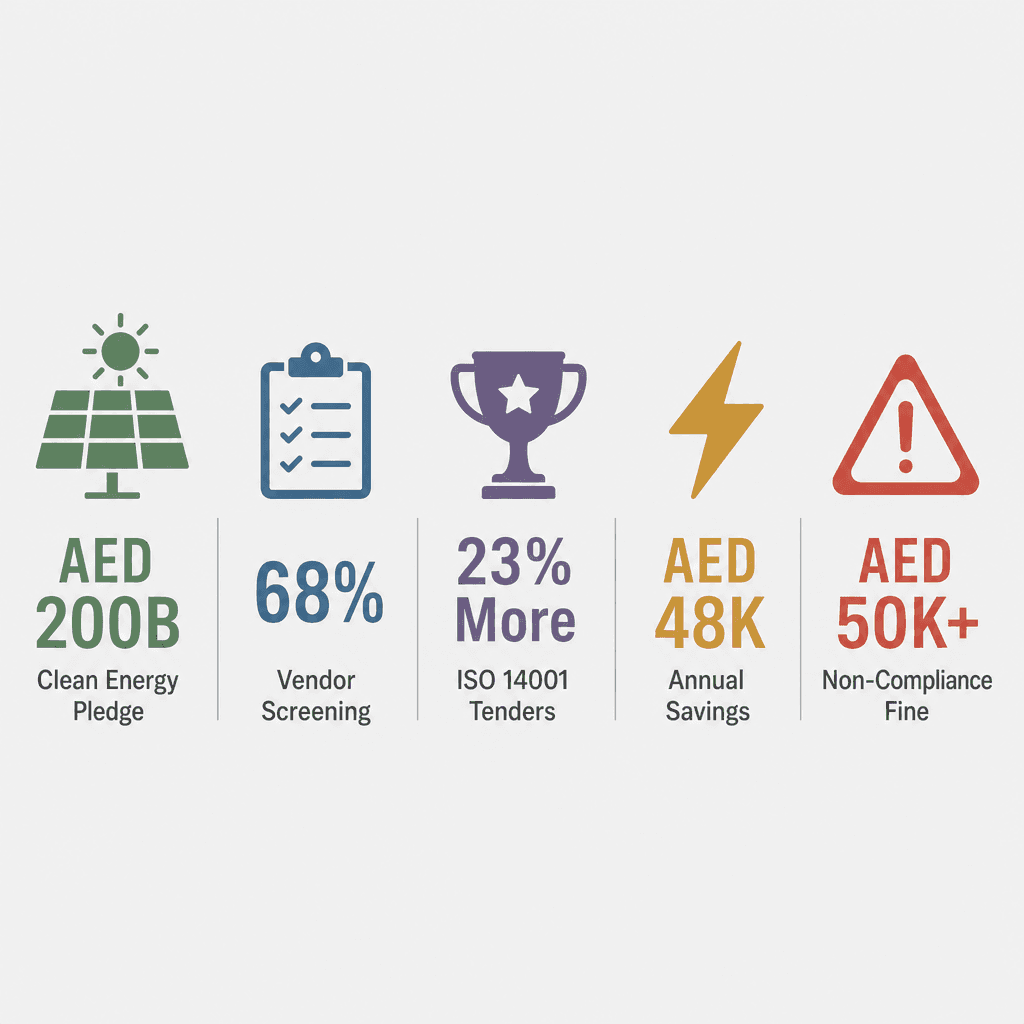
Companies holding ISO 14001 environmental management certification win 23% more government tenders in Dubai, according to the DET. With 68% of UAE procurement officers factoring sustainability into vendor selection, certification directly improves your chances of securing contracts.
Energy Efficiency Saves Businesses AED 48,000 Annually
Energy-efficient UAE businesses save an average of AED 48,000 per year in utility costs, based on DEWA data. A Dubai South logistics firm cut electricity spend by AED 52,000 after switching to LED lighting, with DEWA rebates covering 40% of installation costs and a payback period under 14 months.
Non-Compliance Penalties Start at AED 50,000
Federal Decree-Law No. 11 of 2023 mandates sustainability reporting for listed companies and large enterprises, with penalties starting at AED 50,000 per disclosure period for non-compliance. Free zone authorities are also aligning license renewals with sustainability benchmarks, meaning unlisted businesses face growing disclosure expectations.
EU Carbon Rules Now Affect UAE Exporters
The EU Carbon Border Adjustment Mechanism came into force for UAE manufacturing exporters shipping to Europe from 2026. Products without a verified carbon footprint will trigger carbon levies on EU importers, making unverified UAE goods less price-competitive in European markets.
UAE Has Committed AED 200 Billion to Clean Energy
The UAE Net Zero 2050 strategy includes a commitment of AED 200 billion to renewable energy infrastructure. This large-scale grid transition means energy cost savings for businesses are expected to grow as cleaner energy sources come online.
Three Pillars Underpin the UAE Sustainability Framework
The UAE government's sustainability framework rests on UAE Net Zero 2050, the Dubai Green Economy Initiative, and Federal Decree-Law No. 11 of 2023 on ESG reporting. Together, these create a unified regulatory and commercial environment that rewards businesses with verified sustainability programmes.
In 2026, the UAE has committed AED 200 billion to renewable energy infrastructure through the UAE Net Zero 2050 strategy (UAE Ministry of Energy and Infrastructure, 2026). Over 68% of UAE procurement officers now factor sustainability credentials into vendor selection (Dubai Chamber of Commerce, 2026). Companies with ISO 14001 certification win 23% more government tenders in Dubai (DET, 2026). Non-compliance with Federal Decree-Law No. 11 of 2023 on ESG reporting carries penalties starting at AED 50,000 for listed entities (SCA, 2026). Energy-efficient UAE businesses save an average of AED 48,000 per year in utility costs (DEWA, 2026).
Sustainable business practices in the UAE directly affect your ability to win contracts, reduce operating costs, and avoid regulatory penalties. This guide gives UAE business owners a practical, step-by-step framework covering ESG reporting, energy savings, waste compliance, supply chain standards, and how to communicate sustainability to clients and investors. Read our ESG reporting UAE guide alongside this article for full disclosure requirements.
Ing esg reporting
Energy savings
Waste compliance
Supply chain standards
How to communicate sustainability to clients
Investors
Why Sustainability Matters for UAE Businesses Now
Sustainable business practices in the UAE matter because government procurement, investor criteria, and enterprise contracts now require ESG credentials. Companies with verified sustainability programmes win more bids, pay lower energy costs, and avoid regulatory penalties under UAE Federal Decree-Law No. 11 of 2023 on corporate sustainability reporting. For more detail, see our guide on ESG reporting in the UAE under Federal Decree Law 11.
The Commercial Case for Going Green in UAE
Your competitors are already filing ESG disclosures. If you're not, you're losing bids you don't even know you're losing. The numbers are clear: 68% of UAE procurement officers factor sustainability into vendor selection (Dubai Chamber of Commerce, 2026), and companies holding ISO 14001 environmental management certification win 23% more government tenders in Dubai (DET, 2026).
The energy savings argument is just as compelling. A mid-sized logistics firm in Dubai South reduced annual electricity spend by AED 52,000 after switching to LED lighting and motion sensors, with DEWA's Demand Side Management rebate covering 40% of the upfront installation cost. That's a payback period of under 14 months. Energy-efficient businesses across the UAE save an average of AED 48,000 per year in utility costs (DEWA, 2026), and the UAE's AED 200 billion clean energy investment commitment means those savings will grow as the grid transitions.
Green business in the UAE isn't a cost centre. It's a revenue driver with a measurable AED return.
Regulatory Risk of Ignoring Sustainability
UAE Federal Decree-Law No. 11 of 2023 mandates sustainability reporting for listed companies and large enterprises. Non-compliance penalties start at AED 50,000 per disclosure period for listed entities (SCA, 2026). Free zone authorities, including Dubai South, are aligning license renewal requirements with sustainability benchmarks, so even unlisted businesses will face disclosure expectations from 2026 onward.
The international exposure is equally real. The EU Carbon Border Adjustment Mechanism (CBAM) came into force for UAE manufacturing exporters shipping to Europe from 2026. If your products carry an unverified carbon footprint, EU importers will pay a carbon levy on your goods, making your pricing uncompetitive. Sustainable business practices in the UAE are now a prerequisite for cross-border trade, not just a local compliance issue. For more detail, see our guide on sustainable product demand in the UAE.
UAE Government Sustainability Framework
The UAE Government sustainability framework is built on three pillars: UAE Net Zero 2050, the Dubai Green Economy Initiative, and Federal Decree-Law No. 11 of 2023 on ESG reporting. Together these set binding emissions targets, voluntary green business incentives, and mandatory disclosure rules that every UAE company needs to understand.
UAE Net Zero 2050 - What It Means for Your Business
The UAE Net Zero by 2050 Strategic Initiative targets 44% clean energy in the national mix by 2050 (UAE Government, 2026). At the emirate level, Dubai's Clean Energy Strategy 2050 goes further, targeting 100% clean energy for Dubai by 2050. Businesses in carbon-intensive sectors, including manufacturing, logistics, and construction, face phased regulatory tightening from 2026 onward as both targets cascade into procurement and licensing requirements.
The opportunities are concrete. DEWA's Shams Dubai programme allows businesses to install rooftop solar and sell surplus electricity back to the grid at AED 0.23 per kWh (DEWA, 2026). Subsidised energy audits are available through dewa.gov.ae. Green procurement preferences apply to certified suppliers. These aren't future incentives, they're available now, and businesses using them are cutting costs while competitors wait.
Dubai Green Economy Initiative and DET Green Business License
The Dubai Green Economy Initiative positions Dubai as a global hub for the green economy by 2030. One practical output is the DET Green Business License, a category that reduces annual license renewal fees to AED 1,500 (DET, 2026), compared to standard renewal rates. To qualify, a business must meet at least three of five DET green criteria, which include completing an energy audit, maintaining a written waste management plan, and implementing a supplier sustainability code.
A retail company in Business Bay recently qualified under three DET criteria, energy audit, waste plan, and a supplier code covering packaging materials, and secured the reduced AED 1,500 renewal fee within one license cycle. In Abu Dhabi, the Estidama Pearl Rating System, administered by the Abu Dhabi Department of Urban Planning and Municipalities, applies to all commercial fit-outs and sets the baseline for sustainability for UAE companies operating in the capital (moei.gov.ae).
ESG and Sustainability Actions - Costs, Timelines and Eligibility (UAE, 2026)
Action | Estimated Cost (AED) | Timeline | Who It Applies To |
|---|---|---|---|
GRI Self-Assessment Report | 0 (staff time only) | 6–8 weeks | All UAE businesses |
Professional ESG Audit | 8,000–18,000 | 4–6 weeks | SMEs seeking tenders |
ISO 14001 Certification | 15,000–35,000 | 3–6 months | Manufacturing, logistics |
DEWA Energy Audit (subsidised) | 0–2,500 | 2–4 weeks | DEWA-connected businesses |
DET Green Business License Renewal | 1,500 | 5–7 working days | Dubai mainland businesses |
Carbon Offset Credits (per tonne CO2) | 35 per tonne | Immediate | All UAE businesses |
Shams Dubai Solar Net Metering Setup | 12,000–40,000 install | 8–12 weeks | Dubai commercial properties |
Sources: DEWA 2026, DET 2026, UAE Carbon Alliance 2026, market rates 2026
ESG for Small and Medium Businesses in UAE
ESG for small and medium UAE businesses means tracking three areas: environmental impact (energy, waste, emissions), social practices (fair wages, worker safety, Emiratisation), and governance (board accountability, anti-corruption, data privacy). SMEs are not yet mandated under Federal Decree-Law No. 11 of 2023, but voluntary reporting opens tenders and investor access that closed businesses can't reach.
What ESG Reporting Covers for a UAE SME
Environmental metrics cover Scope 1 and Scope 2 carbon emissions, monthly energy consumption in kWh, and water use in litres. Social metrics include your Emiratisation ratio, MOHRE-compliant worker accommodation standards, and Wage Protection System (WPS) payroll compliance. Governance covers your Ultimate Beneficial Owner (UBO) register filed with the Ministry of Economy, an anti-bribery policy, and data protection compliance under UAE Personal Data Protection Law (PDPL), Federal Decree-Law No. 45 of 2021.
You don't need a large budget to start. A 15-person consultancy in DIFC used a free GRI Standards template (available at globalreporting.org) to produce a two-page ESG summary. That document helped them win a AED 400,000 government advisory contract by satisfying the client's supplier ESG questionnaire. The SCA mandates full ESG disclosure for listed companies (sca.gov.ae); for everyone else, GRI or TCFD voluntary frameworks are the practical starting point for an ESG UAE company profile.
ESG Reporting Costs and Timelines for UAE SMEs
A basic ESG audit from a UAE-registered sustainability consultant costs between AED 8,000 and AED 18,000 (market rate, 2026). GRI-aligned self-reporting costs nothing beyond staff time, roughly 20 hours for a 10-person business from data collection to a finished document. Carbon offset credits via UAE Carbon Alliance are priced at AED 35 per tonne of CO2 equivalent (UAE Carbon Alliance, 2026), giving you a straightforward route to carbon neutrality claims while you build longer-term reduction measures.
Your first ESG report typically takes 6 to 8 weeks from the point you start collecting data. The table above shows the full cost and timeline breakdown for every major sustainability action a UAE business should consider in 2026.
Energy Efficiency Actions for UAE Businesses
UAE businesses reduce energy costs through DEWA's Demand Side Management programme, LED retrofits, smart metering, and rooftop solar via the Shams Dubai net metering scheme. A standard commercial LED retrofit in a 200 sqm Dubai office saves approximately AED 14,400 per year and pays back within 18 months.
Five Steps to Cut Energy Costs in a UAE Business
Follow these five steps to implement sustainable business practices in the UAE that produce a measurable reduction in your DEWA bills:
A 200 sqm Dubai office that completed all five steps reduced its monthly DEWA bill from AED 8,200 to AED 3,800, an annual saving of AED 52,800. That's a green business UAE story with a direct line to the bottom line.
DEWA Programmes and Abu Dhabi Energy Incentives
DEWA's Green Building Regulations require all new commercial fit-outs above 300 sqm to meet the Al Sa'fat green rating, so if you're fitting out new premises, build sustainability in from the design stage rather than retrofitting later. In Abu Dhabi, the Department of Energy's Demand Response Programme pays businesses AED 0.18 per kWh for load-shifting during peak hours (doe.gov.ae). That's a direct revenue stream for businesses with flexible consumption patterns.
Etihad ESCO, Abu Dhabi's energy services company, offers energy performance contracts with zero upfront cost for qualifying manufacturing and commercial clients. Savings are shared over the contract term, making it accessible for businesses that can't fund capital expenditure. Sharjah Electricity and Water Authority (SEWA) provides free energy efficiency consultations for industrial customers, worth requesting before any facility expansion.
Waste and Environmental Management in UAE
UAE businesses must comply with Federal Law No. 12 of 2018 on Integrated Waste Management. Commercial waste generators above 200 kg per day in Dubai must register with Dubai Municipality, maintain a waste management plan, and use licensed waste contractors. Non-compliance fines start at AED 5,000 per incident.
UAE Waste Compliance Requirements for Businesses
Federal Law No. 12 of 2018 on Integrated Waste Management is your primary legal reference. In Dubai, the threshold is clear: generate more than 200 kg of commercial waste per day and you must register with Dubai Municipality and maintain a written waste management plan. Hazardous waste, including chemical, medical, and electronic waste, requires a contractor from the UAE Ministry of Climate Change and Environment (moccae.gov.ae) approved list. In Abu Dhabi, the Environment Agency Abu Dhabi (EAD) oversees industrial waste permits, with annual fees ranging from AED 2,000 to AED 5,000 depending on waste classification.
A restaurant group in JBR registered with Dubai Municipality, switched to a licensed waste contractor, and introduced food composting across three outlets. The result: a 60% reduction in landfill waste and AED 18,000 saved per year in disposal fees. Sustainability for UAE companies in the F&B sector is often a waste cost story as much as an energy one.
Practical Waste Reduction Actions with AED Savings
Food and organic waste composting cuts disposal costs by up to AED 18,000 per year for F&B businesses. Emirates Environmental Group (EEG) offers free commercial paper and cardboard collection for volumes above 50 kg per pickup (eeg-uae.org), removing a recurring cost entirely. Enviroserve UAE provides free IT equipment collection for e-waste, avoiding a disposal fee of approximately AED 3,500 per tonne that unlicensed disposal would otherwise incur.
There's also a circular economy angle worth capturing. Licensed scrap dealers pay an average of AED 0.35 per kg for cardboard and significantly more for metal (UAE scrap market, 2026). If your business generates consistent volumes, a monthly collection agreement converts a waste cost into a modest revenue line and strengthens your ESG environmental reporting simultaneously.
Sustainable Supply Chain in UAE
A sustainable supply chain in UAE means auditing suppliers against environmental, social, and governance criteria, preferring UAE-origin goods where possible, and including sustainability clauses in procurement contracts. UAE government tenders from 2025 onward require Tier 1 suppliers to hold at least one recognised sustainability certification.
How to Audit Your UAE Suppliers for Sustainability
Start by requesting supplier self-assessment questionnaires that ask about ISO 14001 certification, Sedex SMETA audit status, or equivalent third-party verification. Dubai Customs operates a Compliant Trader programme at dubai.customs.gov.ae, prioritising enrolled suppliers reduces your supply chain compliance risk. The Ministry of Industry and Advanced Technology's (MOIAT) Make in UAE certified suppliers qualify for a 10% tender price preference under government procurement rules (moiat.gov.ae), making UAE-origin sourcing a commercial advantage, not just an ethical one.
Adding a supplier sustainability clause to all purchase orders above AED 25,000 takes about 30 minutes with a standard legal template. One Dubai construction company did exactly this and saw 14 of its 20 key suppliers achieve ISO 14001 within 12 months to retain the contract. That's a supply chain transformation driven by one procurement policy change.
Build a Supplier Code of Conduct for Your UAE Business
Your supplier code of conduct should cover four baseline areas: no child labour (aligned with UAE Labour Law Federal Decree-Law No. 33 of 2021), fair wages verified through MOHRE's Wage Protection System (WPS), health and safety standards, and environmental compliance with Federal Law No. 12 of 2018. Verify that all suppliers are enrolled in WPS before awarding contracts, non-enrolled suppliers represent a compliance liability for your own business.
On the green procurement side, specify recycled content percentages, low-VOC materials, and FSC-certified timber in tender documents. A Dubai retailer that included FSC-certified timber and 30% recycled content packaging requirements in all supplier tenders found that within two tender cycles, eight of its twelve packaging suppliers had updated their product lines to comply. The Dubai South Business Hub Free Zone business support team can help you draft these clauses in a format that meets UAE government tender requirements.
Is sustainability reporting mandatory for small UAE companies?
No. Federal Decree-Law No. 11 of 2023 currently mandates ESG disclosure for listed companies and large enterprises. SMEs are not legally required to report. But voluntary reporting using GRI Standards is free, takes roughly 20 hours for a small team, and directly improves your ability to qualify for government and enterprise tenders that require ESG documentation from suppliers.
Communicating Sustainability to Clients and Investors
UAE businesses communicate sustainability credibly by publishing an annual ESG summary, displaying verified certifications on proposals, and referencing specific AED savings or emissions reductions. Unsubstantiated green claims risk UAE Consumer Protection Law penalties of up to AED 250,000, quantify every claim you make.
Citations
UAE Cabinet.. uaecabinet.ae. UAE Cabinet, 2023.
Dubai Chamber of Commerce.. dubaichamber.com. Dubai Chamber, 2024.
Ministry of Human Resources and Emiratisation.. mohre.gov.ae. MOHRE UAE, 2024.
Dubai Economy and Tourism.. dubaidet.gov.ae. DET Dubai, 2024.
UAE Ministry of Economy and Tourism.. moet.gov.ae. MOET UAE, 2024.
Frequently Asked Questions