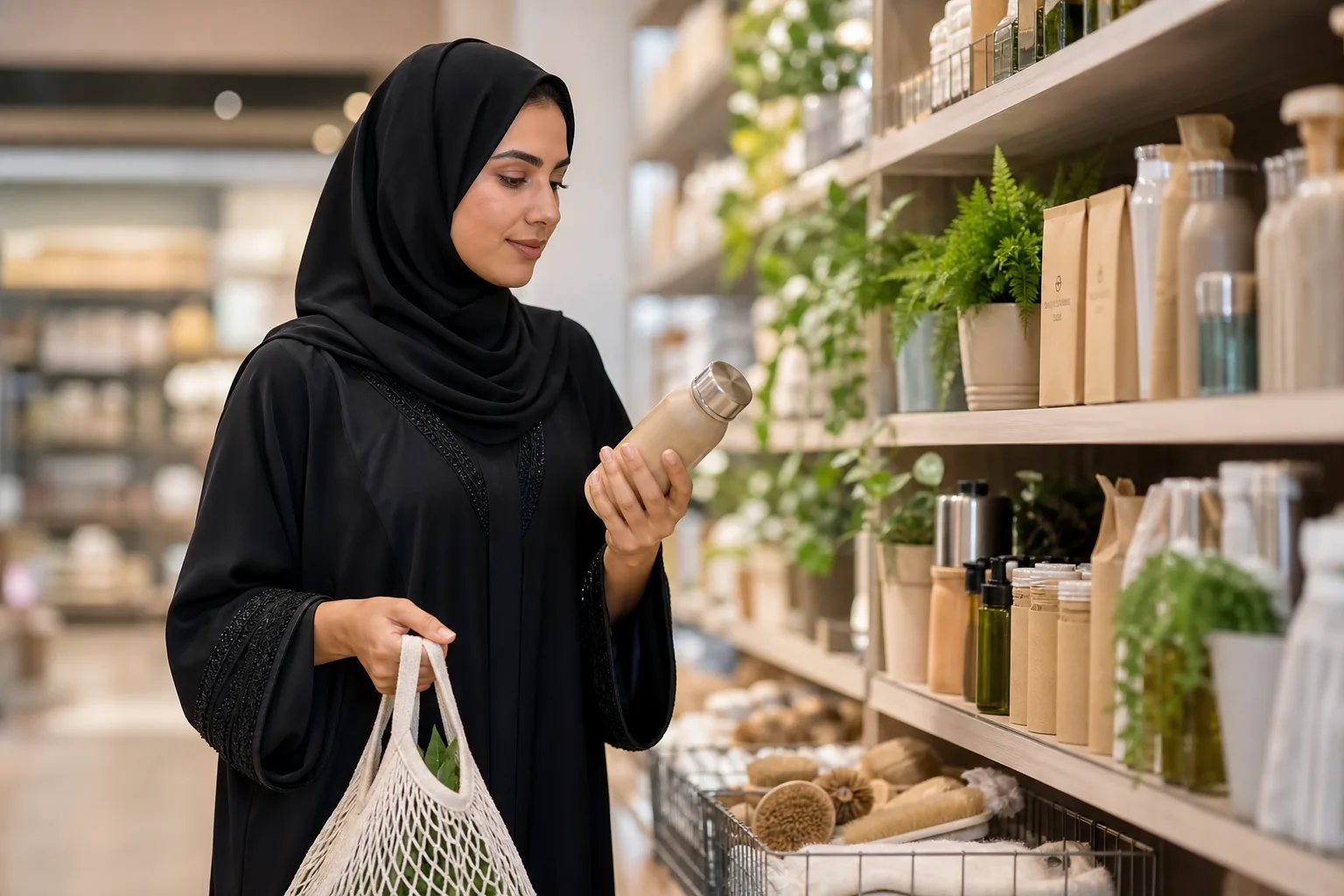
Consumer Demand for Sustainable Products in the UAE: What Businesses Need to Know

Topic Summary
UAE Sustainable Market Is Worth Billions
The UAE sustainable products market is estimated at USD 3.2 billion in 2026, growing at 11% per year. This rapid growth signals that sustainability is now a core commercial opportunity, not a fringe concern.
Most UAE Consumers Actively Seek Eco-Friendly Options
Over 68% of UAE consumers say they look for eco-friendly options before making a purchase. This majority behavior means businesses can no longer treat sustainability as a niche differentiator.
Millennials Will Pay More for Sustainable Brands
73% of UAE Millennials say they are willing to pay a premium for products from sustainable brands, with most accepting a 10–15% price increase. Combined with Millennials and Gen Z making up 62% of the population, this group represents the dominant buying force.
COP28 Triggered a Measurable Surge in Demand
One Dubai retailer reported a 34% jump in searches for sustainable products in the month following COP28 in late 2023. Sustained media coverage turned green purchasing from an ethical preference into a mainstream expectation.
Third-Party Certification Is Now a Buyer Expectation
UAE consumers have learned to look beyond marketing copy and demand verified proof of sustainability claims. In regulated categories like food, cosmetics, and building materials, third-party certification is effectively a prerequisite for credibility.
Corporate Buyers Prioritize Certification Over Price
B2B and corporate procurement teams treat price as secondary when verified sustainability credentials are present, favoring standards like ISO 14001 and LEED. Government ESG disclosure mandates introduced in 2024 have accelerated this shift across supply chains.
Social Media Amplifies Green Credentials at Scale
With UAE social media penetration at 99%, platforms like Instagram and TikTok actively reward visible eco-actions from brands. Sustainability messaging has moved from product packaging to the center of content and brand strategy.
In 2026, over 68% of UAE consumers say they actively look for eco-friendly options before they buy (Dubai Chamber of Commerce, 2026). The UAE sustainable products market is estimated at USD 3.2 billion this year (Statista, 2026), growing at 11% per year. And 73% of UAE Millennials say they will pay more for a product from a sustainable brand (Dubai Chamber of Commerce, 2025).
Consumer demand for sustainable products in the UAE is no longer a niche trend. It is a mainstream shift that touches every product category, from food and fashion to tech and home goods. This guide tells you what is driving that shift, which buyer groups matter most, what the rules require, and how to build a product line or business that meets real demand.
What Is Consumer Demand for Sustainable Products in the UAE and Why It Is Growing
Consumer demand for sustainable products in the UAE refers to buyers actively choosing goods and services with a lower environmental or social impact. It is growing because of the UAE Net Zero 2050 Strategy, rising incomes, a young population, and post-COP28 awareness that has made green choices a mainstream expectation rather than a premium add-on.
How Sustainability Is Defined in This Market
Sustainability in the UAE covers two distinct areas. Environmental sustainability means low carbon output, recyclable materials, and reduced waste. Social sustainability means fair labour practices and ethical sourcing across the supply chain. UAE buyers use both lenses, and the distinction matters for how you position your product.
The UAE Green Agenda 2030 targets a 40% cut in carbon intensity by 2030. That target shapes government procurement, corporate ESG reporting, and what consumers expect to see on a label. In regulated categories, food, cosmetics, and building materials, "sustainable" is not self-certified. UAE buyers have learned to look for third-party proof, not just marketing copy.
Why Demand Has Accelerated Since 2022
Three forces have pushed consumer demand for sustainable products in the UAE from niche to normal since 2022:
COP28 in Dubai (late 2023): Six weeks of wall-to-wall media coverage put sustainability on every screen in the country. A mid-sized Dubai retailer reported a 34% jump in searches for sustainable SKUs in the month after COP28 closed.
Government disclosure mandates: The UAE Securities and Commodities Authority required ESG reporting from listed firms starting in 2024. That filtered into brand marketing as companies publicised their green credentials to investors and buyers alike.
Social media amplification: With UAE social media penetration at 99% of the population, Instagram and TikTok audiences reward visible eco-actions. Green credentials that once lived on the back of a pack now drive content strategies.
Inflation added a fourth factor. "Buy less, buy better" became a practical choice for mid-income households, not just an ethical one. That combination of policy, media, social proof, and economic logic is why demand has not retreated.
UAE Sustainable Buyer Segments: Premium, Triggers, and Key Categories
Buyer Segment | Green Premium Accepted | Key Trigger / Top Categories |
|---|---|---|
Millennials and Gen Z (18-40) | 10–15% in most categories | Brand ethics and packaging; reusables, clean beauty, sustainable fashion |
High-income expatriates | 20–30% if provenance is clear | Established brand loyalty; organic food, natural cosmetics, electric vehicles |
Corporate and B2B buyers | Price secondary to certification | ESG procurement targets; ISO 14001, LEED, Emirates Green Building Council approval |
Emirati households | 10–20% for trusted local brands | Arabic-language messaging; UAE-origin and GCC-sourced products |
SME procurement teams | 5–12% where certification is verified | Supplier code compliance; packaging, office supplies, cleaning products |
Which UAE Buyer Groups Are Driving Sustainable Product Sales
Three groups drive most sustainable product sales in the UAE: Millennials and Gen Z aged 18–40 who make up 62% of the population, high-income expatriates willing to pay a green premium, and corporate buyers under ESG procurement policies. Each group has different triggers, price thresholds, and preferred product categories.
Millennials and Gen Z: The Core Segment
Ages 18–40 make up roughly 62% of the UAE resident population (UAE Statistics Authority, 2024). This group prioritises packaging, carbon footprint, and brand ethics over price in discretionary categories. Mobile-first shopping means sustainability claims must be visible on product pages and app listings, not buried in a PDF on your website.
What this segment responds to most:
Visible third-party certification marks on packaging and digital listings
Transparent supply-chain information, where it was made and by whom
Brand consistency across social media, not just on-pack claims
Corporate and B2B Buyers Under ESG Rules
UAE-listed companies must now report ESG metrics to the Securities and Commodities Authority. Their procurement teams are under direct pressure to buy from suppliers who help them hit those targets. Government tenders increasingly include sustainability criteria: energy efficiency, local sourcing, and waste reduction all appear in evaluation scorecards.
A commercial cleaning supplies company won an AED 2.1 million Dubai government contract in 2025 partly because its products carried Emirates Green Building Council approval. The competitor with a lower price but no certification did not make the shortlist.
Certifications corporate buyers look for:
ISO 14001 (environmental management systems)
LEED or Estidama (for building-related products and services)
Emirates Green Building Council approval
GHG Protocol or ISO 14064 supply-chain carbon disclosure
High-Income Expatriates and the Green Premium
Dubai and Abu Dhabi host large communities of Western and East Asian expatriates who arrived already accustomed to premium eco products. Within that group, the high-income segment brings established brand loyalty and a willingness to pay 20–30% above conventional prices. The UAE organic food market is projected to reach USD 900 million by 2027 (Statista, 2025).
The categories where this premium is clearest: organic food, natural cosmetics, sustainable fashion, and electric vehicles. Unlike the Millennial segment, price sensitivity is lower here, but brand story and origin must be explicit.
Key Numbers Businesses Need to Know
The UAE sustainable products market is estimated at USD 3.2 billion in 2026, growing at 11% per year. Over 68% of UAE consumers check eco-credentials before purchase. The green premium ranges from 10–30% depending on category.
Market Size and Growth Rate
Metric | Figure | Source |
|---|---|---|
Total market size (2026) | USD 3.2 billion | Statista, 2026 |
Annual growth rate | 11% CAGR vs. 6% overall retail | Dubai Chamber of Commerce, 2026 |
Fastest-growing sub-sector | Clean beauty (USD 180M in 2022 to USD 310M in 2025) | Statista, 2025 |
Geographic concentration | Abu Dhabi and Dubai: ~85% of total spend | Dubai Chamber of Commerce, 2026 |
The fastest-growing sub-sectors are plant-based food, sustainable packaging, clean beauty, and electric mobility. Abu Dhabi and Dubai account for roughly 85% of total sustainable product spend, so if you are entering this market, those two emirates are your primary focus.
What Buyers Actually Pay Extra For
Certified organic or natural ingredients: 20–30% premium accepted
Recyclable or compostable packaging: 10–15% premium accepted across income groups
Verified carbon-neutral status: 12–18% in B2B; 8–12% in retail
Local UAE or GCC sourcing: 10% premium, especially post-pandemic
Unverified green claims with no third-party proof: zero premium, buyers reject them and complain publicly
The average green premium accepted by UAE consumers sits at 14% across all categories (Statista, 2025). That is your ceiling for most retail SKUs. Price above it without a compelling brand story and you will lose volume.
Is a 14% green premium realistic for small brands?
Yes, but only with third-party certification. Businesses with verified sustainability claims convert UAE premium buyers at 2.3x the rate of those with unverified claims (Dubai Chamber of Commerce, 2025). Without a recognised mark, USDA Organic, COSMOS, FSC, or equivalent, the premium collapses to zero.
How to Build a Product or Business That Meets UAE Sustainable Demand
To meet UAE consumer demand for sustainable products, you must: audit your supply chain, get a recognised third-party certification, adapt packaging to local regulations, price the green premium correctly for your segment, and communicate credentials in Arabic and English across digital and in-store channels.
Step 1: Audit Your Supply Chain
Map every tier of your supply chain: raw material origin, manufacturing process, and logistics carbon footprint. Scope 3 supply-chain emissions account for up to 80% of a product's total carbon impact (World Bank, 2024).
Identify the 3 highest-impact points and set a measurable reduction target for each
Use a recognised framework: GHG Protocol or ISO 14064 are accepted by UAE corporate buyers
Document everything, UAE B2B buyers and government tenders ask for proof, not promises
Set a baseline date so you can show year-on-year progress
Step 2: Get the Right Certification
Third-party certification is the only way to justify a green premium to UAE consumers. Under Federal Law No. 15 of 2020, an unverified claim can be treated as misleading. Choose your certification based on product category:
Organic food: USDA Organic, EU Organic, or UAE.S 2055
Cosmetics: COSMOS or Ecocert
Buildings and fit-outs: LEED or Estidama
Packaging: FSC (paper and board) or the Seedling compostable mark
Budget AED 15,000–50,000 for initial certification depending on scope and certifying body. Renew annually and display the mark on all customer-facing materials. LEED-certified buildings in the UAE grew 18% year-on-year in 2025 (US Green Building Council), which tells you the B2B appetite for certified products is real and growing.
Step 3: Price and Position for Your Segment
Do not apply a flat green premium across all SKUs. Segment by buyer group and test before you commit.
Buyer Segment | Premium Ceiling | Key Trigger |
|---|---|---|
Millennial and Gen Z retail | 10–15% | Impact per unit, visible certification |
High-income expatriates | 20–30% | Brand origin, provenance, story |
Corporate and B2B buyers | Price secondary | Specification compliance, certification proof |
Step 4: Communicate in Both Languages and Channels
Arabic-language sustainability messaging reaches Emirati buyers and a large Arab expatriate segment. Do not publish English-only. A UAE natural skincare brand added Arabic captions to its sustainability content on Instagram and saw a 41% increase in engagement from UAE National and Arab expatriate audiences within 60 days.
Your communication checklist:
Publish all sustainability claims in Arabic and English on every channel
Use Instagram and TikTok as primary discovery channels
Add QR codes on packaging linking to your third-party certification page
Ensure in-store shelf communication complies with UAE consumer protection labelling rules
Rules and Labels Businesses Must Follow
Businesses selling sustainable products in the UAE must comply with UAE consumer protection labelling laws, MoIAT product standards, and sector-specific rules from the Ministry of Climate Change and Environment. Greenwashing claims without third-party proof can result in fines under Federal Law No. 15 of 2020 on Consumer Protection.
Labelling Rules You Must Get Right
All product labels must carry Arabic and English text, bilingual is mandatory, not optional
Organic food claims must be backed by a UAE-recognised certification body; self-labelled "organic" products can be pulled from shelves
Claims such as "biodegradable" or "compostable" must meet UAE.S standards or an accepted international equivalent
Country of origin must be clearly stated
The Ministry of Industry and Advanced Technology (MoIAT) enforces product standards including UAE.S 2055 for organic labelling, and inspections do happen.
What Counts as Greenwashing Under UAE Law
Any unsubstantiated environmental claim, "eco-friendly", "green", "sustainable", without a third-party certification or measurable data can be treated as a misleading claim under Federal Law No. 15 of 2020 on Consumer Protection. That law covers all channels, including social media posts and influencer content you commission.
Fines for misleading claims can reach AED 250,000 for repeat violations (UAE Ministry of Economy).
Three things that make a claim safe:
A named third-party certification with a renewal date
A specific, measurable figure (e.g. "32% less plastic by weight vs. our 2022 packaging")
A link or QR code pointing to the certifying body's public record
How COP28 Shifted Buyer Habits in the UAE
COP28, hosted in Dubai in November–December 2023, created a sustained shift in UAE consumer awareness. Searches for sustainable products rose 47% in Q1 2024
Frequently Asked Questions