
Topic Summary
What Is Third Party Approval Dubai License and Why It Matters
A third party approval dubai license requirement means a sector regulator must sign off on your activity before the Department of Economy and Tourism issues your trade license. Healthcare, education, real estate, media, and financial activities commonly trigger this extra regulatory layer and cost.
What Each Regulator Charges for Approval
Approval fees vary significantly by authority. DHA charges for healthcare-related activities, RERA for real estate activities, and DED for certain mainland activity endorsements. Each authority sets its own fee schedule, which may be annual or per-application. Mapping the specific approvals required for your activity codes before you register prevents unexpected authority costs appearing after your trade license is already issued.
Hidden Costs Beyond the Regulator Fee Itself
Beyond the stated approval fee, applicants often pay for document attestation, translation, facility inspections, and resubmission after corrections. These add-ons can push total third party approval dubai license costs 20-40% higher than the regulator's published fee schedule.
Steps to Budget for Your Approval Costs
Budgeting for a third party approval dubai license follows five steps: identify your ISIC-classified activity, confirm which regulator applies, request the current fee schedule, add translation and inspection buffers, and build the total into your license application timeline before submission.
Key Benefits of Planning for Third Party Approval Dubai License Costs Early
Planning for approval costs early protects your launch timeline, avoids surprise invoices mid-application, and lets you compare bundled activity packages that may reduce the number of separate regulator touchpoints you need to pay for.
Common Mistakes That Inflate Approval Costs
The most common mistakes include guessing which regulator applies, submitting untranslated documents, ignoring renewal deadlines, and bundling unrelated activities that each trigger a separate approval fee, all of which add avoidable cost to a third party approval dubai license application.
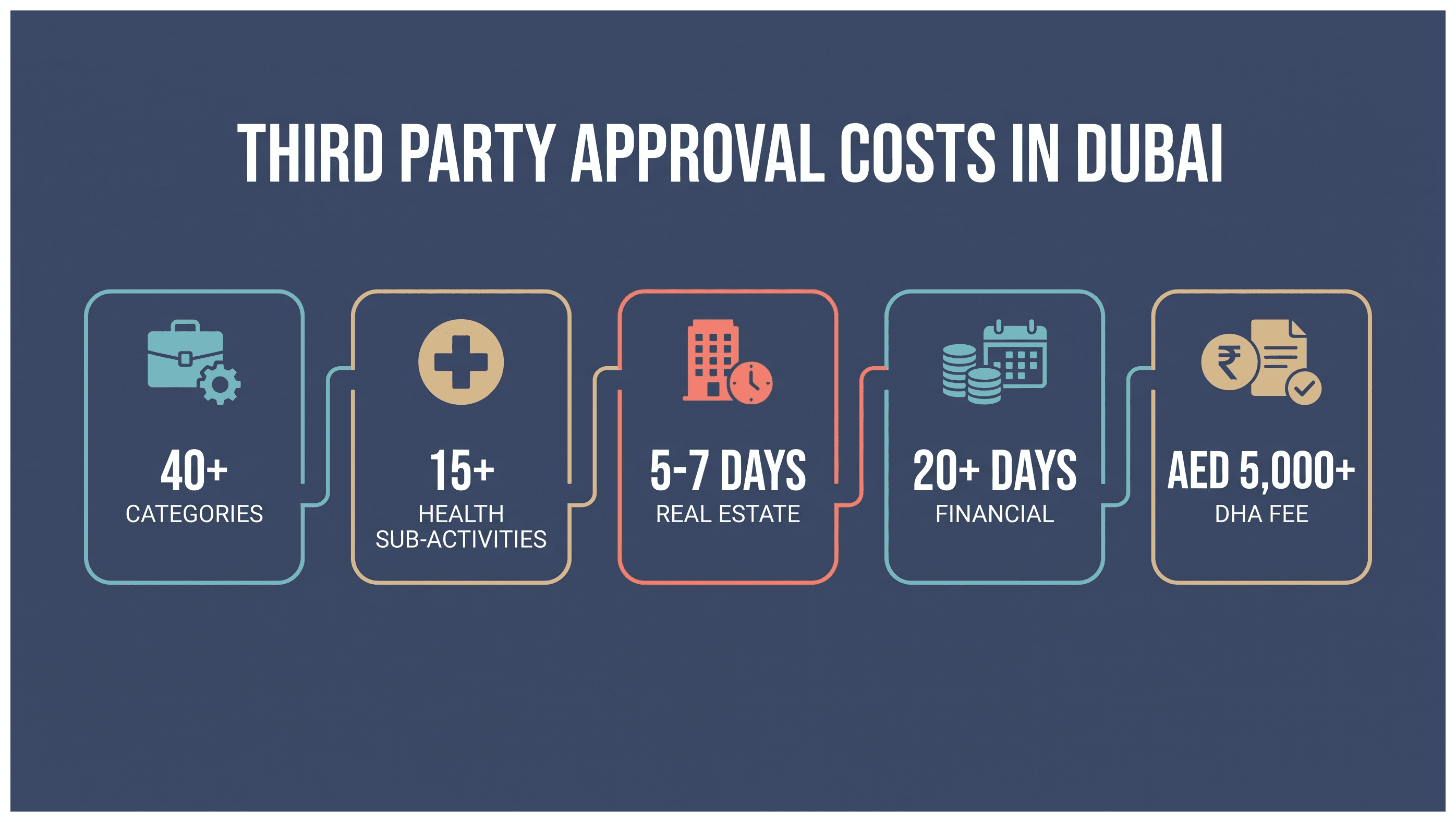
In 2026, over 40 regulated activity categories in Dubai require a named government regulator to approve a trade license before issuance (u.ae, 2026). That's 1 in roughly every 10 licensed activities. Healthcare alone touches 15+ sub-activities [1]. Real estate brokerage approvals add 5-7 business days on average [2]. Financial sign-offs can stretch past 20 business days [3]. DHA facility fees often exceed AED 5,000 [4]. RERA broker certification runs into thousands more [5]. You'll learn what a third party approval dubai license actually costs across the main regulators, which activities trigger these fees, and how to budget for them before you apply.
What Is Third Party Approval Dubai License and Why It Matters
A third party approval dubai license requirement means a sector regulator must sign off on your activity before the Department of Economy and Tourism issues your trade license. Healthcare, education, real estate, media, and financial activities commonly trigger this extra regulatory layer and cost.
How Regulators Fit Into the Licensing Chain
The Department of Economy and Tourism (DET) handles the core mainland trade license. But DET doesn't review everything itself. For a regulated activity, DET refers your file to the relevant authority first, and nothing moves until that regulator clears it.
Even free zone companies aren't exempt here. A free zone authority can issue your license shell, but if your activity falls under a regulated category, you still need the external sign-off before you can legally operate. Over 40 activity categories carry this requirement in 2026 (u.ae, 2026).
Think of a clinic applicant: DET won't finalize anything until Dubai Health Authority reviews the facility, the staff qualifications, and the equipment list. The sequence runs application, referral, regulator review, then license issuance. Skip a step and you start over.
Activities Classified Under ISIC That Trigger Approval
Dubai's activity codes map back to the International Standard Industrial Classification (ISIC) Rev.4 framework, which groups all economic activity into 21 sections (United Nations Statistics Division, 2008, still accurate as of 2026).
Section Q (human health) almost always needs DHA clearance.
Section P (education) needs Knowledge and Human Development Authority review.
Section L (real estate) routes through Dubai Land Department.
Section K (financial services) often needs Central Bank input.
Your activity code, not your business name, decides which regulator sees your file.
Regulator Approval Fee Ranges by Sector
Feature | Regulator | Typical Fee Range |
|---|---|---|
Dubai Health Authority - clinic and facility fees | Dubai Health Authority (DHA) | AED 5,000 to AED 15,000+ |
Dubai Land Department - broker registration fees | Dubai Land Department / RERA | AED 2,000 to AED 6,000 annually |
Ministry of Economy - restricted trading sign-off | Ministry of Economy | AED 1,000 to AED 5,000 |
Central Bank - financial activity clearance | Central Bank of the UAE | AED 10,000 and up, case dependent |
Dubai Municipality - food and industrial activity checks | Dubai Municipality | AED 1,500 to AED 4,000 |
What Each Regulator Charges for Approval
Fees vary widely by regulator. Dubai Health Authority approvals for clinics often run several thousand dirhams, Dubai Land Department real estate approvals carry separate registration charges, and Ministry of Economy sign-offs for restricted trading activities add processing fees on top of standard license costs.
Dubai Health Authority Fees
Facility inspection fees often exceed AED 5,000 (Dubai Health Authority, 2025).
Professional qualification verification adds separate per-staff charges.
Renewal fees typically sit lower than the first approval, but they're not free.
Take a dental supplies trading company. Before they can stock inventory, DHA requires product registration on top of the standard trade license, and this is distinct from clinic approval fees. A related example is covered in our guide to a dental supplies trading license in Dubai, where the starting cost of the license package itself runs AED 12,500 under a zero-visa setup.
Dubai Land Department and Real Estate Regulators
RERA registration fees apply to every individual broker, not just the firm.
Annual renewal charges recur even without new transactions.
Training certificates (the RERA course) add a further cost before you're cleared.
A mortgage brokerage firm has to budget for RERA certification separately from its mortgage advisers and brokers business license in Dubai, especially given Dubai property transactions have reached record annual highs in recent years.
Ministry of Economy and Financial Regulators
Restricted trading activities, think precious metals, telecom equipment, or pharmaceuticals, need Ministry of Economy sign-off before DET will issue anything. Central Bank and insurance-related clearances add their own layer on top.
Consider an applicant for a bank brokers business license in Dubai. Central Bank clearance often adds two to three weeks to the overall timeline, and that delay pushes back visa processing too. Free zone base license fees stay separate from these approval costs: the regulator charge applies regardless of jurisdiction once the activity itself is regulated.
Hidden Costs Beyond the Regulator Fee Itself
Beyond the stated approval fee, applicants often pay for document attestation, translation, facility inspections, and resubmission after corrections. These add-ons can push total third party approval dubai license costs 20-40% higher than the regulator's published fee schedule.
Document and Translation Charges
Foreign certificates need legal translation into Arabic.
Attestation through UAE embassies adds per-document fees.
Typing centers charge separately for form submission.
A foreign-qualified auditor can't skip this. Their credentials need attestation before DET and the regulator even open the file, which means budgeting translation costs upfront, not as an afterthought. See our notes on an auditing of accounts business license in Dubai for related documentation requirements.
Resubmission and Delay Penalties
Rejected applications don't just cost time. Correcting them often means paying inspection or review fees again. A clinic that fails its first DHA site inspection, say, over a floor plan issue, has to pay for a second visit and resubmit documents.
That delay ripples into visa processing too, since residency visas tied to the company license can't move until the license itself clears. Early document review, even if it feels like an extra step, saves real money down the line.
Steps to Budget for Your Approval Costs
Budgeting for a third party approval dubai license follows five steps: identify your ISIC-classified activity, confirm which regulator applies, request the current fee schedule, add translation and inspection buffers, and build the total into your license application timeline before submission.
Step 1: Confirm Your Activity Code and Regulator
Match your activity to its ISIC classification first.
Check DET's activity list for an approval flag.
Don't assume. Verify with the source document.
Step 2: Request Fee Schedules Directly
Contact the regulator's portal for current fees.
Avoid relying on outdated blog estimates.
Fees change yearly, sometimes mid-year.
Step 3: Add a Contingency Buffer
Set aside 20-30% above quoted fees.
Factor in translation and courier costs.
Build this into your cash flow plan early.
How long does a third party approval take in Dubai?
Most approvals take between 5 and 20 business days, depending on the regulator. Health and financial clearances run longer. Real estate broker approvals tend to clear faster, often within a week.
Key Benefits of Planning for Third Party Approval Dubai License Costs Early
Planning for approval costs early protects your launch timeline, avoids surprise invoices mid-application, and lets you compare bundled activity packages that may reduce the number of separate regulator touchpoints you need to pay for.
Faster Visa and License Issuance
Pre-cleared approvals shorten the overall processing window. A founder tying a business license in Dubai to a residency visa package avoids delay when the regulator sign-off comes through on schedule, not weeks late.
Clearer Total Setup Budget
Combine license, visa, and approval costs into one projection.
Avoid mid-process cash flow surprises.
Review the fee schedule before, not after, you commit funds.
Common Mistakes That Inflate Approval Costs
The most common mistakes include guessing which regulator applies, submitting untranslated documents, ignoring renewal deadlines, and bundling unrelated activities that each trigger a separate approval fee, all of which add avoidable cost to a third party approval dubai license application.
Guessing Instead of Confirming the Regulator
Filing with the wrong authority wastes weeks.
Reprocessing fees apply on resubmission.
Always confirm before you file, not after rejection.
Bundling Unrelated Activities
Each regulated activity may need its own approval.
Review your full activity list before grouping anything.
One license can carry multiple separate regulator fees.
Our breakdown of which trading activities need a second regulator in Dubai covers this in more detail, including over 50 product categories classified as restricted under Ministry of Economy oversight.
Third party approval dubai license costs vary by regulator, activity, and documentation needs, but founders who confirm requirements early avoid the steepest surprises. Review your activity list against current regulator fee schedules before you submit your next application.
References
Frequently Asked Questions