
Topic Summary
Batch Government Admin Into One Quarterly Day
Dubai entrepreneurs lose significant time handling DET, GDRFA, and FTA tasks reactively as crises arise. Consolidating these into a single quarterly admin block can recover 8 to 12 hours per quarter and eliminate costly last-minute scrambles.
Set Fixed Meeting Days to Protect Deep Work
Booking meetings only on designated days like Tuesday and Thursday preserves three full deep-work days each week. This structure prevents the constant context-switching that fragments productivity across a six-day working week.
Automate Compliance Deadline Reminders Early
UAE VAT returns are due within 28 days of the tax period end, and late trade license renewals incur fines from AED 250 per day. Setting automated reminders at 30, 14, and 7 days before each deadline eliminates penalties and emergency time loss.
Convert Your Commute Into Learning Time
Dubai commutes can run 36 to 90 minutes each way, totalling two to three hours of daily productive time lost. Replacing passive radio with audiobooks or business podcasts can equate to more than 24 books absorbed per year.
Define WhatsApp Response Windows to Reclaim Focus
With WhatsApp penetration above 83% in the UAE, an always-on communication culture fragments attention throughout every waking hour. Setting defined response windows, such as 9 to 12 AM and 4 to 6 PM, can recover up to 90 minutes of focused work daily.
Hire a Virtual Assistant Before Burnout Hits
Dubai founders handling all admin personally lose an estimated 5 to 10 hours per week on low-value tasks. A virtual assistant at AED 2,000 to 4,000 per month can recover 10 to 12 billable hours weekly, making the hire economically straightforward.
Use Ramadan's Slower Pace for Strategic Planning
Ramadan's reduced business tempo creates a rare window of lower meeting pressure and client demand in the UAE calendar. Entrepreneurs who schedule deep planning and strategy work during this period gain a structural advantage before the year's busiest quarters resume.
By Editorial Team, Business setup specialists with direct experience advising UAE entrepreneurs across Dubai free zones and mainland operations. Full bio →
In 2026, entrepreneurs in Dubai lose an estimated 2 to 3 hours of productive time daily to commuting alone (TomTom Traffic Index, 2024). Add a 6-day working week culture prevalent across UAE sectors, a regulatory environment requiring DET, GDRFA, and FTA compliance that simply does not exist in most Western markets, and a relationship-driven business culture where cancelling a majlis carries real reputational cost, and you start to see why time management for entrepreneurs in Dubai is a different discipline entirely. UAE business owners spend an estimated 15 to 20% of their working week on administrative tasks alone (Dubai SME Survey, 2023). Late trade license renewals incur fines from AED 250 per day (DET, 2025). For more detail, see our guide on achieving work-life balance as a Dubai entrepreneur.
UAE VAT returns are due within 28 days of the tax period end. WhatsApp penetration in the UAE sits above 83% of the population, creating an always-on communication culture that fragments focus at every hour of the day.
This guide covers 10 specific time management tips for entrepreneurs in Dubai, calibrated for how business actually works in the UAE, from batching government admin and using Ramadan's slower pace strategically, to managing WhatsApp culture and hiring virtual assistants before burnout forces the decision. Each strategy is practical, specific, and built for the Dubai context.
What Time Management for Dubai Entrepreneurs Actually Means
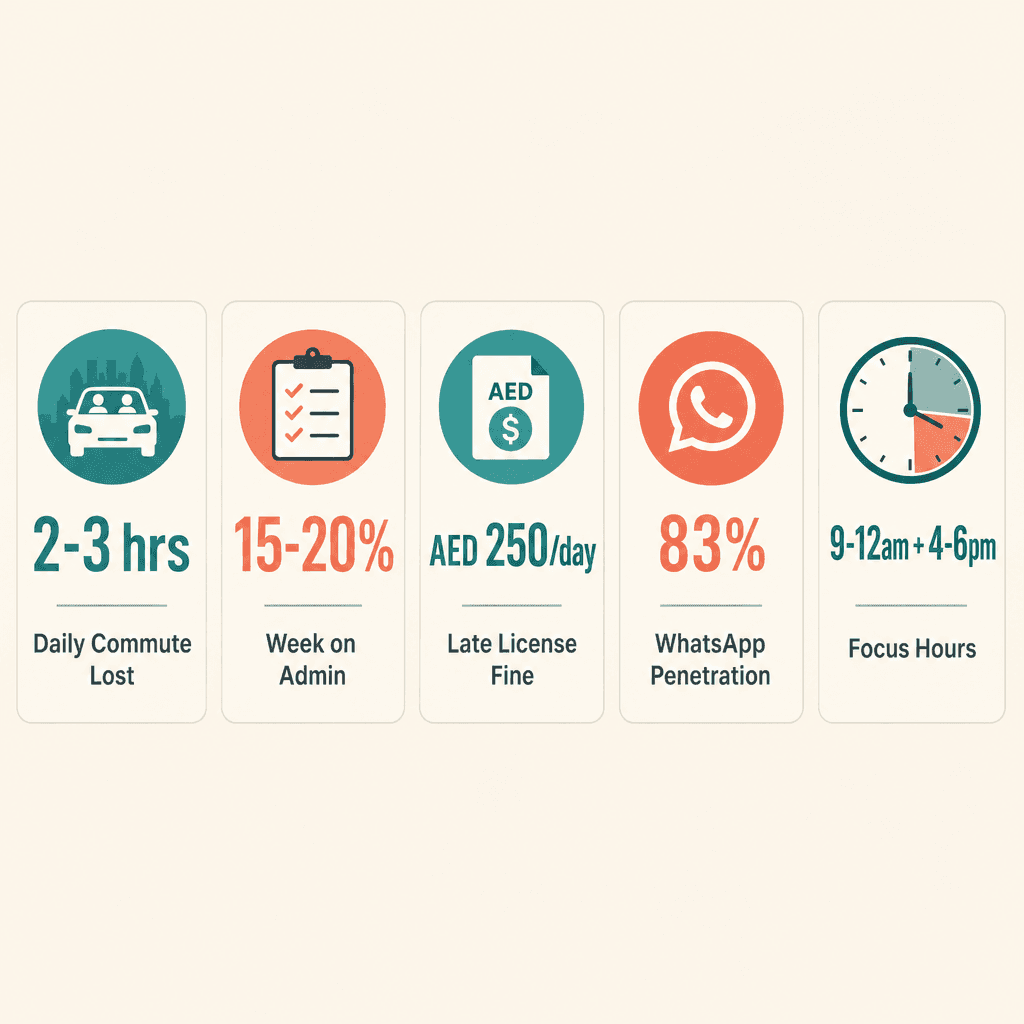
Time management for Dubai entrepreneurs means designing a structured system around the UAE's unique pressures, a 6-day working week in many sectors, daily 2 to 3 hour commutes, face-time relationship culture, and regulatory obligations with DET, GDRFA, and FTA that do not exist in most other markets. Generic productivity advice written for a 9-to-5 Western context does not translate. The Dubai entrepreneur needs a system built around the specific friction points of this city.
Reactive Time Management vs. Structured Time Management for Dubai Entrepreneurs
Feature | Reactive Approach | Structured Dubai Strategy |
|---|---|---|
Government Admin Tasks | ❌ Handled as crises arise, scattered half-days lost across the quarter | Batched into one quarterly Admin Day, 8 to 12 hours recovered per quarter |
Meeting Scheduling | ❌ Meetings booked any day, fragmenting focus across the entire week | Tuesday/Thursday meeting days only, 3 full deep-work days protected |
Compliance Deadlines | ❌ Missed renewals trigger AED 250+/day fines and emergency scrambles | Automated reminders at 30, 14, and 7 days, zero late penalties |
Commute Time | ❌ 36 to 90 minutes each way lost to passive music or radio | Audio learning converts commute into 24+ business books per year |
Client Communication | ❌ 24/7 WhatsApp availability fragments focus across all waking hours | Defined response windows (9 to 12 AM, 4 to 6 PM), 90 minutes of focus recovered daily |
Administrative Support | ❌ Founder handles all admin personally, 5 to 10 hours per week of low-value work | VA hired at AED 2,000 to 4,000/month, 10 to 12 billable hours recovered per week |
Annual Planning | ❌ Planning happens reactively mid-quarter when problems surface | Dedicated planning retreat in late December, full year mapped before January's pace begins |
Why Dubai Creates Unique Time Pressure for Business Owners
The 6-day working week norm across many UAE sectors means entrepreneurs feel genuine pressure to stay available Saturday as well as Sunday through Friday. Face-time matters here. Cancelling a business lunch or a majlis carries reputational cost that simply does not exist in transactional Western markets, relationships are the pipeline, so protecting them competes directly with protecting your schedule.
Traffic between Business Bay, DIFC, and Deira can consume 90 minutes each way during peak hours (TomTom Traffic Index, 2024). A founder running a consultancy in JLT who attends two in-person client meetings daily in different parts of the city can lose 25 to 30% of their working hours to transit alone. That is before a single email is opened.
DET trade license renewals, GDRFA visa applications, and FTA VAT filings all create recurring time obligations
Ejari renewals, medical insurance renewals, and free zone permit renewals add to the compliance calendar
Dubai ranked among the top 10 most congested cities globally in 2024 (TomTom Traffic Index, 2024)
UAE VAT filing cycles are quarterly or monthly depending on annual turnover threshold
The Cost of Unstructured Time in a High-Velocity Market
Dubai moves fast. Deals, partnerships, and competitor moves happen in compressed timeframes, so lost time carries an asymmetric cost here that it does not in slower markets. Without a deliberate structure, the social and administrative demands of the UAE will fill every available hour, and then some.
An e-commerce founder in Dubai South described spending three full days in a single quarter handling trade license-related paperwork reactively. A quarterly admin batch day would have compressed that into one focused session. For broader context on how to run a small business in Dubai, the operational demands are significant, time management is not optional, it is structural. The goal is not efficiency for its own sake. It is protecting the hours that generate revenue.
Ten Time Management Tips for Entrepreneurs in Dubai That Actually Deliver Results
The most effective time management tips for entrepreneurs in Dubai include batching government admin into one quarterly day, protecting morning hours for revenue-generating work, leveraging Ramadan's slower pace for strategic planning, automating compliance reminders, and setting firm WhatsApp communication boundaries to reclaim focus time. Here are the strategies that consistently move the needle for productivity for business owners in the UAE.
Batch Your Government Admin to Reclaim Productive Days
DET license renewals, GDRFA visa applications, FTA VAT filings, and Ejari renewals all run on fixed annual or quarterly cycles. Map every one of them into a master calendar at the start of the year. Then designate one full day per quarter as your Admin Day.
Pre-load a shared document folder with passport copies, Emirates ID scans, and your current trade license
Book government portal appointments in advance so Admin Day does not stall on queue times
Process DET renewals, visa status checks, and VAT preparation in a single block
This single habit can recover 8 to 12 hours per quarter for the average Dubai SME owner
A trading company owner in Dubai South batched her DET renewal, employee visa renewals, and VAT return preparation into one quarterly Admin Day. Her total compliance time dropped from scattered half-days across the quarter to a single focused session. UAE VAT returns are due within 28 days of the end of the tax period, knowing that date in advance is the difference between scheduled action and crisis management.
Protect Morning Hours for Client-Generating Work
Treat the first 2 hours of your working day as non-negotiable. No email, no WhatsApp, no admin. Use that window exclusively for revenue-generating work: proposals, client calls, content creation, or strategic thinking. Dubai's late-evening WhatsApp culture makes mornings the only reliably uninterrupted window available for deep work.
A Dubai-based digital marketing agency founder moved all client outreach and proposal writing to 8 to 10 AM before opening any communication apps. Within 90 days she reported a 40% increase in new business pitches sent per month. Communicate this boundary to your team and clients as a professional norm, not an apology. Most people respect a clear system far more than they resent it.
Batch Meetings Into Specific Days of the Week
Rather than letting meetings colonise every day, designate Tuesday and Thursday as your meeting days. This keeps Sunday and Monday clear for focused output and protects at least three full working days per week for project delivery and strategic tasks. Context switching costs up to 40% of productive time, according to research by the American Psychological Association, batching meetings eliminates most of that cost.
A financial consultant in DIFC implemented a Tuesday/Thursday meeting policy and found that client satisfaction actually increased. She was more prepared and more present in each meeting because she was not context-switching constantly. Frame this to clients as a commitment to giving them your full attention on those days, not as a scheduling restriction.
Strategic Time Tools Every Dubai Entrepreneur Should Implement Now
If you want to know how to manage time as an entrepreneur in Dubai, the answer involves four core tools: a compliance calendar covering all UAE regulatory deadlines, a virtual assistant at under AED 4,000 per month, a co-working focus session routine, and a commute audio-learning habit. Together these productivity tips for Dubai entrepreneurs can recover 10 to 15 hours per week without reducing business output.
Automate Compliance Reminders So Deadlines Never Catch You Off Guard
Build a compliance calendar in Google Calendar or Zoho Calendar with recurring reminders set 30, 14, and 7 days before every UAE regulatory deadline. Key dates to include: trade license renewal, all employee visa expiries (typically 2 to 3 year cycles creating staggered obligations as your team grows), VAT return due dates, medical insurance renewal, Ejari expiry, and any free zone-specific permit renewals.
Zoho business solutions for Dubai South companies offer integrated compliance tracking that connects with your broader business operations calendar. A logistics startup at Dubai South implemented a Zoho-based compliance calendar and eliminated all late renewal penalties, previously a recurring cost of AED 500 to 2,000 per incident. One 15-minute setup session at the start of the year can save hours of stress and real money.
Hire a Virtual Assistant Before You Think You Need One
The UAE has a deep pool of skilled virtual assistants, both locally based and remote, available at AED 2,000 to 4,000 per month for part-time support. The ROI calculation is straightforward: if your billable hour is worth AED 500, a VA handling 10 hours of admin per week pays for itself within the first 4 to 8 hours of recovered time. For a full framework on what to delegate, see outsourcing for startups in the UAE.
Delegate immediately: inbox triage, meeting scheduling, travel bookings, government appointment booking
Also delegate: invoice chasing, social media scheduling, document preparation, and supplier follow-ups
A Dubai-based business consultant hired a part-time VA at AED 3,000 per month to handle all scheduling and document preparation. Within 60 days she had reclaimed 12 billable hours per week, a net gain of over AED 30,000 per month at her billing rate. Hire before burnout forces the decision.
Use Dubai's Co-Working Culture for Deep Focus Sessions
Dubai has one of the highest concentrations of co-working spaces per capita in the Middle East, with flexi desk access typically ranging from AED 150 to 400 per day. Booking a dedicated session away from your office, your phone, and your team creates a psychological and physical boundary that protects deep work in a way that staying at your desk rarely does.
Spaces like A4 Space, Nasab, and the Dubai South Business Hub Free Zone offer professional environments designed for focused output. A SaaS founder based in Dubai Marina books a flexi desk in the DIFC every Monday morning as his CEO thinking time. His company's pivot strategy was written and stress-tested in a single focused session there. Use co-working days for your highest-cognitive tasks: strategy documents, proposals, financial modelling, and content creation.
Use Commute Time for Audio Learning and Strategic Input
Dubai commutes averaging 45 to 90 minutes each way are non-negotiable for many entrepreneurs. The question is whether that time is passive or active. Replace music or radio with business podcasts, audiobooks, and recorded conference sessions relevant to your industry. Use a voice memo app to capture ideas triggered during listening, some of the best strategic insights surface when your hands are on the wheel and your mind is relaxed.
A retail entrepreneur in Dubai reported completing the equivalent of 24 business books per year by listening during her daily commute, an input volume that would be impossible to achieve through traditional reading given her schedule. Dubai residents spend an average of 36 minutes commuting one way during peak hours (TomTom, 2024). That is 72 minutes of daily learning time waiting to be activated.
How to Use the Ramadan Schedule Strategically as a Dubai Entrepreneur
Ramadan's reduced business pace, shorter working hours mandated by UAE law and a slower deal-making environment, makes it the ideal period for deep work, annual strategy reviews, and long-form planning tasks that are impossible to complete during the rest of the year's high-velocity business calendar. Most Dubai entrepreneurs treat Ramadan as a productivity loss. The smart ones treat it as a gift.
Why Ramadan Is the UAE Entrepreneur's Hidden Planning Season
UAE Ministerial Resolution mandates that working hours during Ramadan are reduced by 2 hours per day for all employees (UAE Ministry of Human Resources, 2025, still accurate as of 2026). Client meetings, deal closures, and new business pitches slow significantly as decision-makers observe the month. Business deal velocity in the UAE typically drops 30 to 40% during Ramadan, creating a window that most entrepreneurs waste.
A Dubai-based management consultancy deliberately schedules its annual strategy offsite during the second week of Ramadan each year, using the quieter client pipeline to focus entirely on internal planning. The interruption cost of running that same offsite in October or February would be prohibitive. Ramadan in the current calendar cycle falls in Q1, aligning it naturally with post-New Year review cycles.
Tasks Best Suited to the Ramadan Productivity Window
Annual financial review and budget planning for the next 12 months
Updating your business plan, pitch deck, or investor materials
Completing online certifications, courses, or professional development modules
Writing SOPs (standard operating procedures) for your team that you have been deferring
Reviewing and renegotiating supplier contracts and service agreements
An events management company owner in Dubai uses Ramadan exclusively to write the following year's marketing calendar, redesign client proposals, and complete two online courses. Those same tasks would take months to complete during the rest of the year's event-season pace. Time management for UAE business owners means treating every calendar cycle, including religious ones, as a strategic resource.
Managing Communication Boundaries and Annual Planning as a Dubai Business Owner
Dubai's always-on WhatsApp business culture and the absence of a designated annual planning ritual are two of the biggest hidden time drains for entrepreneurs. Learning how to manage time as an entrepreneur in Dubai means actively designing your communication system and your planning calendar, not just reacting to both. These productivity tips for Dubai business owners are among the highest-ROI changes you can make.
Set Clear Client Communication Boundaries in a WhatsApp-First Market
UAE business culture runs heavily on WhatsApp. Clients expect fast responses and many send messages late at night or on weekends as a matter of course. Without active management, this creates an always-on availability expectation that fragments your focus across every waking hour. Constant connectivity interruptions reduce deep work capacity by up to 40%.
Set defined response windows, for example, 9 AM to 12 PM and 4 PM to 6 PM, and communicate them proactively to clients as a quality-of-service commitment, not an excuse. Use WhatsApp Business's automated away messages and label system to manage expectations during off-hours. Mute non-urgent group chats and designate one daily review window for catching up on group communications.
A property consultant in Dubai implemented a WhatsApp response policy communicated to all clients at onboarding: responses within 4 business hours, Monday to Saturday. Client complaints dropped and her focus time increased by an estimated 90 minutes per day. Most UAE clients respect a well-communicated boundary far more than they resent an inconsistent availability pattern. For more on how to run a small business in Dubai, operational systems like this are foundational.
Run an Annual Planning Retreat Before the Dubai Business Year Takes Over
January in Dubai is peak business season. GITEX-era follow-ups, post-holiday deal rushes, and the first-quarter event calendar mean the year accelerates immediately. If you have not planned before January begins, you will not plan at all, you will just react.
Book a dedicated half-day or full-day planning retreat in the last week of December or the first week of January. Do it away from your office: a hotel business lounge, a co-working space, or a coffee shop you do not normally visit creates the cognitive separation needed for strategic thinking. Agenda: review prior year financials, set 3 annual goals, map quarterly milestones, review your team structure, and identify the single constraint holding your business back.
A Dubai South-based import-export entrepreneur holds his annual planning day at a hotel in Downtown Dubai each January 2nd. He has done it for three consecutive years and credits the ritual with enabling him to triple revenue over that period by identifying his single biggest bottleneck each year and solving it before Q1 ended. That is a repeatable, specific, and transferable practice.
Citations
Federal Tax Authority.. tax.gov.ae. FTA UAE, 2023.
Dubai Economy and Tourism.. dubaidet.gov.ae. DET Dubai, 2024.
UAE Ministry of Economy and Tourism.. moet.gov.ae. MOET UAE, 2024.
General Directorate of Residency and Foreigners Affairs Dubai.. gdrfad.gov.ae. GDRFA Dubai, 2024.
UAE Cabinet.. uaecabinet.ae. UAE Cabinet, 2023.
Frequently Asked Questions