
Topic Summary
Amazon.ae: Massive Reach, Higher Fees
Amazon.ae dominates UAE market share and gives sellers access to over 5 million active monthly shoppers plus FBA warehousing in Dubai. Referral fees run 5–15% per category, and a valid UAE trade license is required before you can open a seller account.
Noon: Strong GCC Audience, Comparable Costs
Noon is the Gulf-founded rival with particularly strong traction among Saudi and Emirati shoppers in electronics, fashion, and grocery. Commission rates of 5–12% are similar to Amazon, and the same trade license requirement applies from day one.
Shopify: Best Margin Control for Independent Sellers
Shopify plans start from USD 39 per month with no revenue share, making it far cheaper than marketplace commissions at scale. You'll pay third-party payment gateway fees of roughly 2–3% since Shopify Payments isn't yet available in the UAE, but you retain full ownership of customer data.
WooCommerce and Magento: Flexible but Technical
WooCommerce is free to install but requires hosting, plugin management, and ongoing developer time, while Magento suits high-volume operations with complex catalogues at implementation costs that can reach six figures in AED. Both options demand more technical investment than hosted platforms like Shopify.
Niche Platforms: Namshi and Carrefour UAE
Namshi focuses on fashion and lifestyle but has selective brand approval, making it better suited to established labels than new entrants. Carrefour UAE Marketplace is expanding its third-party seller program and offers strong reach for consumer goods categories.
Licensing and VAT Obligations Apply Everywhere
Regardless of platform, every UAE seller needs a valid trade license before onboarding, with a DSBH free zone e-commerce license starting from AED 12,500. Once annual turnover exceeds AED 375,000, VAT registration with the Federal Tax Authority becomes mandatory and no marketplace will handle that on your behalf.
Platform Choice Shapes Your Entire Business Structure
The platform you sell on directly affects your fee structure, fulfilment obligations, and the type of trade license you need from day one. First-time founders who overlook this decision often face costly restructuring once they hit growth milestones like the AED 375,000 VAT threshold or the 9% corporate tax trigger.
In 2026, UAE e-commerce revenue is projected to surpass USD 9.2 billion, making the Emirates one of the fastest-growing online retail markets in the Middle East (Statista, 2024). The UAE's internet penetration sits at 99% of the population (u.ae, 2024). Amazon.ae charges referral fees of 5-15% per category. Noon's commission rates run 5-12%. A DSBH free zone e-commerce license starts from AED 12,500. VAT registration is mandatory once turnover hits AED 375,000 in any 12-month period. And corporate tax at 9% applies to taxable income above AED 375,000 for financial years starting on or after 1 June 2023 (Ministry of Finance, 2023).
Yet most first-time founders who plan to start a business in Dubai underestimate one decision that shapes every other: which platform they sell on and how that choice interacts with their trade license, VAT obligations, and visa structure. This guide compares the top e-commerce platforms in the UAE across cost, scope, seller requirements, and licensing fit, then gives you a clear recommendation by founder scenario so you can pick the right setup before you spend a dirham.
What Are the Top E-commerce Platforms in the UAE
The top e-commerce platforms in the UAE include Amazon.ae, Noon, Carrefour UAE, Namshi, and independent Shopify or WooCommerce stores. Each operates differently: marketplaces let you list under their brand, while independent stores give you full control of the customer relationship, pricing, and data. The platform you choose isn't just a sales channel, it directly affects your fee structure, fulfilment obligations, and the type of trade license you need from day one.
Marketplace Platforms: Amazon.ae and Noon
Amazon.ae dominates UAE market share and gives sellers access to Fulfillment by Amazon (FBA) warehousing in Dubai. The trade-off is referral fees of 5-15% per category, plus FBA fulfilment fees on top. A Dubai-based electronics reseller listing on both Amazon.ae and Noon can reach over 5 million active monthly shoppers without running any paid advertising in the first 90 days, that's the genuine draw of marketplace reach.
Noon is the Gulf-founded rival with strong traction in electronics, fashion, and grocery. Its audience skews more Saudi and Emirati than Amazon's, which matters if you're targeting GCC buyers. Commission rates are comparable to Amazon at 5-12% by category.
Both platforms share one hard requirement: a valid UAE trade license before onboarding. No license means no seller account. And once your turnover exceeds AED 375,000 annually, VAT registration with the Federal Tax Authority becomes mandatory, the marketplace won't handle that for you.
Independent Storefronts: Shopify, WooCommerce, and Magento
Shopify is the most common independent store builder for UAE founders. Monthly plans start from USD 39 with zero revenue share on sales, your margin stays yours. Shopify Payments isn't yet available in the UAE, so you'll pay third-party payment gateway fees of roughly 2-3%, but that's still far less than marketplace commissions at scale.
WooCommerce is free to install on WordPress, but it requires hosting (from USD 10/month), plugin management, and developer time. Magento suits high-volume operations with complex catalogues; implementation costs can reach six figures in AED. The real advantage of independent stores? Full ownership of customer data and a branded checkout, both critical for repeat-purchase brands.
A Dubai-based skincare brand launched on Shopify in 2024, avoided marketplace fees entirely, and scaled to AED 500,000 monthly revenue within 18 months through direct email marketing to its own customer list. That's the compounding value of owning your customer relationship.
Niche and Vertical Platforms: Namshi, Carrefour UAE, and noon Food
Namshi: Fashion and lifestyle focus; brand approval is selective. Suits established fashion labels more than new entrants.
Carrefour UAE Marketplace: Expanding into third-party sellers; strong for FMCG and household categories.
noon Food and Talabat: Food-delivery verticals requiring an additional food handling permit from Dubai Municipality or the equivalent emirate authority, on top of your trade license.
Conversion vs. reach: Niche platforms drive higher conversion in their category but limit your total addressable audience.
Worth flagging: under ISIC Rev.4 Section G (Wholesale and Retail Trade), e-commerce is classified by the type of goods or services sold, not the sales channel. A trading license in Dubai covers the commercial activity; the platform is simply the distribution channel.
Top E-commerce Platforms in the UAE: Cost, Scope, and License Fit Compared
Platform | Fee Model | Audience Fit | License Requirement | Fulfilment | Best For |
|---|---|---|---|---|---|
Amazon.ae | AED 40/month (pro) + 5-15% referral fee | Electronics, household, health | UAE trade license required | FBA available | Market testers and volume sellers |
Noon | Free registration + 5-12% commission | Fashion, electronics, grocery | UAE trade license required | Noon Express available | UAE and KSA audience reach |
Shopify | USD 39-399/month; 0% revenue share | Any category | UAE trade license required | Self-arranged 3PL | Brand builders wanting full margin control |
WooCommerce | Hosting from USD 10/month + gateway fees 2-3% | Any category | UAE trade license required | Self-arranged | Tech-comfortable founders on tight budgets |
Namshi | Commission-based (UNVERIFIED: <rate>), confirm before publishing | Fashion and lifestyle only | UAE trade license + brand approval | Namshi-managed | Established fashion labels |
Carrefour UAE Marketplace | Commission-based (UNVERIFIED: <rate>), confirm before publishing | FMCG, household | UAE trade license required | Carrefour-managed | FMCG and household brands |
Platform-by-Platform Cost and Scope Comparison
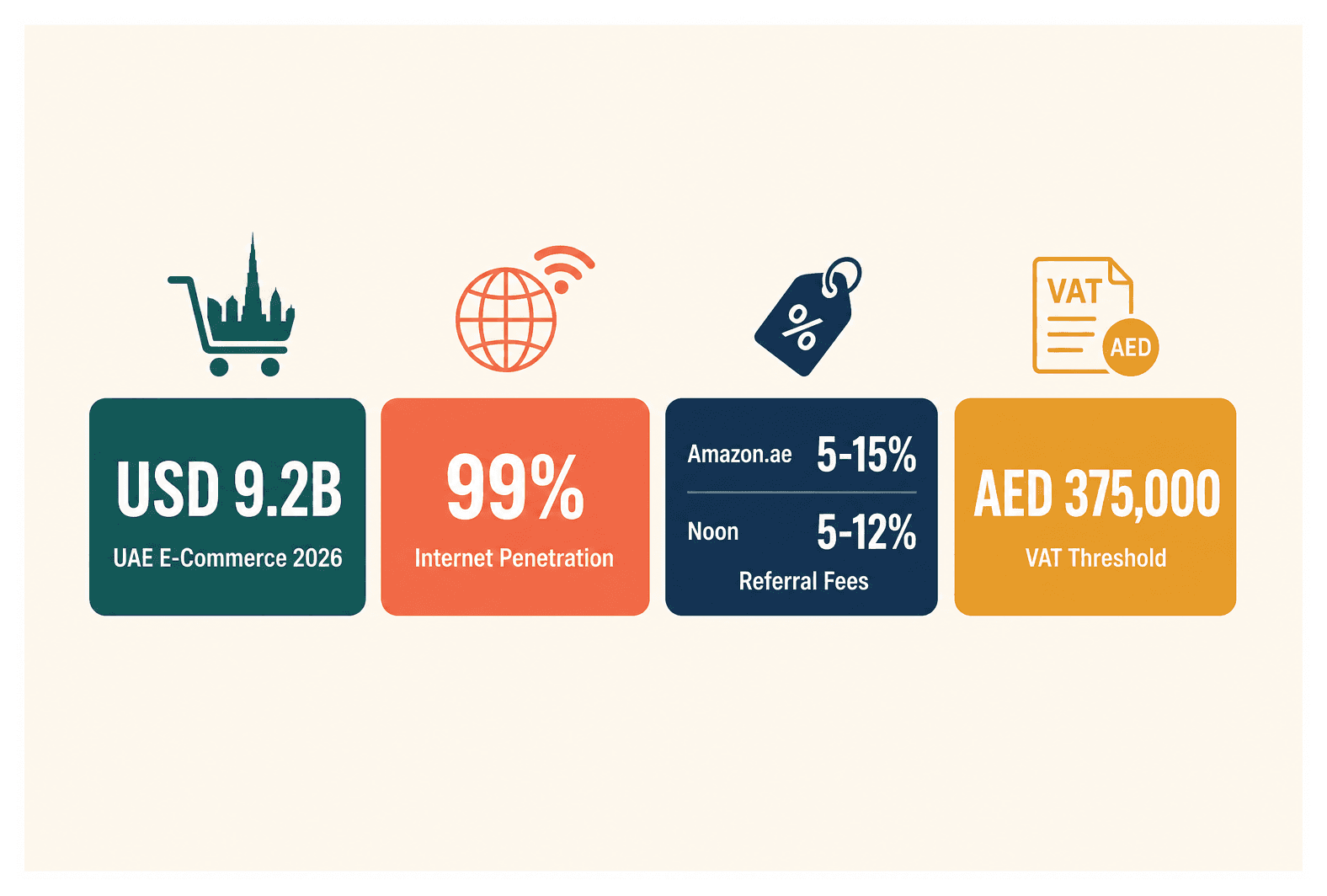
UAE e-commerce platform costs range from zero upfront on Amazon.ae and Noon (fee per sale) to USD 39 per month on Shopify with no revenue share. Marketplace platforms charge 5-15% referral fees. Independent stores carry hosting and development costs but give full margin control and customer data ownership. The right choice depends on how quickly you want to reach buyers versus how much of your margin you're willing to share to get there.
Fee Structures Side by Side
Amazon.ae: No monthly fee on the individual plan; AED 40/month on the professional plan; referral fees 5-15% by category; FBA fulfilment fees charged separately per unit stored and shipped.
Noon: Free seller registration; commission rates 5-12% by category; Noon Express fulfilment available at additional cost.
Shopify: USD 39-399/month depending on plan; 0% transaction fee if using Shopify Payments (not yet available in UAE); third-party payment gateway fees typically 2-3%.
WooCommerce: Hosting from USD 10/month; payment gateway fees 2-3%; developer costs variable and potentially significant.
In practice, a seller moving AED 50,000/month in goods on Amazon.ae at a 10% average referral fee pays AED 5,000 per month to the platform. The same seller on Shopify pays USD 39 plus gateway fees, roughly AED 200 total. The gap compounds fast as revenue grows.
Visa and License Impact by Platform Choice
Here's something many first-time founders miss: the platform you choose doesn't sponsor your visa. That's always your trade license doing that work. Every platform requires a valid UAE trade license before activating your seller account.
A DSBH free zone e-commerce license starts from AED 12,500.
First-year all-in cost for a sole founder with one visa starts from AED 18,350.
Visas are always an additional cost on top of the license, they are never included in the base package.
If you plan to hire staff or bring dependants, factor in additional visa costs before choosing a lean license package.
You can check your exact business setup cost in Dubai using the DSBH cost calculator before committing to any package. One more thing worth flagging: DSBH does not provide bonded warehousing or customs integration. Goods entering the UAE mainland market from a free zone are duty-suspended, not duty-exempt, customs duties apply at the point of mainland entry.
VAT, Corporate Tax, and Customs Rules Every UAE Online Seller Must Know
UAE VAT is 5% and applies once annual turnover exceeds AED 375,000. Corporate tax at 9% applies to taxable income above AED 375,000 for financial years starting on or after 1 June 2023. Late registration for either carries a one-time AED 10,000 penalty. Free zone goods are duty-suspended, not duty-exempt, a distinction that matters the moment your stock crosses into the mainland market.
VAT Obligations for Online Sellers
Register for VAT with the Federal Tax Authority once taxable turnover hits AED 375,000 in any 12-month period.
VAT applies to goods and services sold to UAE customers, including cross-border digital services.
Amazon.ae and Noon do not collect VAT on your behalf, that obligation stays with you as the seller.
VAT late registration penalty: AED 10,000.
Corporate Tax and Qualifying Free Zone Status
The UAE corporate tax rate is 9% on taxable income above AED 375,000 for financial years starting on or after 1 June 2023 (Ministry of Finance, 2023). A Qualifying Free Zone Person (QFZP) can access a 0% rate, but only if all four conditions below are satisfied independently:
Maintains adequate economic substance in a free zone.
Derives income from qualifying activities as defined under the Corporate Tax Law.
Meets the de minimis non-qualifying revenue threshold.
Satisfies the transfer pricing conditions under the relevant regulations.
Not all free zone companies automatically qualify. Each condition must be met on its own terms. And the corporate tax late registration penalty is a one-time flat AED 10,000, not a recurring monthly charge. Budget for it upfront rather than discovering it later.
How to Choose the Right Platform: A Step-by-Step Decision Guide
Choose your UAE e-commerce platform by working through five decisions in order: product category fit, fulfilment capability, fee tolerance, brand control priority, and license compatibility. Founders who skip the license step first often find their preferred platform rejects their seller application at onboarding, a frustrating and avoidable delay.
Step 1: Match Platform to Product Category
Amazon.ae: Strongest for electronics, books, household, and health products.
Noon: Strong in fashion, electronics, and grocery; UAE and KSA audience.
Namshi: Fashion and lifestyle only; requires brand approval, not suitable for new entrants without an established label.
Shopify or WooCommerce: Any category; no platform gatekeeping on what you sell.
Step 2: Assess Fulfilment and Warehousing Options
Amazon FBA gives access to Prime-eligible two-day delivery; fees apply per unit stored and per unit shipped.
Noon Express offers similar fulfilment from Noon's Dubai warehouse at comparable cost.
Shopify and WooCommerce require you to arrange your own third-party logistics (3PL) provider or dropshipping model.
Free zone licenses do not automatically grant access to bonded warehousing; DSBH does not provide bonded warehousing or customs integration.
Step 3: Confirm License and Regulatory Fit
Every platform requires a valid UAE trade license before activating a seller account. A DSBH e-commerce license is issued in one business day with zero paid-up share capital required. You can review the full list of business activities in Dubai before applying to confirm your planned activities are covered.
For regulated categories (health supplements, medical devices, food), DSBH licenses the commercial activity and the named regulator, Ministry of Health and Prevention (MOHAP), Dubai Municipality, or equivalent, approves it separately.
Each activity beyond the first five costs AED 2,000 at DSBH; confirm your full activity list before submitting.
Is a free zone license enough to sell on Amazon.ae?
Yes. A valid UAE free zone trade license, including a DSBH e-commerce license, satisfies Amazon.ae's seller registration requirement. The license must be current and cover the relevant trading activity. Amazon does not require a mainland license specifically, but it does verify that your license is active before approving your seller account.
Which License Structure Suits Your E-commerce Model
Dubai South Business Hub Free Zone licenses start from AED 12,500. Founders building an independent brand store need a broader trading or e-commerce license from AED 12,500. Sellers in regulated categories need the relevant regulator approval on top of any trade license. The top e-commerce platforms in the UAE all require the same starting point: a valid license in hand before you list a single product.
Scenario A: Marketplace-Only Seller (Amazon.ae or Noon)
A sole founder importing home décor from Europe and listing on Amazon.ae can be fully licensed and operational within two business days using a DSBH B2C e-commerce license. That's a genuinely fast market entry, zero paid-up share capital, one business day for license issuance, and a UAE residency visa available as part of the same structure.
Dubai South Business Hub Free Zone licenses start from AED 12,500.
First-year all-in cost for a sole founder with one visa: from AED 18,350.
License issued in one business day; zero paid-up share capital required.
Ideal for founders testing the UAE market before committing to an independent store build.
Scenario B: Independent Store Founder (Shopify or WooCommerce)
A standard DSBH e-commerce or trading license from AED 12,500 covers operating an independent online store.
If you're also offering software, SaaS, or advertising services alongside product sales, add an ICT license activity in Dubai; each activity beyond the first five costs AED 2,000.
An independent store paired with a free zone license gives you full brand ownership and direct customer relationships, no marketplace fee drag on your margin.
Scenario C: Multi-Channel Seller (Marketplace Plus Own Store)
A single DSBH license can cover both marketplace selling and an independent store, no second license needed if all activities sit within the approved list.
Review your full business activities list before applying to avoid paying AED 2,000
References
Frequently Asked Questions