
Topic Summary
Understand What a Trade License Activity Actually Is
A trade license activity is a formally approved description of every revenue-generating action your company is legally permitted to take. Operating outside your listed activities is a compliance breach that can trigger fines, license suspension, or visa cancellation.
Treat the Activity List as a Binding Legal Schedule
Issuing authorities compare your actual operations against listed activities during inspections and renewal checks. Banks also review the list when assessing business account applications, and mismatches are a common cause of rejections.
Know the Real Cost of Getting Activities Wrong
Listing the wrong activities forces a full application restart, delaying operations before you earn a single dirham. Both VAT and corporate tax late registration each carry a flat AED 10,000 penalty, costs that are entirely avoidable with the right setup.
Learn How Dubai Codes Map to ISIC Standards
Dubai activity codes are derived from ISIC Rev.4, the UN's four-level international classification system covering all economic activity across 21 top-level sections. Understanding the parent ISIC category helps you determine whether a new service you want to offer already falls under a code you hold.
Remember That E-Commerce Is Not a Standalone Category
Units selling via the internet are classified by the goods or services they sell, not by the channel they use. This means your activity codes must reflect what you sell, not simply the fact that you sell it online.
Spot Which Activities Require a Separate Approval Step
Certain regulated activities require approval from a government body beyond the license-issuing authority before you can operate. Identifying these early in your application prevents unexpected delays after your license is issued.
Plan Ahead for Adding or Removing Activities Later
Activity amendments are possible once your company is running, but each change carries a processing fee and can affect your bank account, visa eligibility, and tax obligations. Getting the list right at the start is significantly cheaper than correcting it later.
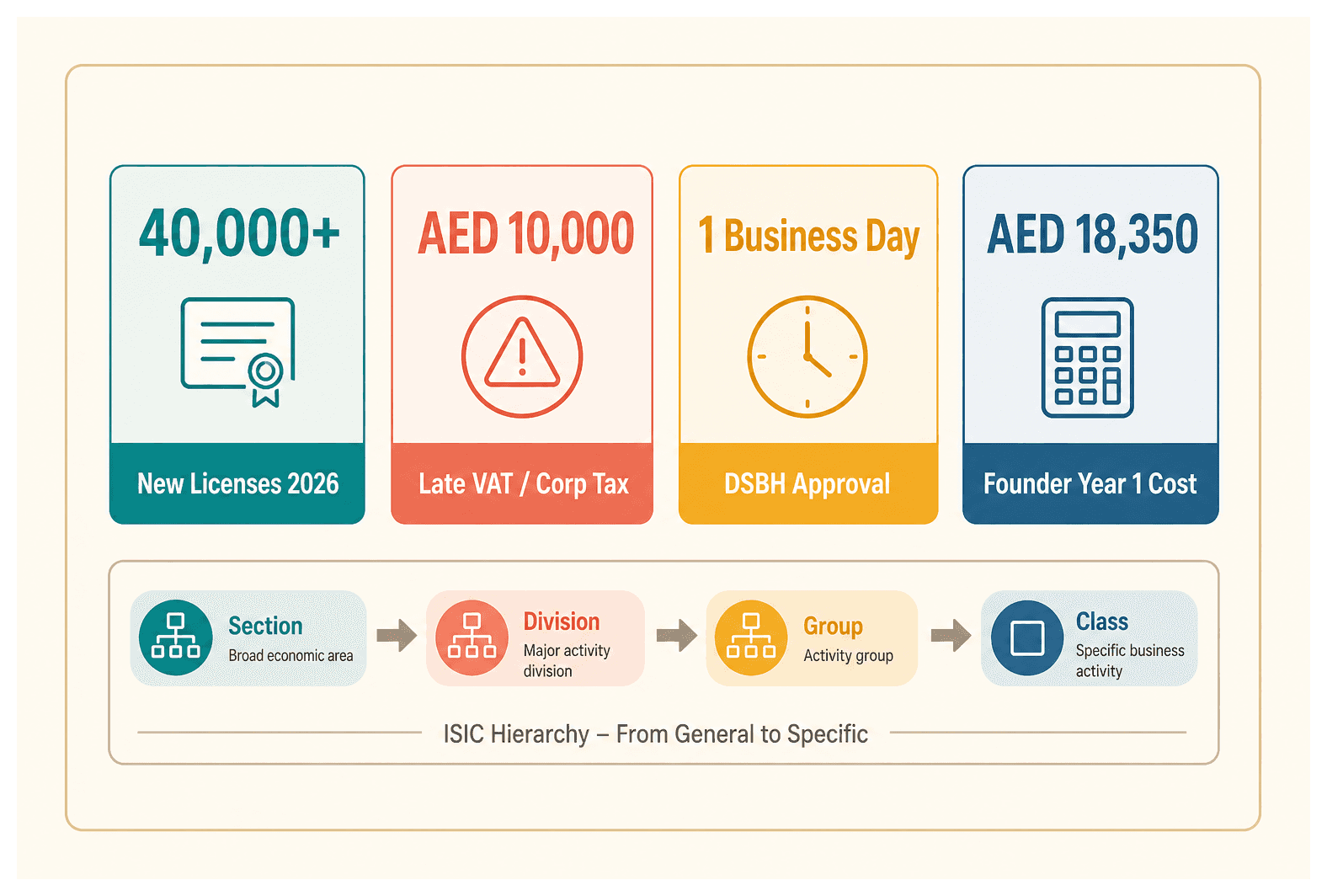
In 2026, more than 40,000 new business licenses are expected to be issued across Dubai's free zones and mainland jurisdiction. Yet a significant share of first-time founders submit applications listing the wrong activities, a mistake that forces a restart, delays operations, and adds avoidable cost before the business earns a single dirham. The VAT late registration penalty alone is AED 10,000 (Federal Tax Authority, 2026). Corporate tax late registration carries the same AED 10,000 one-time flat penalty. Dubai South Business Hub (DSBH) issues licenses in one business day once documents are approved. Licenses start from AED 12,500. First-year cost for a sole founder with one visa starts from AED 18,350. Zero paid-up share capital is required.
This guide explains exactly what a trade license activity dubai is, how the activity list is structured, how to read the codes and categories on your license document, what regulated activities require a separate approval step, and how to add or remove activities once your company is running, so you get it right the first time.
What Is a Trade License Activity Dubai and Why It Controls Everything
A trade license activity dubai is a formally approved description of what your company is legally permitted to do. Every revenue-generating action your business takes must match an activity listed on your license. Operating outside those listed activities is a compliance breach that can result in fines, license suspension, or visa cancellation. This is not a technicality, it is the legal boundary of your entire operation.
The Legal Weight Behind the Activity List
Your license activity list is a legally binding schedule, not a general description of your business. The issuing authority, whether a free zone or DET (Dubai's Department of Economy and Tourism) for mainland companies, compares your actual operations against listed activities during inspections and renewal checks. Banks review the activity list when assessing your business bank account application, and mismatches cause rejections. Corporate tax and VAT registration obligations can also differ depending on which activities are listed.
VAT late registration penalty: AED 10,000 (Federal Tax Authority, 2026)
Corporate tax late registration penalty: AED 10,000 one-time flat penalty
A founder who lists "Management Consultancy" but invoices for "Software Development" services is operating outside their licensed scope, even if the invoice amount is small
Mismatches flagged at renewal can delay visa renewals for every employee on the license
How Activities Map to International Classification Standards
Dubai activity codes are derived from ISIC Rev.4, the UN's International Standard Industrial Classification of All Economic Activities, approved by the UN Statistical Commission in March 2006 (UN Statistics Division, 2006). ISIC uses a four-level hierarchy: Sections (letter), Divisions (2-digit), Groups (3-digit), and Classes (4-digit). Free zone activity lists reflect this logic using their own internal code numbers, while mainland DET codes follow a parallel but distinct numbering scheme.
Understanding the ISIC parent category helps you identify whether a new service you want to offer already falls under a code you hold or requires a separate addition. There are 21 top-level ISIC sections covering all economic activity. Worth noting: e-commerce is not a standalone ISIC category. Units selling via the internet are classified by the goods or services they sell, not the channel they use to sell them.
For example, ISIC Section J covers Information and Communication. An ICT license dubai holder whose activity codes sit in this section can invoice for software, data services, and digital publishing without needing a separate trading code, because all three fall within the same ISIC division.
How to Read the Activity List on Your Trade License Document
A trade license document lists each approved activity as a code and a plain-language description. Read the description column, not just the code. Each line is a separate permission. If a service you plan to invoice for does not appear word-for-word or as a clear subset of a listed description, you are not yet licensed to perform it. The code is a reference identifier; the description is the operative legal text.
The Three Columns That Matter on Every License
Activity code: the numeric identifier assigned by the issuing authority, traceable to the ISIC hierarchy
Activity description: the plain-language name that defines your legal permission, this is what governs your operations
Activity type: usually classified as Commercial, Professional, Industrial, or Tourism, this affects which physical space requirements and regulatory approvals apply
Some licenses also show a "group" or "category" header grouping related activities under a broader ISIC division. On a Dubai South Business Hub license, for instance, a founder might see code 6201 with description "Computer Programming Activities" under activity type "Professional", meaning they can invoice for bespoke software builds but cannot resell packaged software without adding a separate trading license dubai activity.
Common Misreading Mistakes and How to Avoid Them
Assuming a broad category title covers all sub-activities, it does not; each sub-activity needs its own line on the license
Confusing "General Trading" with unlimited trading rights, general trading licenses specify permitted commodity groups and exclude regulated goods entirely
Reading only the code number and ignoring the description text, descriptions govern; codes are reference identifiers only
Overlooking the activity type column, which determines whether a physical office, warehouse, or production facility is mandatory
A practical example: a founder holding a "Wholesale of Food Products" activity who begins selling cosmetics is operating unlicensed for that product line, even though both sit under commercial trading in general terms. The description is specific; the permission is specific.
Does the activity type affect my visa quota?
Yes. Your activity type influences the visa allocation associated with your license. Industrial activities typically require a physical production facility, which affects the space-to-visa ratio applied by the free zone authority. Professional activities under a desk or flexi-desk arrangement carry a different quota structure. Confirm your visa needs against your activity type before submitting.
Regulated Activities: When Your License Alone Is Not Enough
Certain trade license activities in Dubai require a secondary approval from a named government regulator in addition to the license itself. The free zone or DET licenses the activity; the regulator independently approves your right to practise it. Both approvals must be in place before you operate. Skipping the regulatory step is a breach regardless of your license status.
Which Regulators Cover Which Activity Types
Healthcare activities: Dubai South Business Hub licenses the activity; the Dubai Health Authority (DHA) approves the practice separately, a wellness clinic at Dubai South must hold both the DSBH trade license and a DHA facility license before seeing a single patient
Education and training activities: DSBH licenses the activity; the Knowledge and Human Development Authority (KHDA) approves the programme or institution separately
Financial services activities: DSBH licenses the activity; the Central Bank of UAE or the Securities and Commodities Authority (SCA), depending on the service, approves the firm separately
Always identify the named regulator for your specific activity before submitting your license application, approval timelines vary significantly between regulators and can add weeks to your launch schedule
For a healthcare license dubai holder, neither the DSBH document alone nor the DHA license alone is sufficient. You need both. The same logic applies to education license dubai holders awaiting KHDA programme approval.
How to Check Whether Your Chosen Activity Is Regulated
Review the activity description on the issuing authority's published activity list, regulated activities are usually flagged with a "NOC required" or "external approval required" notation
Search the named regulator's website for licensing requirements specific to your activity code before committing to that activity
Ask your formation consultant to confirm both the free zone approval path and the regulatory approval path upfront
Budget for regulatory approval fees separately, they are not included in the free zone license fee and can vary considerably by sector
How to Select and Add Trade License Activities at Dubai South Business Hub
At Dubai South Business Hub Free Zone, you select activities from a published list during the application process. The first five activities are included in the license fee, which starts from AED 12,500. Each activity added beyond five costs AED 2,000. You can add activities after incorporation by submitting an amendment request. The license can be issued in one business day once documents are approved.
Step-by-Step: Choosing Activities Before You Apply
List every service or product you plan to invoice for in the next 12 months, include everything, even occasional revenue streams
Search the business activities list at Dubai South Business Hub and match each service to the closest approved description
Check the activity type column, confirm whether each activity is Professional, Commercial, or Industrial, as this affects your space requirements
Flag any activity marked as requiring external regulatory approval and open a separate track for that regulator before you submit
Count your total activities, the first five are covered within the license fee; plan AED 2,000 per activity beyond five
Here's a real-world example. A founder launching a digital marketing agency lists: Digital Marketing Services, Social Media Management, Content Creation, SEO Consultancy, and Email Marketing, five activities, all within the base license fee starting from AED 12,500. Their first-year cost as a sole founder with one visa starts from AED 18,350. Zero paid-up share capital is required. DSBH launched in September 2025, making it one of Dubai's newest free zone options for founders.
Trade License Activity Types: Key Differences
Feature | Professional Activity | Commercial Activity |
|---|---|---|
Nature of business | Knowledge and advisory services, revenue comes from expertise, not goods | Buying and selling physical goods, revenue comes from trade margins |
Inventory requirement | None, no stock or storage needed | May require warehouse or storage space depending on goods volume |
Typical regulatory NOC | Less common, most advisory activities approve without a third-party NOC | May apply for regulated goods (food, chemicals, medical devices) |
Physical space | Flexible desk or virtual office typically sufficient | May require physical premises or storage depending on commodity |
Common examples | Consultancy, IT development, UX design, financial advisory | Import, export, distribution, wholesale, retail |
Adding or Removing Activities After Your License Is Issued
Submit an activity amendment request to Dubai South Business Hub, this is a formal license modification, not an informal update
Provide a brief written justification for the new activity and confirm it does not require a regulatory NOC before submitting the amendment
The AED 2,000 per-activity fee applies to each new activity added beyond your first five across the life of the license, not just at inception
Removing an activity does not generate a refund but keeps your license cleaner for bank and visa processing purposes
Visas tied to your license are unaffected by activity amendments unless the amendment triggers a new regulatory review
Visas are always an additional cost, they are never included in the license fee
Activity Categories You Will See on a Dubai Free Zone License
Dubai free zone licenses group activities into four main categories: Professional (knowledge and advisory services), Commercial (buying and selling goods), Industrial (manufacturing and processing), and Tourism (hospitality and travel services). Each category carries different space, capital, and regulatory requirements. Most first-time founders operating service businesses will fall under the Professional category, and that's where the licensing process tends to move fastest.
Professional Activities: Knowledge and Advisory Services
A professional license dubai covers consultancy, technology, creative, legal advisory, accounting, and similar knowledge-based services. There's no requirement to hold physical inventory or a warehouse. Regulatory NOC requirements are less common for professional activities, which typically makes them the fastest activity type to approve. A management consultant, a UX designer, and a financial analyst would all hold Professional activity codes, their revenue comes from expertise, not goods.
This is the most common starting point for solo founders and small teams setting up in Dubai. If you're invoicing for time, advice, or digital deliverables, Professional is almost certainly your category.
Commercial and Industrial Activities: Goods-Based Operations
Commercial activities cover import, export, distribution, and retail of physical goods, a trading license dubai falls in this category
Industrial activities cover manufacturing, assembly, processing, and packaging, typically requiring a physical production facility
Both categories may require additional approvals from Dubai Municipality or sector-specific authorities depending on the goods involved
Founders combining goods sales with advisory services should list both a Commercial and a Professional activity, they are not mutually exclusive on a single license
A practical example: a founder importing and reselling fitness equipment holds a Commercial activity. If they also offer personal training consultancy, they add a Professional activity on the same license. Both can coexist. The key is making sure every revenue stream has a matching activity description before the first invoice goes out.
Tax and Banking Implications of Your Activity List
Your trade license activity list directly affects corporate tax classification, VAT registration obligations, and bank account approval. Banks match your stated business purpose against your listed activities. The Federal Tax Authority uses your activities to determine VAT applicability. Listing activities accurately at the outset prevents costly amendments, penalties, and account freezes later.
Corporate Tax and VAT: What Your Activities Signal
UAE corporate tax applies at 9% on taxable income above AED 375,000, your activity list determines whether your entity can qualify for Qualifying Free Zone Person (QFZP) status, which requires meeting four specific conditions including deriving income from qualifying activities
VAT registration is mandatory once taxable supplies exceed AED 375,000 annually, your activity list defines which supplies are taxable, zero-rated, or exempt
Mismatches between your invoiced services and your licensed activities can trigger FTA scrutiny during a VAT audit
Never describe your free zone status as tax-free, corporate tax obligations depend on QFZP qualification, not free zone location alone
The late registration penalties are identical for both taxes: AED 10,000 for VAT and AED 10,000 (one-time flat penalty) for corporate tax (Federal Tax Authority, 2026). Getting your activity list right from day one is far cheaper than correcting it under FTA scrutiny.
Why Banks Scrutinise Your Activity List
UAE banks are required under Anti-Money Laundering (AML) regulations to verify that your banking activity matches your licensed business purpose. Receiving payments for services not listed on your license raises compliance flags and can result in account restrictions. When applying for a bank account opening in UAE, present your license with the activity list clearly visible, the relationship manager will cross-reference it against your stated business purpose.
Adding a new activity to your license before expanding into a new revenue stream protects both your banking relationship and your compliance record. It's a AED 2,000 amendment that can prevent a far more disruptive account freeze.
Can I invoice in a currency other than AED if my activity list is correct?
Yes. Your trade license activity list governs what you can invoice for, not the currency you use. UAE free zone companies routinely invoice in USD, GBP, EUR, and other currencies. The key requirement is that the service or product on the invoice matches a listed activity description on your license, regardless of the currency denomination.
Five Numbered Rules for Getting Your Trade License Activity Dubai Right
Getting your trade license activity dubai right means listing every revenue source, checking for regulatory approvals, confirming activity types, staying within your licensed scope when invoicing, and reviewing your list at each renewal. These five rules prevent the most common compliance failures that delay operations and add cost for first-time founders in Dubai.
The Five Rules Every Founder Should Follow
List every revenue stream you plan to invoice for before you apply. Do not assume you can add activities quietly later without a
References
Frequently Asked Questions