Topic Summary
Trade License Creates a Separate Legal Entity
A trade license is issued to a registered company, not an individual, giving it the right to sign contracts, open corporate bank accounts, and pitch to government procurement teams. A freelance permit only authorizes a named individual, meaning all contracts are signed in your personal name.
Freelance Permits Lock You to One Activity
A freelance permit covers a single pre-approved activity, while a DSBH trade license includes up to five activities from day one, with additional activities available for AED 2,000 each. This makes the trade license far more flexible if your business spans multiple service lines.
Trade License Costs Start From AED 12,500
A DSBH free zone trade license starts from AED 12,500 and can be issued in one business day with zero paid-up share capital required. The all-in first-year cost including one investor visa starts from AED 18,350.
Visa Capacity Differs Significantly Between Structures
A freelance permit typically supports only a single self-sponsored visa with no employee visa quota, making it impossible to hire even a part-time assistant. A trade license through a free zone like DSBH opens the door to multiple employee visas as your team grows.
Hiring Staff Requires a Trade License
If you plan to employ staff, subcontract work, or bring on a business partner, a freelance permit simply does not provide the legal framework to do so. Only a registered company holding a trade license can sponsor employee visas and enter employment contracts.
Tax Penalties Apply Regardless of Structure
Late corporate tax registration carries a one-time AED 10,000 penalty from the Federal Tax Authority, so getting your structure right early matters financially. VAT registration also becomes mandatory once taxable supplies exceed AED 375,000 over 12 months.
Solo Freelancers May Outgrow Permits Quickly
A freelance permit can work short-term for a solo operator with one or two project-based clients, but becomes a constraint the moment growth requires subcontracting, partnerships, or corporate client contracts. Choosing the right structure before spending money saves costly restructuring later.
In 2026, more than 40% of first-time founders arriving in Dubai ask the same question in their first consultation: do I need a trade license or a freelance permit? The answer shapes everything. Your visa capacity. Your ability to sign contracts in a company name. Your total first-year cost. A DSBH free zone trade license starts from AED 12,500, is issued in one business day, and requires zero paid-up share capital (Dubai South Business Hub, 2026). First-year all-in cost with one investor visa starts from AED 18,350. Late corporate tax registration carries a one-time penalty of AED 10,000 (Federal Tax Authority, 2026). The VAT registration threshold sits at AED 375,000 in taxable supplies over 12 months.
This article breaks down the trade license vs Dubai freelance permit decision using a direct comparison across cost, scope, visa impact, and fit. You'll leave with a clear recommendation by scenario so you can choose the right structure before you spend a dirham.
What Is a Trade License in Dubai and How Does It Differ from a Freelance Permit
A trade license in Dubai is a legal instrument issued by a free zone authority or the DET that authorizes a registered company to conduct named commercial, professional, or industrial activities. A freelance permit authorizes a named individual to offer specific services without forming a company. The two are structurally different legal entities with different visa, tax, and contract rights.
Defining a Trade License in Dubai
A trade license is issued to a legal entity, not to an individual. The company itself holds the right to trade, sign contracts, and open a corporate bank account. That distinction matters enormously when you're pitching to a corporate client or a government procurement team.
Free zone trade licenses such as those issued by Dubai South Business Hub (DSBH) cover commercial, professional, and service business activities under one instrument. Key DSBH facts worth knowing upfront:
License fee from AED 12,500
Issued in one business day from application approval
Zero paid-up share capital required
Up to five activities included; each additional activity beyond five costs AED 2,000
Take a practical example. A marketing consultant who wants to pitch to corporate clients, sign service agreements in a company name, and eventually hire a junior designer needs a trade license, not a freelance permit. The permit simply wouldn't cover employing staff or entering contracts as a registered entity.
Defining a Freelance Permit in Dubai
A freelance permit is issued to a named individual. It ties that individual's right to work commercially to a specific, pre-approved list of activities. There's no separate legal entity created; contracts are signed in the individual's own name.
Visa eligibility under a freelance permit is typically limited to a single self-sponsored visa with no employee visa quota. So if you're thinking about bringing on even a part-time assistant, a freelance permit won't give you the structure to do it.
Freelance permits are available through select free zone and mainland authorities in Dubai. Worth flagging clearly: DSBH does not issue freelance permits. Its scope is limited to trade licenses. A solo graphic designer working for one or two clients on a project basis may find a permit sufficient short-term, but would outgrow it the moment they want to subcontract work or bring on a partner.
Trade License vs Freelance Permit in Dubai: Key Differences
Feature | Trade License (Free Zone, DSBH) | Freelance Permit |
|---|---|---|
Legal structure | Registered company, a separate legal entity that holds the right to trade | Named individual, no separate entity; contracts signed personally |
Starting cost | From AED 12,500 (DSBH); first-year all-in with one visa from AED 18,350 | Varies by issuing authority, UNVERIFIED: confirm current fees before publishing |
Activity scope | Up to 5 activities from day one; AED 2,000 per additional activity beyond five | Single activity cluster approved at issue; amendments required for any changes |
Visa quota | Investor visa plus employee visa quota; family sponsorship available | Typically one self-sponsored visa only; no employee quota |
Corporate bank account | Yes, opened in the company name | No, personal account only |
Employee headcount | Scalable with visa quota as the business grows | Not supported without converting to a full license |
Who it suits | Founders planning to grow, hire, or sign corporate contracts | Solo practitioners with a single defined service and no near-term growth plans |
Trade License vs Dubai Freelance Permit: Side-by-Side Comparison
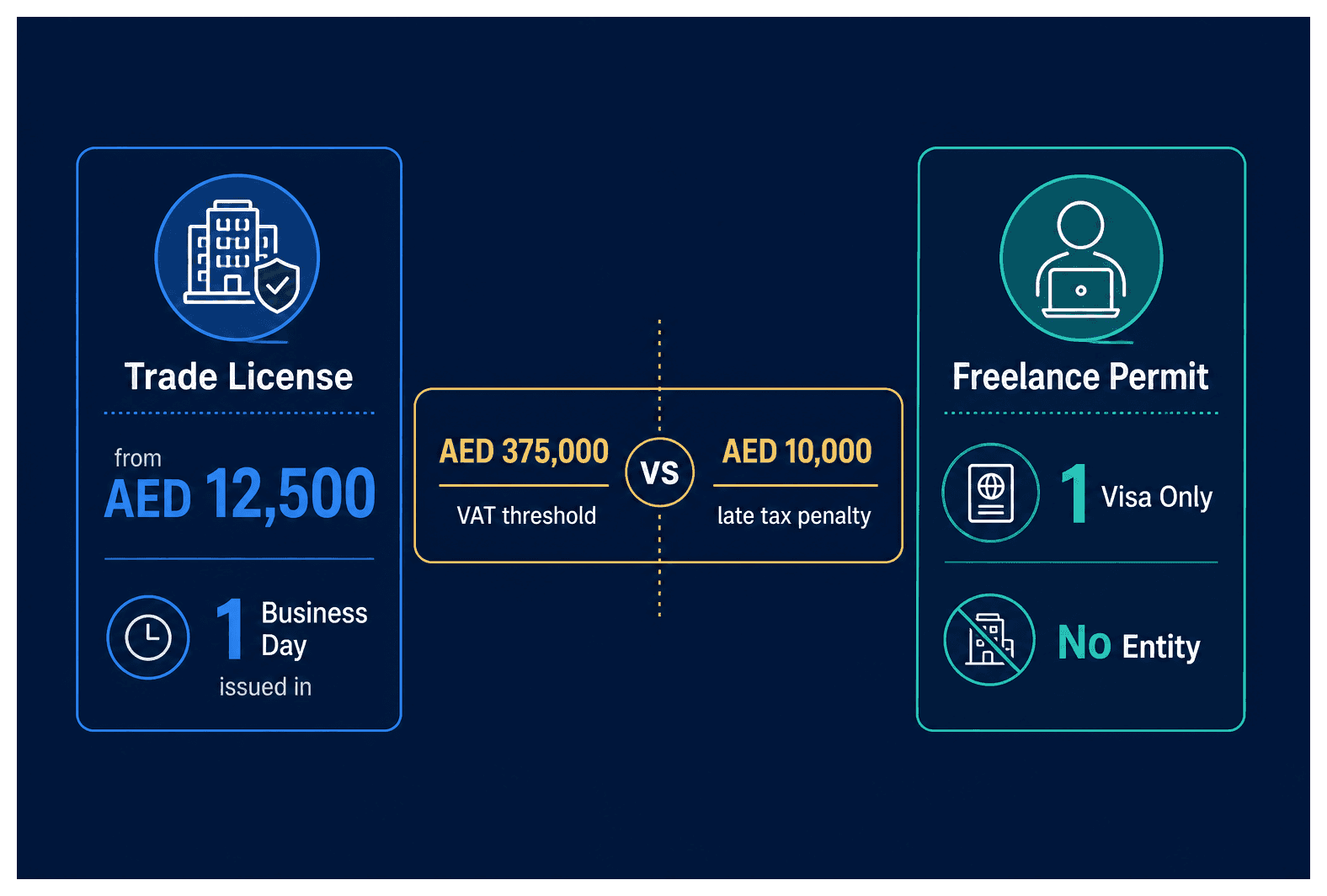
A trade license creates a legal entity, supports multiple visa slots, and allows a company to operate across a broad range of named activities. A freelance permit covers one individual, one approved activity cluster, and typically one self-sponsored visa. Cost, scalability, and contract rights differ significantly between the two.
Cost Comparison
A DSBH free zone trade license starts from AED 12,500. The first-year all-in cost for a sole founder with one investor visa starts from AED 18,350. Visas are always an additional cost, they're never included in the license fee itself.
Key cost line items to plan for with either structure:
Trade name registration
Establishment card
Medical insurance (mandatory for visa holders)
Annual license or permit renewal
Visa renewal (separate from the license renewal)
A founder comparing a DSBH trade license at AED 18,350 all-in against a freelance permit should factor in that the trade license delivers a corporate bank account, a UAE residency visa, and the right to invoice under a company name. The permit fee may look lower on paper, but it doesn't include a visa or any of those commercial rights.
Scope and Activity Rights
A trade license can cover up to five activities from the outset. Need to add a sixth? That's AED 2,000 per additional activity. A consultant who starts in management advisory but wants to add training delivery and content production within 12 months is far better served by a trade license that accommodates multiple activities from day one.
A freelance permit, by contrast, is restricted to the specific activity cluster approved at issue. Adding new activities typically requires a permit amendment or a new application entirely. Trade license holders can also hold assets and enter contracts in the company name. Check the full list of business activities in Dubai available under a DSBH trade license to see which categories fit your model.
Visa Impact and Headcount Capacity
A DSBH trade license includes an investor visa entitlement and supports additional employment visas as the business grows. A freelance permit typically supports only one self-sponsored visa. Hiring staff under a permit structure requires converting to a full license first, which means paying setup costs twice.
The investor visa issued under a trade license also carries different rights and renewal terms compared to an employment visa. Founders planning to bring a spouse, family member, or junior hire within the first year need the visa quota that only a trade license provides.
Is a trade license the same as a business license in Dubai?
In everyday usage, the terms are interchangeable. Technically, a trade license is the formal instrument issued by a free zone authority or the DET that grants a legal entity the right to conduct named commercial activities in Dubai. "Business license" is the informal term most founders use to mean the same document. Both refer to the same legal instrument under UAE commercial law.
Tax and Compliance Obligations for Each Structure
Both trade license holders and freelance permit holders are subject to UAE corporate tax and VAT rules. A trade license creates a legal entity that must register for corporate tax once revenue thresholds are met. A freelance permit holder is treated as an individual business and faces the same registration obligations. Late registration penalties are AED 10,000 for each tax.
Corporate Tax Obligations
UAE corporate tax applies to both free zone companies and individual permit holders once taxable income thresholds are met. A free zone company may qualify as a Qualifying Free Zone Person (QFZP) and benefit from a 0% rate on qualifying income, but only if it meets all four conditions:
It has adequate substance in a free zone
It derives qualifying income as defined by the Ministry of Finance
It has not elected to be taxed under the standard regime
It complies with transfer pricing rules
Never describe any structure as tax-free. The correct position is that specific qualifying income may be subject to a 0% rate under defined conditions. A DSBH free zone company earning AED 500,000 in qualifying income from international clients should take proper legal advice on QFZP eligibility rather than assuming a 0% rate automatically applies. Late corporate tax registration carries a one-time flat penalty of AED 10,000 (Federal Tax Authority, 2026).
VAT Registration and Obligations
VAT registration is mandatory once taxable supplies exceed AED 375,000 in a 12-month period, regardless of whether the entity is a trade license company or a freelance permit holder. Late VAT registration carries a penalty of AED 10,000.
DSBH is not a designated zone and does not carry designated-zone VAT or customs benefits. Free zone goods are duty-suspended, not duty-exempt. Don't conflate the two. A service-based DSBH company billing AED 400,000 in its first year must register for VAT and charge 5% on taxable supplies to UAE-based clients, regardless of its free zone status. For more on banking and taxation in Dubai, DSBH's beyond-hub services cover the key compliance steps.
Which Structure Suits Which Type of Founder
A trade license suits founders who plan to scale, hire, sign corporate contracts, or operate across multiple activities. A freelance permit suits solo practitioners offering a single service with no near-term growth plans. If you anticipate needing a UAE residency visa, a corporate bank account, or the ability to employ staff, a trade license is the right choice.
When a Trade License Is the Right Choice
Choose a trade license if any of the following apply:
You need a UAE investor residency visa and want to sponsor dependants
You plan to hire one or more staff in the next 12 months
You want to invoice clients under a company name and open a corporate bank account
You offer more than one type of service or commercial activity
You want the credibility of a registered legal entity when pitching to corporate or government clients
A B2B technology consultant planning to pitch enterprise clients in the Gulf is a clear example. Procurement teams at large companies require a vendor to be a registered legal entity with a corporate bank account and a UAE trade license number. A permit simply won't clear that bar. A DSBH trade license starts from AED 12,500, with a first-year all-in cost from AED 18,350 including one investor visa UAE application.
When a Freelance Permit May Be Sufficient
A freelance permit may work if all of the following are true:
You are a solo practitioner offering a single, clearly defined service
You have no near-term plans to hire anyone
Your clients are comfortable paying an individual rather than a company
Your activity is on the approved list for the permit authority you're applying to
Your annual revenue is likely to stay below AED 375,000, keeping VAT complexity minimal
A freelance photographer shooting for a handful of regular clients, with no plans to hire and wanting the lowest possible setup cost, may find a permit adequate for year one. But the option to convert to a trade license as the business grows is worth planning for from the start. Note: DSBH does not issue freelance permits. Use the business setup cost in Dubai calculator to model your first-year spend before committing.
How to Set Up a Trade License in Dubai: Step-by-Step
Setting up a trade license in Dubai through a free zone takes five steps: choose your activity, select your free zone and license type, reserve your trade name, submit your application with supporting documents, and receive your license. At DSBH, the license is issued in one business day from application approval.
References
Frequently Asked Questions