Topic Summary
Tourist Visas: Short Stays Made Simple
The UAE offers 30-day tourist visas from AED 300 and 90-day multi-entry options for AED 650, open to all nationalities. Both are issued through ICP or GDRFA and are fully digital to apply for in 2026.
Employment Visas Require Two Separate Steps
Workers need both a MOHRE work permit and an ICP residence visa, two linked but distinct documents processed through separate portals. Government fees for employment visas range from AED 3,000 to AED 5,000 for a two-year visa.
Green Visa Offers Five-Year Self-Sponsored Residency
Skilled employees earning at least AED 15,000 per month with a degree, or self-employed individuals earning AED 360,000 per year, can qualify for the five-year Green Visa. Fees run between AED 1,800 and AED 2,200 and the visa is issued directly by ICP.
Golden Visa Rewards Long-Term Investors
The 10-year Golden Visa requires a minimum AED 2 million investment in real estate or public funds and costs AED 2,800 to AED 3,800 in application fees. It is issued jointly by ICP and RERA and is among the most prestigious long-term residency options available.
Free Zone Investor Visas Last Three Years
Entrepreneurs holding a free zone trade license can obtain a three-year investor residence visa for AED 3,500 to AED 5,500. The visa is co-issued by ICP and the relevant free zone authority, making it a popular route for business owners.
ICP and GDRFA Manage Millions of Records Annually
ICP processed over 8.4 million active residence visa records in 2026, while GDRFA Dubai handled 3.1 million new applications in the first half of the year alone. Most processes are fully digital, with biometric enrollment at approved typing centres as the only required in-person step.
In 2026, the ICP portal processed over 8.4 million active UAE residence visa records. Over 3.1 million new applications were filed in H1 2026 alone. The UAE offers more than 15 distinct visa pathways, with fees ranging from AED 100 for a transit visa to AED 50,000 or more for a Golden Visa. Tourist visas start at AED 300, employment visas cost AED 3,000–5,000 in government fees, and the 10-year Golden Visa requires a minimum AED 2 million real estate investment.
The types of visas in UAE cover every situation, tourist, employee, entrepreneur, and long-term investor. This guide explains every major UAE visa category for 2026: who qualifies, what it costs in AED, how long it lasts, and which pathway fits your goals. You'll also see how Dubai South Business Hub Free Zone residency services can handle your visa and company formation in one step. For more detail, see our guide on Dubai immigration and visa guide. For more detail, see our guide on comparing UAE visa types. For more detail, see our guide on 5-year UAE tourist visa requirements. For more detail, see our guide on Dubai family visa fees and requirements. For more detail, see our guide on dependent visa in Dubai requirements and cost. For more detail, see our guide on complete guide to the UAE Golden Visa. For more detail, see our guide on UAE visa amnesty guide for overstayers. For more detail, see our guide on UAE visa number guide. For more detail, see our guide on UAE visa options for sponsoring family members.
Overview of UAE Visa System in 2026
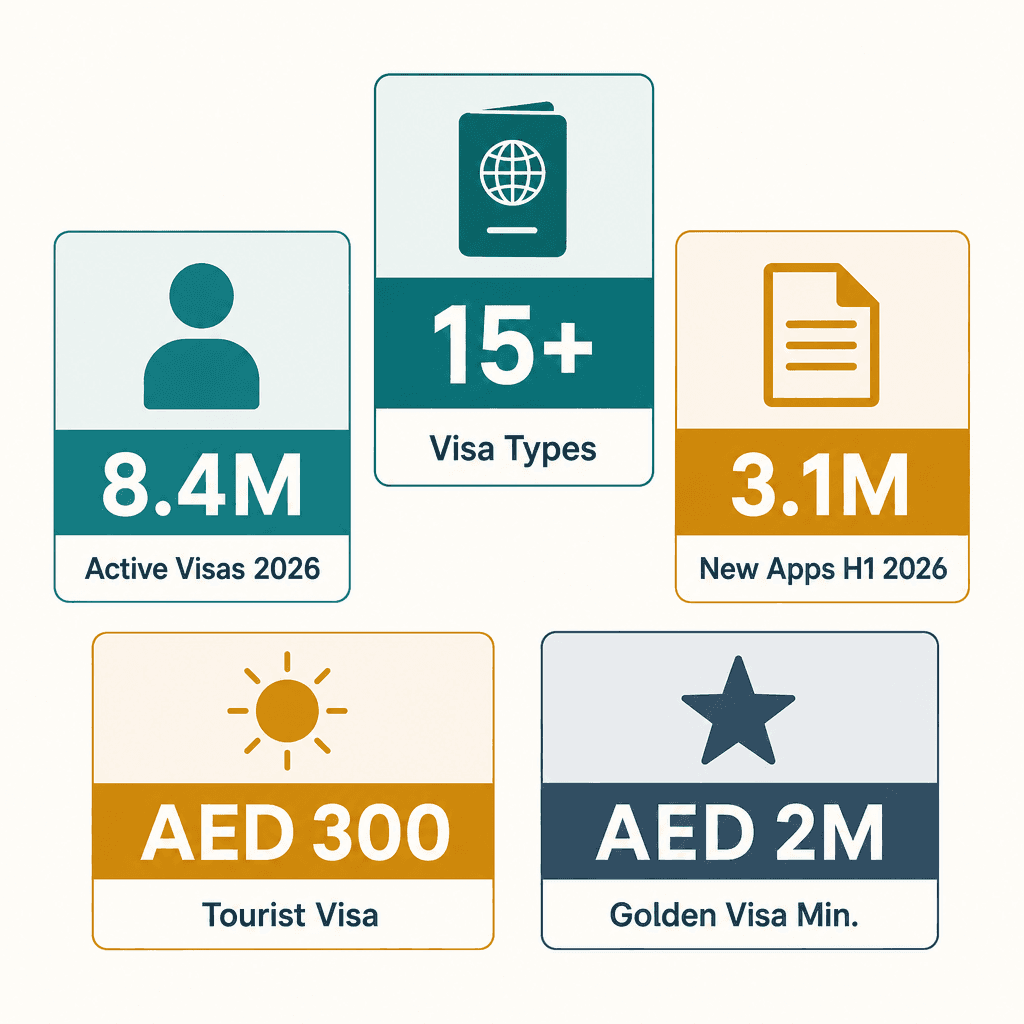
The UAE visa system in 2026 covers more than 15 categories managed by ICP and GDRFA, including tourist, employment, investor, Green Visa, and Golden Visa pathways. Fees range from AED 100 for a transit visa to AED 50,000 or more for a Golden Visa application. Each category has distinct eligibility criteria, validity, and renewal rules. For more detail, see our guide on UAE Green Visa eligibility for marketing professionals. For more detail, see our guide on UAE GDRFA return permit guide.
UAE Visa Types 2026 - Fees, Validity, and Eligibility Comparison
Visa Type | Validity | Fee (AED) | Eligibility | Issuing Authority |
|---|---|---|---|---|
Tourist Visa (30-day) | 30 days | AED 300 | All nationalities | ICP / GDRFA |
Tourist Visa (90-day Multi-Entry) | 90 days | AED 650 | All nationalities | ICP / GDRFA |
Employment Visa | 2 years | AED 3,000–5,000 | Employer-sponsored workers | MOHRE + ICP |
Investor Visa (Free Zone) | 3 years | AED 3,500–5,500 | Free zone trade license holders | ICP + Free Zone Authority |
Green Visa (Skilled Employee) | 5 years | AED 1,800–2,200 | AED 15,000/month salary + degree | ICP |
Green Visa (Self-Sponsored) | 5 years | AED 1,800–2,200 | AED 360,000/year income requirement for self-employed applicants | ICP |
Golden Visa (Investor) | 10 years | AED 2,800–3,800 | AED 2 million real estate or public investment | ICP + RERA |
Who Issues UAE Visas and Which Portal to Use
ICP (Federal Authority for Identity, Citizenship, Customs and Ports Security) manages all federal visa issuance via icp.gov.ae. It processed 8.4 million active residence visa records in 2026. GDRFA Dubai handles Dubai-specific residency and entry permits through gdrfad.gov.ae, processing 3.1 million new applications in H1 2026 alone.
MOHRE (Ministry of Human Resources and Emiratisation) issues work permits that precede employment residence visas. The work permit and the residence visa are linked but separate documents, you need both. Most applications are fully digital in 2026; biometric enrollment at approved typing centres is the only in-person step.
A British national applying for a 2-year employment visa files the work permit through MOHRE at mohre.gov.ae, then the residence visa through ICP, two portals, one sequential process.
How UAE Visas Are Classified
There's a distinction worth flagging early: entry permits let you enter the UAE, while residence visas let you live and work there. Short-term visas run up to 90 days; long-term visas span 1, 2, 5, or 10 years. The UAE now offers 15+ distinct visa pathways in 2026, expanded significantly under visa reforms effective 2022–2026.
The other key split is sponsored versus self-sponsored. Employment and family visas require an employer or resident sponsor. Investor, Green, and Golden visas are self-sponsored, you qualify on your own credentials or business structure. An entrepreneur setting up a free zone company at Dubai South Business Hub Free Zone becomes their own visa sponsor, with no employer required. Each visa type also ties to a specific MOHRE or ICP classification code, so matching the right code to your application prevents costly processing errors.
For a full breakdown of recent rule changes, see the UAE visa rule changes 2026 guide.
Tourist and Visit Visas
UAE tourist and visit visas in 2026 cover 30-day single-entry options at AED 300, 60-day visas at AED 450, and 90-day multi-entry visas at AED 650. GCC residents and nationals of 50+ countries receive visa-on-arrival or visa-free access. GDRFA and ICP both process these applications online within 24–48 hours. For more detail, see our guide on visa options for retiring in the UAE. For more detail, see our guide on UAE digital nomad visa options.
Tourist Visa Options and Fees in AED
The UAE welcomed 17.15 million international visitors in 2025 (Dubai Tourism, 2025), and the visa fee structure is designed to be accessible. Here's the current tier breakdown:
Applications go through icp.gov.ae or approved airlines including Emirates and flydubai. A Canadian entrepreneur, for example, uses a 90-day multi-entry visa at AED 650 to visit the UAE three times in one year while comparing free zone options before committing to a company formation.
Visa-on-Arrival and Visa-Free Access
Over 50 nationalities receive visa-on-arrival at UAE airports, including citizens of the USA, UK, EU member states, Australia, Canada, and Japan. The standard stamp is 30 days, extendable to 90 days. No prior ICP application is needed, immigration stamps it on arrival.
GCC nationals (Saudi Arabia, Kuwait, Bahrain, Oman, Qatar) enter UAE without any visa and can reside freely. GCC residents holding valid residence permits may also receive visa-on-arrival for 30 days. A UK passport holder landing at Dubai International Airport gets a free 30-day stamp with zero paperwork.
Employment and Work Visas
UAE employment visas in 2026 require a MOHRE work permit followed by an ICP residence visa. The standard 2-year employment visa costs AED 3,000–5,000 in total government fees. The process takes 7–15 business days. Employers in mainland companies and free zones sponsor the visa; free zone employees are processed through their respective free zone authority.
How to Apply for a UAE Work Visa - Step by Step
MOHRE processed over 2.3 million WPS salary file submissions per month in 2026, which gives you a sense of the scale of employment activity in the UAE. Here's the exact process:
An Indian software engineer hired by a Dubai free zone company completes all five steps in 12 business days, with the free zone authority acting as the MOHRE-equivalent sponsor.
Skill-Based Visa Classifications and Salary Thresholds
MOHRE classifies workers into skill levels 1–5 based on education and occupation. Higher skill levels attract lower permit fees, a practical incentive to have credentials properly attested. There's no minimum salary for a standard work visa, but AED 4,000/month is the threshold for sponsoring dependants.
Certain professionals face additional steps. A licensed physician joining a private Dubai hospital must obtain DHA registration before MOHRE processes the work permit, adding 3–4 weeks to the timeline. Engineers, lawyers, and other regulated professionals face similar credential attestation requirements through DET or HAAD. Free zone employment visas bypass MOHRE in some zones but must still comply with ICP medical and Emirates ID requirements.
Investor and Partner Visa UAE
The UAE investor visa grants 3-year renewable residency to company owners and shareholders. It requires a valid trade license and a minimum share value of AED 72,000 in a mainland or free zone company. Free zone investors at Dubai South Business Hub Free Zone can secure this visa without a local sponsor and without a minimum salary threshold. For more detail, see our guide on investor visa options for Dubai free zone owners.
Who Qualifies for an Investor Visa in UAE
Any owner or shareholder in a UAE-registered mainland or free zone company qualifies. The mainland route requires a minimum share value of AED 72,000 (DET, 2026). Free zones set their own thresholds, often lower, and in many cases, a valid trade license is the only qualifying document with no share value minimum at all.
Multiple shareholders can each hold an investor visa tied to the same company. There's no minimum salary requirement. The visa is valid for 3 years and renews as long as the trade license remains active. Two co-founders registering a technology consultancy at Dubai South Business Hub Free Zone both receive 3-year investor visas tied to their company license, no local sponsor, no minimum salary.
Partner Visa vs. Investor Visa - Key Differences
The partner visa is issued to a shareholder in a mainland LLC and may require a local service agent or Emirati partner for certain activity categories. The investor visa, issued to free zone company owners, involves 100% foreign ownership with no local partner required (UAE Companies Law, 2021). Both carry 3-year renewable validity but are processed through different authorities, DET for mainland, the relevant free zone authority for free zones.
A German entrepreneur choosing between a Dubai mainland LLC and a Dubai South Business Hub Free Zone license picks the free zone route to avoid the local partner requirement and reduce setup costs. For a full comparison of both routes, the partner and investor visa Dubai guide covers every detail.
Long-Term Residency Visas - Green Visa and Golden Visa
The UAE Green Visa offers 5-year self-sponsored residency for skilled employees and investors earning AED 15,000/month or more. The Golden Visa grants 10-year residency to investors with AED 2 million in real estate or public investment, outstanding talents, and exceptional students. Both are issued by ICP and require no employer sponsor.
UAE Green Visa - Who Qualifies and What It Costs
Introduced in 2022 and fully operational in 2026, the Green Visa is one of the most practical types of UAE residence visa for mid-to-senior professionals. Eligible categories include:
Government fees are AED 1,000–1,500 for the visa itself, plus Emirates ID (AED 370) and a medical test (AED 320). ICP processes the application directly via icp.gov.ae, no employer sponsor involved. Green Visa holders can also sponsor their own family members without any additional salary threshold.
A Pakistani marketing manager earning AED 18,000/month with a bachelor's degree qualifies for the Green Visa and self-sponsors her own 5-year residency without needing her employer's involvement.
UAE Golden Visa - Categories and Investment Thresholds
The Golden Visa is 10-year renewable residency, fully self-sponsored. The investor category requires AED 2 million in UAE real estate registered with RERA, or AED 2 million in a UAE public investment fund. The entrepreneur category covers owners of UAE start-ups valued at AED 500,000 or more, or those with a prior business exit in the UAE.
Talent categories include doctors, scientists, artists, athletes, and inventors, all nominated by a relevant UAE federal or emirate-level authority. Outstanding students with a GPA of 3.75 or above from UAE or international universities also qualify. A South African investor who purchases a completed Dubai villa for AED 2.1 million registers with RERA and applies through ICP, approval typically arrives within 30 days.
Digital Nomad and Remote Worker Visas
The UAE Virtual Working Programme visa is designed for remote workers who earn their income from outside the UAE. Applicants need to show AED 30,000/month in remote income to qualify for the 1-year residence visa, which can be renewed annually.
UAE Virtual Working Programme - How It Works
The Virtual Working Programme is administered by ICP and targets professionals who work remotely for companies based outside the UAE. Eligibility is assessed on proof of employment or business ownership and minimum monthly income. Here's how the process works:
No physical office is required — a home address or flexi-desk at the free zone satisfies the requirement. A British graphic designer obtains a self-employment license from Dubai South Business Hub Free Zone, then files a 2-year residence visa through ICP, keeping first-year costs competitive. Explore your options at Dubai South Business Hub Free Zone residency
References
icp.gov.ae (icp.gov.ae)
gdrfad.gov.ae (gdrfad.gov.ae)
mohre.gov.ae (mohre.gov.ae)
Citations
General Directorate of Residency and Foreigners Affairs Dubai.. gdrfad.gov.ae. GDRFA Dubai, 2024.
Federal Authority for Identity, Citizenship, Customs and Port Security.. icp.gov.ae. ICP UAE, 2024.
Ministry of Human Resources and Emiratisation.. mohre.gov.ae. MOHRE UAE, 2024.
UAE Ministry of Economy and Tourism.. moet.gov.ae. MOET UAE, 2024.
Dubai Economy and Tourism.. dubaidet.gov.ae. DET Dubai, 2024.
Frequently Asked Questions