
Topic Summary
Choose the Right Legal Structure First
Foreign companies can establish a branch, subsidiary, or representative office in the UAE, each carrying distinct liability and operational implications. Selecting the wrong structure early can create compliance gaps and delay market entry.
Understand Branch vs. Subsidiary Liability
A branch office keeps the parent company legally responsible for all UAE liabilities, while a subsidiary limits exposure to its own share capital. This distinction is critical for risk management and long-term financial planning.
Representative Offices Have Strict Activity Limits
A representative office can only handle promotional and liaison functions — it cannot generate revenue, trade commercially, or sign contracts in the UAE. Companies seeking market presence without full operations often use this structure as a first step.
Mainland Licensing Opens Local Market Access
Mainland companies are licensed through emirate-level authorities like Dubai's Department of Economy and Tourism and can contract directly with UAE government entities. This jurisdiction suits businesses whose primary customers are within the domestic market.
Free Zones Offer Sector-Focused Regulatory Frameworks
Free zones provide independent licensing authorities tailored to industries such as logistics, technology, consultancy, and aviation. Certain free zones also qualify as designated economic zones with specific VAT treatment under Federal Tax Authority rules.
Location Can Influence Trade and Logistics Strategy
Some free zones, such as Dubai South Business Hub Free Zone, are positioned near major transport infrastructure like Al Maktoum International Airport. Proximity to multimodal trade corridors can be a meaningful operational advantage for import- and export-driven businesses.
Legalise Parent Company Documents Early
Foreign company setup in the UAE requires properly legalised parent company documents aligned with the relevant authority's requirements. Preparing these documents in advance significantly reduces processing delays and supports smoother regulatory approval.
International expansion requires careful jurisdictional selection, regulatory alignment, and structured operational planning. For corporations evaluating UAE business setup for foreign companies, the decision involves understanding licensing frameworks, ownership rules, tax exposure, and regulatory obligations across federal and emirate-level authorities.
A foreign company setup UAE requires selecting the appropriate legal structure, ensuring parent company documents are properly legalised, and aligning proposed activities with approved classifications. Whether establishing a branch of an existing entity or incorporating a subsidiary, early regulatory clarity reduces delays and supports long-term compliance.
Legal Structures Available for UAE Business Setup for Foreign Companies
When planning a UAE business setup for foreign companies, selecting the appropriate legal structure is a foundational decision. The chosen structure determines liability exposure, permitted activities, regulatory obligations, and whether the parent company retains direct responsibility for UAE operations. Foreign companies typically consider one of the following structures:
Branch Office
A branch office is an extension of the foreign parent company and is not a separate legal entity. The parent company remains legally responsible for the branch's liabilities and contractual obligations. The branch may conduct activities aligned with the parent company's scope, subject to approval by the relevant licensing authority.Subsidiary (Limited Liability Company)
A subsidiary is incorporated as a separate legal entity within the UAE. Liability is generally limited to the company's share capital. This structure is commonly used in foreign company setup UAE where operational separation from the parent entity is required. Subject to approved activity lists and regulatory conditions, subsidiaries may be established with 100% foreign ownership.Representative Office
A representative office is restricted to promotional, liaison, and market research functions. It may promote the parent company's services but is not permitted to conduct commercial trading, generate revenue, or enter into contracts within the UAE. This structure is typically used for market presence without direct operational activity.
Mainland vs Free Zone: Jurisdiction Options for UAE Business Setup for Foreign Companies
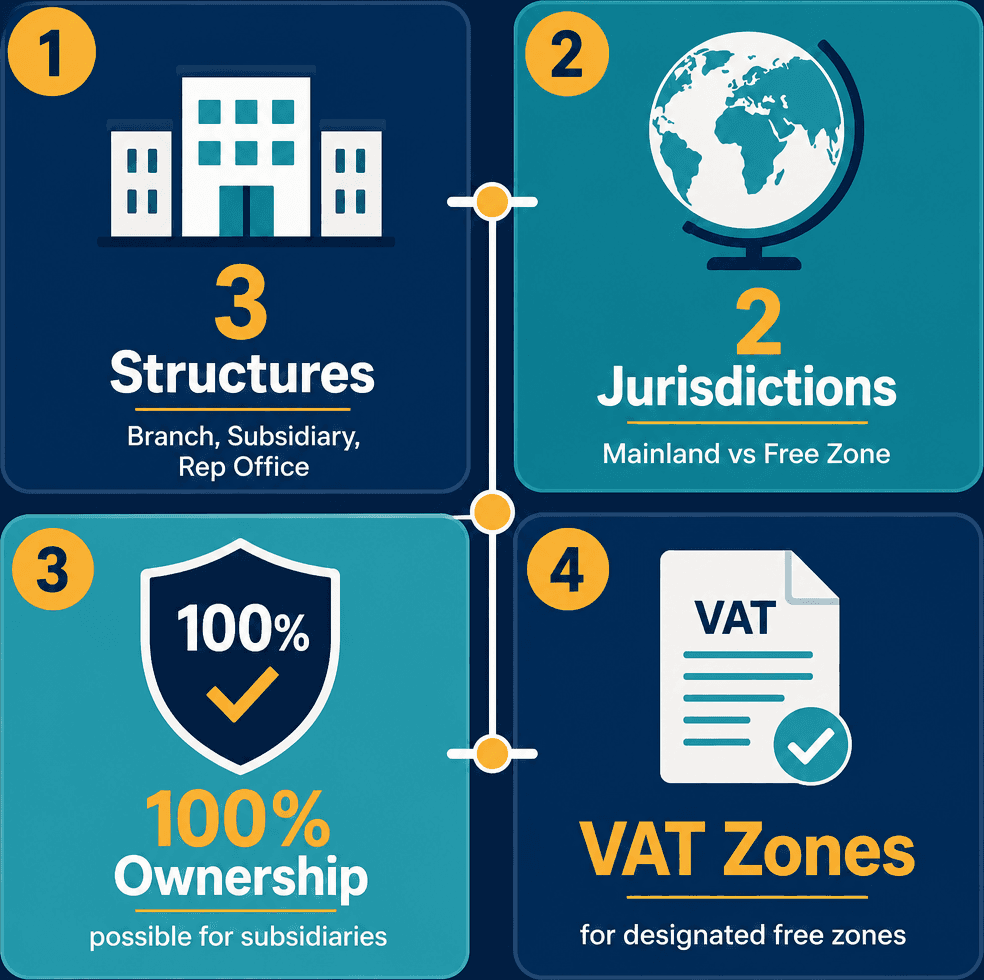
For the UAE business setup for foreign companies, jurisdiction selection determines licensing authority, operational scope, regulatory oversight, and tax treatment. The decision between mainland and free zone structures should be based on business model, target market, and long-term operational requirements.
Mainland (Onshore)
Mainland companies are licensed by the relevant emirate authority, such as the Department of Economy and Tourism (DET) in Dubai. This structure allows businesses to operate directly within the UAE local market and to contract with government entities, subject to activity approvals. Licensing requirements, office space obligations, and regulatory conditions depend on the selected activity and authority guidelines.
Free Zones
Free zones operate under independent regulatory authorities and provide sector-focused licensing categories. They are commonly selected for international trade, logistics, consultancy, technology, and aviation-related activities. Certain free zones may qualify as designated economic zones for VAT purposes, subject to Federal Tax Authority regulations and applicable conditions.
Jurisdictions such as Dubai South Business Hub Free Zone operate within a master-planned district positioned near Al Maktoum International Airport, offering proximity to multimodal trade corridors while maintaining defined licensing and compliance standards.
Five Key Steps for UAE Business Setup for Foreign Companies
Although procedures vary slightly between mainland and free zone authorities, UAE business setup for foreign companies generally follows a defined process.
Cost Considerations for UAE Business Setup for Foreign Companies
The cost of UAE business setup for foreign companies depends on the chosen jurisdiction, business activity, office requirement, and visa allocation. Licensing authorities publish official fees, and total setup costs should be assessed based on the selected structure and operational needs.
Indicative ranges may include:
Free Zone license packages: starting from approximately AED 12,000, depending on activity and workspace type
Mainland company formation: starting from approximately AED 15,000, subject to activity classification and office leasing requirements
Employment or investor visas: typically ranging between AED 3,000 and AED 7,000 per visa, depending on visa category and processing conditions
Additional costs may apply for document legalisation, establishment card issuance, medical testing, Emirates ID processing, and other administration services.
From a taxation perspective, the UAE applies a 9% Corporate Tax rate on taxable profits exceeding AED 375,000. Free Zone entities may apply a 0% rate on qualifying income, subject to Corporate Tax law and ongoing compliance conditions.
Comprehensive cost planning should therefore consider licensing, immigration, workspace, and tax obligations before proceeding with incorporation.
Operational and Compliance Considerations
Although foreign company registration UAE processes are structured, operational readiness depends on several regulatory elements that directly affect how the business functions after licensing.
Banking Due Diligence
A corporate bank account is essential for invoicing clients, receiving payments, paying suppliers, and meeting statutory obligations. Without an active bank account, a licensed company cannot operate commercially.
Bank approval is subject to independent due diligence, including review of shareholder background, source of funds, business model, and projected transactions. Clear activity descriptions and complete documentation reduce delays during this stage.
Corporate Tax Registration and Qualification
Corporate tax registration determines how and when your company reports profits to the Federal Tax Authority. Missing registration deadlines may result in administrative penalties.
For Free Zone entities seeking to apply a 0% rate, eligibility depends on meeting the conditions of a Qualifying Free Zone Person. This includes carrying out approved activities and maintaining the required level of operations in the UAE. Decisions made at incorporation stage can affect how your company is taxed in future financial years.
Annual License Renewals and Legal Standing
A trade license confirms the legal right to operate. If a license expires, the company may face operational suspension, immigration restrictions, or fines. Renewal requires valid lease documentation, updated company records, and compliance with authority requirements. Ongoing monitoring prevents disruption to contracts and banking relationships.Audit and Financial Reporting Requirements
Accurate financial records support tax filings, banking reviews, and regulatory inspections. Some Free Zones require audited financial statements as part of annual compliance. Corporate tax regulations also require financial reporting aligned with recognised accounting standards. Establishing proper accounting systems from incorporation reduces corrective work later.
Planning for these obligations at the beginning supports operational continuity and reduces regulatory risk.
Why Location Matters in UAE Business Setup for Foreign Companies
Beyond licensing and compliance, location influences operational efficiency, logistics planning, and long-term scalability. Dubai South Business Hub Free Zone is positioned within Dubai South, a master-planned district developed around aviation, logistics, and trade activity. Its close proximity to Al Maktoum International Airport places businesses near a growing air cargo and passenger hub.
Close proximity to Al Maktoum International Airport
Companies operating within the district benefit from close access to airport infrastructure, which supports air freight movement and international connectivity. This is particularly relevant for trade, e-commerce, aviation, and logistics-dependent activities.Access to Jebel Ali Port and Trade Corridors
Dubai South connects to major road networks linking Jebel Ali Port and other logistics gateways. This supports multimodal cargo movement across air, sea, and land routes, subject to customs and regulatory procedures.Regional Connectivity
With ongoing rail and road network development, the district connects to Abu Dhabi and other parts of the UAE. For businesses managing regional teams or supply chains, this proximity supports operational coordination.
Location should therefore be assessed not only from a branding perspective, but from a logistics, staffing, and long-term infrastructure standpoint.
Compliance Requirements in UAE Business Setup for Foreign Companies
Foreign company setup UAE does not conclude when the license is issued. Ongoing compliance obligations apply at both corporate and regulatory levels and should be integrated into operational planning from the beginning.
Corporate Tax
The UAE applies a 9% corporate tax rate on taxable profits exceeding AED 375,000. Free Zone entities seeking to apply a 0% rate must meet the conditions of a Qualifying Free Zone Person and maintain proper documentation of qualifying income. Compliance includes timely registration, financial record keeping, and statutory filings.Ultimate Beneficial Owner (UBO) Reporting
All UAE companies are required to maintain and file accurate information relating to their Ultimate Beneficial Owners (UBO). This includes identifying individuals who ultimately own or control the company and updating records where changes occur.Anti-Money Laundering (AML) and KYC Obligations
Banks and certain regulated entities apply Know Your Customer (KYC) procedures when onboarding companies. Businesses must provide clear documentation regarding ownership structure, source of funds, and business activity. Ongoing monitoring may apply depending on transaction profile and sector classification.
Compliance should therefore be viewed as an ongoing operational responsibility rather than a one-time incorporation requirement.
Conclusion: UAE Business Setup For Foreign Companies
UAE business setup for foreign companies involves more than incorporation. It requires structured jurisdiction selection, accurate activity classification, regulatory alignment, and ongoing compliance planning.
Whether establishing a branch or incorporating a subsidiary, foreign company setup UAE decisions should prioritise liability structure, operational scope, banking readiness, and tax compliance. Early planning reduces amendments, supports smoother account opening, and strengthens long-term governance.
Jurisdictions such as Dubai South Business Hub Free Zone operate within a master-planned district near Al Maktoum International Airport, offering proximity to trade corridors within a defined licensing and regulatory environment. For international companies, location, infrastructure, and compliance clarity together influence operational stability.
Careful structuring at incorporation stage supports sustainable expansion and reduces regulatory exposure in future financial years.
Useful Resources
Citations
Federal Tax Authority.. tax.gov.ae. FTA UAE, 2023.
Dubai Airports.. dubaiairports.ae. Dubai Airports, 2024.
Dubai Economy and Tourism.. dubaidet.gov.ae. DET Dubai, 2024.
UAE Ministry of Economy and Tourism.. moet.gov.ae. MOET UAE, 2024.
Central Bank of the UAE.. centralbank.ae. CBUAE, 2024.
Frequently Asked Questions