
Topic Summary
Federal Law No. 15 of 2020 Covers Everyone
This law applies to all goods, services, and digital products sold to consumers in the UAE, with no sector exemptions. Whether sales happen in-store, via an app, or through social media, the obligations remain identical.
Fines Reach Up to AED 2,000,000
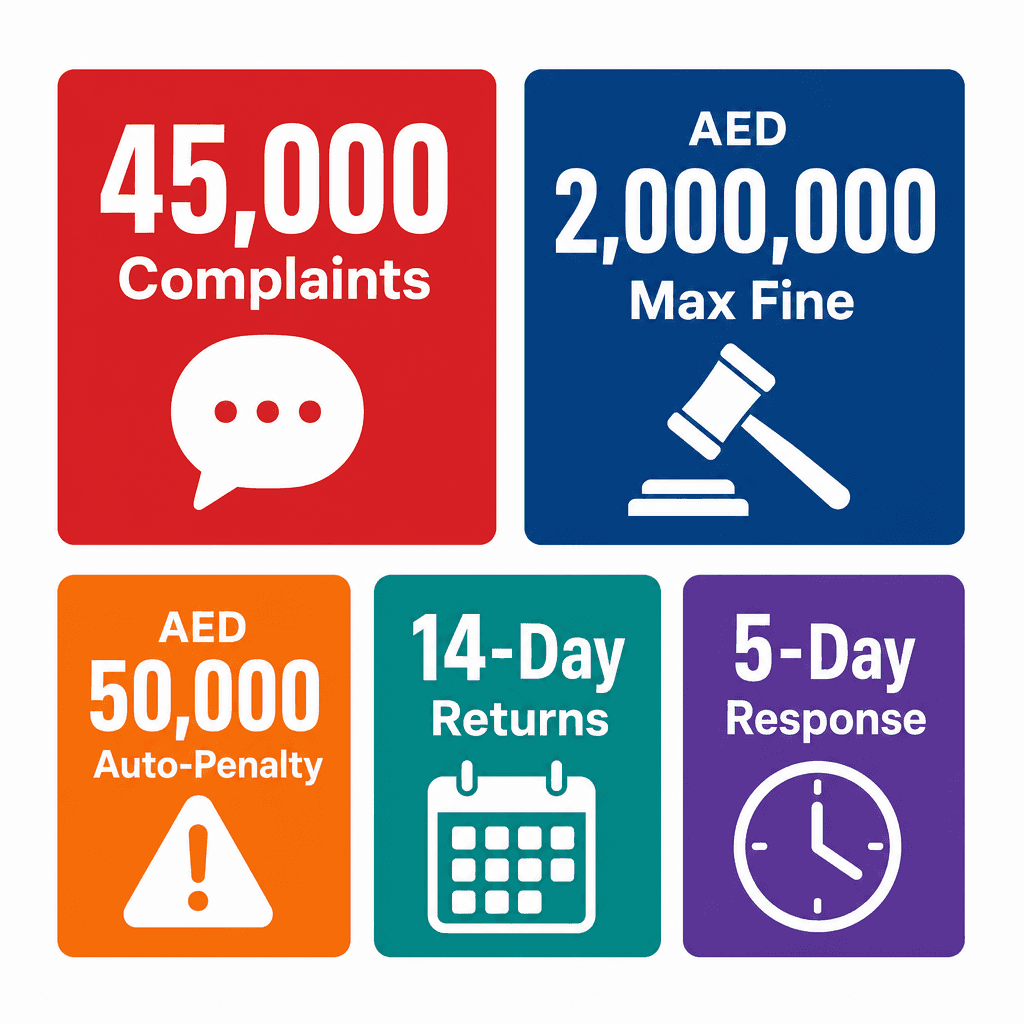
Breaching UAE consumer protection rules can result in fines as high as AED 2,000,000 under Federal Law No. 15 of 2020. Even a single non-response to a DET complaint notice triggers an automatic AED 50,000 penalty.
Digital Commerce Rules Tightened in 2023
Cabinet Resolution No. 66 of 2023 closed gaps in the original 2020 law by adding specific obligations for subscription services, marketplace platforms, and data-driven pricing. Platform audits on major UAE e-commerce sites accelerated through 2024 to 2026.
The 14-Day Return Window Is Mandatory
A statutory 14-day return window for defective goods applies across every sector, including retail, food, hospitality, and services. Businesses cannot contractually waive or shorten this consumer right.
Six Core Consumer Rights Businesses Must Honour
UAE law grants consumers rights to accurate information, safe products, fair pricing, refunds or exchanges, enforceable warranties, and protection from misleading advertising. All six rights apply to every transaction, without exception.
DET Investigations Start Within Five Business Days
A complaint filed via consumerrights.ae triggers a formal DET investigation within five business days, and businesses must respond within that same window. Ignoring a complaint notice is never a safe or viable option.
Misleading Pricing Tops the Complaint Charts
In 2026, the Department of Economic Development recorded over 45,000 consumer complaints across the UAE, with misleading pricing and refund refusals the most common issues. Keeping pricing transparent and refund policies compliant is a practical first line of defence.
In 2026, the Department of Economic Development recorded over 45,000 consumer complaints across the UAE, with misleading pricing and refund refusals topping the list (UAE Ministry of Economy, 2026). Federal Law No. 15 of 2020 carries fines of up to AED 2,000,000 for businesses that breach UAE consumer protection rules, and enforcement is intensifying. A single non-response to a DET complaint notice triggers an automatic AED 50,000 penalty. Cabinet Resolution No. 66 of 2023 tightened digital commerce obligations further, and platform audits across noon.com and Amazon.ae accelerated through 2024 to 2026 (UAE Ministry of Economy, 2024). The 14-day statutory return window for defective goods applies to every sector, retail, food, hospitality, and services included.
This guide covers every obligation UAE businesses selling to consumers must meet under UAE consumer protection law, from return policies and warranty requirements to e-commerce rules and DET penalties, so you can trade with confidence and avoid costly violations. Keep your company compliance calendar UAE updated alongside this guide. For more detail, see our guide on UAE data protection laws. For more detail, see our guide on UAE brand and consumer protection guidelines. For more detail, see our guide on debt recovery for UAE businesses.
UAE Consumer Protection Law Overview
UAE consumer protection is governed by Federal Law No. 15 of 2020, which replaced the 2006 law and covers all businesses selling goods or services to consumers in the UAE. It grants consumers rights over pricing transparency, product safety, fair contracts, and accurate advertising, with enforcement by the Department of Economic Development. For more detail, see our guide on trademark protection and consumer rights in the UAE.
What Federal Law No. 15 of 2020 Covers
Federal Law No. 15 of 2020 was enacted in November 2020 and took effect immediately, replacing the older Federal Law No. 24 of 2006. The scope is broader and the enforcement powers are significantly stronger. It applies to all goods, services, and digital products sold to consumers anywhere in the UAE, no sector is exempt.
The law defines a "consumer" as any natural or legal person acquiring goods or services for personal, non-commercial use. That definition matters practically. A Dubai-based electronics retailer selling laptops online is fully subject to Federal Law No. 15 of 2020, whether the sale happens in-store, through an app, or via a social media link. The channel doesn't change the obligation. For more detail, see our guide on legal compliance for SMEs in Dubai.
Cabinet Resolution No. 66 of 2023 amended the law specifically to address digital commerce gaps, covering subscription services, marketplace platforms, and data-driven pricing practices that the 2020 text hadn't fully anticipated (UAE Ministry of Economy, 2023).
Regulatory Bodies That Enforce UAE Consumer Law
The Department of Economic Development (DET) is the primary enforcement authority in each emirate. In Dubai specifically, Dubai Economy and Tourism (DET) handles consumer complaints and inspections. The Ministry of Economy sets federal policy and coordinates cross-emirate enforcement where violations span multiple jurisdictions.
The Consumer Protection Department within each DET investigates complaints, issues fines, and can refer criminal cases to the Public Prosecution. A complaint filed via consumerrights.ae triggers a formal investigation within 5 business days, and businesses must respond within that same window. The DET Dubai hotline (600 54 5555) handles urgent escalations. Ignoring a complaint notice is never a safe option.
Key Consumer Rights Under UAE Law
UAE law grants consumers six core rights: the right to accurate information, the right to safe products, the right to fair pricing, the right to a refund or exchange, the right to enforceable warranty terms, and the right to protection from misleading advertising. Businesses must respect all six in every transaction.
The Six Core Rights Every Business Must Recognise
Consumer Rights in Service Contracts
Service agreements must clearly state scope, duration, total price, and cancellation terms. Unfair contract terms, automatic renewals without advance notice, disproportionate cancellation fees, are void under UAE consumer protection law. Cabinet Resolution No. 66 of 2023 strengthened these protections specifically for subscription-based services.
A gym membership contract that auto-renews for 12 months without 30-day advance notice to the consumer is unenforceable. Consumers must also receive a written receipt or digital confirmation for every transaction above AED 100. That's not a courtesy, it's a legal requirement.
Business Obligations to Consumers
Under UAE consumer protection law, businesses must display prices in AED and Arabic, provide accurate product information, issue receipts for every sale, honour warranty commitments, and never engage in deceptive advertising. Non-compliance exposes businesses to DET investigations, mandatory compensation orders, and fines starting at AED 10,000.
Step-by-Step Compliance Checklist for UAE Businesses
Prohibited Business Practices Under UAE Consumer Law
Selling counterfeit, expired, or non-conforming goods is a criminal offence, not just a civil violation. Expired goods can trigger prosecution alongside civil penalties, and DET can order business suspension for repeat offenders.
Bait-and-switch advertising is explicitly prohibited. In 2025, DET Dubai issued AED 150,000 in fines to a group of electronics retailers operating a coordinated bait-and-switch scheme on smartphone promotions (Dubai Economy and Tourism, 2025). Withholding material information that would affect a consumer's purchase decision is classified as deception under the law, the standard is what a reasonable consumer would need to know, not what you chose to disclose.
Worth flagging: refusing to honour a valid refund request without documented legal justification is itself a breach of Federal Law No. 15 of 2020. "Company policy" is not a legal justification when the statutory right applies.
Return and Refund Policy Requirements
UAE businesses are required to accept returns and offer refunds or exchanges for defective goods within a minimum of 14 days from purchase. For non-defective goods, businesses may set their own policy but must display it clearly at the point of sale. Blanket "no refund" policies are not legally enforceable.
Minimum Statutory Return Periods in UAE
For defective goods, the consumer has the right to return, exchange, or receive a price reduction within 14 days of purchase under Federal Law No. 15 of 2020. If a defect appears after 14 days but within the warranty period, repair or replacement becomes the minimum remedy, the consumer can't demand a cash refund at that stage, but you can't simply refuse to act either.
A Dubai mall retailer that posts "Exchange Only, No Cash Refunds" is operating a policy that contradicts Federal Law No. 15 of 2020 if the returned item is defective. The consumer is entitled to a cash refund in that scenario. DET can compel the refund as part of complaint resolution, the sign on the wall doesn't override the statute.
Perishable goods and customised items may be exempt from the standard return window, but businesses must state this clearly at the point of sale before purchase. Gift cards and vouchers cannot carry blanket "no refund" terms that conflict with consumer rights.
How to Display Your Refund Policy Correctly
Your refund policy must be visible at the point of sale. For retail, that means physical signage in Arabic and English, not buried in a terms document behind the counter. For e-commerce, the policy must appear before the consumer completes payment, not in a confirmation email afterwards.
An Abu Dhabi fashion retailer that hides its 7-day exchange-only policy in small print on the back of a receipt does not meet DET's disclosure standard. DET inspectors check policy display compliance during routine business audits, and non-compliant display is a standalone violation, separate from any underlying refund dispute. Your policy terms can add to statutory rights, but they cannot reduce them.
Warranty Obligations for UAE Businesses
UAE businesses must provide a minimum warranty of two years on durable goods sold to consumers, unless a longer period is specified by the manufacturer. Warranties must be written in Arabic, state the repair or replacement process clearly, and cannot be voided by conditions that disadvantage the consumer unfairly.
Mandatory Warranty Terms Under Federal Law No. 15 of 2020
Article 16 of Federal Law No. 15 of 2020 mandates a minimum two-year warranty on durable goods, electronics, appliances, vehicles, and furniture are all covered. The warranty document must be in Arabic and specify covered defects, exclusions, repair timeframe, and a UAE-based contact for claims. Businesses cannot charge consumers for warranty repairs within the covered period.
An air conditioning supplier in Ajman that charges AED 200 for a service visit during the two-year warranty period is in direct violation of Federal Law No. 15 of 2020. All warranty-period repairs must be provided at no cost. If a repair exceeds 30 days, the consumer is entitled to a temporary replacement or a full refund, that 30-day clock matters operationally.
UAE Consumer Protection Violation Fines and Timelines 2026
Violation Type | Fine Range (AED) / Consequence |
|---|---|
Misleading advertising | AED 50,000 to AED 500,000 per campaign |
Refund refusal (defective goods) | AED 10,000 to AED 100,000 + mandatory refund order |
Failure to display price in AED | AED 10,000 to AED 50,000 |
Selling expired or non-conforming goods | AED 50,000 to AED 2,000,000 + possible criminal referral |
No Arabic labelling on products | AED 10,000 to AED 100,000 |
Warranty refusal within covered period | AED 25,000 to AED 250,000 |
Non-response to DET complaint notice | AED 50,000 automatic penalty |
Warranty Obligations for Imported and Branded Goods
Here's the thing many importers miss: if the foreign manufacturer has no UAE presence, the importer or authorised distributor bears full warranty liability. Grey market importers cannot disclaim warranty obligations, UAE consumer protection law holds the seller liable, full stop.
A UAE distributor importing Korean home appliances is fully liable for two-year warranty fulfilment. Redirecting consumers to the Korean manufacturer's overseas service centre is not compliant. Cabinet Resolution No. 66 of 2023 confirmed distributor liability explicitly for imported goods. Extended warranties sold as add-ons must provide benefits beyond the statutory two-year minimum to be legally valid, selling a "3-year warranty" that simply repackages the mandatory coverage is a deceptive practice.
If your business imports goods, review your UAE AML and KYC requirements alongside your consumer protection obligations, both frameworks carry significant penalties for non-compliance.
Consumer Protection for Online and E-Commerce Businesses
UAE e-commerce businesses are subject to Federal Law No. 15 of 2020 and the additional requirements of Cabinet Decision No. 31 of 2021 on e-commerce. Online sellers must display their trade license number, full business address, return policy, and total price including delivery fees before the consumer confirms purchase.
E-Commerce Disclosure Requirements in UAE
Cabinet Decision No. 31 of 2021 governs e-commerce consumer protection requirements and adds specific obligations on top of the base law. Here's what every online seller must display:
A Dubai-based fashion e-commerce store operating on Instagram must still display its DET trade license number in its bio or link-in-bio landing page. Social commerce is not exempt. The 7-day cancellation right also applies to online purchases where the product does not match its description, consumers don't need to prove a defect, just a material discrepancy.
What qualifies as a material product description discrepancy under UAE e-commerce law?
A material discrepancy is any difference between the product as described or shown online and the product actually delivered, including colour, size, specification, or condition. If a consumer receives a product that differs from its listing in a way that would have affected their purchase decision, they have a 7-day cancellation right under Cabinet Decision No. 31 of 2021 (UAE Ministry of Economy, 2021).
Platform Responsibility and Marketplace Sellers
Marketplace platforms including noon and Amazon.ae share liability for seller compliance with UAE consumer protection rules. But that shared liability doesn't protect individual sellers. A third-party seller on noon.com must hold a valid UAE trade license and display accurate product information, noon's platform terms do not insulate the seller from Ministry of Economy enforcement.
Platform audits intensified through 2024 to 2026 under the UAE's digital economy strategy. Ministry of Economy conducts periodic sweeps of major platforms to verify seller compliance, and individual sellers found non-compliant face direct fines. Marketplace registration alone is not a substitute for your own trade license (moet.gov.ae, 2025).
Penalties and DET Enforcement
DET can issue fines from AED 10,000 to AED 2,000,000 for consumer protection violations under Federal Law No. 15 of 2020. Repeat offenders face business license suspension or permanent closure. The DET also has authority to order mandatory consumer compensation and refer criminal cases to the Public Prosecution.
UAE Consumer Protection Fine Structure in 2026
First-time violations range from AED 10,000 to AED 250,000 depending on severity. Repeat violations attract AED 250,000 to AED 2,000,000. Selling counterfeit goods carries criminal prosecution alongside civil fines up to AED 2,000,000 and up to two years imprisonment. DET can also order mandatory product recalls at the business's expense.
In 2025, a Dubai retail chain received an AED 400,000 fine for running a "sale" that inflated original prices before discounting, a practice DET classifies as deceptive pricing (Dubai Economy and Tourism, 2025). DET processed over 45,000 consumer complaints in 2025, and the Ministry of Economy has signalled continued enforcement intensity through 2026 (UAE Ministry of Economy, 2026).
How the DET Complaint and Investigation Process Works
A Ras Al Khaimah retailer that ignores a DET complaint notice faces an automatic AED 50,000 penalty for non-response, even if the underlying complaint turns out to be unfounded. Responding promptly and professionally is always the right call, regardless of whether you believe the complaint has merit.
Does UAE consumer protection law apply to free zone businesses selling to UAE consumers?
Yes. Free zone registration does not exempt a business from Federal Law No. 15 of 2020 if it sells goods or services to consumers within the UAE. The law applies based on where the consumer is located and where the transaction occurs, not where the business is licensed. DET enforcement covers all businesses transacting with UAE-based consumers (Federal Law No. 15 of 2020, Article 3).
How Dubai South Business Hub Free Zone Helps
Dubai South Business Hub Free Zone provides businesses with direct compliance guidance on UAE consumer protection obligations, helping companies align their policies, contracts, and advertising practices with Federal Law No. 15 of 2020 before they begin trading, reducing the risk of DET fines and consumer complaints from day one.
Useful Resources
Citations
UAE Cabinet.. uaecabinet.ae. UAE Cabinet, 2023.
Dubai Economy and Tourism.. dubaidet.gov.ae. DET Dubai, 2024.
UAE Ministry of Economy and Tourism.. moet.gov.ae. MOET UAE, 2024.
UAE Government Portal.. u.ae. UAE Government, 2024.
Federal Tax Authority.. tax.gov.ae. FTA UAE, 2023.
Frequently Asked Questions