
Topic Summary
Five-Year Window for Tax Refund Claims
From 2026, businesses have a fixed five-year period to claim corporate tax refunds or use excess tax credits. Any credits not claimed within this window may lapse permanently, making active monitoring of tax balances essential.
Stricter Enforcement and Extended Review Powers
Tax authorities will gain the ability to review past tax periods beyond the standard timeframe, particularly where misreporting or non-compliance is suspected. Businesses must maintain accurate financial records, audit trails, and supporting documentation as a non-negotiable requirement.
Binding Official Tax Interpretations Introduced
Authorities will now issue official, binding interpretations of tax rules that both businesses and tax officers must follow consistently. This brings greater certainty to tax planning but reduces flexibility in how rules can be interpreted.
Final Transition Period for Older Tax Credits
Businesses holding older tax credits nearing expiry have until the end of 2026 to claim or adjust those amounts. This makes it the ideal time to review historical tax positions and resolve any outstanding balances.
UAE Corporate Tax Rate Remains Competitive
The standard corporate tax rate stays at 9% on taxable income above AED 375,000, with income below that threshold effectively taxed at zero. This structure is designed to support startups and small businesses while ensuring larger entities contribute fairly.
Corporate Tax Applies Uniformly Across All Emirates
Corporate tax is a federal law, meaning the same rates, registration rules, and compliance requirements apply in Dubai, Abu Dhabi, and every other emirate. Businesses operating across multiple emirates face a single, consistent framework rather than varying local rules.
Free Zone Companies Face Specific Conditions
Free zone businesses are subject to corporate tax but may qualify for preferential treatment depending on the nature of their activities and compliance with qualifying conditions. Companies operating across both free zones and the mainland should pay particular attention to the 2026 procedural updates.
The UAE has entered a new phase in its business and tax environment. After introducing corporate tax in recent years, the focus is now shifting towards refinement, enforcement, and clarity. As we step into 2026, founders starting a business in the UAE must understand how corporate tax in the UAE works, what is changing, and how to stay compliant without disrupting operations.
This guide explains the UAE corporate tax framework, highlights the key procedural changes expected in 2026, clarifies the UAE corporate tax rate, and walks you through how to register for corporate tax in the UAE.
Understanding Corporate Tax in the UAE
Corporate tax in the UAE is a direct tax imposed on the net profits earned by businesses operating in the country. It applies to companies registered in the UAE, to foreign entities with a permanent presence, and to individuals conducting licensed commercial activities that meet the taxable thresholds.
Unlike VAT, which is charged on transactions, corporation tax is based on profits after deducting allowable business expenses. This structure aligns the UAE with global tax practices while keeping rates competitive.
Why 2026 is an Important Year for Businesses?
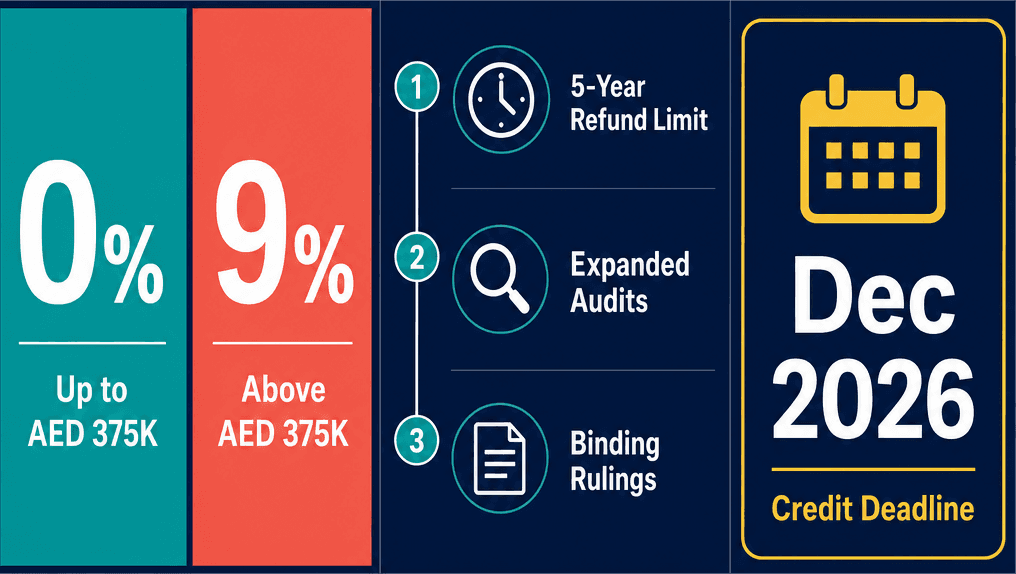
While corporate tax has been in force since 2023, 2026 marks a shift toward tighter procedures and stronger enforcement rather than a change in tax rates. The objective is to reduce ambiguity, improve transparency, and ensure long-term consistency in how tax laws are applied.
These updates are especially relevant for companies that:
Have complex structures
Operate across free zones and the mainland
Carry forward tax credits or losses
Rely on long-term financial planning
Key Corporate Tax Changes to Watch in 2026:
From 2026 onwards, businesses will have a fixed five-year window to claim corporate tax refunds or use excess tax credits. Any credit not claimed within this period may lapse.
What this means for businesses:
Companies must actively monitor tax balances and historical filings. Passive accounting practices could result in lost refunds.
Tax authorities will gain the ability to review past tax periods beyond the standard timeframe, particularly in cases involving misreporting or suspected non-compliance.
What this means for businesses:
Maintaining accurate financial records, audit trails, and supporting documentation is essential, not optional.
Authorities will be able to issue official and binding interpretations of tax rules. Once issued, these interpretations must be followed consistently by businesses and tax officers alike.
What this means for businesses:
Greater certainty in tax planning, but less flexibility in interpretation.
Businesses holding older tax credits that are nearing expiry will be given a final transition period up to the end of 2026 to claim or adjust those amounts.
Action point:
Now is the right time to review historical tax positions and clean up unresolved balances.
9% corporate tax on taxable income above AED 375,000
This structure supports small businesses and startups while ensuring that larger profit-making entities contribute fairly.
Certain multinational enterprises may be subject to additional rules under global minimum tax frameworks, depending on group revenue and structure.
Who is Required to Pay Corporate Tax?
Corporate tax applies to a wide range of business entities, including:
Mainland UAE companies
Free zone companies (subject to conditions)
Foreign companies with a permanent establishment in the UAE
Individuals conducting licensed commercial activities
Some sectors, such as natural resource extraction, remain subject to separate emirate-level taxation.
Corporation Tax in Dubai: Is It Different?
Many businesses ask whether the corporation tax in Dubai works differently from other emirates. The answer is simple: corporate tax is a federal law.
This means:
The same tax rates apply across all emirates
Registration, filing, and compliance rules are uniform
Dubai businesses follow the same framework as those in Abu Dhabi, Sharjah, or other regions
Dubai remains attractive due to infrastructure, global connectivity, and business-friendly policies, not tax exemptions alone.
How to Register for Corporate Tax in the UAE?
Understanding how to register for corporate tax in the UAE is a critical compliance step. Registration is mandatory for most licensed businesses, including free zone entities, even if they ultimately qualify for a 0% corporate tax rate on qualifying income, subject to applicable Corporate Tax rules.
Step-by-Step Registration Process:
Confirm Tax Applicability: Assess whether your business falls within the UAE corporate tax framework. Most UAE-licensed entities are required to register, regardless of whether tax is payable.
Prepare Required Documents: You will typically need:
Ownership and shareholder details
Passport and Emirates ID of the authorised signatory
Financial year details
Audited financial statements are not required at the registration stage.
Create an Online Tax Account: Register or log in via the (FTA) Federal Tax Authority's EmaraTax portal. Businesses already registered for VAT use the same account.
Apply for Corporate Tax Registration: Submit the corporate tax registration application through the portal. Once approved, the FTA will issue a Corporate Tax Registration Number (CTRN).
Maintain Accurate Records: Registration is only the beginning. Businesses must maintain proper accounting records and monitor filing deadlines to remain compliant.
If a business ceases operations or no longer meets registration requirements, a formal deregistration request must be submitted to the Federal Tax Authority.
Filing and Compliance Obligations
Once registered, businesses must meet ongoing compliance requirements:
File corporate tax returns annually
Submit returns within 9 months from the end of the financial year
Maintain financial statements and supporting records
Follow transfer pricing and related-party rules where applicable
Penalties may apply for late registration, late filing, or inaccurate reporting.
Why UAE Corporate Tax Changes Matter for Business Planning?
The UAE is transitioning from a low-tax jurisdiction to a globally compliant business hub. For companies, this means:
Businesses that adapt early will find it easier to scale, attract investors, and operate smoothly.
Conclusion
The UAE corporate tax system in 2026 is not about higher taxes; it is about clearer rules, stronger enforcement, and long-term stability. Understanding corporate tax in the UAE, staying aware of procedural changes, and completing registration correctly will protect your business from penalties and uncertainty. Early preparation is the key to stress-free compliance. If you require expert guidance on tax filing, book a consultation with our experts. If you are in the UAE, call us on 800-DSHUB (37482). Meanwhile, you can write to us your query at setup@dubaisouthbh.com.
Useful Resources
Citations
Federal Tax Authority.. tax.gov.ae. FTA UAE, 2023.
UAE Ministry of Economy and Tourism.. moet.gov.ae. MOET UAE, 2024.
UAE Cabinet.. uaecabinet.ae. UAE Cabinet, 2023.
Dubai Economy and Tourism.. dubaidet.gov.ae. DET Dubai, 2024.
UAE Government Portal.. u.ae. UAE Government, 2024.
Frequently Asked Questions