Topic Summary
Understand What a UAE Entry Permit Is
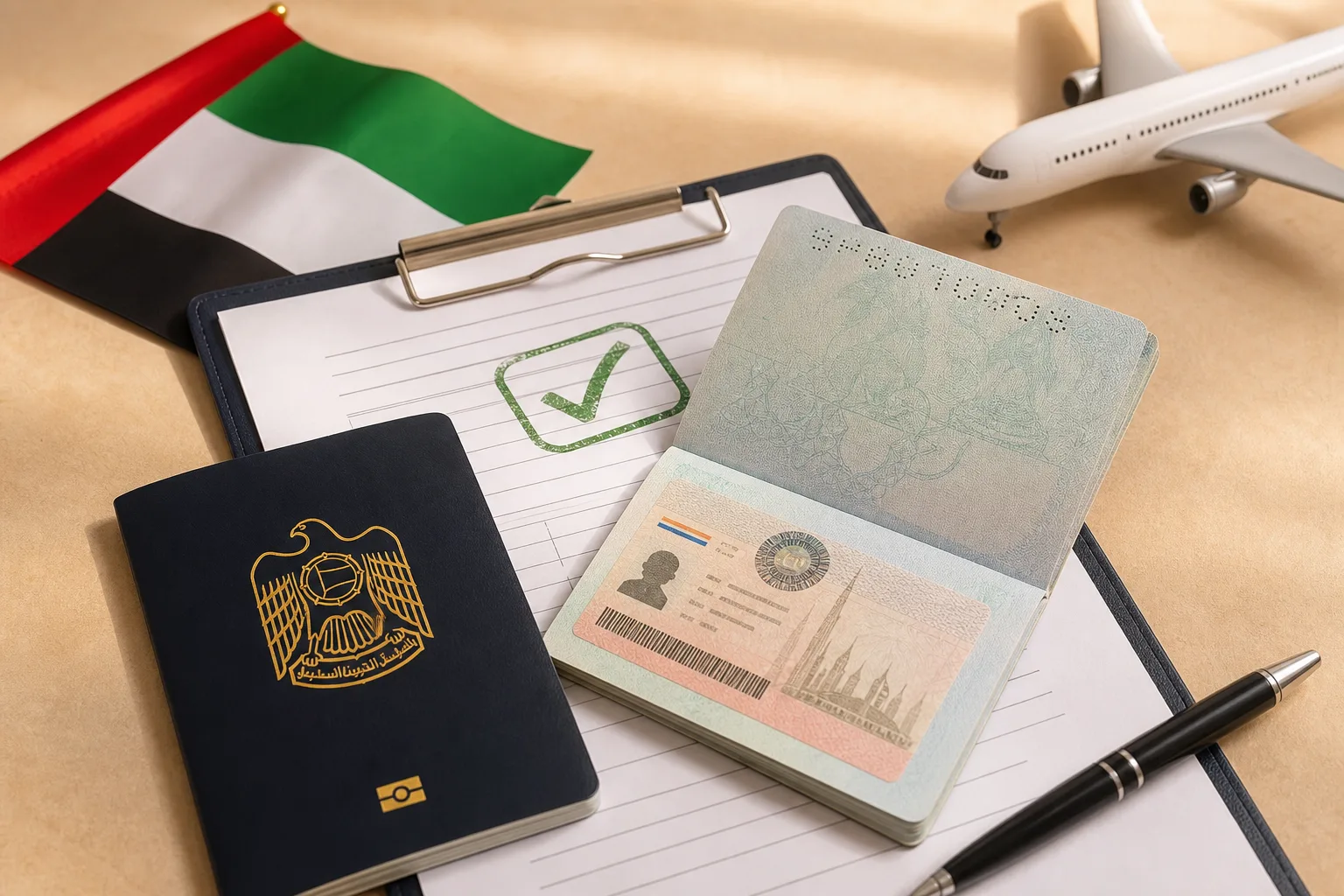
A UAE entry permit is an official pre-arrival authorisation from ICP or GDRFA that lets a foreign national enter the UAE to begin residency procedures. It is legally distinct from a tourist visa and is the mandatory first step before any residence visa application.
Know Who Must Hold One Before Arriving
Anyone entering the UAE for employment, business setup, dependent sponsorship, or long-term residency must hold a valid entry permit before or upon arrival. GCC nationals and holders of existing UAE residence visas are exempt from this requirement.
Choose the Right Application Route
Employment entry permits are routed through MOHRE and GDRFA, while investor and Golden Visa permits are handled directly by GDRFA. Applications are submitted digitally via icp.gov.ae or GDRFA's smart apps, with no physical sticker issued at the point of approval.
Budget for Fees and Processing Times
Standard employment entry permits cost AED 370 and are delivered digitally within 3 to 5 working days. Knowing the exact fee and timeline upfront helps applicants plan travel and onboarding schedules without delays.
Track the 60-Day Validity Window Carefully
The 60-day validity period begins on the date of entry into the UAE, not the date the permit was issued. Applicants must complete Emirates ID biometrics and a medical fitness test within this window to avoid overstay penalties.
Don't Confuse It With a Tourist Visa
A tourist visa allows a short stay of 30 to 90 days with no residency pathway, while an entry permit is specifically designed to enable a residence visa application from inside the UAE. Attempting to convert a tourist visa into residency without an entry permit or change-of-status approval is not permitted under Federal Decree-Law No. 29 of 2021.
Move Quickly From Permit to Stamped Residence Visa
Once inside the UAE on a valid entry permit, applicants should immediately schedule their DHA medical fitness test and Emirates ID biometrics to stay within the 60-day window. Completing these steps promptly is the fastest route to a stamped residence visa.
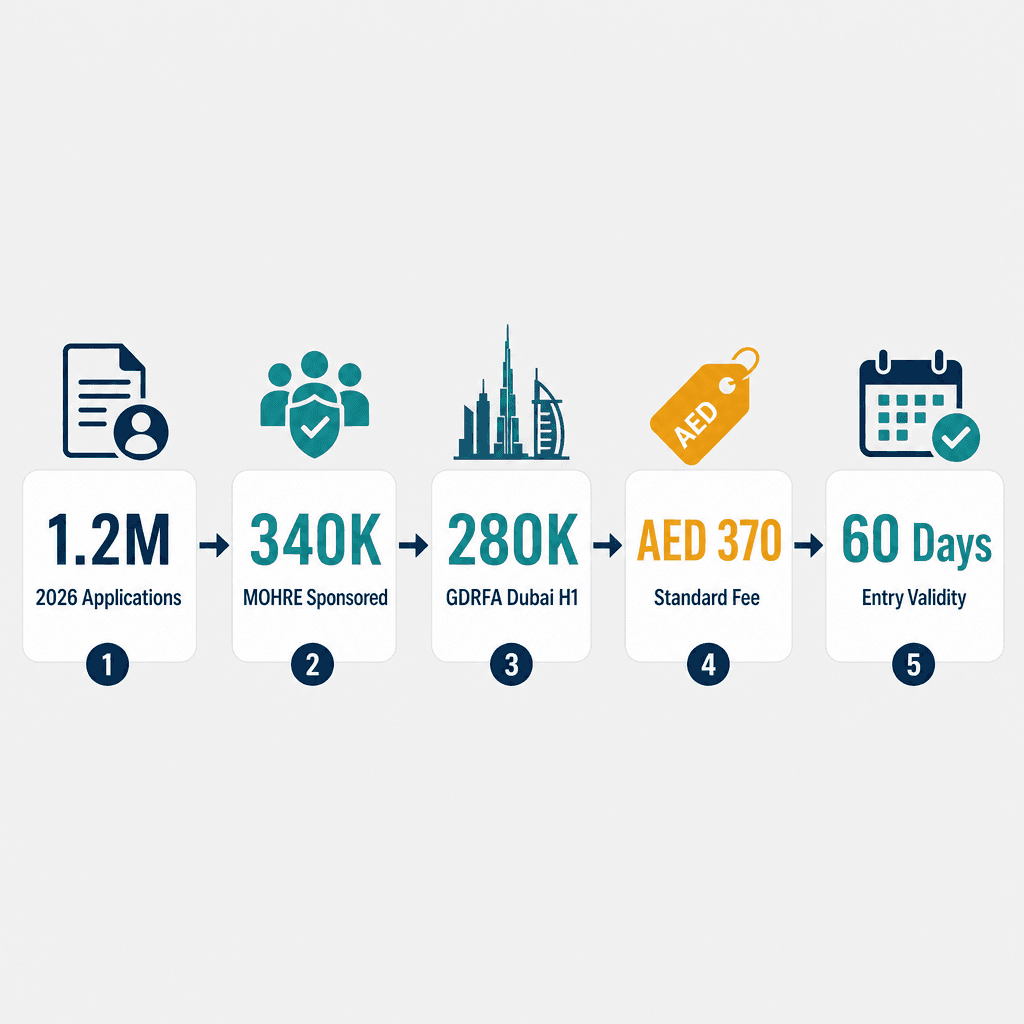
In 2026, the ICP portal processed over 1.2 million UAE entry permit applications from first-time arrivals and employment entrants, a 14% year-on-year increase. Over 340,000 of those were employer-sponsored employment entry permits routed through MOHRE. The GDRFA Dubai alone issued more than 280,000 investor and employment entry permits in H1 2026. Standard employment permits cost AED 370 and arrive digitally within 3 to 5 working days. This guide covers every permit type, exact AED fees, the GDRFA and MOHRE application routes, and how to move from UAE entry permit to stamped residence visa in the shortest possible time.
What Is a UAE Entry Permit
A UAE entry permit is an official pre-arrival authorisation issued by ICP or GDRFA that allows a foreign national to enter the UAE legally. It is the mandatory first step before applying for a residence visa and is typically valid for 60 days from the date of entry. For more detail, see our guide on how to apply for a UAE residence visa quickly. For more detail, see our guide on UAE entry permit validity and extension guide.
Definition and Legal Basis
A UAE entry permit, also called a residence entry permit or pre-entry visa, is distinct from a tourist visa. It specifically authorises the holder to enter the UAE for the purpose of completing residency procedures. It is not a short-stay document. It is the gateway document that kicks off the entire residence visa process.
The legal basis is Federal Decree-Law No. 29 of 2021 on Entry and Residence of Foreigners, which governs how all foreign nationals enter and reside in the UAE. Under this law, no foreign national can begin a residence visa application inside the UAE without a valid entry permit or an approved change-of-status application.
The permit is issued as a digital document via icp.gov.ae or GDRFA's smart apps. There is no physical sticker at issuance. Worth flagging: the 60-day clock starts on the date of entry into the UAE, not the date the permit was issued. A software engineer hired by a Dubai mainland company receives their employer-sponsored entry permit via MOHRE and GDRFA before boarding their flight. They land, activate the permit, and have 60 days to complete Emirates ID biometrics and a DHA medical fitness test.
Entry Permit vs. Tourist Visa vs. Residence Visa
These three documents are often confused, but they serve completely different purposes. A tourist visa allows a short-term stay of 30 to 90 days with no pathway to residency. A UAE entry permit is a pre-arrival permit specifically issued to enable a residency visa application from inside the UAE. A residence visa is the long-term status stamped in your passport after you complete medical tests, biometrics, and an Emirates ID application.
You cannot apply for a residence visa from inside the UAE without first holding a valid entry permit or change-of-status approval. An investor who wants a 10-year Golden Visa, for example, cannot simply fly in on a tourist visa and apply. They need an investor entry permit issued by GDRFA before or upon arrival. The entry permit is the bridge between being a visitor and becoming a UAE resident. For a full breakdown of ICP digital tools, see the ICP smart services UAE guide.
Who Needs a UAE Entry Permit
Anyone entering the UAE to take up employment, establish a business, sponsor dependents, or obtain long-term residency needs a UAE entry permit. GCC nationals are exempt. Certain nationalities receive visa-on-arrival instead, but employer-sponsored and investor entrants must hold a permit before arrival.
Mandatory Cases for an Entry Permit
The following categories of entrants must hold a UAE entry permit before or upon arrival:
Who Is Exempt from a UAE Entry Permit
GCC nationals from Saudi Arabia, Kuwait, Bahrain, Oman, and Qatar enter and reside in the UAE without a separate entry permit. UAE citizens and holders of valid UAE residence visas re-enter on their existing visa status.
Nationals of 50 or more countries are eligible for visa-on-arrival or e-visa for short stays, meaning they don't need a pre-issued entry permit for tourism. But here's the key distinction: if their employer wants to put them on a residence visa, the employer must still apply for a formal UAE entry permit through MOHRE before the residency process begins. A US national can enter Dubai on a 90-day visa-on-arrival for tourism, but that tourist status cannot be converted into a residence visa without a separately issued entry permit (MOHRE, mohre.gov.ae, 2026). For more detail, see our guide on Dubai immigration process.
Types of UAE Entry Permits
The UAE issues five main entry permit categories: employment entry permits sponsored by employers via MOHRE, investor entry permits via GDRFA, dependent entry permits, domestic worker permits, and mission entry permits for short-term professional assignments. Each has different fees, processing times, and eligibility requirements.
Employment Entry Permit - Employer-Sponsored
For mainland company employees, the employer applies for the employment entry permit through the MOHRE e-services portal at mohre.gov.ae. For free zone employees, the free zone authority, such as Dubai South, issues the permit through GDRFA on the employer's behalf. A logistics company in Dubai South free zone, for example, applies for an employment entry permit for a new warehouse manager through the Dubai South authority, which coordinates directly with GDRFA.
The permit specifies the employee's designation, salary band, and employer. Any changes to those details require a new permit. Standard processing takes 3 to 5 working days; express processing takes 1 to 2 working days.
Investor Entry Permit and Mission Permit
The investor entry permit is issued by GDRFA for business owners, shareholders, and company directors. It is valid for 60 days and can be renewed once for an additional 60 days. Golden Visa applicants, both 5-year and 10-year categories, also begin with an investor-category entry permit before the long-term visa is stamped. Free zone investors receive their entry permit through the free zone's government relations team, not directly from GDRFA.
The mission entry permit is for professionals entering to complete a specific short-term project. It is typically valid for 30 days and is non-renewable. An Indian entrepreneur setting up a trading LLC in Dubai South applies for an investor entry permit through the free zone's PRO team and receives it digitally within 3 working days. Explore Dubai South Business Hub Free Zone residency services for bundled investor visa packages (GDRFA, gdrfad.gov.ae, 2026).
How to Apply - Step by Step
To apply for a UAE entry permit, the sponsor, whether an employer or free zone authority, submits the application through icp.gov.ae or the GDRFA smart app, uploads required documents, pays the fee in AED, and receives a digital permit within 3 to 5 working days. The applicant then travels to the UAE to activate it.
Employment Entry Permit Application via MOHRE and GDRFA
A Dubai South free zone company completes the full GDRFA employment entry permit in under 20 minutes via the ICP smart services portal. No physical paperwork is required at any stage.
Investor Entry Permit Application via GDRFA
A Pakistani investor establishing a consultancy in Dubai South receives their investor entry permit within 3 working days via the Dubai South authority's in-house PRO team, with zero trips to a government centre.
UAE Entry Permit Costs in AED
UAE entry permit fees range from AED 370 for a standard employment permit to AED 500 for an investor permit and AED 570 for express processing. Additional inside-country status change fees apply if the applicant is already in the UAE. All fees are paid through icp.gov.ae or GDRFA smart services.
Full Fee Breakdown by Permit Type
An employer bringing in 3 new staff on standard employment entry permits pays AED 1,110 total (3 x AED 370), processed in one batch submission through the MOHRE e-services portal. The table below shows all current permit fees and processing times for 2026.
UAE Entry Permit Fees and Processing Times 2026
Permit Type | Fee (AED) | Processing Time | Issuing Authority |
|---|---|---|---|
Employment Entry Permit (Standard) | 370 | 3–5 working days | MOHRE / GDRFA |
Employment Entry Permit (Express) | 570 | 1–2 working days | MOHRE / GDRFA |
Investor Entry Permit | 500 | 3–5 working days | GDRFA |
Mission Entry Permit | 300 | 3–5 working days | GDRFA |
Dependent Entry Permit | 370 | 3–5 working days | ICP / GDRFA |
Inside-Country Status Change | 640 (additional) | 5–7 working days | ICP |
Practical Considerations on Fees
All fees are paid online. No cash payments at government counters.
Inside-country status change (AED 640 additional) applies when an applicant is already in the UAE on a tourist visa and needs to convert to a residency track without exiting.
Free zone PRO teams typically bundle the entry permit fee into their residency services package. Confirm what is included before paying separately.
Express processing is worth the AED 200 premium when a start date is imminent. Standard processing is fine for planned relocations with a 2-week lead time.
For a full breakdown of ICP fee structures and payment options, see the ICP smart services UAE guide.
Validity and Extension
A UAE entry permit is valid for 60 days from the date the holder enters the UAE. It can be extended once for an additional 60 days at a cost of AED 600 through icp.gov.ae. Overstaying without extension incurs a fine of AED 100 per day.
Extension Process and Overstay Fines
The extension fee is AED 600, applied through icp.gov.ae before the original 60-day period expires. The maximum extended stay is 120 days total (60 days plus a 60-day extension). No second extension is available. A new hire whose medical test is delayed due to a DHA appointment backlog can apply for this 60-day extension online, buying the employer time to complete the residency without the employee exiting the country.
Overstay fines are AED 100 per day after the permit expires. These are payable before any new visa or permit can be issued. GDRFA Dubai and ICP both enforce these penalties. There is no grace period. If residency cannot be completed within 120 days, the applicant must exit the UAE and a fresh UAE entry permit must be issued from scratch (ICP, icp.gov.ae, 2026).
What Happens If You Miss the Deadline
Missing the 120-day maximum is more costly than most people expect. A 10-day overstay adds AED 1,000 in fines before any new application can proceed. The employer also needs to cancel the original permit and re-apply, adding another 3 to 5 working days. Plan your medical and biometrics appointments in the first two weeks after entry, don't leave them to the final days of the permit window.
For help managing the Amer Centre appointment process in Dubai, the Amer Centre Dubai guide covers every step.
Entry Permit to Residence Visa - Next Steps
After entering the UAE on an entry permit, the holder must complete a DHA medical fitness test, submit biometrics at an ICP-registered typing centre, and pass an Emirates ID application. The residence visa is then stamped in the passport, and the full process typically takes 7 to 15 working days.
Step-by-Step: Entry Permit to Stamped Residence Visa
A new Dubai South free zone employee can realistically complete all steps in 10 working days: medical on Day 2, biometrics on Day 3, visa stamped on Day 9, Emirates ID delivered on Day 12 (Emirates Post, 2026).
Documents Required for Residence Visa Stamping
Amer Centres in Dubai accept all documents digitally through the Amer app. No physical file is required. For a complete walkthrough of the Amer Centre submission process, see the Amer Centre Dubai guide
References
icp.gov.ae (icp.gov.ae)
mohre.gov.ae (mohre.gov.ae)
gdrfad.gov.ae (gdrfad.gov.ae)
Citations
Federal Authority for Identity, Citizenship, Customs and Port Security.. icp.gov.ae. ICP UAE, 2024.
General Directorate of Residency and Foreigners Affairs Dubai.. gdrfad.gov.ae. GDRFA Dubai, 2024.
Ministry of Human Resources and Emiratisation.. mohre.gov.ae. MOHRE UAE, 2024.
Dubai Economy and Tourism.. dubaidet.gov.ae. DET Dubai, 2024.
UAE Cabinet.. uaecabinet.ae. UAE Cabinet, 2023.
Frequently Asked Questions