Topic Summary
Topic Summary
UAE Launches National Campaign to Become World Startup Capital In 2026, the UAE ranks among the top 10 startup ecosystems globally (Global Startup Ecosystem Report, 2025). Over $3.5 billion in venture capital was deploye
UAE Launches National Campaign to Become World Startup Capital
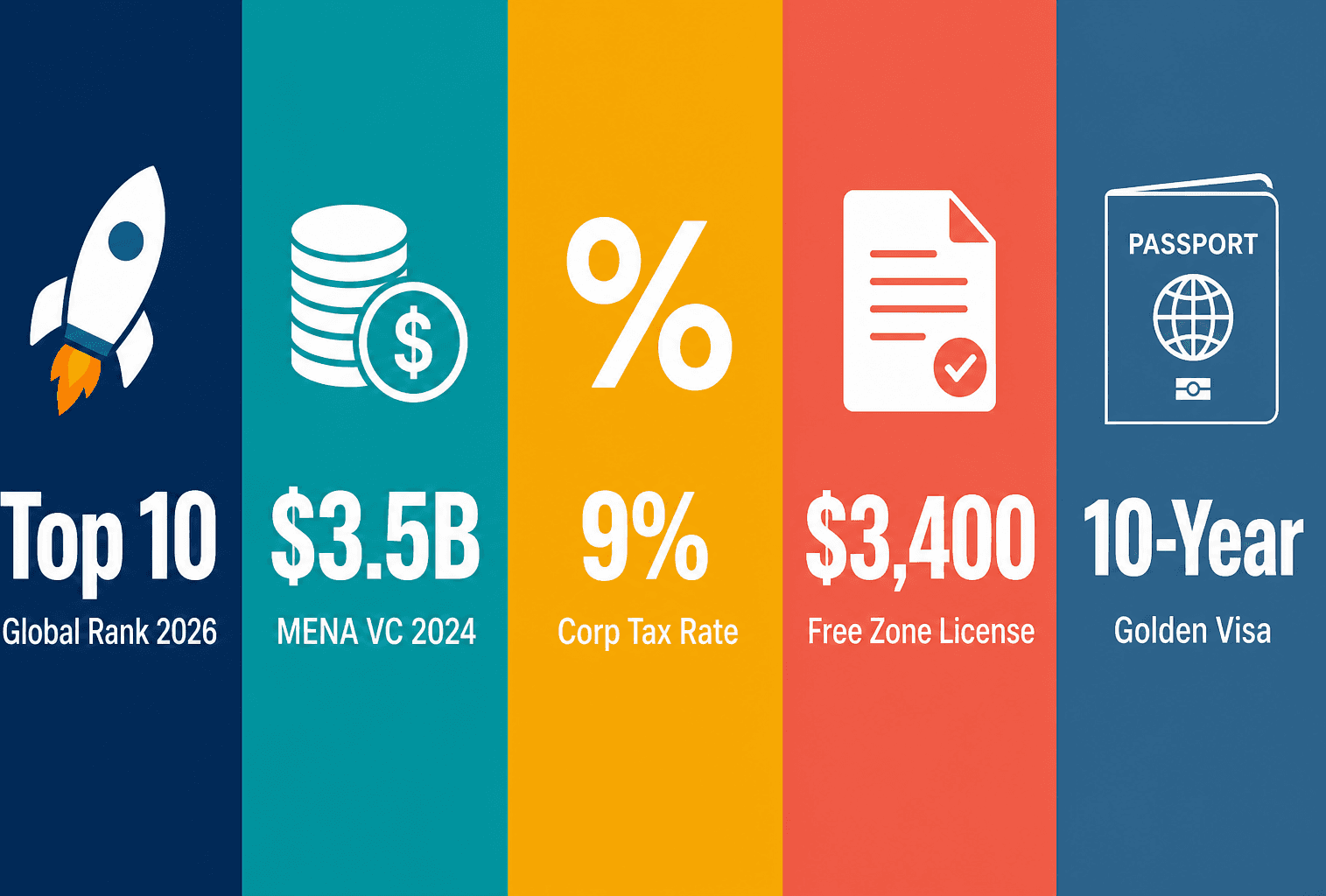
In 2026, the UAE ranks among the top 10 startup ecosystems globally (Global Startup Ecosystem Report, 2026). Over $3.5 billion in venture capital was deployed across MENA in 2024 (MAGNiTT, 2024). The UAE's 9% corporate tax rate remains among the lowest for tech companies worldwide (UAE Federal Tax Authority, 2023). Free zone licenses start from AED 12,500, roughly $3,400 (Dubai South Business Hub, 2026). And a 10-year Golden Visa is now available to qualifying founders with startups valued at AED 500,000 or above (UAE ICP, 2022). These aren't aspirational figures. They're the operating conditions behind a formal national campaign to make the UAE the world startup capital by 2031.
This article breaks down what the UAE startup capital campaign actually commits to in policy terms, which accelerators and funds are open to founders right now, how visa reform gives you a genuine talent edge, where the ecosystem still has gaps, and what all of this means practically if you're weighing a UAE setup in 2026 or 2026.
What Is the UAE Startup Capital Campaign and Why It Matters
The UAE startup capital campaign is a government-led initiative combining Golden Visa access for entrepreneurs, a National Startup Programme, AED 100 billion in foreign investment facilitation, and regulatory sandboxes for fintech and crypto, designed to make the UAE the world's leading destination for high-growth founders by 2031. It's not a single announcement. It's a stack of coordinated policy tools that lower entry costs, extend residency security, and connect founders to government customers and international capital.
The Policy Commitments Behind the Campaign
Golden Visa (10-year residency): Available to founders whose startups meet an AED 500,000 valuation threshold or who hold a meaningful investment track record. This removes the annual renewal friction that historically made founders treat UAE as a temporary base rather than a permanent one.
National Startup Programme: Launched by the Ministry of Economy to provide structured mentorship pipelines and access to government procurement channels, giving early-stage companies a route to paying government clients, not just advisory support.
AED 100 billion FDI facilitation target: This is not a grant pool. It's a coordinated effort to lower barriers for international capital entering UAE-registered ventures, targeting the growth-stage funding gap that the regional market currently can't fill alone.
Regulatory sandboxes: Operated by the UAE Central Bank and VARA (Virtual Assets Regulatory Authority) for fintech and crypto companies, allowing live product testing with real users before full licensing.
The sandbox pathway has already produced tangible results. Crypto exchange Bybit relocated its global headquarters to Dubai in 2023 under VARA's regulatory framework, a direct consequence of sandbox-to-license pathways being clearly defined rather than left to interpretation. That kind of regulatory certainty is what separates the UAE from other aspiring startup hubs in the region.
UAE Government Accelerators Compared: Which One Fits Your Startup Stage
Programme | Key Benefit | Best For |
|---|---|---|
Dubai Future Accelerators | Paid pilot pathway with 30+ government entity partners within cohort period | B2G startups needing a government reference customer fast |
DIFC FinTech Hive | Operate under DIFC common law jurisdiction; 100+ companies supported since 2017 | Financial services founders, fintech, insurtech, regtech |
Hub71 Abu Dhabi | Equity-free incentives up to $500,000; subsidised housing and office space | Funded early-stage startups seeking sovereign capital adjacency |
SHERAA Sharjah | Pre-seed support with lower cost base and regional market access | First-time founders from emerging markets at idea or MVP stage |
Mohammed Bin Rashid Innovation Fund | Soft loans and guarantees, non-dilutive capital, no equity given up | Post-revenue companies bridging to Series A without dilution |
Why the Timing Aligns with Global Founder Movement
The post-2022 tech correction pushed founders to look beyond Silicon Valley and London for lower operating costs and more accessible capital. The UAE's zero personal income tax and 9% corporate tax rate (with free zone exemptions for qualifying income) create a structurally lower cost base that compounds over a five-year growth cycle.
The macro framework here is Dubai's D33 agenda, which targets doubling Dubai's economy to AED 32 trillion by 2033. Startup growth is a core pillar of D33, not a side initiative. The UAE startup capital campaign sits inside that larger ambition, which means the policy commitments are backed by the same institutional machinery driving the broader economic transformation.
The Practical Ecosystem Powering the UAE Startup Hub
The UAE startup hub is anchored by four major accelerators: Dubai Future Accelerators (government-corporate matching), DIFC FinTech Hive (regulated financial innovation), Hub71 in Abu Dhabi (equity-free incentives up to $500,000), and SHERAA in Sharjah (early-stage support with regional market access). Each serves a distinct founder profile, and picking the right one matters more than most founders realise.
Dubai's Government-Backed Accelerators
Dubai Future Accelerators: Pairs startups with 30+ government entities. This is a pilot-to-procurement pathway, not a grant programme. Founders leave the cohort with a paying government client, a reference that would take years to secure through conventional sales cycles.
DIFC FinTech Hive: Has supported over 100 fintech, insurtech, and regtech companies since 2017. Companies operate under DIFC's common law jurisdiction, which matters significantly for international investor confidence and term sheet structuring.
A healthtech startup entering Dubai Future Accelerators, for example, gains a direct pilot with a Dubai Health Authority entity. That's not a hypothetical benefit, it's a customer reference that compresses years of enterprise sales into a single cohort cycle. Both programmes require active UAE incorporation, so launching your company at Dubai South Business Hub Free Zone before applying gives you a same-day entry point.
Hub71 in Abu Dhabi and SHERAA in Sharjah
Hub71 offers equity-free incentives including subsidised housing, office space, and up to $500,000 in co-investment matching, one of the most generous non-dilutive packages available to early-stage founders anywhere in the MENA region. Hub71 portfolio company Pure Harvest Smart Farms raised $180 million in funding after using the programme's investor network access, demonstrating that the capital connections are real.
SHERAA (Sharjah Entrepreneurship Centre) focuses on pre-seed and early-stage founders, with particular strength in supporting first-time entrepreneurs from emerging markets. These two programmes aren't redundant, Hub71 gives you Abu Dhabi's sovereign wealth adjacency, while SHERAA gives you Sharjah's lower cost base and a more structured early-stage curriculum. The dubai startup ecosystem benefits from having both.
Four stat cards showing UAE startup ecosystem metrics: $3.5B VC deployed in MENA 2024, $500K Hub71 equity-free incentives, 100+ DIFC FinTech Hive companies, AED 100B FDI facilitation target. UAE Startup Ecosystem: Key Numbers at a Glance $3.5B VC deployed MENA 2024 MAGNiTT, 2024 $500K Hub71 equity-free co-investment match Hub71, 2026 100+ DIFC FinTech Hive companies since 2017 DIFC FinTech Hive, 2024 AED 100B FDI facilitation target by 2031 UAE Ministry of Economy, 2023
UAE startup ecosystem headline metrics, sources: MAGNiTT 2024, Hub71 2026, DIFC FinTech Hive 2024, UAE Ministry of Economy 2023.
Funding Landscape for UAE Startups
UAE startup funding comes from four main sources: government funds (Khalifa Fund, Mohammed Bin Rashid Innovation Fund), angel investor networks (Dubai Angel Investors), regional VC firms (BECO Capital, Global Ventures, Wamda), and sovereign-adjacent vehicles. Combined, these deployed over $3.5 billion across MENA in 2024 (MAGNiTT, 2024). The dubai startup scene 2026 is showing continued momentum at seed and Series A, though gaps persist at growth stage, more on that below.
Government Funds Available to Founders
Khalifa Fund (Abu Dhabi): Provides funding up to AED 5 million for UAE-registered SMEs. Priority sectors include technology, manufacturing, and services. Some schemes require a UAE national co-founder or Emirati partnership arrangement.
Mohammed Bin Rashid Innovation Fund (MBRIF): Offers guarantees and soft loans rather than equity, useful for founders who want non-dilutive capital to bridge to a Series A without giving up additional ownership.
Here's a practical detail most guides skip: both funds have sector eligibility requirements tied to your licensed business activity. A logistics-tech founder registering under ISIC Division 52 (Support activities for transportation) rather than a generic "technology consultancy" code will qualify for a broader set of government fund programmes. Getting your activity classification right at incorporation isn't an administrative detail, it directly affects which capital channels you can access. See our business funding in UAE guide for a full breakdown of eligibility criteria.
Angel Networks and Regional VC in the Dubai Startup Ecosystem
Dubai Angel Investors has backed 60+ startups since inception, with typical ticket sizes of AED 500,000 to AED 2 million at pre-seed stage.
Regional VC firms active in the dubai startup ecosystem include BECO Capital, Global Ventures, and Wamda, all with portfolio companies incorporated in UAE free zones.
Convertible notes and SAFE instruments are now standard in UAE deals following DIFC law updates, removing a friction point for US-based founders familiar with Y Combinator-style structures.
BECO Capital led a $15 million Series A for Sarwa, a Dubai-based robo-advisor, demonstrating that regional VC can lead meaningful rounds in regulated financial services. For deal structure detail and a breakdown of how UAE term sheets work, see our guide on how to raise venture capital in Dubai.
How UAE Visa Policy Gives Founders a Real Talent Advantage
UAE visa reform gives founders three practical tools: the 10-year Golden Visa for qualifying entrepreneurs, the 5-year Green Visa for skilled professionals and freelancers, and specialist talent visas for engineers, developers, and researchers. Together, these let startups recruit and retain global talent without annual renewal disruption, and that's a bigger operational advantage than it sounds when you're trying to keep a core team focused during a growth phase.
Golden Visa, Green Visa, and What They Actually Cover
Golden Visa (10 years): Available to founders with a startup valued at AED 500,000 or above, or those with a meaningful investment track record. This is the headline visa, but it has a real qualification bar, don't assume you qualify without checking the ICP criteria.
Green Visa (5 years): Self-sponsored, no employer requirement. Ideal for solo founders, freelance technical talent, and early hires who don't yet meet Golden Visa thresholds.
Partner and dependent visas: Once a founder holds UAE residency, family members can be sponsored, resolving a key relocation objection for founders with families.
A Series A-stage founder who qualifies for the Golden Visa can sponsor a CTO on a specialist talent visa and bring a co-founder spouse on a partner visa, building a core team on stable long-term residency within four to six weeks. That's the kind of practical timeline the uae startup capital campaign makes possible through coordinated visa and incorporation infrastructure.
Is the UAE talent market deep enough for technical hiring?
Honestly, not yet. The UAE doesn't have a graduate talent pipeline in software engineering comparable to India, the US, or the UK. Founders building technical products will recruit regionally and internationally for the foreseeable future. The Green Visa helps: international hires can self-sponsor after an initial employer-sponsored period, reducing long-term HR overhead. But the visa reforms facilitate international recruitment, they don't replace the need for it.
What the UAE Still Needs to Compete with Global Startup Hubs
The UAE startup capital campaign faces three honest gaps: a shallow local graduate talent pipeline in technical disciplines, a limited domestic exit market with few large-cap acquirers, and early-stage follow-on capital that thins significantly between Series B and growth equity. Acknowledging these is part of making a sound decision about where to base your company.
Talent Pipeline and Exit Market Depth
Local university output in computer science and engineering is growing but doesn't yet match the density of Bangalore, Tel Aviv, or London. For the dubai startup ecosystem to reach world startup capital uae status by 2031, this pipeline needs to deepen substantially.
On exits: Careem's $3.1 billion Uber acquisition in 2020 remains the benchmark. It's clear proof that UAE-headquartered startups can achieve tier-one exits. But it's still the exception, not the norm. The acquirer pool is thinner than US or European markets, most exits are cross-border M&A rather than domestic strategic acquisitions, and the DFM and ADX, while developing as IPO pathways, don't yet offer the liquidity depth of Nasdaq or the LSE.
Follow-On Capital and Series B Gaps
Pre-seed and seed capital is well-supplied relative to deal flow. The gap opens sharply at Series B and above, where ticket sizes exceed what most regional VC funds can lead alone. Regional funds typically max out below $15 million in lead tickets. International growth equity funds like SoftBank Vision Fund and Tiger Global have participated in UAE deals but not systematically, founders raising $20 million or more typically need a lead from outside the region.
A UAE-based SaaS company reaching $5 million ARR will find seed-stage VC readily available, but may need to look to European or US growth funds for a $25 million Series B. The AED 100 billion FDI facilitation target is partly designed to address this, by lowering barriers for international funds to deploy into UAE-incorporated entities (MAGNiTT, 2024).
6 Reasons the UAE Startup Capital Campaign Creates Real Advantages for Founders in 2026 and 2026
The UAE startup capital campaign gives founders six concrete advantages: zero personal income tax, government accelerator access, a 10-year Golden Visa, regulatory sandboxes for regulated industries, AED 100 billion in facilitated foreign investment, and free zone licenses with same-day issuance. These advantages are structural, not promotional, and they're available right now in the dubai startup scene 2026.
The Six Structural Advantages
Zero personal income tax: Founders retain 100% of salary distributions. Over a five-year growth cycle, this compounds materially versus a 40%+ marginal rate in the UK or US.
Government accelerator access: Paid pilots with government entities within cohort periods (Dubai Future Accelerators model) compress customer acquisition timelines by years, not months.
Ten-year Golden Visa: Long-term residency stability removes annual renewal overhead that disrupts focus during critical growth phases.
Regulatory sandboxes: Fintech and crypto founders can test live products with real users before full licensing, reducing time-to-market in regulated categories.
AED 100 billion FDI facilitation: Structured to attract international growth capital that the regional market can't yet supply independently.
Free zone licenses from AED 12,500: Same-day digital issuance at Dubai South Business Hub Free Zone means founders can be incorporated and accelerator-eligible within 24 hours.
Picture this: a US-based fintech founder relocating to UAE under the Golden Visa, entering DIFC FinTech Hive, and incorporating at Dubai South Business Hub Free Zone can be fully operational, licensed, resident, and in a government accelerator, within four to six weeks. That's the practical reality the uae startup capital campaign has built.
How to Position Your Company Inside the Campaign
Register your business activity using ISIC-aligned codes that match your target fund and accelerator eligibility criteria, activity classification directly affects which government programmes you can access.
Choose a free zone that supports visa sponsorship, has a digital onboarding platform, and is recognised by the major government fund portals (Khalifa Fund and MBRIF both accept Dubai South Business Hub Free Zone licenses).
Time your accelerator applications with your incorporation, most cohorts require an active UAE trade license as a prerequisite, so late incorporation means missing cohort windows.
Pre-align your ISIC activity codes with Khalifa Fund or MBRIF criteria during incorporation. Founders who do this avoid reclassification delays that can push funding applications back by months.
Dubai South Business Hub Free Zone covers 3,500+ business activities, issues licenses from AED 12,500, and includes five activities at no extra cost, making it one of the most practical entry points for founders responding to the uae startup capital campaign. Launch your company at Dubai South Business Hub Free Zone to start the process.
UAE Startup Capital Campaign: Policy Tools at a Glance
A visual summary of the six policy commitments powering the UAE's bid to become world startup capital by 2031.
Golden Visa: 10-year residency for founders with startups valued at AED 500,000+
AED 100 billion FDI facilitation target, coordinated barrier reduction for international capital
9% corporate tax with free zone qualifying income exemptions (0% personal income tax)
VARA regulatory sandbox: live product testing before full crypto/fintech licensing
Dubai Future Accelerators: 30+ government entity partners, paid pilot pathway
Free zone licenses from AED 12,500 with same-day digital issuance
Suggested alt text: Infographic showing six policy pillars of the UAE startup capital campaign, Golden Visa, AED 100B FDI target, 9% corporate tax, VARA sandbox, Dubai Future Accelerators, and AED 12,500 free zone licenses, as a vertical card stack with icons and key figures.
Start Your Company Inside the UAE Startup Capital Campaign
Founders acting on the UAE startup capital campaign should incorporate in a free zone that supports accelerator eligibility, visa sponsorship, and government fund applications. Dubai South Business Hub Free Zone issues licenses from AED 12,500 with same-day digital processing and covers 3,500+ business activities, a direct on-ramp to the campaign's benefits inside the uae startup hub.
Frequently Asked Questions
What is the UAE startup capital campaign?
The UAE startup capital campaign is a national initiative launched to position the UAE as the world's leading startup hub by attracting global entrepreneurs and venture capital. The campaign leverages the UAE's top-10 global ecosystem ranking and low 9% corporate tax rate. Entrepreneurs can explore opportunities through official UAE free zone portals.