
Topic Summary
UID Is Your Permanent UAE Identity Anchor
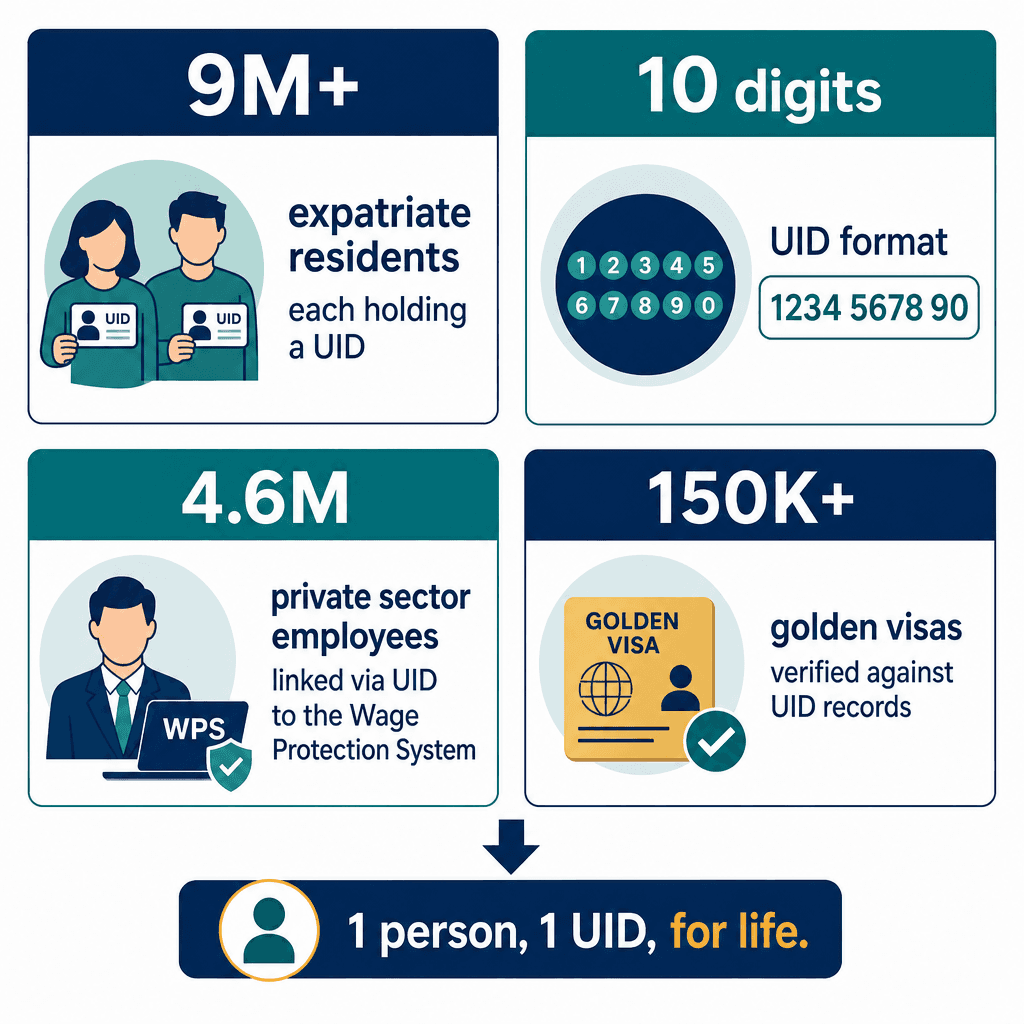
The UAE UID (Unique Identification Number) is a 10-digit code assigned by the ICP that stays with you for life, regardless of visa renewals or employer changes. One person receives one number, and every government interaction traces back to it.
ICP Issues and Owns Your UID Record
The Identity and Citizenship Authority (ICP), formerly FAIC, is the sole federal body responsible for assigning and maintaining UID records. It links your immigration, residency, and Emirates ID data into a single unified profile.
Find Your UID on Your Residence Visa Sticker
Look for the field labelled "Personal No." or "UID" printed just above the visa validity dates on your passport visa sticker. It is also embedded in your Emirates ID records and appears on entry permit documents.
UID and Emirates ID Are Not the Same
The UID is 10 digits and issued by ICP for immigration purposes, while the Emirates ID number is 15 digits and serves a different function across separate government systems. Submitting the wrong number on a form can trigger automatic rejection or stall a visa renewal.
Millions of Residents Rely on UID Daily
Over 9 million expatriate residents have been assigned a UID, and the Wage Protection System alone links more than 4.6 million private sector employees through their individual numbers. The 150,000-plus golden visas issued since launch are each verified against a UID record.
Your UID Survives Every Visa Category Change
Switching from an employment visa to an investor visa or converting to a 10-year golden visa does not generate a new UID. The same number assigned at your very first UAE residency application remains your identifier across every subsequent government portal interaction.
By Editorial Team, UAE business setup specialists with direct experience in free zone licensing, visa processing, and government portal compliance. Full bio →
Over 9 million expatriate residents currently live and work in the UAE. Every single one of them has been assigned a UID number. The UAE processed more than 1 million visa transactions through GDRFA Dubai alone in a single year. The Wage Protection System covers over 4.6 million private sector employees, all linked through their individual UIDs. The UAE golden visa programme has issued over 150,000 visas since its launch, each one verified against a UID record. And yet a significant share of residents cannot locate their UID number on demand, or worse, confuse it with their Emirates ID number and submit the wrong figure on a government form.
That single mistake can trigger an automatic rejection, stall a visa renewal, or block an Emirates ID application entirely. This guide explains exactly what a uid number uae is, how it differs from your Emirates ID, where to find it, and how to use it correctly across every major government portal, so you stop treating it as a bureaucratic footnote and start managing it as the compliance asset it actually is. For more detail, see our guide on UAE UID number detailed guide.
What is a UID Number in the UAE?
A UID (Unique Identification Number) in the UAE is a permanent numerical identifier assigned to every individual who enters the UAE's residency or visa system. Issued by the Identity and Citizenship Authority (ICP), it stays with you for life and links all your immigration, residency, and Emirates ID records in one unified profile. For more detail, see our guide on unified number importance in UAE immigration. Your UAE UID number is linked to your investor visa and is required for MOHRE registrations, banking and business setup applications.
The Official Definition and Issuing Authority
UID stands for Unique Identification Number, a permanent numeric code assigned by the UAE's Identity and Citizenship Authority, known as ICP (formerly the Federal Authority for Identity and Citizenship, or FAIC). The ICP is the federal body responsible for managing biometric and identity records for all UAE residents and visitors (ICP UAE, 2024).
Your uid number uae is assigned the first time you enter the UAE's residency ecosystem, whether that's through an employment visa, an investor visa, or a family sponsorship. From that point on, it becomes your permanent identifier across every interaction with the UAE's federal government systems. Unlike your passport number, it doesn't change when you renew your visa, switch employers, or move between visa categories.
Consider a British entrepreneur who received an investor visa in 2018, renewed it twice, and recently converted to a 10-year golden visa. He holds the exact same uid number uae that was assigned during his first UAE residency application in 2018. Every record, every renewal, every government portal interaction traces back to that single number. That's the design, one person, one identifier, for life.
What the UID Number Actually Looks Like
A UAE uid number uae is typically a 10-digit numeric code. It appears on your residence visa sticker in your passport, on entry permit documents, and is embedded in your Emirates ID records. On official documents it may be labelled "UID", "Unified ID", or "Personal Number" depending on which portal or form you're viewing, the label changes, but the number doesn't.
On a UAE residence visa sticker, look for the field labelled "Personal No." or "UID", it's the 10-digit number printed just above the visa validity dates. Don't confuse it with the Emirates ID number (which is 15 digits) or the GDRFA file number. These are distinct identifiers serving different functions across different government systems, and mixing them up is one of the most common causes of application delays in the UAE.
UAE Identification Numbers at a Glance (2026) | |||
Identifier | Format | Issuing Authority | Primary Use |
|---|---|---|---|
UID (Unique Identification Number) | 10 digits | ICP (Federal) | Visa, immigration, residency system |
Emirates ID Number | 15 digits (784-YYYY-XXXXXXX-X) | ICP (Federal) | Daily identification, banking, telecoms |
GDRFA File Number | Variable | GDRFA Dubai | Dubai visa file tracking |
Labour Card Number | Variable | MOHRE | Employment and WPS records |
How is it Different from Your Emirates ID Number?
Your Emirates ID number is the 15-digit code printed on your physical Emirates ID card, used for daily identification. Your UID is a separate 10-digit number embedded in the residency system that tracks your visa and immigration history. Both are linked, but they serve distinct functions across different government platforms.
Two Numbers, Two Purposes
Your Emirates ID number follows the format 784-YYYY-XXXXXXX-X (15 digits total) and is what you hand over at a bank, a hospital, or a hotel reception. It's the number that verifies your identity in private-sector and consumer transactions. Your uid number uae, by contrast, is the underlying residency system identifier, the number immigration officers, PRO firms, and government portals use to pull up your visa record, check your residency history, and verify there are no prior overstay flags or cancellation issues.
The two numbers are cross-referenced, your Emirates ID record and your residency record are linked using the UID as the connecting key. But they live in different fields on different forms, and substituting one for the other causes immediate system errors. Many residents go years without knowing their uid number uae because it's rarely required in daily life. The problem is that when you do need it, during a visa renewal, a golden visa application, or an Emirates ID correction, you need it immediately and exactly right.
When a company HR manager submits a new employee's visa application through the GDRFA e-services portal, it's the uid number uae, not the Emirates ID number, that the system requires to retrieve the employee's immigration history. The Emirates ID number simply won't work in that field, because it's the wrong identifier for that system.
When Each Number is Required
Your Emirates ID number is what you'll use for bank account opening, SIM card registration, health insurance claims, hotel check-in, and most private-sector transactions. Your uid number uae is what you'll need for visa renewals, status changes, GDRFA applications, MOHRE portal registration, and ICP services including Emirates ID renewal itself.
Some portals, including the UAE's federal government portal at u.ae, require both numbers at different stages of the same transaction. A Dubai-based marketing agency owner learned this the hard way when she tried to renew her team's Emirates IDs through ICP's smart services portal. She entered the Emirates ID numbers in the UID fields. The system rejected the forms immediately, a two-digit field length difference made the error obvious to the portal, but not to her until the rejection notice arrived.
Which number do I need for MOHRE registration?
MOHRE requires your uid number uae for all employee visa and labour card transactions, including Wage Protection System registration. Your Emirates ID number is not accepted as a substitute in MOHRE's employee management portal. Always verify the UID from your visa sticker or ICP Smart Services before starting any MOHRE submission.
Emirates ID Number vs UID Number: When to Use Each (2026) | ||
Transaction | Emirates ID Number | UID Number |
|---|---|---|
Bank account opening | Required | Not required |
SIM card registration | Required | Not required |
Visa renewal (GDRFA) | Not accepted | Required |
MOHRE employee registration | Not accepted | Required |
Emirates ID renewal (ICP portal) | Login only | Required for record retrieval |
Golden visa application | Supporting document | Primary identifier |
Where to Find Your UID Number
You can find your UAE uid number uae on your residence visa sticker in your passport (labelled "Personal No." or "UID"), through the ICP smart services portal using your Emirates ID, or by contacting the typing centre or PRO firm that processed your original visa application.
Physical Documents That Display Your UID
The most reliable physical source is your residence visa sticker. Look for the field labelled "Personal No." or "UID", it's the 10-digit number printed just above the visa validity dates. Your original entry permit (the document issued when your visa was first approved) also carries the uid number uae, and some ICP correspondence references it alongside your Emirates ID card number.
An Indian finance professional who relocated to Abu Dhabi in 2020 found her uid number uae printed in the top-right section of her residence visa sticker, labelled "Personal No.", a field she had previously ignored entirely because no bank or telecom provider had ever asked for it. When her employer's PRO needed the number to process her first visa renewal, she had to physically open her passport to find it. Worth knowing: even if your visa has since been renewed, your old visa sticker still displays your uid number uae correctly, because the number doesn't change.
Digital Channels for Retrieving Your UID
If you don't have your passport to hand, the ICP Smart Services portal at icp.gov.ae lets you log in with your Emirates ID number and retrieve your full residency record, which includes your uid number uae. UAE PASS, the national digital identity app, links to your ICP profile and can surface the number within your residency details. For Dubai residents specifically, the GDRFA portal at gdrfad.gov.ae allows residency status checks that display the UID. Abu Dhabi residents can use the Abu Dhabi Residents Office (ADRO) portal for the same purpose.
A free zone company director who lost his passport was able to retrieve his uid number uae within minutes through the ICP Smart Services portal, using just his Emirates ID number and a face ID verification via UAE PASS. No office visit required. That's the fastest route if you're in a time-sensitive situation and your physical documents aren't accessible.
Why Your UID Number Matters for Business Owners
For business owners in the UAE, the uid number uae is the backbone of every visa, labour, and government portal transaction. Without it, you cannot sponsor employees, renew residency visas, register on MOHRE, or process Emirates ID renewals. Errors or gaps in UID records can stall operations and expose businesses to compliance risk.
Employee Visa Sponsorship and Labour Compliance
Every employee visa you sponsor as a UAE business is tracked under both your company's establishment card and each employee's individual uid number uae. MOHRE requires the UID to register employees, issue labour cards, and manage Wage Protection System (WPS) salary transfers. The WPS currently covers over 4.6 million private sector employees, and every single one of those salary records is linked to a UID. If an employee's uid number uae is incorrectly recorded in your MOHRE file, salary disbursements can be flagged and the employee's labour card may fail to generate. MOHRE fines for WPS non-compliance can reach AED 5,000 per affected employee.
A logistics company operating in a major free zone discovered that three of their employees had been enrolled in MOHRE under a transposed UID digit, a single number switched during manual data entry at the typing stage. When WPS salary transfers were processed, the system flagged the mismatch and temporarily blocked the company's ability to add new visa quotas. Resolving it took two weeks and a formal ICP correction application. The operational disruption was entirely avoidable with a pre-submission UID audit.
Visa Renewals, Status Changes, and Cancellations
Every residency transaction, renewal, amendment, cancellation, or category change, is processed against the employee's uid number uae in the GDRFA system. A discrepancy between the UID on file with GDRFA and the UID in your company documents will trigger a rejection at the typist stage, before the application even reaches an immigration officer. Business owners applying for their own investor or partner visa renewals face the same requirement: the UID on the trade license file must match the ICP record exactly.
A co-founder of a Dubai mainland company applied to upgrade his 3-year investor visa to a 10-year golden visa. The application was rejected because his trade license file carried a legacy uid number uae from his original 2016 visa, a number that had been manually re-entered incorrectly during a 2019 company restructure. Correcting it required a formal ICP amendment request, a notarised document set, and a processing window of approximately 10 working days. The golden visa programme has issued over 150,000 visas since its launch (UAE Government Portal, 2023), and every single application goes through UID verification before approval.
One important note for free zone operators: companies processing visas through zone authorities still rely on federal UID records managed by ICP and GDRFA. A UID error in a free zone visa file requires a federal correction, not a zone-level fix. Your Dubai South Business Hub Free Zone residency services team can facilitate that correction, but the authority sits with ICP.
How to Use Your UID Number on Government Portals
To use your uid number uae on UAE government portals, locate it on your visa sticker first, then enter it accurately in the designated field on ICP, GDRFA, or MOHRE platforms. Always cross-check the number before submission, a single digit error triggers automatic rejection and requires a formal correction process to resolve.
Step 1: Confirm Your UID Before Starting Any Application
Before logging into any UAE government portal, retrieve your uid number uae from your physical visa sticker or the ICP Smart Services portal and write it down exactly as it appears. Don't rely on memory, and don't copy it from a third-party document like a PRO's email or a scanned form, always verify against the ICP source record directly. If you're processing applications on behalf of employees, collect each employee's UID individually and maintain a secure internal HR record.
PRO teams at established UAE companies maintain a master UID register for all visa holders on their company file, updated every time a visa is renewed, so that any government portal submission can be verified in seconds rather than minutes. It's a simple practice that eliminates the single most common cause of portal application failures.
Step 2: Navigate the Correct Portal for Your Transaction
Each major government portal serves a specific function, and each one requires your uid number uae at a different stage. ICP Smart Services at icp.gov.ae handles Emirates ID renewals, personal data amendments, and residency record queries, the UID is required at the login or application stage. GDRFA Dubai at gdrfad.gov.ae manages visa renewals, entry permits, status changes, and cancellations for Dubai residents, the UID is the primary identifier for individual records in this system. MOHRE's portal at mohre.gov.ae covers labour card issuance, WPS registration, and employee data management, the UID links the employee's immigration record to their labour file. For more detail, see our guide on UAE immigration card explained.
A free zone HR manager processing a batch of visa renewals through GDRFA's e-services platform confirmed that each renewal submission requires the employee's uid number uae in the "Applicant ID" field. Without it, the system cannot retrieve the employee's existing residency record and the application simply cannot proceed. There's no workaround, the UID is the entry point.
Step 3: Submit, Track, and Store Your Confirmation
After submitting any portal application using your uid number uae, save the application reference number and screenshot the confirmation page. UID-based tracking lets you check real-time status updates on both the GDRFA and ICP portals without needing to call or visit the authority. Once the transaction completes, update your internal records to confirm the UID used matches the ICP record, this prevents compounding errors on future applications.
After successfully renewing four employee visas through GDRFA, a Dubai South free zone company received digital confirmation emails referencing each employee's uid number uae. Their HR team used those confirmations to update their internal HR system the same day, keeping their records aligned with federal immigration data. That's the right process, submit, confirm, update, store.
Useful Resources
Citations
Federal Authority for Identity, Citizenship, Customs and Port Security.. icp.gov.ae. ICP UAE, 2024.
General Directorate of Residency and Foreigners Affairs Dubai.. gdrfad.gov.ae. GDRFA Dubai, 2024.
Ministry of Human Resources and Emiratisation.. mohre.gov.ae. MOHRE UAE, 2024.
UAE Government Portal.. u.ae. UAE Government, 2024.
Dubai Economy and Tourism.. dubaidet.gov.ae. DET Dubai, 2024.
Frequently Asked Questions