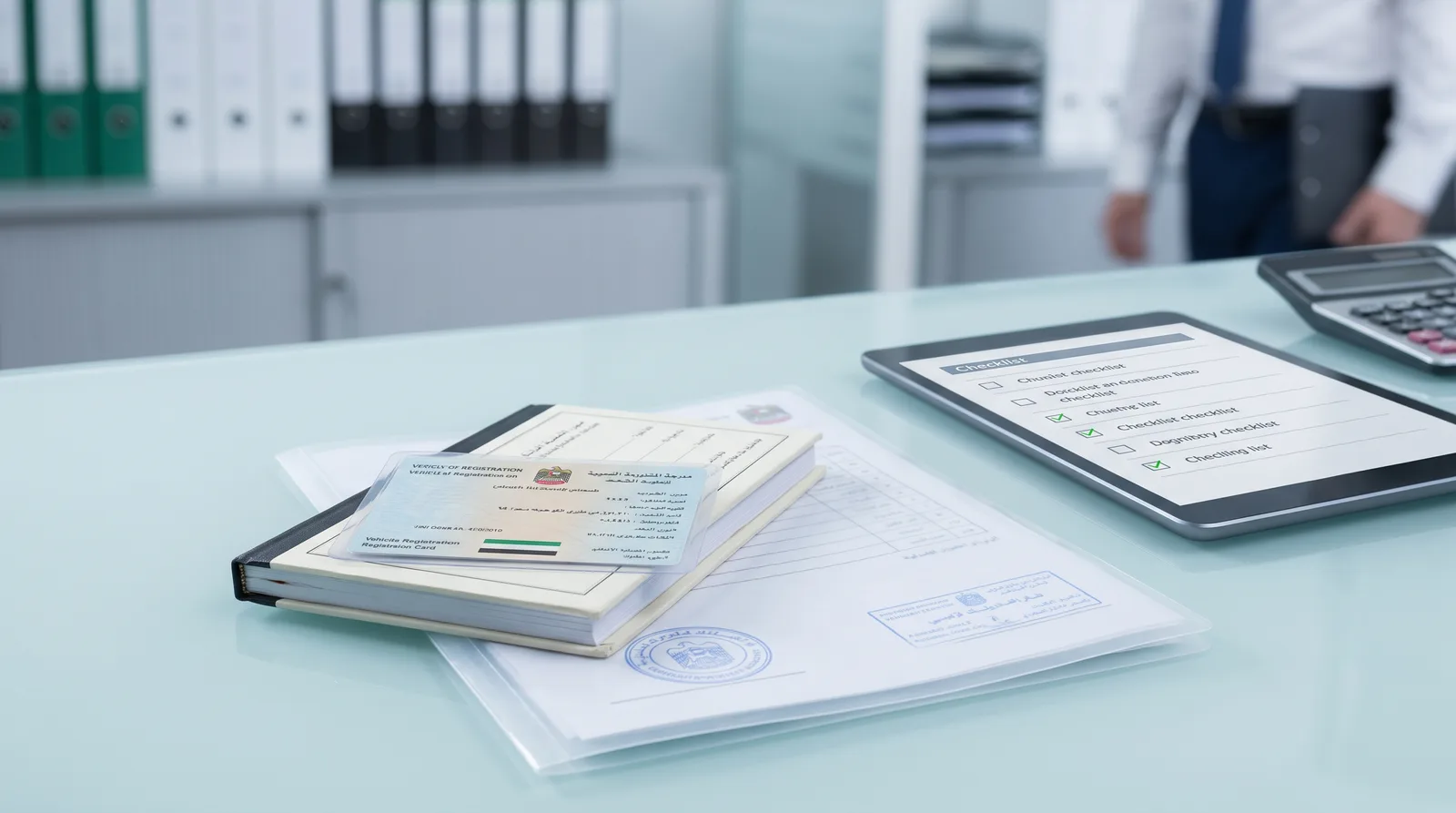
Topic Summary
What Vehicle Documents a Dubai Company Must Hold
A Dubai company must hold a valid vehicle registration card (Mulkiya), a UAE motor insurance certificate of at least third-party cover, a passing vehicle inspection certificate, and the driver's UAE license. Commercial vehicles also require a route permit or no-objection letter f
Vehicle Documents Dubai Cost: One-Off and Recurring Fees
Vehicle document costs in Dubai split into one-off fees, registration, title transfer, plate issuance, and annual recurring fees covering Mulkiya renewal, insurance, and inspection. A typical light commercial vehicle costs AED 1,200–AED 2,000 to register initially and AED 1,100–A
How to Register a Company Vehicle in Dubai: Step-by-Step
To register a company vehicle in Dubai, obtain motor insurance first, then book an RTA inspection if the vehicle is over three years old, submit the vehicle documents at an RTA registration centre with your trade license and Emirates ID of the authorised signatory , pay the fees,
Commercial Vehicle Documents: What Changes for Vans, Trucks, and Specialist Fleets
Commercial vehicles in Dubai require a commercial-grade insurance policy, a valid RTA route permit for goods transport, and in some cases a Dubai Police heavy vehicle permit. Light commercial vehicles under 3.5 tonnes follow a streamlined RTA path; heavier vehicles face additiona
Operating a single unregistered company vehicle in Dubai can trigger an RTA fine of AED 10,000, and that figure doubles if the vehicle is also running without valid insurance (u.ae, 2024). Most first-time founders discover the full scope of vehicle documents a company in Dubai must hold only after a roadside stop or a failed fleet audit, by which point the penalties are already accumulating.
This guide covers every document your company must keep for each vehicle, what each one costs, how the renewal cycle works, and exactly where the process tends to stall. Read it before your first vehicle goes on the road.
Vehicle Document Costs: One-Off vs. Annual Recurring Fees
Cost Item | One-Off Costs | Annual Recurring Costs |
|---|---|---|
Vehicle Registration (Mulkiya) | AED 370–AED 450 for first registration of a new vehicle (RTA, 2024) | AED 370–AED 450 per vehicle per year at renewal (RTA, 2024) |
Title Transfer / Insurance | AED 350 for title transfer of a used vehicle purchased by a company (RTA, 2024) | AED 700–AED 5,000+ per year for commercial motor insurance depending on vehicle type and value |
Number Plate / RTA Inspection | Standard number plate included in the base registration fee; no separate charge | AED 150–AED 350 per inspection for vehicles over three years old (RTA, 2024) |
Replacement Mulkiya / Late Fines | AED 50–AED 100 to replace a lost or damaged Mulkiya at any RTA centre (RTA, 2024) | AED 10 per day for each day the Mulkiya renewal is overdue |
Exclusions | PRO service fees, customs transit permits, specialist route permits, and bank NOC fees are NOT included above | Fleet management software, fuel cards, and vehicle servicing are NOT included above |
What Vehicle Documents a Dubai Company Must Hold
A Dubai company must hold a valid vehicle registration card (Mulkiya), a UAE motor insurance certificate of at least third-party cover, a passing vehicle inspection certificate, and the driver's UAE license. Commercial vehicles also require a route permit or no-objection letter from the RTA. Missing any one of these makes the vehicle non-compliant and exposes the company to fines, impoundment, and potential liability.
The Mulkiya: Your Primary Registration Card
The Mulkiya is issued by the Roads and Transport Authority (RTA) and is the foundational proof of ownership and roadworthiness for every company vehicle. It must be kept inside the vehicle at all times and produced on request by Dubai Police or RTA inspectors. The card displays the chassis number, plate number, registered owner (the company), and expiry date, and every detail must match your trade license exactly.
A mismatch between the company name on the Mulkiya and the trade license is one of the most common compliance gaps found during fleet audits. Consider this scenario: a logistics company operating three delivery vans discovers during a Dubai Police check that one Mulkiya still shows the previous owner's name after a second-hand purchase. The vehicle is impounded until a title transfer is completed at the RTA, a delay that costs the business a full working day and AED 350 in transfer fees.
Mulkiya renewal fee: AED 370–AED 450 per vehicle per year depending on vehicle type (RTA, 2024)
Title transfer fee for a used vehicle purchased by a company: AED 350 (RTA, 2024)
The Mulkiya must be physically present in the vehicle, not just stored digitally
Insurance Certificate: Minimum Cover Required
UAE law mandates at minimum third-party liability insurance for every motor vehicle on the road. Comprehensive cover is optional, but strongly advisable for company fleets where vehicle downtime directly affects operations. The insurance certificate must be current, even a one-day lapse invalidates the Mulkiya renewal process entirely.
Commercial vehicles (vans, trucks, tankers) require a commercial motor insurance policy specifically. A standard private vehicle policy will not be accepted by the RTA for a company-registered vehicle. The Insurance Authority UAE regulates approved insurers; only policies from providers on their licensed register are accepted. A trading company renewing four van registrations once found that its insurer's license had lapsed, the RTA rejected all four certificates and the entire renewal was delayed until a replacement policy from an approved provider was sourced.
Third-party only insurance for a light commercial vehicle runs approximately AED 700–AED 1,200 per year (market average, 2024). Comprehensive commercial cover ranges from AED 2,000 to AED 5,000 or more depending on vehicle value and declared use.
Vehicle Inspection Certificate and NOC Requirements
Vehicles more than three years old must pass an RTA-approved inspection before the Mulkiya can be renewed. The inspection covers brakes, lights, tyres, emissions, and chassis integrity. A pass certificate is valid only for that renewal cycle, it doesn't carry forward.
Commercial vehicles operating on specific routes, such as heavy goods transport or passenger transport, require a separate route permit or no-objection certificate (NOC) from the RTA. Worth flagging for free zone operators: companies transporting goods beyond the free zone boundary into Dubai mainland must also hold a customs-endorsed transit document. A newly registered free zone company that starts delivering goods to mainland clients without this NOC faces a fine and vehicle detention at the first checkpoint, even if the Mulkiya and insurance are both valid.
RTA inspection fee: AED 150–AED 350 depending on vehicle category. Re-inspection after a failure: AED 60 per re-test (RTA, 2024).
Vehicle Documents Dubai Cost: One-Off and Recurring Fees
Vehicle document costs in Dubai split into one-off fees, registration, title transfer, plate issuance, and annual recurring fees covering Mulkiya renewal, insurance, and inspection. A typical light commercial vehicle costs AED 1,200–AED 2,000 to register initially and AED 1,100–AED 1,800 per year to maintain. Knowing which bucket each cost falls into helps you build an accurate startup budget from the outset.
One-Off Registration and Setup Costs
First registration of a new vehicle includes plate issuance, Mulkiya production, and RTA administration fees. Standard number plates are included in the base registration, no separate charge. Second-hand vehicles purchased in a company name incur a title transfer fee on top of standard registration. Custom or personalised plates carry additional fees that vary by number combination.
A practical example: a service company buying a used pick-up truck pays AED 350 for the title transfer, AED 370 for the new Mulkiya, AED 150 for inspection (the vehicle is four years old), and AED 900 for third-party insurance. Total first-year outlay: AED 1,770. These are standard RTA published rates and exclude any PRO service fees, customs transit permits, or specialist route permits your operation may require.
Annual Recurring Document Costs
Mulkiya renewal is due every year and can't be completed without a valid insurance certificate and, where applicable, a passing inspection certificate. Insurance is the largest recurring variable, premiums shift with the vehicle's age, declared value, and claims history.
Mulkiya renewal: AED 370–AED 450 per vehicle per year (RTA, 2024)
Commercial insurance (third-party): AED 700–AED 1,200 per year
Commercial insurance (comprehensive): AED 2,000–AED 5,000+ per year
RTA inspection (vehicles over 3 years): AED 150–AED 350 per cycle
Late renewal fine: AED 10 per day per vehicle
Companies with fleets of five or more vehicles can negotiate fleet insurance rates, which typically reduce per-vehicle premiums by 10–20%. A company with six delivery vans that negotiates a fleet policy can reduce its average per-vehicle cost from AED 1,100 to AED 920, saving AED 1,080 across the fleet annually. Early renewal is available up to 30 days before Mulkiya expiry, so there's no reason to let a fine accumulate. For a full picture of your startup outlay, use the business setup cost calculator to add vehicle document fees as a separate line item.
How to Register a Company Vehicle in Dubai: Step-by-Step
To register a company vehicle in Dubai, obtain motor insurance first, then book an RTA inspection if the vehicle is over three years old, submit the vehicle documents at an RTA registration centre with your trade license and Emirates ID of the authorised signatory, pay the fees, and collect the Mulkiya. The sequence matters, skipping a step means a rejected application and a second visit.
Step 1: Prepare Your Company Documents
You need the original trade license, a copy of the authorised signatory's Emirates ID, and a letter of authorisation if a PRO is handling the registration on the company's behalf. Free zone companies must present the free zone license, not a mainland DET license, and confirm the vehicle will be registered under the free zone entity's name. Financed vehicles also require the bank's NOC and the original sales invoice.
A newly licensed free zone trading company once sent its PRO to the RTA with only the Emirates ID. The transaction was rejected because the original trade license wasn't present, a second trip the following day added an unnecessary delay. Double-check your document pack before leaving the office.
Step 2: Obtain Insurance Before You Visit the RTA
The RTA won't process a registration or renewal without a valid insurance certificate, so insurance must be arranged first, not as an afterthought at the counter. Policies can be arranged directly with an Insurance Authority UAE-approved insurer or through a licensed broker. The certificate must show the company as the named insured, matching the trade license name exactly.
An ICT company registering its first company car arranged insurance online in under two hours, received the certificate by email, and completed the RTA registration the same morning. The whole process, start to finish, took less than half a day. Always verify your insurer appears on the Insurance Authority UAE approved register before purchasing, the RTA checks this at the counter.
Step 3: Complete the RTA Registration and Collect the Mulkiya
Walk-in registration is available at RTA vehicle licensing centres across Dubai, including locations at Umm Ramool, Al Barsha, and Deira. Appointments can also be booked via the RTA app, which reduces waiting time significantly. Payment is accepted by card or cash. The Mulkiya is printed and handed over on the same day for standard registrations, and number plates are issued at the same visit for new vehicles.
A services company that pre-booked appointments registered two vans in a single RTA visit, total time at the centre was under 45 minutes, and both Mulkiyas were collected before noon. That's the realistic best case when your documents are in order.
Commercial Vehicle Documents: What Changes for Vans, Trucks, and Specialist Fleets
Commercial vehicles in Dubai require a commercial-grade insurance policy, a valid RTA route permit for goods transport, and in some cases a Dubai Police heavy vehicle permit. Light commercial vehicles under 3.5 tonnes follow a streamlined RTA path; heavier vehicles face additional licensing layers that can extend the setup timeline by several days.
Light Commercial Vehicles (Under 3.5 Tonnes)
Pickup trucks and vans under 3.5 tonnes follow the standard RTA registration path, with the key difference being a commercial insurance policy rather than a private one. These vehicles can be registered under a free zone or mainland trade license. Annual inspection is required once the vehicle exceeds three years from first registration. Mulkiya renewal for light commercial vehicles runs AED 420–AED 450 per year (RTA, 2024).
A real estate brokerage that registers a branded van under its free zone license for site visits follows exactly this path, the process mirrors standard private vehicle registration in every respect except the insurance category. Check that your business activities list covers the intended vehicle use before registering.
Heavy Vehicles and Specialist Equipment
Trucks over 3.5 tonnes require a separate heavy vehicle classification on the Mulkiya and a higher insurance category. Route permits from the RTA are mandatory for heavy goods vehicles operating on designated roads. Oversized or abnormal loads require a Dubai Police escort permit in addition to the RTA documents. Crane vehicles, tankers, and refrigerated trucks each have category-specific inspection requirements that go beyond the standard brake-and-lights check.
Heavy vehicle Mulkiya: separate classification, higher registration band
RTA route permit: mandatory for goods transport on designated routes
Dubai Police escort clearance: required for oversized or abnormal loads
Category-specific inspections: cranes, tankers, refrigerated units assessed separately
A company transporting construction materials with a 10-tonne truck must hold both an RTA route permit and a Dubai Police escort clearance. Without both documents
References
Frequently Asked Questions