Topic Summary
Dubai South's Scale Sets It Apart
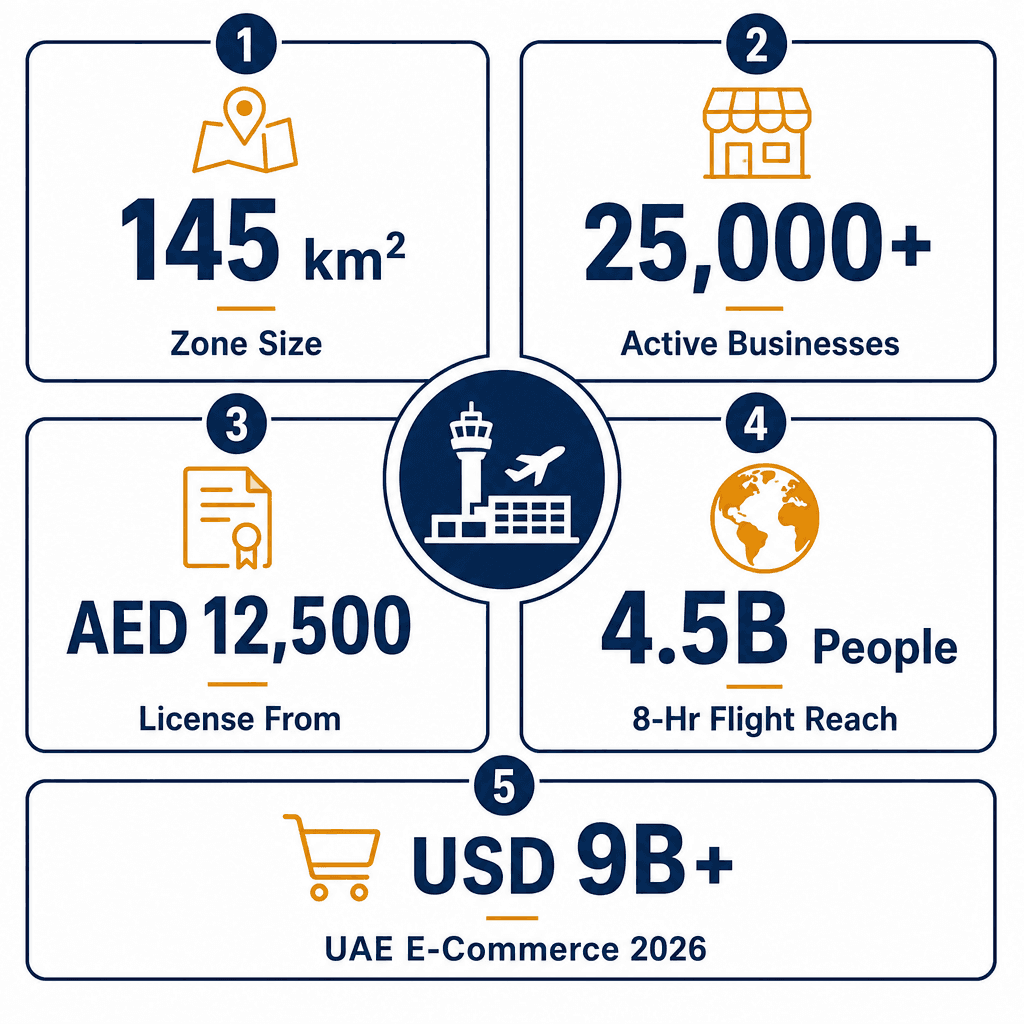
Dubai South spans 145 sq km and hosts over 25,000 active businesses, giving operators genuine ecosystem scale rather than just planning ambition. Its size also means businesses can expand in phases without relocating.
Airport Access Unlocks a Massive Market
Al Maktoum International Airport sits at the heart of Dubai South and sits within an 8-hour flight radius of approximately 4.5 billion people. For distribution and 3PL operators, that connectivity is a core strategic advantage.
Bonded Status Delivers Real Cash-Flow Benefits
Bonded warehouse status lets businesses store imported goods without triggering UAE import duty until items physically leave the zone. An e-commerce retailer holding electronics inventory, for example, defers the 5% import duty until each order ships domestically.
Free Zone Licensing Beats Mainland on Key Terms
Dubai South free zone licenses offer 0% corporate tax on qualifying income up to AED 375,000 and 100% foreign ownership, advantages not available under standard mainland industrial licenses in areas like Al Quoz or Dubai Investment Park. Licenses start from AED 12,500.
One License Can Cover Multiple Logistics Activities
A single Dubai South free zone logistics license can cover storage, pick-and-pack, and last-mile dispatch under one regulatory framework. This removes the need for 3PL and distribution operators to manage multiple license types for closely related activities.
Understand the Trade-Off for Domestic Sales
While free zone status offers significant advantages, direct retail sales into the UAE domestic market require a customs clearance step or a mainland distributor arrangement. Operators whose primary flow is import-store-export face this constraint least.
E-Commerce Growth Makes Dubai South Timely
The UAE e-commerce market is projected to exceed USD 9 billion by 2026, making logistics infrastructure investment increasingly time-sensitive. Dubai South's integrated free zone and airport proximity position it as a natural hub for fulfilment operations targeting that growth.
In 2026, Dubai South spans 145 sq km [1] and hosts over 25,000 active businesses [2]. Al Maktoum International Airport sits at its core, targeting 260 million passengers at full build-out [3]. The UAE e-commerce market is projected to exceed USD 9 billion by 2026 [4]. Free zone licenses start from AED 12,500 [5]. The airport's 8-hour flight radius covers approximately 4.5 billion people [6]. For any e-commerce, distribution, or 3PL operator evaluating warehouse Dubai South options, the infrastructure footprint here is unlike anything else in the UAE.
This guide covers the types of warehouse and industrial facilities available at Dubai South, which business models they suit best, the operational advantages of locating here, and the practical factors to weigh before signing a lease, so you can make a well-grounded location decision. For more detail, see our guide on Dubai South residential and business communities.
What Is a Warehouse Dubai South and How the Zone Is Structured
A warehouse Dubai South is an industrial or storage facility located within the Dubai South master-planned city, a 145 sq km free zone and logistics hub adjacent to Al Maktoum International Airport. Units range from small fulfilment bays to large-scale distribution centres, all operating under a single integrated free zone authority. For more detail, see our guide on warehouse cost in a Dubai free zone.
The Dubai South Master Plan and Its Logistics Core
Dubai South is a purpose-built city divided into eight distinct districts. The Logistics District is the primary zone for warehousing and industrial activity, sitting closest to the airport cargo terminal and offering the densest concentration of ready-built and built-to-suit facilities.
The zone is governed by the Dubai South Free Zone Authority (Dubai South Business Hub Free Zone), which issues licenses and manages tenancy for the entire master-planned area. With over 25,000 active businesses across the ecosystem, the zone has genuine operational scale, not just planning ambition. That 145 sq km footprint gives operators room to expand without relocating, which matters if you're planning multi-phase distribution growth.
Worth flagging for license planning: under the UN's International Standard Industrial Classification (ISIC Rev.4), warehousing and storage activities sit under Section H, Division 52. That classification shapes how Dubai South Business Hub Free Zone categorises and licenses storage operations versus manufacturing activities, a distinction that affects which license type you'll need and what activities it covers.
A regional 3PL provider establishing its GCC hub at Dubai South can hold a single free zone logistics license covering storage, pick-and-pack, and last-mile dispatch under one regulatory roof, no need to juggle multiple license types for related activities.
Free Zone vs. Mainland Warehousing: Key Structural Differences
Free zone warehouses at Dubai South benefit from 0% corporate tax on qualifying income up to AED 375,000 (UAE FTA, 2023) and 100% foreign ownership, both unavailable under a standard mainland industrial license in areas like Dubai Investment Park (DIP) or Al Quoz.
Bonded warehouse status is available at Dubai South, allowing goods to be stored without triggering UAE import duty until they physically leave the zone. For importers holding large volumes of international stock, that's a meaningful cash-flow advantage. An e-commerce retailer importing consumer electronics from Asia can hold inventory in a bonded warehouse Dubai South unit, deferring the 5% import duty until each order is dispatched domestically.
The trade-off: direct retail sales into the UAE domestic market require a customs clearance step or a mainland distributor arrangement. For operators whose primary flow is import-store-export or import-store-dispatch, that's rarely a constraint. For details on license structures, see our Dubai South Free Zone guide. For more detail, see our guide on Dubai South Free Zone global trade advantages.
Types of Warehouse and Industrial Facilities Available at Dubai South
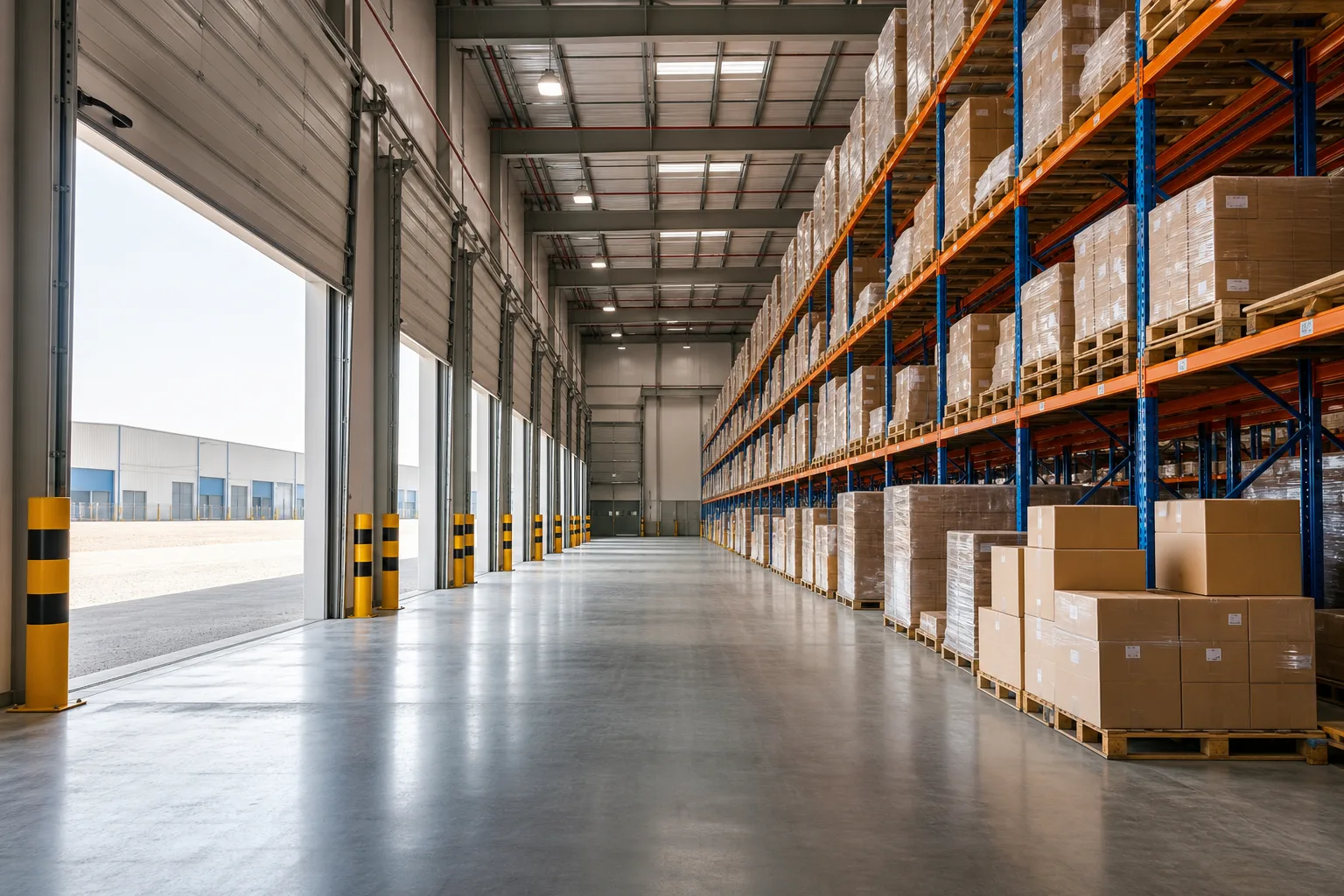
Dubai South offers standard warehouses, temperature-controlled cold storage, light industrial units, built-to-suit distribution centres, and open yard storage. Sizes range from small bay units of around 500 sq ft to large-format facilities exceeding 50,000 sq ft, with bonded and non-bonded configurations available across the Logistics District.
Standard and Large-Format Distribution Warehouses
Conventional dry warehouses are the most common format across the zone, suited to FMCG, retail, and general cargo operators. Modern stock at Dubai South typically features clear heights of 10–14 m, multiple dock-leveller doors, and hard-standing yards designed for HGV turning. Large-format distribution centres ranging from 20,000 to over 100,000 sq ft are available on longer-term leases for operators running regional hubs.
Built-to-suit options let tenants specify racking configurations, mezzanine floors, and office-to-warehouse ratios from the ground up. Timelines typically run 12–18 months from planning approval, so factor that into your go-live schedule if you're pursuing a custom build rather than taking ready stock.
One UAE e-commerce platform scaled from a 2,000 sq ft bay unit to a 15,000 sq ft distribution warehouse within the same Dubai South sub-zone, avoiding the operational disruption of a full relocation, a genuine advantage of the zone's inventory depth.
Cold Storage and Temperature-Controlled Units
Dedicated cold chain infrastructure at Dubai South supports food, pharma, and biotech operators requiring 2°C–8°C ambient or frozen environments down to -18°C. Proximity to Al Maktoum Airport is the defining advantage here: goods can move from aircraft to chilled storage in under 30 minutes, cutting the ambient exposure window that matters most for perishable and temperature-sensitive cargo.
A Gulf food importer routing chilled produce from Europe via Al Maktoum can transfer cargo directly to an on-zone cold store, preserving shelf life in a way that an off-airport warehouse simply can't replicate. Cold storage demand across the UAE is growing at roughly 8% annually (industry estimates), and Dubai South's airport-adjacent position makes it the natural concentration point for that growth.
Pharma operators should verify GDP (Good Distribution Practice) compliance certification for any cold chain facility they're evaluating, not all units carry it, and it's a non-negotiable for regulated product distribution.
Light Industrial Units and Flex Spaces
Light industrial units combine warehouse floor space with production or assembly areas, suited to contract manufacturers, packaging operations, and light engineering businesses. Under ISIC Rev.4, contract manufacturing falls under Section C (Manufacturing) regardless of whether the operator owns the raw materials, a classification point that directly affects which license type Dubai South Business Hub Free Zone will issue for your operation.
Flex units from approximately 500 sq ft serve early-stage operators and product-based startups needing storage plus workspace without committing to large-format leases. A contract packaging company assembling promotional kits for regional FMCG brands, for example, operates from a 1,800 sq ft flex unit at Dubai South, warehouse, assembly, and dispatch under one roof on a 12-month rolling lease.
Dubai South Facility Types and Best-Fit Use Cases
Facility Type | Best-Fit Use Case |
|---|---|
Standard Dry Warehouse | FMCG, retail, and general cargo distribution; high-velocity SKU storage with dock-door access |
Large-Format Distribution Centre | Regional 3PL hubs, omnichannel fulfilment operations handling multi-client or multi-channel inventory at scale |
Cold Storage Unit | Food importers, pharmaceutical distributors, and perishable air freight operators requiring GDP-compliant environments |
Light Industrial / Flex Unit | Contract manufacturing, promotional kit assembly, packaging operations, and product-based startups needing combined workspace and storage |
Bonded Warehouse | Importers deferring UAE customs duty, re-export operators routing GCC-bound stock without incurring domestic import costs |
Open Yard Storage | Oversized cargo, construction materials, project freight, and vehicle logistics requiring hardstanding rather than covered space |
Who Should Be Warehousing at Dubai South
Dubai South warehouse space suits e-commerce fulfilment operators, regional distributors, 3PL providers, cold chain logistics companies, and light manufacturers needing proximity to Al Maktoum Airport and Jebel Ali Port. Businesses with cross-border trade flows, bonded storage needs, or plans to scale GCC distribution benefit most from the zone's infrastructure. For more detail, see our guide on trading and logistics business at Dubai South. For more detail, see our guide on warehouse lease guide for Dubai trading companies.
E-Commerce Fulfilment and Last-Mile Operations
Is your fulfilment operation genuinely optimised for same-day UAE delivery? Dubai South's position between Al Maktoum Airport and the Expo City interchange puts it within 25–35 minutes of most Dubai residential areas, a workable window for same-day SLAs without a secondary urban distribution point.
With the UAE e-commerce market projected to exceed USD 9 billion by 2026 (Statista estimates), the volume case for a well-positioned logistics warehouse dubai is clear. The zone's 24/7 UAE Customs operations reduce clearance delays for high-velocity SKUs shipped by air freight, which matters when you're promising next-day or same-day delivery on international stock.
A cross-border e-commerce operator fulfilling orders across the GCC routes inbound air freight directly from Al Maktoum into a bonded warehouse Dubai South unit, dispatching duty-paid parcels same day to UAE addresses and re-exporting GCC orders duty-free. That single operational setup covers two distinct trade flows from one location.
3PL Providers and Regional Distribution Hubs
Third-party logistics operators can consolidate multi-client inventory under one free zone license, reducing overhead compared to running separate mainland and free zone entities. The Dubai Logistics Corridor, a dedicated bonded transport link connecting Al Maktoum Airport directly to Jebel Ali Port, is the infrastructure differentiator that makes industrial space dubai south genuinely compelling for intermodal operators.
Jebel Ali handles over 14 million TEUs annually (DP World, 2024), making it the region's dominant sea freight gateway. A 3PL managing contracts for three consumer goods brands can consolidate all three into a single 30,000 sq ft Dubai South facility, running air freight receipts and sea freight despatch from the same dock configuration. That's a cost and complexity reduction that off-corridor locations simply can't replicate.
Multi-client inventory under one free zone license
Intermodal air-to-sea transfers via the Dubai Logistics Corridor
Scalable floor space aligned to client contract growth
24/7 customs clearance reducing dwell time on time-sensitive cargo
5 Operational Advantages of Warehouse Dubai South Over Competing Locations
The five core advantages of warehouse Dubai South are: direct airport adjacency for air freight, intermodal access via the Dubai Logistics Corridor to Jebel Ali Port, bonded storage eligibility, free zone tax and ownership benefits, and a scalable inventory of ready-built and built-to-suit industrial space within a single governed zone.
Airport and Port Connectivity That Changes the Supply Chain Maths
A pharmaceutical distributor shipping temperature-sensitive products from Europe compared Dubai South to a DIP warehouse and found the airport-adjacent cold store cut airside transfer time by roughly 40 minutes per consignment. At GDP compliance audit, that 40-minute window is the difference between a pass and a cold-chain deviation record.
Bonded Storage and Customs Efficiency
Bonded warehouse status allows goods to be stored, consolidated, and re-exported without triggering UAE import duty, currently set at 5% on most goods under the GCC common external tariff. At scale, deferring that cost until point of domestic sale is a material cash-flow advantage, particularly for importers holding high-value inventory.
Operators serving GCC markets can use storage dubai south as a duty-suspension hub, routing orders to Saudi Arabia, Kuwait, and Oman without incurring UAE import costs on transit stock. The 24/7 UAE Customs presence at the zone reduces the clearance queues that affect off-airport warehouses, keeping high-velocity SKUs moving. Use the cost calculator to model the duty deferral benefit against your specific import volumes before committing to bonded versus non-bonded space.
Is Dubai South the Right Choice for Warehousing?
For operators prioritising air freight adjacency and e-commerce fulfilment, warehouse Dubai South has a clear edge: on-zone warehouses sit within 5 km of Al Maktoum's cargo terminal, offering unmatched speed for airside logistics. Dubai South Business Hub Free Zone also supports bonded storage and full free zone benefits, making it a strong fit for businesses whose primary freight mode is air cargo and whose delivery geography spans regional and global markets.
Practical Considerations When Choosing Industrial Space Dubai South
When evaluating industrial space Dubai South, operators should assess unit size and clear height against throughput projections, confirm bonded versus non-bonded status, review lease term flexibility, check utility provision (three-phase power, chilled water for cold chain), and align the facility's ISIC activity classification with their intended license type before committing.
Sizing, Spec, and Lease Structure
Calculate required floor area based on peak inventory volume, not average. Undersizing for peak demand is the most common warehouse leasing mistake in fast-growth e-commerce, and it's expensive to fix mid-lease.
Clear height: A 12 m clear height with narrow-aisle racking yields 40–60% more pallet positions than a 6 m unit of the same footprint.
Lease terms: Standard leases at Dubai South run 1–5 years; flex units offer 12-month rolling terms at a per-sq-ft premium.
Total occupancy cost: Confirm whether service charges, utilities, and chiller plant costs are included, headline rent and total cost can diverge significantly.
Dock doors and yard: Match dock door count to inbound/outbound frequency; insufficient dock capacity creates throughput bottlenecks at peak.
An e-commerce operator projecting 2,000 pallet positions at peak quoted on two units: a 6,000 sq ft unit at 6 m clear height and a 4,000 sq ft unit at 12 m. The taller unit cost 15% more per sq ft but delivered the same pallet capacity, a better cost-per-pallet outcome and a smaller footprint to heat, cool, and maintain.
License Type, Activity Classification, and Regulatory Fit
The activity on your Dubai South license must match the primary use of the warehouse. A logistics license covers storage and distribution (ISIC Rev.4, Section H, Division 52); a light industrial license covers assembly or manufacturing (Section C). Mixing activities without the correct license structure creates a compliance risk that typically surfaces at audit or renewal.
If you're running ancillary activities, in-house transport, secondary packaging, kitting, confirm with Dubai South Business Hub Free Zone whether these are absorbed under the principal activity classification or require a separate endorsement. Under ISIC Rev.4, the principal activity is determined by the top-down value-added method (UN, 2008): the activity generating the most value added defines the classification, and ancillary activities that solely support the main operation don't require separate classification.
A 3PL operator adding a contract packing service for a new client should check with Dubai South Business Hub Free Zone whether the activity falls under its existing logistics license or requires a manufacturing endorsement, a 30-minute query that avoids a potential compliance flag at audit. Free zone licenses start from AED 12,500; see the Dubai South business setup cost guide for a full fee breakdown.
How to Secure a Warehouse for Rent Dubai South: Step-by-Step
To secure a warehouse for rent Dubai South, operators should define space requirements and activity type, shortlist facilities by spec and bonded status, obtain indicative terms, align the license activity with the intended warehouse use, submit the tenancy and license application to Dubai South Business Hub Free Zone, and complete fit-out before operational launch.
Four-step process: Define requirements, shortlist and negotiate, apply to Dubai South Business Hub Free Zone, fit out and go live. Securing a Warehouse for Rent Dubai South
Citations
Dubai Economy and Tourism.. dubaidet.gov.ae. DET Dubai, 2024.
DP World.. dpworld.com. DP World, 2024.
Dubai Airports.. dubaiairports.ae. Dubai Airports, 2024.
UAE Ministry of Economy and Tourism.. moet.gov.ae. MOET UAE, 2024.
Dubai Chamber of Commerce.. dubaichamber.com. Dubai Chamber, 2024.
Frequently Asked Questions