
Topic Summary
What Is a Trading License vs Professional License Dubai Comparison
A trading license covers buying, selling, or distributing physical goods, while a professional license covers services, consultancy, or skill-based work. The trading license vs professional license dubai choice depends on whether your revenue comes from goods or expertise, and it directly affects your setup cost and activity scope.
Full Cost Breakdown: Trading License vs Professional License Dubai
At Dubai South, both license types share a similar base registration fee. The difference appears at the customs and logistics level: a trading license requires customs registration for import and export activity, which a pure service license does not. If your business involves any goods — even as part of a service delivery — a trading license is needed, and that registration step adds a modest additional cost.
How Licensing Rules Shape Your Cost
DET regulates which activities fall under trading versus professional categories, and this classification affects approval time, required documentation, and whether extra activity codes are needed. Founders combining goods and services sometimes need dual licensing, which raises the total setup cost.
Steps to Choose the Right License for Your Business
Founders should map their core revenue source, check applicable activity codes, compare visa package tiers, confirm VAT and corporate tax exposure, and finalize documents before submission. Following these steps in order avoids costly reclassification later in the trading license vs professional license dubai decision.
Which Structure Suits Which Founder
Founders selling physical goods, importing stock, or distributing products typically fit a trading license, while consultants, advisors, and skill-based service providers fit a professional license. Hybrid founders offering both often need dual activity coverage to stay compliant and avoid reclassification costs.
Common Mistakes When Comparing Trading License vs Professional License Dubai Costs
Founders often underestimate visa package pricing, overlook VAT and corporate tax obligations, or pick the wrong activity code and need reclassification. Avoiding these errors keeps the true cost of a trading license vs professional license dubai decision predictable from day one.
In 2026, over 100,000 Golden Visas have been issued across the UAE, and many holders run companies licensed under either a trading or professional structure (ICP, 2026). Trading license vs professional license dubai remains the first decision founders face. A trading license moved USD 85 billion in India-UAE trade alone in FY2023-24 [1]. A professional license, by contrast, needs no stock at all. Setup costs at Dubai South Business Hub Free Zone start at AED 12,500 for zero visas [2]. VAT sits at 5% and corporate tax kicks in at 9% above AED 375,000 profit [3]. This guide breaks the trading license vs professional license dubai decision down, comparing full setup costs side by side so you can pick the structure that fits your business model.
What Is a Trading License vs Professional License Dubai Comparison
A trading license covers buying, selling, or distributing physical goods, while a professional license covers services, consultancy, or skill-based work. The trading license vs professional license dubai choice depends on whether your revenue comes from goods or expertise, and it directly affects your setup cost and activity scope.
Defining the Trading License
A trading license covers import, export, and general trading activities, and you'll need to list the specific goods categories you plan to move. Founders running import-export operations lean on this structure most. Trade between India and the UAE crossed USD 85 billion in FY2023-24, a sign of how active goods movement is through this region [1]. Picture a founder importing electronics for regional resale, they'd register under a trading activity code that names the exact product category, not a broad catch-all.
Defining the Professional License
A professional license suits consultancy, IT, education, and advisory work. It's based on personal or team expertise rather than physical stock, and it usually needs less warehouse or storage space. A management consultant advising clients remotely fits neatly here, no inventory, no customs paperwork, just a service agreement and a laptop.
Trading License vs Professional License Dubai: Full Cost Comparison
Feature | Trading License | Professional License |
|---|---|---|
0 Visa Package: AED 12,500 | Good fit for solo importers testing a product line | Ideal for solo consultants working remotely |
1 Visa Package: AED 16,350 | Covers an operations hire managing stock | Covers a junior associate or assistant |
2 Visa Package: AED 18,200 | Fits growing trading teams with logistics staff | Fits growing consultancies adding specialists |
Activity scope: goods vs services | Requires named goods categories on the license | Requires named service or skill categories |
VAT applicability at 5% | Applies to goods sold into the mainland | Applies to billable services rendered locally |
Corporate tax at 9% above AED 375,000 profit | Same threshold, calculated on trading margins | Same threshold, calculated on service fees |
Full Cost Breakdown: Trading License vs Professional License Dubai
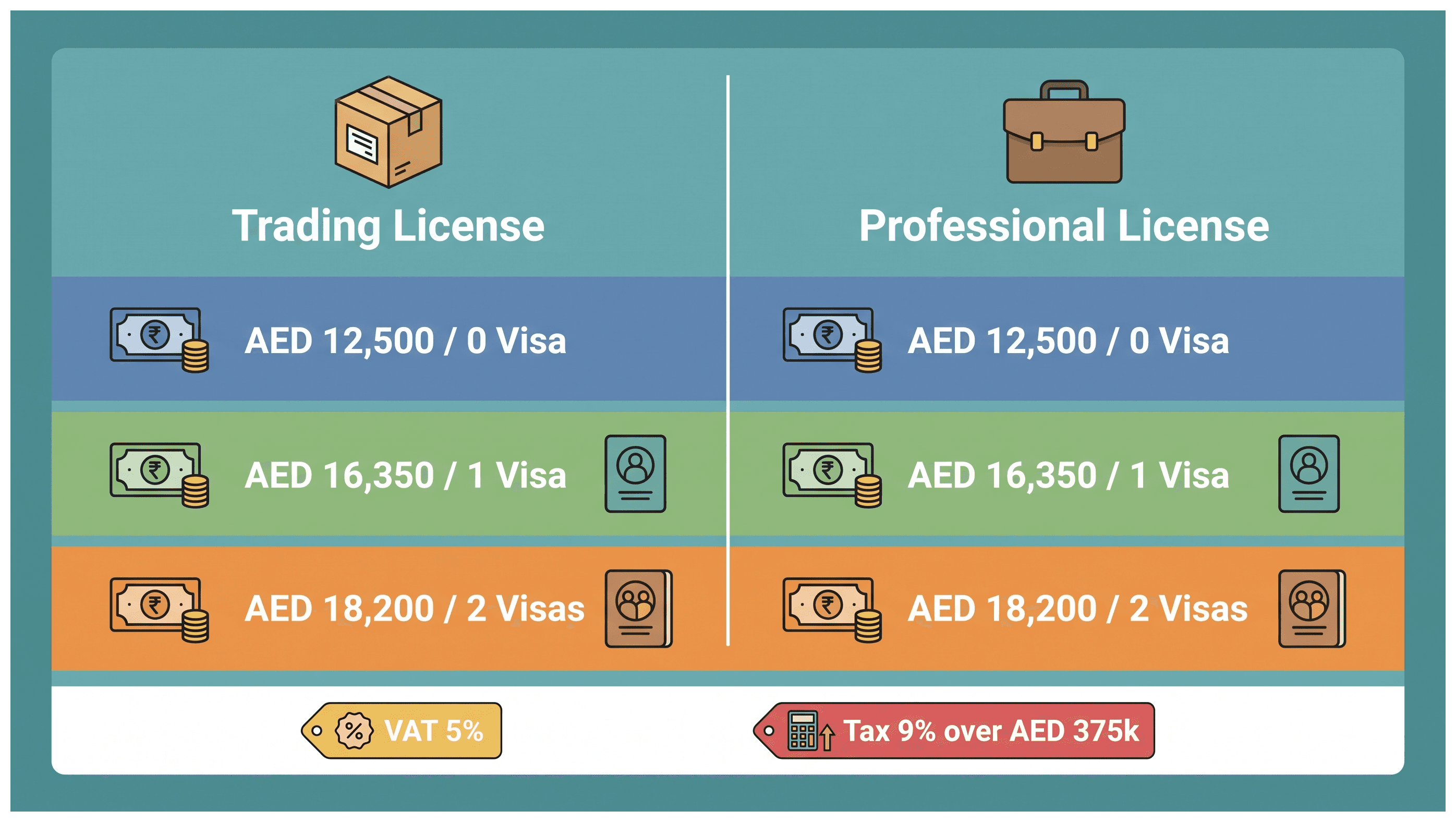
At Dubai South Business Hub Free Zone, standard packages run AED 12,500 with 0 visas, AED 16,350 with 1 visa, and AED 18,200 with 2 visas. Pricing applies equally to trading and professional activities, since the license type doesn't change the package tier, only the approved activity list.
0 Visa Package Pricing
AED 12,500 standard price.
Suits solo founders not sponsoring staff.
Fastest tier to activate.
A solo trading consultant picks this tier to keep overhead low while testing a market.
1 and 2 Visa Package Pricing
AED 16,350 covers a 1 visa package.
AED 18,200 covers a 2 visa package.
Choose based on your hiring plan, not just current headcount.
A trading founder bringing on an operations assistant would go with the 1 visa tier from day one.
Ongoing Tax Obligations
The 5% VAT rate applies where relevant, and 9% corporate tax kicks in above AED 375,000 in annual profit [3]. Worth flagging: Dubai South Business Hub Free Zone is not a designated zone for VAT purposes, and it doesn't offer bonded warehousing. Goods held there are duty-suspended, not duty-exempt, meaning a trading company only pays duty once stock clears into the mainland. Check the cost calculator before you finalize your package.
How Licensing Rules Shape Your Cost
DET regulates which activities fall under trading versus professional categories, and this classification affects approval time, required documentation, and whether extra activity codes are needed. Founders combining goods and services sometimes need dual licensing, which raises the total setup cost.
Activity Codes and Approvals
Each activity maps to a specific code under DET, and adding multiple activities can trigger extra approvals. Approval timing shifts depending on the activity type; some sail through, others need external sign-off. A founder adding both consultancy and general trading activities ends up with two separate code sets to clear.
Combining Trading and Service Activities
Some founders genuinely need both activity types under one license. That combination can raise document requirements and stretch approval timelines. Check the full business activities list before you apply, so you're not caught adding codes mid-process.
Is a hybrid trading and services license worth it in Dubai?
It's worth it if goods and services both drive revenue. Otherwise, stick to one activity type. Dual coverage adds cost and paperwork you don't need if your model is simple.
Steps to Choose the Right License for Your Business
Founders should map their core revenue source, check applicable activity codes, compare visa package tiers, confirm VAT and corporate tax exposure, and finalize documents before submission. Following these steps in order avoids costly reclassification later in the trading license vs professional license dubai decision.
Step 1: Identify Your Core Revenue Source
Goods-based income points to trading.
Service-based income points to professional.
Mixed models may need both codes.
James, a UK founder shipping skincare products into Dubai, chose trading after mapping his revenue to physical goods.
Step 2: Match Activities to Codes
Review the approved activity list first.
Confirm the code matches daily operations.
Ask about restricted activities early.
James checked business activities before filing, avoiding a mismatch.
Step 3: Select Your Visa Package
0 visa suits solo founders.
1-2 visa suits early hires.
Budget AED 12,500 to AED 18,200 total.
James picked the 1 visa tier at AED 16,350 to bring on a warehouse coordinator.
Step 4: Confirm Tax and Compliance Position
Register for VAT once thresholds apply.
Track corporate tax above AED 375,000.
Keep records ready for annual filing.
James used the cost calculator to model his first-year tax exposure before signing.
Which Structure Suits Which Founder
Founders selling physical goods, importing stock, or distributing products typically fit a trading license, while consultants, advisors, and skill-based service providers fit a professional license. Hybrid founders offering both often need dual activity coverage to stay compliant and avoid reclassification costs.
Founders Best Suited to Trading
Import-export operators.
Wholesale distributors.
E-commerce sellers of physical goods.
A founder distributing packaged food products across the GCC would fit the trading category cleanly.
Founders Best Suited to Professional Services
Consultants and advisors.
IT and digital service providers.
Education and training providers.
A marketing consultancy serving regional clients fits under a professional license activity, no inventory needed.
Common Mistakes When Comparing Trading License vs Professional License Dubai Costs
Founders often underestimate visa package pricing, overlook VAT and corporate tax obligations, or pick the wrong activity code and need reclassification. Avoiding these errors keeps the true cost of a trading license vs professional license dubai decision predictable from day one.
Overlooking Tax Obligations
Some founders budget only for the license fee, then get surprised by VAT registration once revenue climbs. The 5% VAT rate and the AED 375,000 corporate tax threshold both need a line in your first-year budget, not an afterthought (Federal Tax Authority, 2025).
Choosing the Wrong Activity Code
Picking a professional code for a goods-based business is a common slip. A reseller licensed as professional often has to amend the license later to add trading activities, costing time and extra fees. Review the business activities list carefully before you submit.
Weighing trading license vs professional license dubai costs comes down to matching your activity type, visa needs, and tax exposure to the right package before you apply. Whether you're moving goods or selling expertise, the AED 12,500 to AED 18,200 range covers most founder scenarios at Dubai South Business Hub Free Zone. Compare your exact setup cost and pick a visa package that fits your hiring plan before you file.
References
Frequently Asked Questions