
Topic Summary
What Is What Indonesian Founders Need to Know Before Setting Up in Dubai and Why It Matters
What Indonesian founders need to know before setting up in Dubai is the set of legal, visa, tax, attestation and banking rules that apply to an Indonesian national forming a UAE free zone company. Knowing them first prevents rejected documents, delayed licenses and stalled bank accounts.
Regulatory Requirements for Indonesian Founders Forming a UAE Company
Regulatory Requirements for Indonesian Founders Forming a UAE Company
Document Attestation Requirements for Indonesian Nationals
Indonesian nationals typically need valid passports and proof of address. Corporate shareholders also need attested company documents, usually notarized in Indonesia, legalized by the Ministry of Foreign Affairs (Kemlu), then attested by the UAE Embassy and the UAE Ministry of Foreign Affairs ( UAE Government Portal ).
Tax Rules and UAE-Indonesia Treaty Considerations
The UAE and Indonesia have a double taxation avoidance agreement. UAE companies still face corporate tax and VAT duties. Free zone entities can access a 0% rate on qualifying income only, and Federal Tax Authority registration is mandatory ( Federal Tax Authority ).
Residency Visa Rules Indonesian Founders Should Plan For
A free zone license lets Indonesian founders sponsor a residency visa, subject to the quota tied to license and office type. The process covers entry permit, status change, medical test, Emirates ID and visa stamping, regulated by GDRFA and ICP.
Step-by-Step Guide to What Indonesian Founders Need to Know Before Setting Up in Dubai
Indonesian founders can set up in six steps: define the activity, select a free zone, submit documents, receive the license, apply for visas and open a bank account. Travel is only needed for biometrics.
Banking Considerations for Indonesian Entrepreneurs
Indonesian entrepreneurs open a corporate bank account at Central Bank-licensed banks using the trade license, passports, a business plan and source-of-funds evidence. Strict KYC checks mean clear documents reduce delays and declines ( Central Bank of the UAE ).
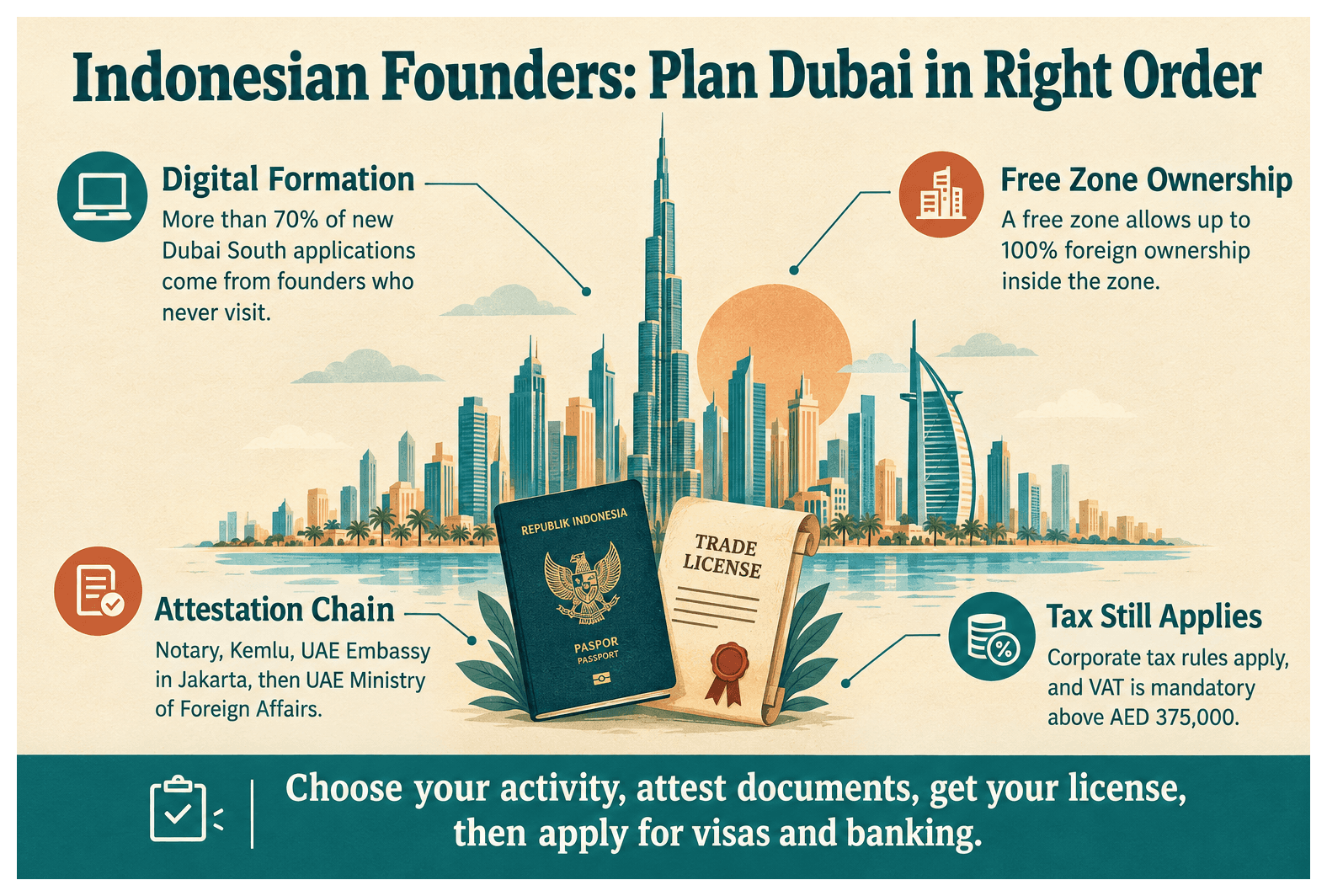
More than 70% of new applications at Dubai South Business Hub come from founders who never visit the UAE during formation (Dubai South Business Hub, 2026). This guide covers what Indonesian founders need to know before setting up in Dubai, so you can plan your company, visa and bank account in the right order.
What Is What Indonesian Founders Need to Know Before Setting Up in Dubai and Why It Matters
What Indonesian founders need to know before setting up in Dubai is the set of legal, visa, tax, attestation and banking rules that apply to an Indonesian national forming a UAE free zone company. Knowing them first prevents rejected documents, delayed licenses and stalled bank accounts.
Why Dubai Attracts Indonesian Entrepreneurs
Dubai links Southeast Asia, the Middle East, Africa and Europe. It hosts more than 595,000 active commercial entities (Dubai Chamber, 2025), and demand is strong in trading, halal food, logistics and digital services.
Picture a Jakarta coffee exporter forming a free zone company to supply Indonesian beans to GCC cafes. That's a typical fit.
How a Free Zone Company Differs From Mainland
A free zone allows up to 100% foreign ownership inside the zone. Selling directly into the mainland generally needs a distributor or extra licensing. A growing community of businesses operate through Dubai South Business Hub Free Zone, which bundles trade licenses with visa packages.
Don't mistake this for a tax-free structure. Corporate tax rules still apply, as covered below. Our guide for Singaporean founders shows the same structure from another market.
Regulatory Requirements for Indonesian Founders Forming a UAE Company
Indonesian founders must choose a licensed business activity, submit passport copies and application forms, pass compliance checks and pay license fees. The free zone authority issues the trade license. Then you can apply for residency visas, an Emirates ID and a bank account.
Choosing Your Business Activity and License Type
Match the activity to your real business model.
E-commerce is classified by goods or services sold, following ISIC logic.
Contract work is classified by the activity performed.
ISIC Rev.4 has 21 sections (UN Statistics Division, 2008).
Related activities can sit on one license where permitted.
An Indonesian furniture exporter, for example, might pick general trading and add a distribution activity.
Key Requirements for Indonesian Founders at a Glance
Requirement | What Indonesian Founders Need |
|---|---|
Passport and photo | Passport valid for at least six months, plus a passport-size photo |
Proof of address | Recent utility bill or bank statement showing your Indonesian residence |
Corporate document attestation chain | Notary, Kemlu, UAE Embassy in Jakarta, then UAE Ministry of Foreign Affairs |
Tax registration (corporate tax and VAT) | Federal Tax Authority registration; VAT mandatory above AED 375,000 |
Bank KYC and source-of-funds documents | Trade license, business plan, Indonesian bank statements, supplier invoices |
Shareholding, Manager and Office Requirements
You can be both shareholder and manager. You'll need a passport, proof of address and a clean compliance profile. Flexi-desk or physical office options depend on your visa quota. Over 90% of UAE free zone applications are digital, so a founder in Surabaya can sign online and receive originals by courier.
Working With a Partner You Have Not Met
More than 40% of new free zone companies list an overseas shareholder who has never visited the UAE. Use a clear shareholder agreement, and verify identity and source of funds early. See our guide on setting up with a partner you haven't met.
Document Attestation Requirements for Indonesian Nationals
Indonesian nationals typically need valid passports and proof of address. Corporate shareholders also need attested company documents, usually notarized in Indonesia, legalized by the Ministry of Foreign Affairs (Kemlu), then attested by the UAE Embassy and the UAE Ministry of Foreign Affairs (UAE Government Portal).
Individual Shareholders: What You Usually Need
Passport with six months' validity.
Passport-size photo.
Proof of residential address.
Usually no attestation. Confirm with the free zone.
Corporate Shareholders: The Attestation Chain
Notarize incorporation certificate, articles and board resolution.
Legalize at Kemlu.
Attest at the UAE Embassy in Jakarta.
Attest at the UAE Ministry of Foreign Affairs.
Allow two to four weeks, plus time for translation. A Jakarta PT (Perseroan Terbatas) holding company owning a Dubai subsidiary follows exactly this route.
Tax Rules and UAE-Indonesia Treaty Considerations
The UAE and Indonesia have a double taxation avoidance agreement. UAE companies still face corporate tax and VAT duties. Free zone entities can access a 0% rate on qualifying income only, and Federal Tax Authority registration is mandatory (Federal Tax Authority).
Corporate Tax and Qualifying Free Zone Income
Non-qualifying income, such as some mainland sales, is taxed at the standard rate. Substance and record-keeping rules apply. A trading company should separate export income from domestic sales before filing.
VAT Registration and the UAE-Indonesia Double Tax Agreement
VAT is mandatory above AED 375,000 (Ministry of Finance).
Confirm current treaty terms with a tax adviser.
Indonesian tax residency may still apply to you.
Check residency before drawing UAE dividends.
Residency Visa Rules Indonesian Founders Should Plan For
A free zone license lets Indonesian founders sponsor a residency visa, subject to the quota tied to license and office type. The process covers entry permit, status change, medical test, Emirates ID and visa stamping, regulated by GDRFA and ICP.
How the Visa Is Tied to Your Trade License
Visa packages come bundled with the license, typically valid two to three years. Once your own visa is stamped, you can sponsor a spouse and children.
Entry, Medical, Emirates ID and Visa Stamping
Entry permit is issued digitally.
Status change happens inside the UAE.
Medical test and biometrics take about a day.
Emirates ID is mandatory for all residents.
Step-by-Step Guide to What Indonesian Founders Need to Know Before Setting Up in Dubai
Indonesian founders can set up in six steps: define the activity, select a free zone, submit documents, receive the license, apply for visas and open a bank account. Travel is only needed for biometrics.
Step 1: Define Your Activity and Choose Dubai South Business Hub
Confirm your activity and visa count. A halal-food importer might pick general trading and two visas. Then book a free consultation to confirm fit.
Step 2: Submit Documents and Receive Your License
Send your passport, photo, proof of address and any attested papers. Sign resolutions digitally. A founder in Medan can receive a digital license without leaving Indonesia.
Step 3: Apply for Visas and Open Your Bank Account
Run the visa process and bank KYC pack in parallel. Bank onboarding often takes several weeks. Book one trip covering biometrics and the bank appointment. Filipino founders face a similar path, as our Filipino guide explains.
Banking Considerations for Indonesian Entrepreneurs
Indonesian entrepreneurs open a corporate bank account at Central Bank-licensed banks using the trade license, passports, a business plan and source-of-funds evidence. Strict KYC checks mean clear documents reduce delays and declines (Central Bank of the UAE).
What UAE Banks Ask For
Trade license and shareholder passports.
Emirates ID if resident.
Business plan with expected volumes.
Indonesian bank statements and supplier invoices.
Office or flexi-desk lease.
Moving Funds Between Indonesia and the UAE
Plan IDR to AED or USD transfers with invoices or contracts. The AED is pegged to the USD at 3.6725. Keep records for UAE and Indonesian reporting, and avoid cash-heavy structures.
Your Next Step
Planning the structure, attestation, tax, visas and banking together saves weeks and avoids rejections. Contact Dubai South Business Hub for a free consultation to map your company formation, residency visa package and banking path.
References
Frequently Asked Questions