Topic Summary
Built Around the World's Largest Planned Airport
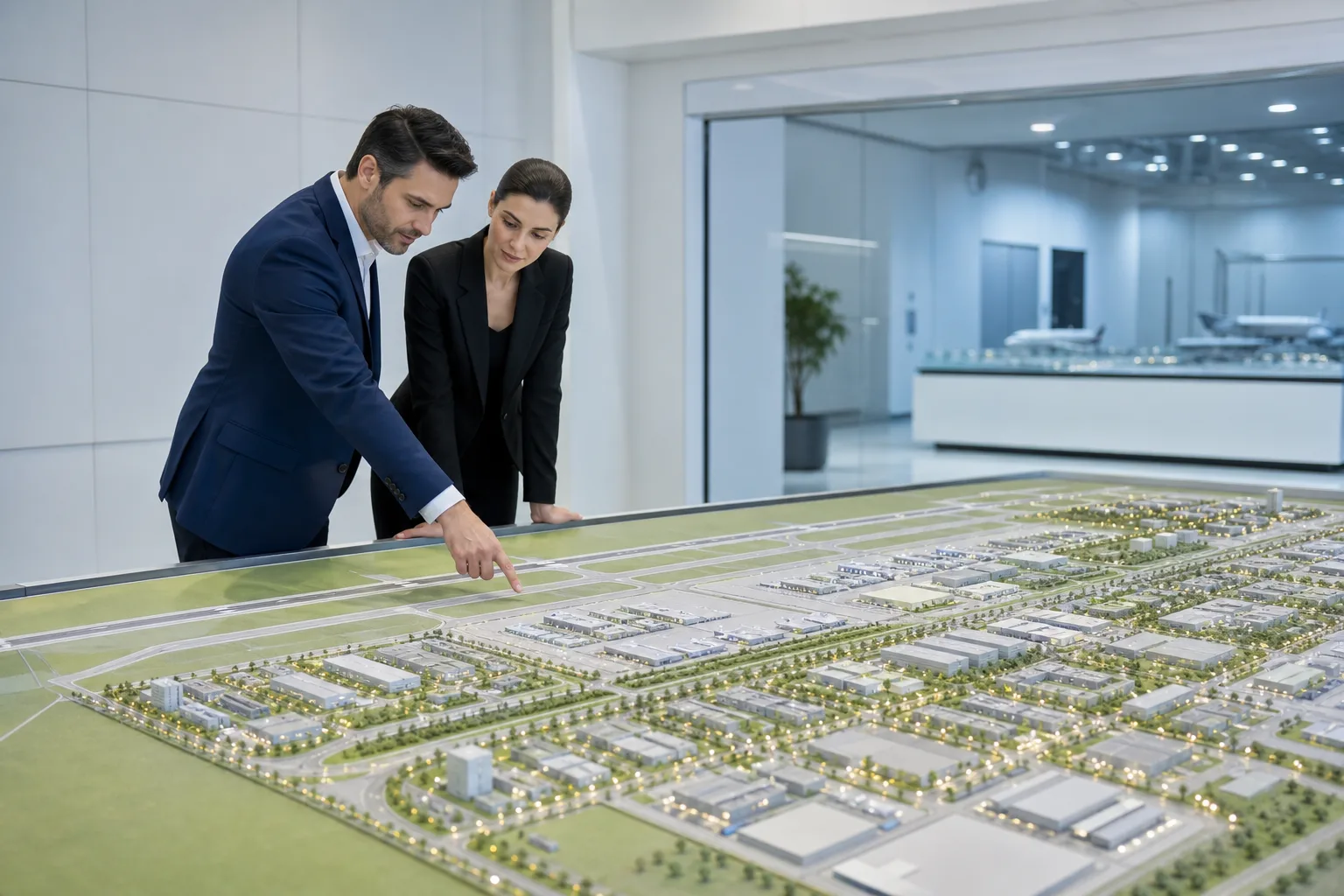
Dubai South is a 145 sq km master-planned city anchored by Al Maktoum International Airport, which will handle 260 million passengers annually when complete. Companies set up there gain immediate proximity to the cargo terminal that will serve that future capacity.
100% Foreign Ownership, No Local Partner
Unlike some business structures in the UAE, Dubai South Free Zone allows international founders to retain full ownership of their company. No local partner or service agent is required to register and operate.
Fast Setup Starting From AED 12,500
Trade licenses at Dubai South Business Hub start from AED 12,500 per year, and registration typically completes in just 3 to 5 business days. Flexi-desk options keep overhead low for small and mid-size companies.
Rare Combination of Air and Sea Access
Dubai South sits within 15 km of Jebel Ali Port, the largest port in the Middle East, while also bordering Al Maktoum International Airport. That dual access to air freight and sea freight in one location is uncommon anywhere in the world.
Zero Corporate Tax on Qualifying Income
Companies that qualify as Qualifying Free Zone Persons under UAE rules pay 0% corporate tax on eligible income, compared to the standard 9% rate applied to mainland businesses earning above AED 375,000. Specific conditions apply, so professional advice is recommended.
Seven Distinct Districts Serve Different Business Needs
Dubai South is divided into seven districts including an Aviation District, Logistics District, Business Park, Residential District, and more. Most small and mid-size companies base themselves in the Business Park, where the free zone authority DSBH issues trade licenses.
Fastest-Growing Free Zone for International Founders
In 2026, over 60% of UAE free zone company formations were linked to logistics and aviation corridors, with Dubai South ranking among the top choices for international founders according to Dubai Chamber of Commerce data. Its growth reflects strong demand from logistics, aviation, and trade-focused businesses.
In 2026, over 60% of UAE free zone company formations chose locations tied to logistics and aviation corridors, with Dubai South Free Zone ranking among the fastest-growing choices for international founders (Dubai Chamber of Commerce, 2026). Dubai South Explained in plain terms: it is a 145 sq km master-planned city built around Al Maktoum International Airport, and it is open right now. The zone covers 145 sq km. It sits next to one of the world's largest planned airports. Licenses start from AED 12,500 per year. Setup takes 3 to 5 business days. Foreign founders keep 100% ownership. No local partner is needed.
This guide covers what Dubai South is, where it sits, who it suits, what a license costs, how to set up, and what you must comply with after you open. By the end, you will know whether it is the right base for your company.
What Is Dubai South and Why It Matters
Dubai South is a 145 sq km master-planned city in Dubai built around Al Maktoum International Airport. It is a free zone and an urban district. Companies set up there get 100% foreign ownership, 0% corporate tax on qualifying income, and direct access to one of the world's largest planned airports. Dubai South Business Hub Free Zone offers business licenses from AED 12,500, 100% foreign ownership, and same-day company setup.
The Core Idea Behind Dubai South
Dubai South is not just a free zone. It is a full city district with homes, logistics parks, an aviation hub, and a business district. The UAE government built it to be the city centre of tomorrow.
Al Maktoum International Airport anchors the whole plan. When complete, it will handle 260 million passengers a year. That makes it the world's largest airport by capacity.
A logistics firm that sets up a company at Dubai South Business Hub today is already a few minutes from the airport cargo terminal. That is the same terminal that will serve the world's biggest airport when the full build is done. Companies here sit next to that future capacity from day one.
The zone also sits next to Jebel Ali Port, the largest port in the Middle East. That combination of air and sea access is rare anywhere in the world.
How Dubai South Is Structured
Dubai South has 7 districts. Each one serves a different purpose.
Aviation District
Logistics District
Business Park District (where DSBH sits)
Golf District
Residential District
Exhibitor District
Al Maktoum Airport District
The Business Park is where most small and mid-size companies choose to base themselves. DSBH is the free zone authority inside that district. You get a free zone trade license from DSBH, not from a mainland authority like Dubai DET.
A software company picking a flexi-desk at DSBH is inside the Business Park district, with the Aviation district and its cargo and MRO operators just a short drive away. DSBH licenses start from AED 12,500 per year, and registration takes 3 to 5 business days (Dubai South Official Portal, 2026).
Where Dubai South Sits and What That Means
Dubai South sits in the south-west of Dubai, close to the Abu Dhabi border. It is next to Al Maktoum International Airport and within 15 km of Jebel Ali Port. That puts your business at the meeting point of air freight, sea freight, and the main UAE motorway network.
Dubai South Free Zone vs UAE Mainland: Key Differences
Feature | Dubai South Free Zone (DSBH) | UAE Mainland (DET) |
|---|---|---|
Foreign ownership | 100%, no local partner needed | 100% permitted for most activities since 2021 reforms, but some sectors still require a local service agent |
Corporate tax on qualifying income | 0% for Qualifying Free Zone Persons (conditions apply) | 9% standard rate on taxable income above AED 375,000 |
Direct UAE market access | Mainly international clients; UAE mainland sales typically need a local distributor or separate mainland entity | Full open access to UAE consumers and businesses with no distributor required |
Setup time | 3 to 5 business days | Typically 2 to 4 weeks depending on activity and approvals |
Minimum license cost | From AED 12,500 per year | Typically AED 15,000 to 25,000+ depending on activity and emirate |
Office requirement | Flexi-desk options available; no physical office needed for most license types | Physical office or Ejari lease required for most DET license categories |
Road, Air, and Sea Access
The zone sits on Sheikh Mohammed Bin Zayed Road. That is the main ring road linking Dubai to Abu Dhabi and the northern emirates.
Al Maktoum International Airport is inside the zone boundary. Your cargo can clear the airport and reach your warehouse in minutes.
Jebel Ali Port is about 15 km away. It handles more container traffic than any port between Europe and Singapore. Here are the 3 access points that matter:
Air: Al Maktoum International Airport, inside the zone
Sea: Jebel Ali Port, 15 km away
Road: Sheikh Mohammed Bin Zayed Road, direct access
A general trading company importing electronics by sea and re-exporting by air can receive containers at Jebel Ali and dispatch air freight from Al Maktoum in the same working day. That kind of speed is hard to match from most other addresses in the UAE.
Distance From Dubai City Centre
Dubai South is about 45 km from Dubai International Airport and Dubai city centre. That distance puts it further from downtown than some other free zones, but closer to Abu Dhabi by about 50 km.
For companies that deal mainly with cargo, manufacturing, or regional logistics, the southern location is an advantage. A freight forwarding company with clients at Jebel Ali Port will find the Dubai South address far more convenient than a city-centre office.
For professional services firms that need daily face-to-face meetings in central Dubai, factor in the commute before you decide. It is an honest trade-off worth thinking through.
Who Can Set Up at Dubai South
Any foreign national or UAE resident can set up a company at Dubai South Business Hub. There is no minimum share capital for most license types. Solo founders, small teams, and larger firms all qualify. The zone suits trading, logistics, tech, consulting, and services businesses most.
Business Types That Fit Best
The top 4 license categories at DSBH are trading, logistics, ICT, and consulting. Here is why each one fits:
Trading companies: import, export, and general trading licenses are among the most common at DSBH. Check the full list of business activities in Dubai to find your code.
Logistics and freight: the airport and port access make this a natural fit.
Tech and ICT firms: the Business Park district has a growing tech community. An ICT license in Dubai covers software, digital services, and IT consulting.
Consulting and professional services: low entry cost and flexi-desk options suit solo consultants well.
Aviation and MRO: the Aviation district next door creates steady demand for related services.
A US-based e-commerce brand opening a regional hub to serve the Gulf can get a DSBH trading license, a flexi-desk, and a UAE residency visa for its founder in under a week. That kind of speed is hard to find anywhere else in the region.
Who Should Look Elsewhere
Financial services, insurance brokerage, real estate brokerage, and clinical healthcare require licenses from other regulators. DSBH does not issue those.
Companies that need a Dubai mainland DET license to trade directly with UAE consumers without a local distributor may find a free zone structure limiting. If your whole client base is walk-in retail in Dubai, a mainland license gives you more direct access.
A retail café chain that needs branches across Dubai would need a mainland DET license, not a DSBH free zone license. Free zone companies selling to UAE mainland customers typically need a local distributor or a separate mainland entity to do so.
What activities does DSBH license?
DSBH issues licenses for trading, logistics, technology, consulting, and services businesses. It does not license financial services, insurance brokerage, real estate brokerage, or clinical healthcare. If your activity falls outside those four restricted areas, DSBH can almost certainly issue your license.
5 Steps to Set Up at Dubai South Business Hub
Setting up at Dubai South Business Hub takes 5 main steps: choose your business activity, reserve your trade name, submit your application and papers, pay your license fee, and collect your license and visa. Most founders complete all 5 steps in 3 to 5 business days.
Steps 1 to 3: Choose, Name, Apply
Step 1, pick your business activity: check the DSBH approved activity list and pick the code that matches what you will do. You can hold more than one activity on a single license.
Step 2, reserve your trade name: your company name must be unique and follow UAE naming rules. Check company name availability before you apply.
Step 3, submit your papers: you need a passport copy, a passport photo, and a completed application form. Most applicants do this online.
DSBH does not require a physical office for most license types at the application stage. A founder in New York can complete steps 1 to 3 entirely online, without travelling to Dubai. That is genuinely useful if you are testing the market before you relocate.
Steps 4 to 5: Pay and Collect
Step 4, pay your license fee: DSBH licenses start from AED 12,500 per year. You pay before the license is issued.
Step 5, collect your license and start your visa: once the license is issued, you can apply for a UAE investor residency visa tied to the company.
The visa process adds a few extra days for medical checks and Emirates ID. A solo founder setting up a consulting company at DSBH paid AED 12,500 for the license and AED 6,500 for the investor visa, with Emirates ID and medical fees on top. Your total first-year cost, including one investor visa, typically runs AED 30,000 to 45,000. Use the business setup cost calculator to get a figure for your specific situation.
Costs and Timelines at a Glance
A DSBH free zone license starts from AED 12,500 per year. Add AED 5,000 to 7,000 for each investor residency visa. A solo founder with one visa typically spends AED 30,000 to 45,000 in year one. Registration takes 3 to 5 business days once your papers are in order.
What You Pay in Year One
Item | Typical cost (AED) |
|---|---|
License fee | From 12,500 per year |
Investor visa (per person) | 5,000 to 7,000 (covers visa, medical, Emirates ID) |
Flexi-desk office | Included in most packages |
Government registration fees | Included in most DSBH packages |
Year one total (1 founder, 1 visa) | 30,000 to 45,000 |
A two-person trading company paid AED 25,000 for the license package and AED 13,000 for 2 investor visas in year one, bringing the total to AED 38,000. Renewal in year two is typically the license fee plus any visa renewals, so costs drop once you are past the first year.
How Long the Process Takes
License registration: 3 to 5 business days
Investor visa (after license is issued): 7 to 14 days, including medical and Emirates ID
Bank account opening: 2 to 6 weeks, depending on the bank
A founder who submitted papers on a Monday had a license in hand by Thursday and their investor visa approved within 2 weeks. Bank account opening is the step that takes the most time. You can start trading under the license before the account is open, so it does not block you from day one. For help with bank account opening in Dubai, DSBH offers dedicated support services.
Tax and Compliance at Dubai South
DSBH free zone companies can pay 0% corporate tax on qualifying income. To get that rate, your company must meet the Qualifying Free Zone Person conditions the Federal Tax Authority sets. VAT at 5% applies to most goods and services. You must register for corporate tax once your company exists.
Corporate Tax: The Key Facts
Corporate tax. The UAE introduced a 9% corporate tax rate in June 2023 under Federal Decree-Law No. 47 of 2022. Free zone companies can pay 0% on qualifying income. You only get that rate if you meet the conditions the Federal Tax Authority (FTA) sets.
Registration. You must register with the FTA once your company exists. Your turnover does not change this duty. Keep your books for 7 years. The FTA can ask to see them at any time.
A DSBH consulting company earning all its income from clients outside the UAE mainland applied for Qualifying Free Zone Person status and paid 0% corporate tax in its first filing year. A tax agent can help you work out whether your income qualifies for that rate.
VAT and Other Duties
VAT: 5% in the UAE. Register with the FTA if your taxable turnover hits AED 375,000 in a 12-month period. Voluntary registration is allowed from AED 187,500.
Customs duty: goods moving into or out of the UAE may attract customs duty. Dubai Customs handles this.
Personal income tax: there is none. The UAE charges no tax on salaries or dividends.
A trading company importing goods into the UAE pays 5% import VAT at the border, then reclaims it on its VAT return if the goods are resold with VAT charged. That makes VAT broadly neutral for most trading businesses.
Do free zone companies in Dubai pay corporate tax?
Yes, but the rate can be 0% on qualifying income. The UAE introduced a 9% corporate tax in June 2023. Free zone companies that meet the Qualifying Free Zone Person conditions set by the Federal Tax Authority pay 0% on qualifying income. FTA registration is mandatory regardless of your turnover.
Key Benefits of Dubai South for Your Business
Dubai South gives your company 100% foreign ownership, 0% corporate tax on qualifying income, full repatriation of profits, and access to the world's largest planned airport. The zone also offers investor residency visas, flexible office options, and a fast 3 to 5 day setup process.
Ownership and Tax Advantages
100% foreign ownership: you do not need a UAE national partner or sponsor.
0% corporate tax on qualifying income: the rate the FTA sets, not a blanket promise.
Full profit repatriation: move your money out of the UAE with no restrictions.
No personal income tax: your salary and dividends are yours in full.
A British founder running a digital marketing agency through DSBH paid no personal income tax on AED 400,000 in director's drawings in 2025. Those 4 points together make the UAE one of the most tax-efficient bases in the world for an international business (UAE Government Portal, 2026).
Location and Infrastructure Advantages
Direct access to Al Maktoum International Airport, the world's largest when fully built
15 km from Jebel Ali Port, the Middle East's biggest container port
On Sheikh Mohammed Bin Zayed Road, the main link between Dubai and Abu Dhabi
Modern warehousing, cold storage, and office space available inside the zone
Proximity to Expo City Dubai, which hosts major international events and draws global visitors
A cold-chain logistics company at Dubai South can move temperature-controlled cargo from the airport to its bonded warehouse in under 20 minutes. That is the kind of operational edge that makes a real difference to margins over time.
Is Dubai South Right for You?
Dubai South Explained in one paragraph: it is a 145 sq km planned city next to Al Maktoum International Airport, home to a free zone where any foreign founder can set up a company in 3 to 5 days, pay 0% corporate tax on qualifying income, and hold 100% ownership. Dubai South Business Hub is the gateway for founders who want a UAE base that grows with the region.
Is Dubai South Right for You?
If you want a UAE company with full foreign ownership, low tax, and fast setup, Dubai South Business Hub is a strong option. A US tech founder comparing free zone options chose DSBH after calculating that the AED 12,500 license fee and 3-day setup beat every other option they had reviewed.
If your business needs direct UAE mainland retail access or a regulated financial license, you will need a different route. The best next step is to check your activity code, run a cost estimate, and confirm the license type before you commit.
DSBH advisors can walk you through the process in a single call. Start your business at Dubai South Business Hub today, or use the cost calculator to get a first-year estimate before you pick up the phone.
A Few Things Worth Checking First
Confirm your activity code is on the DSBH approved list before you apply.
Check whether your clients are mainly outside the UAE mainland. If they are inside it, a free zone structure may add a step.
Budget for bank account opening time (2 to 6 weeks) separately from license setup.
Get a written cost estimate covering the license, visa, and any office fees before you pay anything.
References
Dubai Chamber of Commerce (dubaichamber.com)
Dubai South Official Portal (dubaisouth.ae)
Federal Tax Authority (FTA) (tax.gov.ae)
UAE Government Portal (u.ae)
Frequently Asked Questions