Which Products You Cannot Sell Online From Dubai: What It Costs and What to Check

Topic Summary
Know the Rule and Its Stakes
Restricted products online selling UAE rules ban or limit e-commerce sales of items like counterfeits, unlicensed medicines, and weapon replicas. Your license's activity code determines what you can legally list, so getting it wrong risks fines or delisting.
Spot Fully Banned vs Approval-Needed Goods
Counterfeit goods, firearms replicas, and narcotics paraphernalia are fully banned with no license workaround. Pharmaceuticals, alcohol, and telecom devices are only partially restricted and require approvals from MOHAP, DHA, or the TDRA before listing.
Identify Who Enforces These Rules
DET, the Ministry of Economy, MOHAP, and the TDRA each regulate a different category of restricted goods. Federal Cabinet decisions set nationwide bans, while Dubai's DET handles local trade license enforcement and non-compliance penalties.
Follow Five Steps to Check Restrictions
Sellers should verify their license activity code, cross-check products against federal and local ban lists, and confirm whether sector approvals are needed before listing anything. Skipping this check is the most common reason new e-commerce founders get flagged.
Prepare Documents, Costs and Timelines
Approval processes vary by regulator, with MOHAP, TDRA, and DHA each requiring specific paperwork, fees, and processing windows. Founders should budget extra time and money for these approvals before their first product listing goes live.
Align Your License With Product Plans
Structuring your trade license activity code correctly from the start avoids compliance issues down the line. Mainland and free zone sellers, marketplace vendors, and cross-border shippers all must match their license to the exact goods they intend to sell.
In 2026, over 45,000 new companies registered across the UAE (Dubai Chamber of Commerce, 2025), and a growing share are e-commerce founders. Restricted products online selling UAE rules trip up many of them before their first sale. Roughly 41,000 member companies joined Dubai Chamber in 2023 alone. That's a lot of new sellers who never checked their activity code. Miss this step and you risk fines, delisting, or worse. This guide sets out exactly which products face restricted products online selling UAE bans, who the rules apply to, what documents you need, the cost, and the timing for approvals.
What Is Restricted Products Online Selling UAE and Why It Matters
Restricted products online selling UAE refers to federal and local rules that ban or limit e-commerce sales of certain goods, such as counterfeit items, unlicensed medicines, and weapons replicas. Founders must check activity approvals before listing products, since license codes determine what a company may legally sell.
How the Rule Is Defined
UAE consumer protection law sets out obligations for online sellers, covering disclosure, refunds, and product safety. On top of that sits a separate layer: restricted vs. prohibited goods. Restricted items need extra approval; prohibited items can't be sold at all, full stop.
Your license's activity classification underpins what you're allowed to list. Get the activity code wrong and even a legal product becomes a compliance problem. Take a seller listing herbal supplements without MOHAP approval: expect listing removal and a fine, not a warning.
Who the Rule Applies To
Mainland and free zone e-commerce license holders alike
Marketplace sellers as well as sellers on their own website
Cross-border sellers shipping goods into the UAE
A free zone company selling cosmetics via Instagram still needs the correct activity code, no exceptions
Product Categories: Full Ban vs. Approval Required
Feature | Fully Prohibited | Requires Approval |
|---|---|---|
Counterfeit goods | Banned outright, no license covers this | Not applicable, no approval path exists |
Firearms replicas | Cabinet-listed ban, customs seizure on import | Not applicable |
Pharmaceuticals | Not applicable | MOHAP registration needed before listing |
Alcohol | Not applicable | Limited to licensed distributors only |
Telecom devices | Not applicable | TDRA type approval required |
Which Categories Face Full or Partial Bans
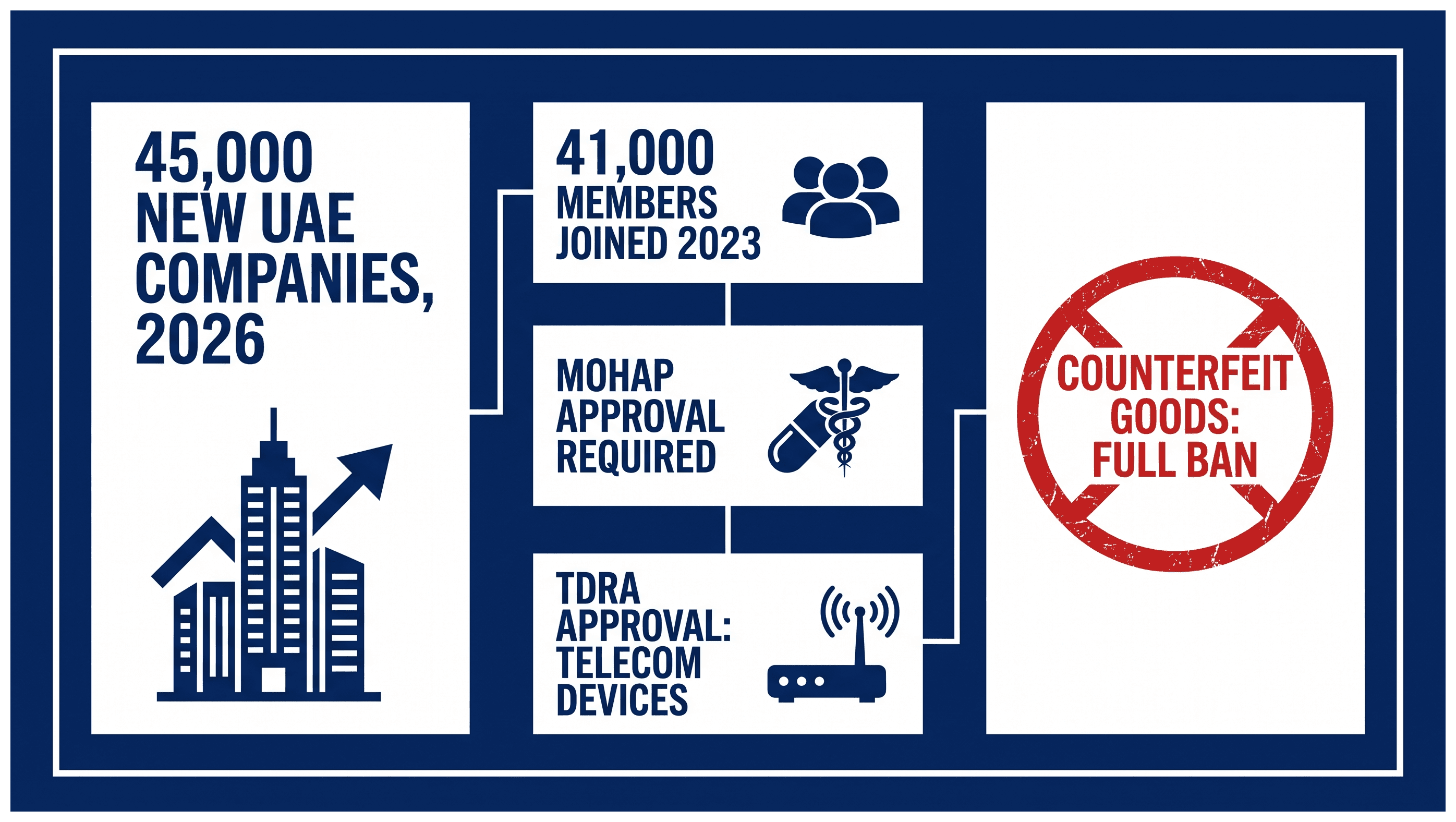
Full bans cover counterfeit goods, narcotics-related paraphernalia, and unregistered firearms replicas. Partial restrictions apply to pharmaceuticals, medical devices, alcohol, and certain telecom equipment, which need approvals from MOHAP, DHA, or the TDRA before online listing.
Fully Prohibited Items
Counterfeit and pirated goods of any kind
Weapons, ammunition, and firearms replicas
Certain publications and restricted media content
Dubai customs regularly seize counterfeit branded goods shipped through local ports, some traced back to online listings. That's a real risk, not a hypothetical one.
Partially Restricted Items
Pharmaceuticals and supplements need MOHAP approval before you can list them, even vitamins. Alcohol sales stay limited to licensed distributors, not general trading license holders. Telecom devices, from routers to radios, often need TDRA type approval first.
Picture an online pharmacy adding vitamins to its catalogue without registering them with MOHAP first. That's an easy way to get your listing pulled and your healthcare business license flagged for review.
Who Regulates Restricted Products Online Selling UAE and Enforces the Rules
DET, the Ministry of Economy, MOHAP, and the TDRA jointly regulate restricted product sales online, each covering a different category. DET handles trade license enforcement, while sector regulators issue product-specific approvals. Non-compliance can trigger fines, listing removal, or license suspension.
Federal vs. Local Oversight
UAE Cabinet decisions set the national ban list, applied uniformly across every emirate. Dubai's Department of Economy and Tourism (DET) enforces licensing compliance on the ground, running inspections and issuing notices. Free zones apply the same federal restrictions, there's no separate rulebook for free zone sellers.
A DET inspection flagging an unlicensed cosmetics listing isn't rare. It happens when sellers assume a general trading license covers everything, which it doesn't.
Penalties for Non-Compliance
Fines scaled by product category and severity of the breach
Marketplace account suspension pending review
Repeat violations risking full license cancellation
5 Steps to Check If Your Product Is Restricted
Checking whether a product is restricted takes five steps: confirm your license activity, cross-check federal ban lists, verify sector approvals, review marketplace policies, and consult an advisor if unsure. Most checks take under a day using official portals.
Step 1: Confirm Your Licensed Activity
Match your product category to the license's activity code
Amend the activity if your scope has changed
Check the list of business activities before you list anything new
Step 2: Cross-Check Federal Ban Lists
Review UAE Cabinet resolutions on banned goods
Check the customs prohibited items list on u.ae
Re-check quarterly, since lists get updated
Step 3: Verify Sector-Specific Approvals
MOHAP approval for health products
TDRA type approval for electronics and telecom devices
DHA clearance where medical devices are involved
Step 4: Review Marketplace Terms
Read platform-specific restricted item policies closely
Gather documentation marketplaces may request upfront
Keep approval letters ready before your listing goes live
Is checking product restrictions worth the time before launch?
Yes. A five-step check takes under a day. Skipping it risks fines, delisting, and license suspension, costs that far outweigh a short compliance review.
What Documents, Costs and Timing to Expect
Documents typically include a valid trade license, passport copies, and sector-specific approval letters. Standard packages start at AED 12,500 for a zero-visa license, rising to AED 16,350 and AED 18,200 for one- and two-visa packages. Sector approvals add 3-10 working days depending on the regulator.
Required Documents Checklist
Trade license copy showing approved activity
Emirates ID and passport copies for shareholders
Sector approval certificates where applicable
License Package Costs
0 Visa Package: AED 12,500
1 Visa Package: AED 16,350
2 Visa Package: AED 18,200
5% VAT applies on applicable fees, and 9% corporate tax applies above AED 375,000 in profit
Note that Dubai South Business Hub Free Zone is not a designated zone for VAT purposes and doesn't offer bonded warehousing. Goods held there are duty-suspended, not duty-exempt. Use the cost calculator to model your own package before applying.
Approval Timelines
Trade license issuance usually takes a few working days once documents are in order. Sector approvals from MOHAP or the TDRA add anywhere from 3 to 10 working days on top of that. Corporate tax registration with the Federal Tax Authority is a short additional step most founders complete in the same week.
How to Structure Your License Around Selling Restrictions
Structuring your license around selling restrictions means selecting the correct activity codes upfront, applying for sector approvals early, and choosing a license that matches your product mix. This avoids costly amendments later and keeps your e-commerce operation compliant from day one.
Choosing the Right Activity Code
A basic trading license limits you to specific product lines, while a general trading license covers a broader mix. If you're planning to sell across multiple categories, say cosmetics and electronics, get the broader scope from day one rather than amending later.
Planning for Sector Approvals Early
Budget time for MOHAP or DHA reviews before you set a launch date, not after. Coordinate documents with your business setup team well ahead of your first shipment. Founders who plan this early rarely hit last-minute delays.
Understanding restricted products online selling UAE protects your license, your listings, and your customers from costly compliance failures.
Review your product list against these rules before you launch, and Build your license around approved activities from the start. Ready to get your activity codes right the first time? Start your company with a structure built for compliant e-commerce.
References
Frequently Asked Questions