Topic Summary
Burnout Hits Most MENA Founders Early
An estimated 72% of startup founders in the MENA region report burnout within their first three years, according to Wamda Research 2024. In Dubai's high-pressure environment, this makes protecting personal time a business-critical priority, not a luxury.
Dubai's Time Zones Create a 16-Hour Workday
Dubai operates across London, Mumbai, and Singapore time zones simultaneously, meaning founders with international clients can face a near-constant active business window. Without deliberate boundaries, every hour of the day becomes a potential work hour.
Productivity Collapses Beyond 55 Hours Weekly
Stanford University research found that output per hour drops sharply after 55 hours of work per week and nearly disappears beyond 70. For Dubai founders, this means grinding longer often produces worse decisions while delivering no real productivity gain.
Investor Due Diligence Now Flags Founder Burnout
UAE-based venture capital firms are increasingly treating founder mental health as a top-three company risk factor during due diligence. Burnout is no longer just a personal concern — it is a direct threat to a startup's fundability and long-term valuation.
WhatsApp Culture Quietly Erases Personal Boundaries
Dubai's business culture relies heavily on WhatsApp for real-time communication, making it difficult for founders to disconnect outside formal working hours. This always-on expectation is one of the city's most underestimated contributors to entrepreneur burnout.
Define What 'Off' Means Before You Can Protect It
Without a clear personal definition of recovery time, every unscheduled hour defaults to work in a city that never fully sleeps. Experts advise founders to explicitly name their non-work activities and treat them with the same commitment as client meetings.
High Living Costs Push Founders to Overmonetise Time
Dubai's elevated cost of living creates financial pressure that encourages founders to fill every available hour with revenue-generating activity. This economic reality makes intentional scheduling and sustainable working rhythms harder — but more essential — than in lower-cost markets.
By Editorial Team, Business setup specialists with direct experience advising founders across UAE free zones and mainland structures. Full bio →
An estimated 72% of startup founders in the MENA region report experiencing burnout within their first three years of operation (Wamda Research, 2024). Dubai, for all its extraordinary opportunity, ranks among the most demanding environments on earth for an entrepreneur trying to protect their personal life. The city operates across at least three active time zones simultaneously. Its cost of living pushes founders to monetise every available hour. And its culture, genuinely, unapologetically, rewards hustle.
But here's the thing: sustainable businesses are built by sustainable founders. Burnout is not a badge of honour. It is a business liability. This article breaks down the Dubai-specific challenges that make work-life balance for entrepreneurs in Dubai genuinely difficult, explains why getting this right is a business decision as much as a personal one, and gives you practical, UAE-specific strategies to build a rhythm that lasts, without sacrificing your ambition.
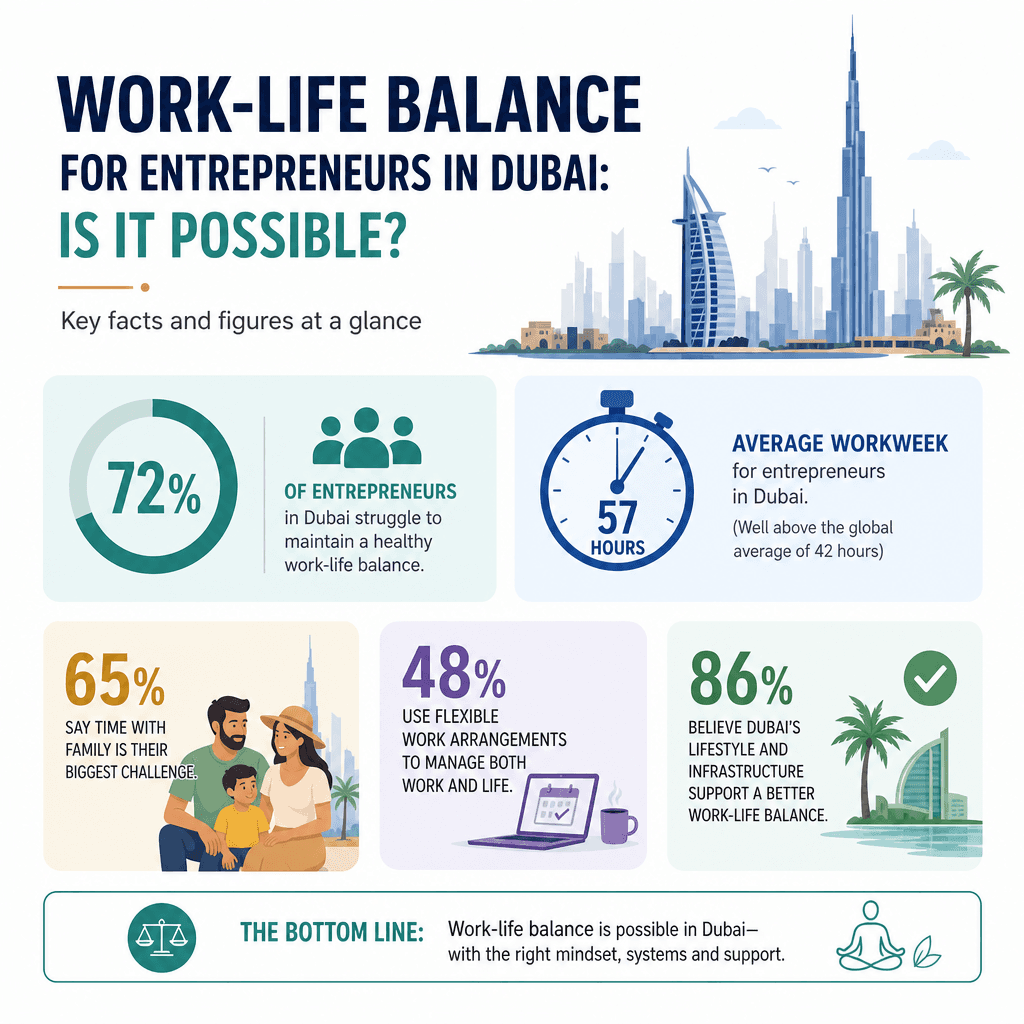
Work-life balance for entrepreneurs in Dubai means deliberately protecting personal time, health, and relationships while running a business in one of the world's most fast-paced markets. It matters because founder wellbeing directly drives business performance, sustained output requires recovery, and burnout is the leading reason UAE startups stall. For more detail, see our guide on time management and work-life balance in Dubai.
Defining Balance in a City That Never Stops
Balance does not mean equal hours. It means intentional boundaries between work and recovery, and in Dubai, those boundaries do not form naturally. The city operates across London, Mumbai, and Singapore time zones simultaneously, creating a near-constant business cycle that makes "switching off" feel almost irresponsible.
Consider a SaaS founder running a Dubai-registered company with clients in London and Singapore. She effectively faces a 16-hour active business window every day. Structure, for her, is not a lifestyle preference, it is survival. Define what "off" looks like for you personally before you can protect it. Without that definition, every hour is potentially a work hour.
Dubai has over 30 free zones (Dubai Free Zones Council, 2024), each with its own operational culture and pace. The city never fully sleeps. That is part of its appeal, and part of its danger for entrepreneur wellbeing in the UAE.
Why Sustainable Founders Build Stronger Businesses
Research from Stanford University found that productivity per hour drops sharply after 55 hours of work per week, and collapses almost entirely beyond 70. Beyond 55 hours, you are essentially working for free, and making worse decisions while doing it. For Dubai's hustle culture, that finding is not abstract. It is a direct challenge to the "grind harder" narrative.
Cognitive performance degrades measurably after prolonged sleep deprivation and overwork. Decision quality suffers first, and for a founder, decisions are the product. UAE-based venture capital firms are increasingly flagging founder mental health as a top-three company risk factor during due diligence. Burnout is not a personal problem; it is an investor concern. That reframe matters. Check out these time management tips for entrepreneurs in Dubai to start building better habits today.
Why Work-Life Balance for Entrepreneurs in Dubai Is Harder Than You Think
Dubai presents unique work-life balance challenges: a six-day work week in many sectors, a WhatsApp culture that erases personal time boundaries, relentless networking pressure, and a high cost of living that pushes founders to work longer. These factors combine to make deliberate balance genuinely difficult, but not impossible.
Burnout-Risk Habits vs. Sustainable Founder Habits in Dubai
Feature | Burnout-Risk Habits | Sustainable Founder Habits |
|---|---|---|
Working hours | 70+ hours per week with no fixed end time | 50–55 hours max; hard stop 3–4 days per week |
WhatsApp boundaries | Available 24/7; reads and replies to 11pm messages | Auto-reply set for 8am–7pm; one emergency channel only |
Weekend use | Friday and Saturday treated as overflow workdays | Friday morning is protected; screen-free time scheduled |
Delegation approach | Does everything personally; fears quality will drop | Outsources bookkeeping, admin, and social media to external specialists |
Networking pace | Attends 4–5 events per week; declines nothing | Batches to 1–2 high-value events per week; declines strategically |
Physical activity | Skipped when busy; no fixed schedule | Fixed gym or padel session 4x per week; non-negotiable |
Mental health awareness | Ignores warning signs; views stress as normal | Attends coaching or peer forums; recognises burnout signals early |
The Six-Day Work Week and WhatsApp Culture
Many UAE sectors, construction, retail, hospitality, and trading, still operate Saturday to Thursday, leaving founders with clients and suppliers on a six-day cycle. The UAE government amended its federal working week to Friday–Saturday in 2022 for public sector employees, but private sector norms vary significantly by industry. If your clients are in traditional sectors, you are effectively on a six-day schedule whether you chose it or not.
WhatsApp is the primary business communication tool in the UAE, with active users exceeding 8 million. Messages arrive at 11pm and carry an implicit expectation of same-day response. One Dubai-based e-commerce founder described receiving supplier messages from Sharjah at midnight and client escalations from Riyadh at 6am, both expecting replies before their own business day began. The blurring of personal and professional messaging apps means switching off requires active, deliberate effort. It does not happen by default. Learn more about how to run a small business in Dubai with clearer operational boundaries from day one.
Networking Pressure and the Cost-of-Living Driver
Dubai's business culture is relationship-driven. Deals happen at dinners, brunches, and events, not just in boardrooms. GITEX, Dubai Expo legacy events, and monthly industry mixers mean an active Dubai founder can realistically attend three to five networking events per week. Each one is individually legitimate. Collectively, they are unsustainable.
The cost-of-living pressure compounds this. Average annual rent for a two-bedroom apartment in central Dubai locations exceeds AED 120,000 (Property Finder Annual Report, 2024). That figure alone drives founders to monetise every available hour. When your fixed costs are high, the temptation to work through weekends, skip recovery time, and say yes to every opportunity feels financially rational, even when it is physically destructive.
Seven Practical Strategies to Protect Your Work-Life Balance in Dubai
To protect work-life balance as an entrepreneur in Dubai: set WhatsApp business hours and communicate them, use the Friday–Saturday weekend deliberately, schedule outdoor activity in cooler months, delegate with intention, batch networking events, build recovery time into your calendar, and use Dubai's world-class wellness infrastructure proactively.
Set WhatsApp Business Hours and Communicate Them
WhatsApp Business's auto-reply feature lets you set a defined response window, for example, 8am to 7pm, Saturday to Thursday. Use it. State your hours in your email signature and in your first message to every new contact. Most people respect explicit boundaries far more readily than assumed ones.
Several Dubai-based marketing agency founders have shared publicly that adding a simple "I respond between 8am and 6pm" note to their WhatsApp status reduced after-hours messages by over 60% within two weeks. Mute group chats outside business hours. Designate a single escalation channel, a specific contact or number, for genuine emergencies only. That one structural decision reclaims your evenings.
Use the Friday–Saturday Weekend Deliberately
Friday morning is protected time for many UAE residents. Make it non-negotiable for yourself. Plan at least one screen-free hour on both weekend days. Between October and April, when temperatures sit between 18°C and 30°C, Dubai's outdoor infrastructure is genuinely world-class, over 200km of designated cycling and running tracks (Dubai Sports Council, 2024), beaches, and trails.
Hatta Mountain Bike Trail and the Jebel Jais via ferrata route in Ras Al Khaimah are popular among Dubai founders for a specific reason: physical challenge forces full mental disengagement. You cannot worry about your pipeline when you are clipped into a rock face. Treat the weekend as a productivity investment, not lost time. Mental recovery directly improves Monday decision quality.
Delegate as a Business Skill, Not a Weakness
The founder who does everything is the bottleneck. Delegation is not abdication, it is the single most effective lever for reclaiming personal time. Identify your three highest-value activities and protect time for those. Outsource or hire for everything else.
A logistics startup founder based in Dubai South reduced her working week from 70 to 52 hours by outsourcing bookkeeping, social media scheduling, and customer support to UAE-based specialists. Revenue grew 18% in the same quarter, because she redirected that time to sales and partnerships. UAE's outsourcing ecosystem is mature and accessible. Explore your options for outsourcing for startups in the UAE to find the right model for your stage.
Why Founder Burnout Stalls UAE Startups, and What the Data Shows
Founder burnout is the leading cause of UAE startup failure, ahead of poor market fit or funding gaps. Chronic overwork impairs decision-making, reduces investor confidence, and accelerates team turnover. Protecting entrepreneur wellbeing in the UAE is not a lifestyle choice; it is a core business risk management strategy.
The Business Cost of Burnout in the UAE Startup Ecosystem
Burned-out founders make slower, poorer-quality decisions. The first casualty is usually hiring and team management, the two areas that compound most significantly over time. High founder stress is directly linked to elevated team turnover, and replacing a senior employee costs an estimated 50–200% of their annual salary (SHRM, 2023). In the UAE's competitive talent market, that is a recurring, avoidable expense.
One Dubai fintech founder described on LinkedIn closing his Series A round and then spending three months unable to work due to burnout. The company missed its post-funding growth targets. Two senior hires left during that period. The funding that was supposed to accelerate growth instead exposed the structural fragility that overwork had created. UAE investors are increasingly conducting founder wellbeing assessments as part of due diligence, that shift is worth taking seriously.
Recognising the Warning Signs Before They Become a Crisis
The Thrive Wellbeing Centre, one of Dubai's largest mental health practices, reports a 40% increase in entrepreneurs seeking support between 2022 and 2024. Recognising the signals early is the difference between a course correction and a crisis.
Physical signals: Persistent fatigue not resolved by sleep. Frequent illness. Disrupted appetite.
Cognitive signals: Difficulty concentrating. Increased decision fatigue. Irritability in meetings.
Behavioural signals: Withdrawing from personal relationships. Working through illness. Inability to enjoy time off.
If you recognise three or more of these, you are not "just tired." You are in early-stage startup founder burnout in the UAE, and it is time to act, not push through.
Is founder burnout really more damaging than poor market fit?
In the UAE startup context, yes. Poor market fit can be pivoted. A burned-out founder cannot pivot effectively because decision quality and energy are already compromised. MAGNiTT's 2023 MENA startup failure analysis found founder-related factors, including burnout, co-founder conflict, and poor delegation, ahead of market conditions as primary failure causes.
Mental Health and Physical Wellness Resources in Dubai
Dubai offers a growing range of mental health and wellness resources for entrepreneurs: licensed therapists and psychologists at clinics like Thrive Wellbeing Centre and Lighthouse Arabia, executive coaching networks, and an extensive indoor sports and fitness infrastructure. Awareness of mental health in the UAE has increased markedly since 2020.
Therapy, Coaching, and Peer Networks in the UAE
Stigma around mental health is reducing rapidly in the UAE. The UAE National Mental Health Policy was updated in 2021 to expand access and reduce barriers to care. Teleconsultation therapy usage in the UAE grew approximately 300% between 2019 and 2023, making support more accessible than it has ever been for founders with unpredictable schedules.
Lighthouse Arabia and Thrive Wellbeing Centre are two of the most established practices serving the entrepreneur community in Dubai. For peer support, the YPO UAE chapter runs structured confidential forums where founders share both business and personal challenges. Several members cite these forums as their most practically valuable support resource, not because they provide answers, but because they normalise the conversation.
Recommended resources for entrepreneur wellbeing in the UAE:
Lighthouse Arabia (clinical psychology and therapy, Dubai)
Thrive Wellbeing Centre (mental health, Dubai)
YPO UAE Chapter (peer forums for business leaders)
DIFC Innovation Hub resilience workshops (cohort-based)
Making the Most of Dubai's Wellness Infrastructure
Dubai's summer heat, regularly above 40°C from June through September, limits outdoor activity significantly. The Dubai Health Authority advises against outdoor exertion between 10am and 6pm during summer months. But the indoor fitness scene is genuinely exceptional. Over 800 registered gyms, yoga studios, padel courts, and wellness centres operate across the city (Dubai Sports Council, 2024).
Padel tennis has become a dominant social sport among Dubai entrepreneurs. Courts at venues like Padel Pro and The Smash are booked solid on weekday mornings, with many founders using early-morning sessions as both a recovery ritual and a networking opportunity simultaneously. That dual function is very Dubai, and it works. Schedule physical activity as a fixed calendar appointment. Not a "when I have time" intention. A fixed appointment.
How Successful Dubai Entrepreneurs Actually Approach Work-Life Balance
Successful Dubai entrepreneurs protect balance through non-negotiable personal anchors, a fixed morning routine, a weekly physical commitment, or a hard stop time, and they talk openly about the difficulty. They treat recovery as a professional discipline, not a personal indulgence, and they build teams that do not require them to be always on.
Patterns That Distinguish Resilient Founders
Across regional media interviews and peer forums, high-performing UAE founders share recognisable patterns. Morning routines before devices are checked, exercise, journaling, or family time, appear consistently. Hard calendar stops: a fixed end time three to four days per week, treated as immovable as a client meeting. And annual leave actually taken, even locally, as a deliberate reset.
Founders who exercise regularly report 21% higher self-rated productivity (Harvard Business Review analysis, 2023). That number is not surprising to anyone who has experienced the clarity of a strong morning workout before a difficult board conversation. The non-negotiable anchor is the mechanism. The specific activity matters less than the consistency.
Common anchors among resilient Dubai founders:
6am gym or padel session, four days per week
Device-free Friday mornings
A weekly dinner with family or close friends, protected in the calendar
One full week of leave per quarter, even if local
Normalising the Conversation in the UAE Business Community
The cultural shift is real and accelerating. UAE business media, accelerators, and free zone communities increasingly feature founder wellbeing as a legitimate topic, not a soft one. Dubai Future Accelerators and several DIFC Innovation Hub programmes now include resilience and mental fitness workshops as part of their cohort curriculum. The DIFC Innovation Hub supports over 300 active startups with access to structured programmes (DIFC, 2024). That is a meaningful shift from five years ago.
Sharing struggles is no longer career-limiting in the Dubai startup scene. It signals self-awareness, which sophisticated investors value. Seek out mentors and advisors who have personally navigated burnout. Their credibility on this topic is not theoretical. For practical guidance on building a sustainable operation, read our guide on how to run a small business in Dubai.
How Dubai South Business Hub Free Zone Makes Balance Easier
Dubai South Business Hub Free Zone reduces the operational friction that drives founder overwork, streamlined company setup, transparent cost structures, and a supportive community mean founders spend less time on administration and more time on the work that matters. A well-structured business foundation is the first step to sustainable founder wellbeing.
Build a Business Structure That Reduces Operational Stress
Choosing the right free zone significantly reduces ongoing compliance and administrative burden. Fewer hours on paperwork means more hours available for recovery, delegation, and the high-value work only you can do. Dubai South Business Hub offers straightforward licensing, transparent fee structures, and access to a founder community, reducing the isolation that is itself a key burnout driver.
Citations
UAE Ministry of Economy and Tourism.. moet.gov.ae. MOET UAE, 2024.
UAE Cabinet.. uaecabinet.ae. UAE Cabinet, 2023.
Dubai International Financial Centre.. difc.ae. DIFC, 2024.
UAE Government Portal.. u.ae. UAE Government, 2024.
Ministry of Human Resources and Emiratisation.. mohre.gov.ae. MOHRE UAE, 2024.
Frequently Asked Questions