Baby Food Trading License in Dubai: Cost and Requirements

Topic Summary
What Products the Licence Actually Covers
A baby food trading licence under Activity Code 4721.8 permits buying, selling, importing, exporting, and distributing products such as infant formula, pureed baby food, organic cereals, and toddler snacks. It does not permit on-site manufacturing, so traders must source products externally.
100% Foreign Ownership Is Available
Setting up through Dubai South Business Hub Free Zone means international traders can own their business outright with no requirement for a local sponsor. Companies can be structured as a Free Zone Establishment for a single shareholder or a Free Zone Company for multiple shareholders.
Key Regulatory Bodies You Must Satisfy
Baby food traders must comply with standards from Dubai Municipality, MOHAP, ESMA, and relevant Halal certification bodies. Infant formula and specialised nutrition products may require MOHAP product registration before they can legally be traded or distributed in the UAE.
Labelling and Certification Requirements to Know
All imported baby food must meet UAE labelling rules, including Arabic labelling, nutritional declarations, and shelf-life markings enforced by Dubai Municipality. Products sold across the UAE and GCC must also carry valid Halal certification from an approved certifying body.
Storage Compliance Can Be a Hidden Obligation
While a warehouse is not always mandatory to obtain the licence itself, compliant storage arrangements must be in place before importing goods. Certain product types may require cold-chain or temperature-controlled facilities to meet UAE food safety standards.
Documents Required to Get Started
Applicants need passport copies for all shareholders and managers, a no-objection certificate if already a UAE resident, and a tenancy or flexi-desk confirmation. Product registration or import approval documentation may also be required depending on the product category.
First-Year Costs Range From AED 20,000 to 50,000
Licence registration fees run AED 5,000 to 15,000, with office or flexi-desk space adding AED 10,000 to 25,000 annually and each visa allocation costing AED 3,000 to 5,000. Total first-year costs vary based on company structure, office type, and the number of visas required.
Dubai's growing population and strong retail sector make it one of the most attractive markets for baby food trading in the region. Rising birth rates, increasing disposable incomes, and health-conscious parents are driving demand across the UAE and wider Middle East.
This guide covers the key requirements, costs, and steps to obtain a baby food trading licence in Dubai through Dubai South Business Hub Free Zone.
What a Baby Food Trading Licence Covers
A baby food trading licence is a commercial authorisation that permits a business to buy, sell, import, export, and distribute baby food products. It falls under trading business activities and is classified as a Trading Licence under Activity Code 4721.8.
This licence covers a wide range of products, including:
Infant formula and follow-on formula
Jarred and pouched pureed baby food
Organic and fortified baby cereals
Toddler snacks and weaning foods
Specialised nutritional products for infants
The licence permits full trading operations, including re-export to regional and international markets. It does not permit on-site manufacturing.
Baby food is a regulated product category in the UAE. Traders must comply with food safety standards set by Dubai Municipality and relevant federal authorities. The Ministry of Health and Prevention (MOHAP) oversees the registration of specialised nutrition products and infant formula. Dubai Economy and Tourism (DET) governs commercial licensing for mainland operations, while free zone authorities such as Dubai South Business Hub issue licences within their jurisdiction.
Licence Requirements and Eligibility
You can set up a baby food trading business in Dubai as a mainland company or as a free zone entity. Dubai South Business Hub Free Zone offers 100% foreign ownership with no requirement for a local sponsor. This makes it a practical choice for international traders and regional distributors.
Free zone companies can be structured as a Free Zone Establishment (single shareholder) or a Free Zone Company (multiple shareholders). Both structures are eligible for the baby food trading activity.
Traders importing physical stock must ensure storage meets UAE food safety standards. Cold-chain or temperature-controlled facilities may be required depending on the product type. While a warehouse is not always mandatory for the licence itself, compliant storage arrangements must be in place before importing goods.
Products classified as specialised nutrition or infant formula may require product registration with MOHAP before they can be traded or distributed in the UAE.
Additional compliance obligations include:
Dubai Municipality Food Safety Department: All imported baby food must meet UAE labelling standards, including Arabic labelling, nutritional declarations, and shelf-life markings.
Emirates Authority for Standardisation and Metrology (ESMA): Certain products may require conformity certification before trading or distribution.
Halal Certification: Products sold in the UAE and GCC must carry valid Halal certification from an approved body.
Required Documents
Passport copies of all shareholders and managers
No-objection certificate (NOC) if the applicant is an existing UAE resident
Tenancy agreement or flexi-desk arrangement confirmation
Product registration or import approval documentation where applicable
Costs and Fees
The cost of a baby food trading licence at Dubai South Business Hub Free Zone depends on your company structure, office type, and number of visa allocations. The table below provides an estimated breakdown of typical costs.
Cost Component | Estimated Range (AED) |
|---|---|
License registration fee | 5,000 to 15,000 |
Annual license renewal | 5,000 to 12,000 |
Flexi-desk or office space | 10,000 to 25,000 per year |
Visa allocation (per visa) | 3,000 to 5,000 |
Government and notarisation fees | 1,000 to 3,000 |
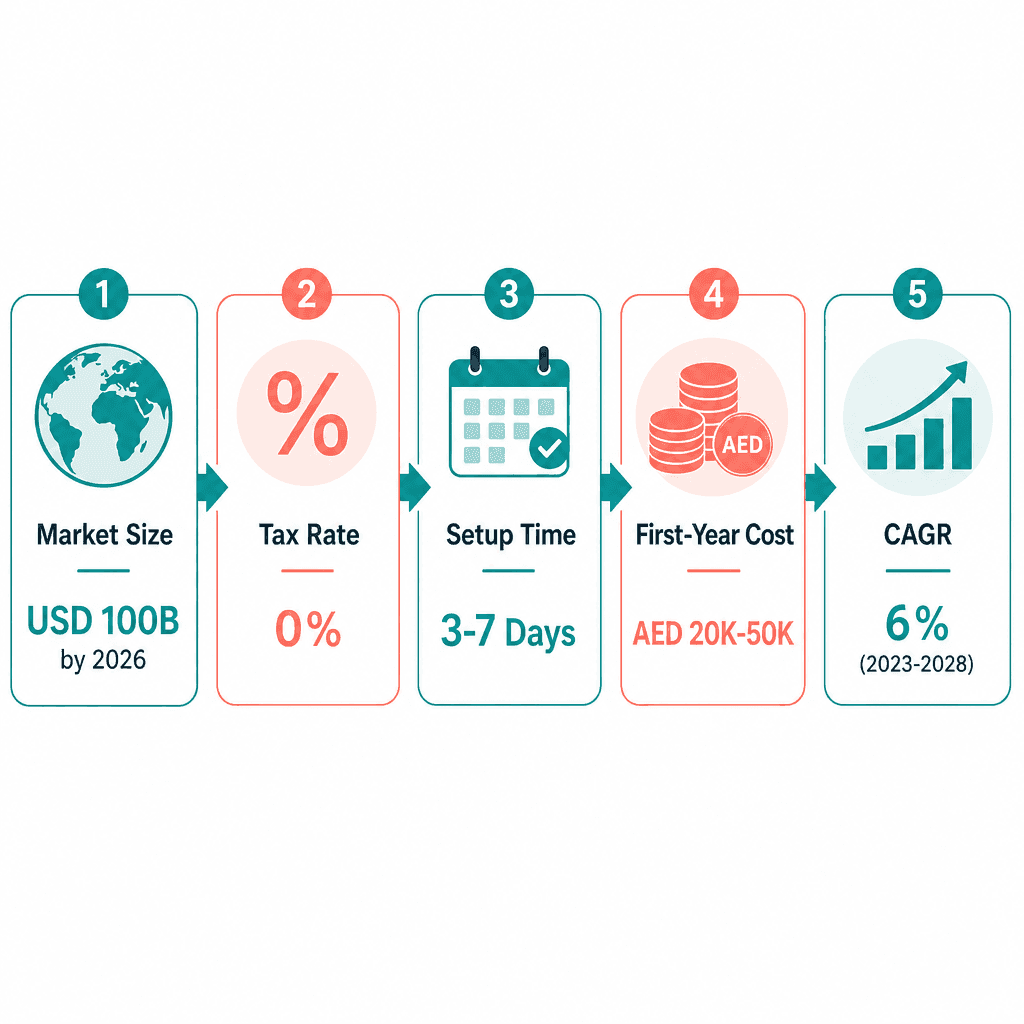
Total first-year costs typically range between AED 20,000 and AED 50,000. This varies based on office type, number of visas, and any additional regulatory approvals required.
Ongoing costs include annual licence renewal, office space, visa renewals, and food safety compliance. Traders should also account for product registration fees where MOHAP approval is required. Use the business setup cost calculator to get a more precise estimate based on your specific requirements.
Additional one-time costs may include trade name reservation and document notarisation. These are typically minor but should be factored into your initial budget.
How to Apply Through Dubai South Business Hub
Dubai South Business Hub Free Zone offers a straightforward application process for baby food trading licences. The typical setup timeline is three to seven working days from submission of complete documentation.
The step-by-step process is as follows:
Confirm your business activity and select Activity Code 4721.8
Choose your company structure — Free Zone Establishment or Free Zone Company
Check your preferred trade name availability and reserve it
Submit your application and required documents to Dubai South Business Hub
Receive initial approval and sign the licence agreement
Pay the applicable fees and obtain your Trading Licence
Apply for UAE residency visas if required
Open a corporate bank account in the UAE
Register with the UAE Food Safety Department and obtain any sector-specific approvals
After receiving your licence, you can apply for residency visas for yourself and your staff. The number of visa allocations depends on your office package. You will also need to open a UAE bank account to operate commercially and receive payments.
Dubai South's location adjacent to Al Maktoum International Airport provides strong logistics advantages. Traders can import in bulk, store goods in bonded warehouses, and re-export to markets across the GCC, East Africa, and South Asia. According to Dubai Trade, the UAE's trade infrastructure supports efficient customs clearance and re-export operations across more than 150 countries.
The baby food sector offers strong commercial potential. Wholesale margins in the UAE typically range from 20% to 40%, depending on the brand, product type, and distribution channel. Premium and organic products often command higher margins. The Dubai Chamber of Commerce identifies food and consumer goods as a key growth sector for the emirate's trade economy.
A baby food trading licence in Dubai requires meeting specific regulatory, documentation, and food safety standards. With the right guidance, the process is straightforward and can be completed quickly.
Contact Dubai South Business Hub today to start your business and get expert support through every step of your baby food trading licence application.
References
Frequently Asked Questions