Project Development Consultancies Business Setup in Dubai: Licensing Guide

Topic Summary
Understand Activity Code 7020.22
This code covers advisory work on planning, feasibility, and coordination of development projects, but excludes physical construction or contracting.
Check Your Professional Eligibility
Professionals with backgrounds in project management, engineering, urban planning, or business strategy can qualify, whether UAE nationals or foreign nationals.
Choose Mainland or Free Zone
Mainland licenses via DET allow unrestricted work with government and local clients, while free zones offer 100% foreign ownership but may limit direct mainland client engagement.
Know the Ownership Rules
Free zones allow full foreign ownership, whereas mainland structures like LLCs may require a local service agent or Emirati partner depending on the setup.
Factor in Corporate Tax
Corporate tax applies to taxable income exceeding AED 375,000, as outlined by the UAE Ministry of Finance guidelines.
Explore Visa Eligibility Options
License holders can access investor and partner visas, supporting both business operations and residency needs.
Estimate Your Setup Costs
Using an online cost calculator can help consultancies plan their budget before committing to a mainland or free zone structure.
Dubai's position as a regional hub for infrastructure, real estate, and economic diversification has made project development consultancy one of the most strategically relevant business activities to license in the emirate. Whether you are advising on large-scale urban development, infrastructure feasibility, or public-private partnerships, understanding the licensing framework is essential before you begin operations. This guide explains what activity code 7020.22 covers, who qualifies to operate under it, and the key licensing and setup considerations for establishing a project development consultancy in Dubai.
📊 Key Facts at a Glance
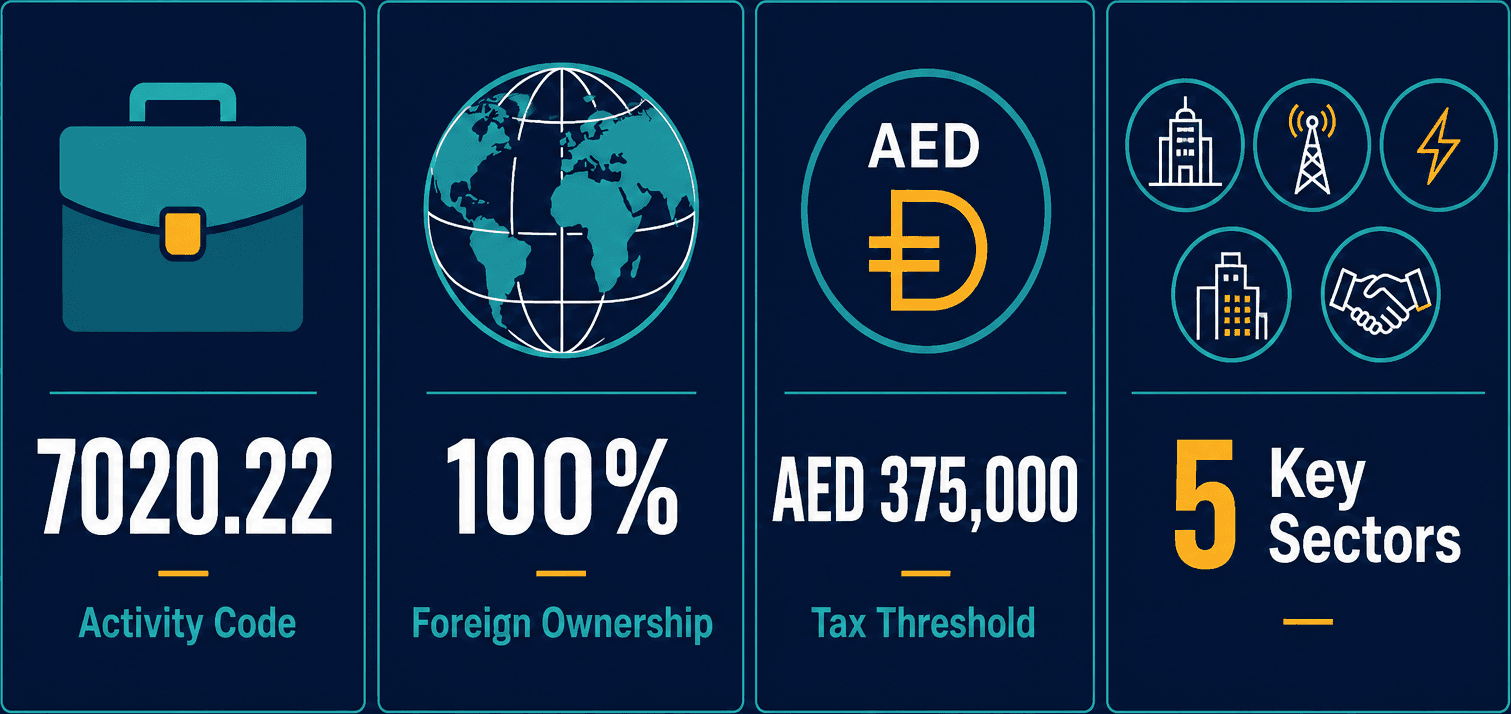
Activity Code: 7020.22 — Project Development Consultancies
License Type: Professional (not commercial)
Ownership: 100% foreign ownership available in free zones; mainland rules vary by structure
Visa Eligibility: Investor and partner visas available to license holders
Corporate Tax: Applies on taxable income above AED 375,000 (see tax.gov.ae)
Key Sectors: Real estate, infrastructure, energy, urban development, PPPs
What Is Activity Code 7020.22: Project Development Consultancies?
Activity code 7020.22 covers professional advisory services related to the planning, coordination, feasibility assessment, and execution support of development projects. Under UAE business classification, this activity encompasses a broad range of consultancy functions across sectors such as real estate, infrastructure, energy, urban development, and public-private partnerships (PPPs).
It is important to understand that project development consultancy is an advisory activity — it does not include physical construction, contracting, or direct implementation work. Businesses licensed under this code provide strategic guidance, project structuring advice, risk analysis, stakeholder coordination, and programme management support to developers, investors, and government bodies. If you also want to explore related business activities in Dubai, a full list is available to help you identify the most appropriate classification for your services. For more detail, see our guide on health management and project consultancy in Dubai.
Who Can Conduct This Activity?
Qualified professionals with backgrounds in project management, engineering, urban planning, architecture, or business strategy
Corporate entities seeking to provide advisory services to property developers, government bodies, or institutional investors
Both UAE nationals and foreign nationals — subject to ownership rules that differ between mainland and free zone jurisdictions
Individuals or firms with demonstrable experience in managing or advising on complex development programmes
Business Setup Options: Mainland vs. Free Zone
Choosing between a mainland and a free zone setup is one of the most consequential decisions for a project development consultancy. Each option has distinct advantages depending on your target client base, preferred ownership structure, and operational scope.
A mainland license is issued via Dubai Economy and Tourism (DET) and allows your consultancy to work directly with UAE government entities, semi-government bodies, and local private-sector clients without restriction. Depending on your chosen legal structure — such as a Limited Liability Company (LLC) or a sole establishment — a local service agent or Emirati partner may be required. You can refer to moet.gov.ae for current guidance on commercial registration standards and legal structures.
A free zone license offers 100% foreign ownership and a streamlined setup process. Free zone companies typically operate with clients within the zone or internationally; working directly with mainland UAE clients may require a branch office or dual-license arrangement. For consultancies with a primarily international or regional client base, a free zone structure can be highly practical. If you are evaluating costs, you can calculate your business setup cost in Dubai using an online estimator before committing to a jurisdiction.
For a professional license in Dubai, the consultancy category applies rather than a commercial trading license — an important distinction that affects the documentation and approval process.
Dubai South Business Hub Free Zone as a Setup Option
Dubai South Business Hub Free Zone offers a practical environment for consultancy businesses seeking 100% foreign ownership and a strategically located base near Al Maktoum International Airport. Its proximity to one of the world's largest planned airport and logistics corridors makes it particularly relevant for project development consultancies targeting aviation, logistics, real estate, and infrastructure sectors active within the Dubai South ecosystem.
Flexible office and flexi-desk options are available, which can meaningfully reduce overhead costs for early-stage consultancy firms that do not require large physical premises. The free zone setup process is structured to support professional service businesses, and the team can guide applicants through trade name reservation, documentation, and visa allocation. You can check your business name availability before initiating the application process.
Licensing Requirements and Typical Setup Steps
While exact requirements may vary by jurisdiction and legal structure, the following steps are typically involved in licensing a project development consultancy in Dubai:
Trade name reservation: Reserve your business name with the relevant authority — DET for mainland, or the free zone authority for free zone setups.
Initial approval: Submit your proposed activity and business details for preliminary approval.
Documentation: Provide passport copies, visa status documentation, and proof of relevant professional qualifications where required by the authority.
Legal structure and agreements: Prepare a Memorandum of Association (MOA) for an LLC, or a service agreement for sole establishments and free zone companies.
Office space: Secure a physical office, shared workspace, or flexi-desk arrangement that meets the jurisdiction's minimum requirements.
License issuance: Upon approval and payment of applicable fees, the professional license is issued.
Visa and Residency Considerations
License holders under activity code 7020.22 are eligible to apply for investor or partner visas. The number of employee visas you can sponsor is generally tied to your office space type and size. UAE residency visa services, including investor visa processing and Emirates ID applications, are available through Dubai South Business Hub Free Zone's support team. The ICP (Federal Authority for Identity, Citizenship, Customs and Port Security) and GDRFA are the authoritative bodies managing residency and entry permit processes. Dependant visas can be applied for once your investor visa is stamped and your Emirates ID is issued.
Regulatory and Compliance Considerations
Operating a project development consultancy in Dubai comes with ongoing regulatory obligations that business owners must plan for:
Corporate Tax: UAE Corporate Tax applies to businesses with net taxable income above AED 375,000. Consult tax.gov.ae for current thresholds, exemptions, and filing requirements.
Economic Substance Regulations (ESR): Depending on your activity type and client base, ESR reporting obligations may apply.
AML Compliance: Anti-money laundering obligations are relevant for consultancies involved in advising on large-scale project transactions or financial structuring.
Annual License Renewal: Licenses must be renewed annually. Failure to renew on time can affect both your business standing and the validity of associated residency visas.
Key Considerations Before Setting Up
Before submitting your license application, consider the following strategic factors:
Define your client base: Whether you plan to serve government, semi-government, or private-sector clients will significantly influence your choice of mainland versus free zone jurisdiction.
Operational geography: Assess whether your consultancy will operate locally, regionally, or internationally — this shapes which setup structure delivers the best value.
Professional qualifications: Verify with the relevant licensing authority whether your qualifications need to be attested or evaluated before your application is accepted.
Budget planning: Account for setup costs, visa fees, office space, and annual renewal charges. Avoid relying on unverified fee estimates circulating online.
Networking and credibility: Consider registering with the Dubai Chamber of Commerce to build credibility and access business development opportunities within the UAE market.
Conclusion
Setting up a project development consultancy in Dubai under activity code 7020.22 offers access to one of the region's most active project markets, with flexible options across mainland and free zone jurisdictions to suit different business models and ownership preferences. From feasibility advisory to project coordination services, the scope of this activity is well-suited to professionals and firms with the expertise to guide complex development programmes.
Speak with the Dubai South Business Hub Free Zone team to explore whether a free zone consultancy license aligns with your project development goals and target market — and take advantage of the strategic location, ownership benefits, and support services available to new businesses in the zone.
References
tax.gov.ae (tax.gov.ae)
moet.gov.ae (moet.gov.ae)
ICP (Federal Authority for Identity, Citizenship, Customs and Port Security) (icp.gov.ae)
GDRFA (gdrfad.gov.ae)
Dubai Chamber of Commerce (dubaichamber.com)
Frequently Asked Questions