Rock Wool Trading License in Dubai: Cost and Requirements

Topic Summary
100% Foreign Ownership With No Local Sponsor
Dubai South Business Hub Free Zone allows international investors to retain full ownership of their rock wool trading company without appointing a UAE national partner. This gives founders complete control over business decisions from day one.
Activity Code 4752.88 Covers a Broad Product Range
The trading license under Activity Code 4752.88 authorises import, export, re-export, and local distribution of rock wool boards, rolls, loose fill, and pipe sections. This flexibility lets license holders serve construction, industrial, and HVAC customers from a single license.
Zero Corporate and Personal Income Tax Benefits
Qualifying free zone businesses pay no corporate tax on eligible income and no personal income tax, making the cost structure highly competitive. These savings can be reinvested into inventory, logistics, or regional market expansion.
Jebel Ali Port Unlocks Regional Re-Export Markets
Dubai's proximity to Jebel Ali, the Middle East's largest container port, gives rock wool traders direct access to GCC, sub-Saharan Africa, and South Asia supply chains. Re-export is explicitly permitted under the license, significantly expanding the addressable market beyond the UAE.
Green Building Codes Are Driving Insulation Demand
UAE regulations such as the Estidama Pearl Rating System increasingly require developers to specify fire-resistant, energy-efficient materials like rock wool from the start of a project. This regulatory tailwind is creating sustained, measurable demand for compliant insulation products across the region.
Fast Processing Timeline for License Applications
Depending on documentation readiness, the rock wool trading license can be processed in as little as a few working days to a few weeks. Prospective investors are advised to request a tailored cost quote directly from the free zone authority to account for visa allocation and package variables.
As Gulf construction activity accelerates and energy-efficiency regulations tighten, demand for rock wool insulation across the UAE and wider MENA region is growing at a measurable pace. This guide explains how to obtain a rock wool trading license (Activity Code 4752.88) at Dubai South Business Hub Free Zone, covering setup costs, compliance requirements, and why Dubai is the region's preferred hub for this trade.
Key Stats at a Glance
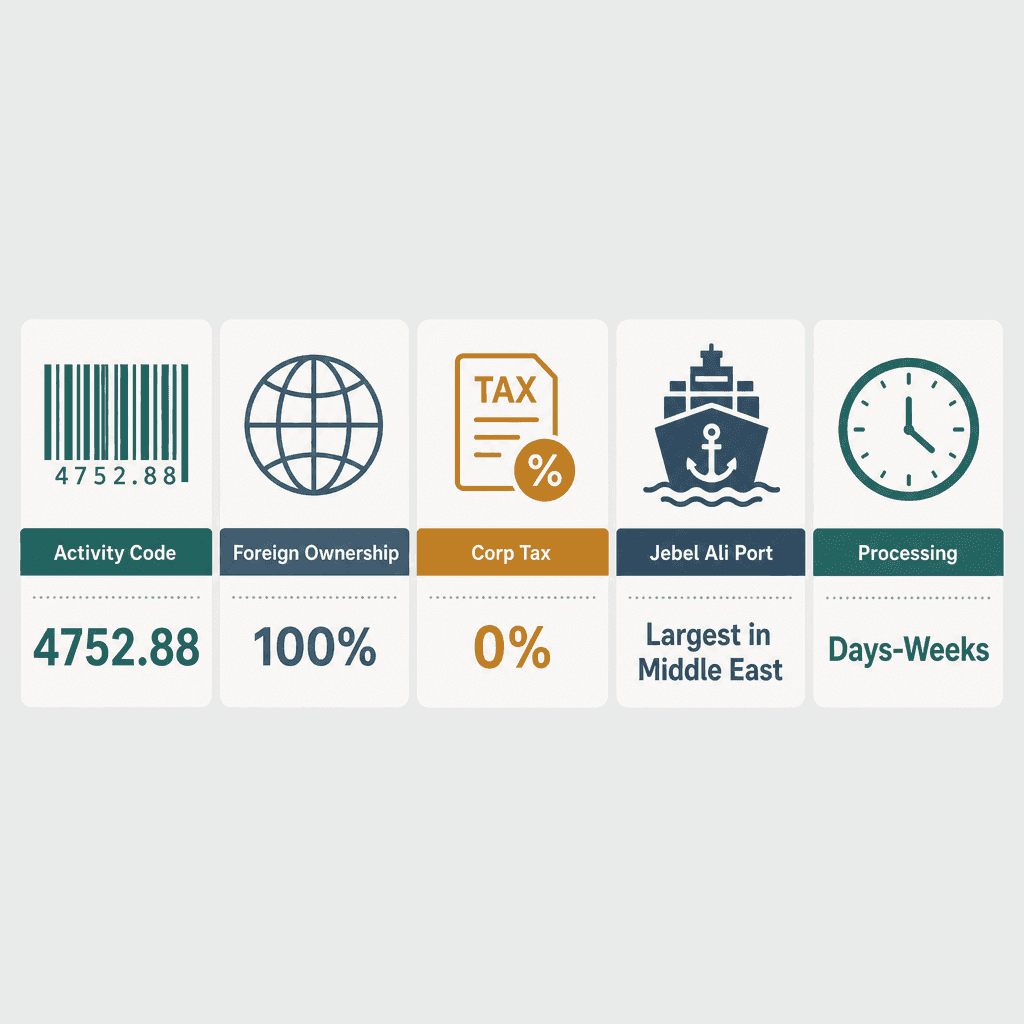
Activity Code: 4752.88 | Category: Trading | License Type: Trading License
100% foreign ownership permitted at Dubai South Business Hub Free Zone
Zero corporate tax on qualifying free zone income and zero personal income tax
Access to Jebel Ali Port, the largest container port in the Middle East
Re-export permitted to GCC, Africa, and South Asia markets
Typical license processing timeline: a few working days to a few weeks depending on documentation
Rock Wool Trade in the UAE: Market Context
The UAE construction sector continues to expand across residential, commercial, and industrial segments, driven by large-scale infrastructure programmes, Expo legacy developments, and a sustained pipeline of real estate projects. This growth is translating directly into rising demand for high-performance insulation materials, with rock wool among the most specified products on the market.
Rock wool's inherent fire-resistance and superior thermal properties make it particularly well aligned with UAE green building codes and the Estidama Pearl Rating System, which encourages developers to adopt materials that reduce energy consumption and improve occupant safety. As these standards become more widely enforced, contractors and developers are increasingly required to specify compliant insulation solutions from the outset of a project.
Dubai's geography amplifies the commercial opportunity further. The emirate functions as a re-export gateway to the broader GCC, sub-Saharan Africa, and South Asia, meaning traders based here can serve a far larger addressable market than the UAE alone. Activity Code 4752.88 is classified under the Trading category and covers the wholesale and retail of rock wool and related insulation materials, providing a clearly defined and commercially flexible scope of trade.
What the Rock Wool Trading License Covers and Who It Suits
A trading license issued under Activity Code 4752.88 authorises the holder to import, export, re-export, and locally distribute rock wool insulation products. The permitted product range is broad and includes rock wool boards, rolls, loose fill, and pipe sections, giving license holders the flexibility to serve diverse customer requirements across construction, industrial, and HVAC applications.
The license is well suited to a range of business profiles. Established insulation product distributors looking to consolidate their regional operations will find the free zone environment particularly efficient. Construction material suppliers seeking to add insulation lines to their portfolio can use the license to source internationally and distribute locally or regionally. International traders from Europe, Asia, or elsewhere who want a GCC base from which to manage supply chains and customer relationships will also benefit from the structure on offer.
A significant advantage of operating within Dubai South Business Hub Free Zone is that 100% foreign ownership is permitted. There is no requirement to appoint a local UAE national as a sponsor or partner, which means investors retain full control of their business from day one.
Setup Costs and Steps at Dubai South Business Hub Free Zone
The total cost of setting up a rock wool trading company at Dubai South Business Hub Free Zone typically encompasses the license fee, registration fee, and visa allocation costs. Exact figures vary depending on the package selected and the number of visas required, so prospective investors are advised to request a tailored quote directly from the free zone authority or a registered business setup adviser. As a general guide, free zone trading licenses in Dubai can range from approximately AED 10,000 to AED 30,000 or more annually, with additional costs for visas and facility arrangements.
The free zone offers both flexi-desk and warehouse facility options, making it accessible to traders at different operational scales. A flexi-desk arrangement suits those who do not need to physically stock goods, while dedicated warehouse space is available for businesses requiring on-site storage and handling capability.
The setup process follows a clear sequence of steps: business name reservation, application submission, document review by the authority, license issuance, and subsequent bank account opening with a UAE-based financial institution. The estimated timeline from application submission to an active license is typically a few working days to a few weeks, depending on the completeness of documentation provided.
Documents Required
Passport copies of all shareholders and directors
Completed application form and a brief business plan summary
No-objection certificate if the applicant currently holds existing UAE residency under another visa
Licensing and Compliance Requirements
Once issued, the trading license must be renewed annually. Renewal fees are broadly comparable to initial license costs and should be factored into ongoing operational budgets. Failure to renew on time can result in penalties or suspension of trading activities.
Rock wool products traded in the UAE are subject to conformity requirements overseen by the Emirates Authority for Standardisation and Metrology (ESMA). Traders should ensure that the products they source meet applicable UAE standards for insulation materials before importing or distributing them. Obtaining the relevant conformity marks or certificates of compliance from suppliers is a standard part of responsible procurement in this product category.
Customs and re-export documentation must comply with Dubai Customs protocols and the specific procedures applicable to free zone operators. This includes accurate declaration of goods, correct tariff classification, and maintaining proper records for audit purposes. Health and safety compliance is also relevant for the storage and handling of mineral wool products, which can release fine fibres if improperly managed. Appropriate personal protective equipment and handling procedures should be in place for any warehouse operations.
Why Dubai South Is Well-Positioned for Rock Wool Trading
Dubai South's physical location is one of its most compelling commercial attributes. The free zone sits adjacent to Al Maktoum International Airport, which enables fast air freight movements for urgent or high-value insulation consignments. For traders managing time-sensitive project deliveries, this proximity offers a meaningful operational advantage.
For larger volume shipments, direct access to Jebel Ali Port, the largest container port in the Middle East, provides unrivalled sea freight connectivity. The port handles vast quantities of building materials and industrial goods, and its established logistics ecosystem means traders benefit from competitive freight rates and efficient customs clearance processes.
From a fiscal perspective, qualifying free zone businesses benefit from zero corporate tax on eligible income and zero personal income tax, allowing traders to structure their operations in a highly tax-efficient manner. These advantages, combined with Dubai's strategic position between manufacturing hubs in Europe and Asia and the fast-growing end markets of the GCC, Africa, and South Asia, make it a logical base for regional rock wool distribution.
Related Activities
Timber Trading Business
Cement & Gypsum Trading Trading License
Reinforcement Steel Bars Trading Trading License
Frequently Asked Questions