Seeds Trading License in Dubai
Topic Summary
Dubai's Location Makes It a Trade Powerhouse
Dubai sits within an eight-hour flight of approximately 4.7 billion consumers across Asia, Africa, Europe, and the Middle East. This unmatched geographic position makes it an ideal hub for re-exporting seeds to fast-growing agricultural markets.
100% Foreign Ownership Is Permitted
Businesses operating under a Seeds Trading License at Dubai South Business Hub Free Zone can retain full foreign ownership of their company. This is a significant advantage for international agri-businesses and entrepreneurs entering the market.
The License Covers a Wide Range of Seeds
Activity Code 4773.17 permits the import, storage, and re-export of vegetable seeds, cereal seeds, flower seeds, and other agricultural planting material. This broad scope gives license holders flexibility to serve diverse regional markets.
Setup Can Be Completed in Two to Four Weeks
The licensing process at Dubai South Business Hub Free Zone is structured and transparent, with a typical timeline of just two to four weeks. Annual license fees start from approximately AED 12,000 to AED 20,000 for a standard trading package.
Zero Corporate Tax on Qualifying Free Zone Income
License holders benefit from a 0% corporate tax rate on qualifying free zone income, significantly improving profit margins for trading and re-export operations. This tax-friendly environment is a key reason agri-businesses choose Dubai as their regional base.
A USD 100 Billion Global Market Is Within Reach
The global seeds market is projected to exceed USD 100 billion by 2030, driven by population growth and demand for climate-resilient, high-yield crop varieties. Dubai-based traders are well-positioned to capture a share of this growth by serving African and South Asian markets.
Jebel Ali Port Provides World-Class Logistics
One of the largest ports globally, Jebel Ali handles millions of tonnes of cargo annually and sits close to Dubai South Business Hub Free Zone. This infrastructure gives seeds traders unrivalled access to international shipping routes for efficient import and re-export operations.
Global food security is reshaping trade priorities, and seeds sit at the very heart of that conversation. As demand for agricultural inputs grows across Africa, South Asia, and the wider Middle East, Dubai has positioned itself as the natural gateway for seeds trading between producers and emerging markets. Whether you are an established agri-business or an entrepreneur entering the sector for the first time, obtaining a Seeds Trading License in Dubai opens the door to one of the world's most strategically connected trade corridors.
This guide covers everything you need to know about the Seeds Trading License under Activity Code 4773.17 at Dubai South Business Hub Free Zone, including what the license covers, who it suits, setup costs, compliance requirements, and why Dubai is the ideal base for this trade.
UAE and Dubai Market Context
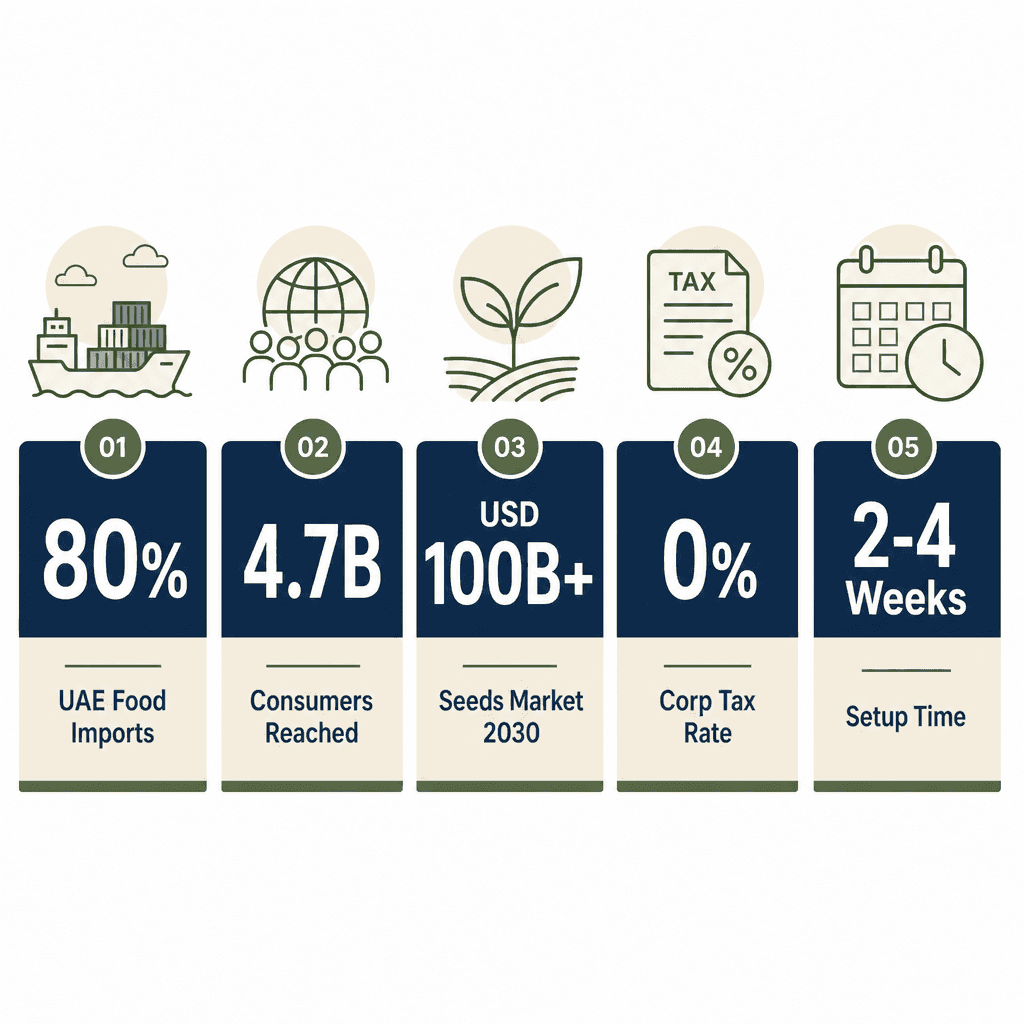
The UAE imports more than 80% of its food supply, making it one of the most import-dependent nations in the world. Agricultural inputs, including seeds, are a critical component of this supply chain. The country's strategic location places it within an eight-hour flight of approximately 4.7 billion consumers across Asia, Africa, Europe, and the Middle East. Dubai's Jebel Ali Port, one of the largest ports globally, handles millions of tonnes of cargo annually, providing unrivalled logistics infrastructure for re-export-focused businesses.
The global seeds market is projected to exceed USD 100 billion by 2030, driven by population growth, climate-resilient crop development, and rising demand for high-yield varieties. Dubai's free zone ecosystem, favourable tax environment, and robust regulatory framework make it an increasingly attractive hub for seeds trading companies looking to serve these growth markets.
What the Seeds Trading License Covers
The Seeds Trading License in Dubai falls under Activity Code 4773.17 and is classified as a Trading License within the Trading category. It permits the holder to engage in the wholesale and retail trading of seeds, including vegetable seeds, cereal seeds, flower seeds, and other agricultural planting material. Licensed businesses may import, store, and re-export seeds to markets across the region and beyond.
Operating from Dubai South Business Hub Free Zone, license holders benefit from a dedicated free zone environment designed to support trading, logistics, and distribution activities with streamlined processes and world-class infrastructure.
Who the License Suits
Agri-businesses seeking a regional distribution hub for seed varieties
Seed manufacturers looking to establish a trading and re-export operation
Agricultural traders importing seeds from Europe, the Americas, or Asia for onward sale
Entrepreneurs entering the agricultural inputs sector
Companies seeking to serve African and South Asian markets via Dubai's logistics network
Seeds Trading in Dubai: Key Facts
Activity Code: 4773.17
License Type: Trading License
Category: Trading
Free Zone: Dubai South Business Hub
Foreign Ownership: Up to 100%
Corporate Tax Rate: 0% on qualifying free zone income
Global Seeds Market (2030 projection): USD 100+ billion
UAE Food Import Dependency: Over 80%
Typical License Setup Timeline: 2 to 4 weeks
Setup Costs and Steps
Setting up a Seeds Trading License at Dubai South Business Hub Free Zone is a structured and transparent process. Costs vary depending on office space requirements, visa allocations, and any additional regulatory approvals needed, but typical license fees start from approximately AED 12,000 to AED 20,000 per year for a standard trading license package.
Step-by-Step Setup Process
Step 1 - Choose your business activity: Confirm that seeds trading under Activity Code 4773.17 aligns with your intended operations.
Step 2 - Select your company structure: Free zone companies typically operate as Free Zone Establishments (FZE) for sole shareholders or Free Zone Companies (FZC) for multiple shareholders.
Step 3 - Submit your application: Provide passport copies, business plan, and completed application forms to Dubai South Business Hub.
Step 4 - Obtain initial approval: The free zone authority reviews and issues initial approval, usually within a few working days.
Step 5 - Secure your workspace: Choose from flexi-desk, office, or warehouse options depending on your operational needs.
Step 6 - Receive your license: Upon payment of fees and submission of all documents, your Seeds Trading License is issued.
Step 7 - Open a corporate bank account: Proceed with banking setup to begin operations.
Licensing and Compliance Requirements
Seeds are an agricultural commodity subject to regulatory oversight in the UAE. License holders must be aware of the following compliance requirements:
Imported seeds must comply with UAE Ministry of Climate Change and Environment (MOCCAE) phytosanitary regulations, including valid phytosanitary certificates from the country of origin.
Certain seed varieties may require additional approvals or testing before they can be traded or re-exported.
Labelling requirements must meet UAE standards, including accurate variety descriptions and country of origin declarations.
Businesses storing seeds in quantity may need to comply with specific warehouse temperature and humidity standards to maintain seed viability.
Annual license renewal is required, along with updated documentation where applicable.
Why Dubai Is Well-Positioned for Seeds Trading
Dubai's advantage in seeds trading is not simply geographic, though location is undeniably significant. The emirate offers a combination of factors that few other jurisdictions can match:
World-class logistics: Proximity to Jebel Ali Port and Al Maktoum International Airport enables efficient import and re-export operations.
100% foreign ownership: Free zone licenses allow full foreign ownership without the need for a local partner.
Tax efficiency: Qualifying free zone businesses benefit from 0% corporate tax on eligible income and no personal income tax.
Regulatory clarity: Dubai South Business Hub provides a transparent, business-friendly regulatory environment.
Market access: UAE free trade agreements and bilateral trade relationships open markets across the GCC, Africa, and Asia.
Banking and finance: Dubai's mature financial sector supports trade finance, letters of credit, and multi-currency accounts essential for international seeds trading.
Get Started
Use the cost calculator for a tailored quote.
Verify your business name with the company name check.
Browse the full business activities directory.
Get in touch to start your application.
Frequently Asked Questions