Setting Up an Underwater Telecommunications & Power Cables Installation & Maintenance Services Business in Dubai

Topic Summary
Understand Activity Code 4321.99 Scope
This code covers installation, repair and maintenance of subsea telecom and power cables, including fibre-optic networks and offshore renewable energy links. It spans survey work, cable laying, jointing, and ROV or diver-based inspections.
Align With National Digital and Energy Goals
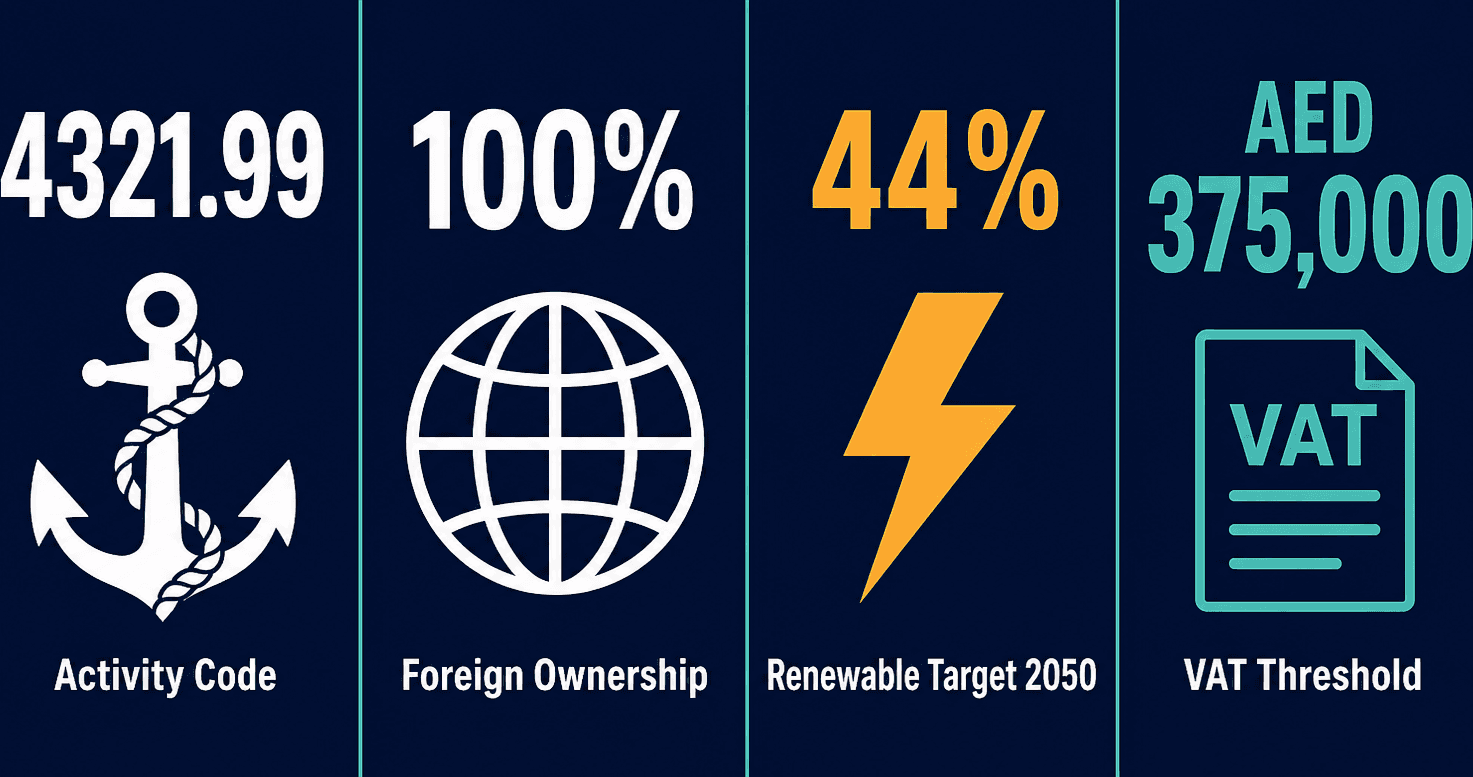
Dubai's subsea cable sector supports the UAE's digital economy strategy and its target of 44% renewable energy by 2050. This makes the activity strategically important for offshore wind, solar grid connections, and international data links.
Know Who Can Operate This Business
LLCs, foreign branch offices, and free zone entities can all conduct this activity, provided they employ qualified marine or electrical engineers. Regulators expect verifiable technical credentials given the complexity of subsea work.
Choose Between Mainland and Free Zone Licensing
Businesses must decide between a mainland licence from the Dubai Department of Economy and Tourism or a free zone licence offering full foreign ownership. The choice depends on client location, project execution needs, and desired operational flexibility.
Consider Dubai South Business Hub Free Zone
This free zone is highlighted as a practical entry point for technical and marine infrastructure companies entering the underwater cable sector. It offers 100% foreign ownership and a streamlined setup process for specialist contractors.
Prepare for Multiple Regulatory Approvals
Companies must engage with the Dubai Maritime Authority, TDRA, and DED or the relevant free zone authority depending on their structure. Meeting these regulatory requirements is essential before beginning offshore or telecom infrastructure work.
Factor in VAT and Financial Thresholds
Businesses generating over AED 375,000 in annual turnover must register for VAT under UAE tax law. Understanding this threshold early helps with accurate financial planning and compliance from the outset.
Dubai's position as a global maritime and digital infrastructure hub makes it one of the most strategically valuable locations in the world for underwater telecommunications and power cable services. Whether you are an international engineering firm looking to expand into the Gulf or a specialist contractor targeting offshore energy projects, Dubai offers a compelling environment to establish and grow this type of business.
This guide covers everything you need to know about registering and operating an Underwater Telecommunications & Power Cables Installation & Maintenance Services business under activity code 4321.99 in Dubai — including licensing pathways, regulatory approvals, and why free zones like Dubai South Business Hub Free Zone offer a practical entry point for technical and marine infrastructure companies.
📊 Key Facts at a Glance
Activity Code: 4321.99 — Underwater Telecommunications & Power Cables Installation & Maintenance Services
Licence Type: Industrial or Professional (depending on scope)
Ownership: 100% foreign ownership available in free zones
Key Regulators: Dubai Maritime Authority, TDRA, DED / Free Zone Authority
VAT Threshold: AED 375,000 annual turnover
Strategic Location: Dubai sits at the crossroads of Europe, Asia, and Africa subsea cable routes
What Does Activity Code 4321.99 Cover?
Activity code 4321.99 encompasses the installation, laying, repair, and ongoing maintenance of underwater cables — both telecommunications and high-voltage power cables. This includes subsea fibre-optic networks, inter-island data links, offshore platform power connections, and renewable energy cable systems linking offshore wind or solar installations to the onshore grid.
The scope is broad and technically demanding. Operators may be involved in survey and route planning, cable laying using specialist vessels, jointing and termination works, and post-installation inspection and maintenance using remotely operated vehicles (ROVs) or diving teams. You can explore the full list of business activities in Dubai to understand how this activity sits within the wider classification framework.
This activity is directly relevant to the UAE's national ambitions. The country's digital economy strategy relies on resilient subsea connectivity, while its clean energy transition — targeting 44% renewable energy by 2050 — will require significant offshore and inter-grid cabling infrastructure. References to the UAE's official regulatory environment can be found via Dubai Trade and the UAE government portal.
Who Can Conduct This Activity?
This activity can be conducted by Limited Liability Companies (LLCs), branch offices of foreign companies, or free zone entities. Given the technical complexity of the work, licensing authorities typically expect companies to demonstrate that they employ — or are directed by — qualified marine engineers, electrical engineers, or telecoms infrastructure specialists with verifiable credentials.
On the mainland, foreign shareholders may hold up to 100% ownership in many professional and technical sectors following the UAE's 2021 commercial companies law amendments, though specific activity classifications should be confirmed with the Department of Economy and Tourism (DET). In a free zone, 100% foreign ownership is a standard feature of the structure.
Licensing and Business Setup Requirements in Dubai
Companies wishing to operate under activity code 4321.99 must choose between a mainland licence issued by the relevant emirate's economic department or a free zone licence. The right choice depends on where your clients are located, whether you need to execute projects directly on UAE soil or offshore, and your preferred ownership and operational structure.
For mainland licensing, the UAE Ministry of Economy and the Dubai Department of Economy and Tourism oversee the framework. Depending on whether your company's primary function is construction and installation (industrial) or advisory and technical consultancy (professional), the licence classification will differ. Companies actively laying cables or operating marine vessels are more likely to require an industrial or contracting licence classification.
Typical documents required during the application process include:
Trade name reservation certificate
Memorandum and Articles of Association (MOA)
Passport copies of all shareholders and directors
Proof of technical qualifications and relevant engineering credentials
Business plan or scope of activities description
No Objection Certificate (NOC) if applicable for branch offices
You can use the business setup cost calculator to get an initial estimate of your licensing investment before committing to a specific structure.
External Regulatory Approvals
Businesses conducting subsea operations in UAE waters will almost certainly require approval from the Dubai Maritime Authority (DMA), which oversees maritime safety, vessel operations, and offshore works within Dubai's jurisdiction. This is a critical step that must be factored into your setup timeline.
For telecommunications cable projects specifically, coordination with the Telecommunications and Digital Government Regulatory Authority (TDRA) may also be required, particularly where cables connect to UAE landing stations or interface with national telecoms infrastructure. Environmental impact assessments and marine safety compliance documentation are standard requirements for any offshore or nearshore cable works.
Setting Up in a Free Zone: Dubai South Business Hub as a Practical Option
For international companies entering the UAE market, a free zone licence offers several structural advantages: 100% foreign ownership, full repatriation of profits, and a streamlined incorporation process with a single point of contact for licensing and visa services.
Dubai South Business Hub Free Zone is particularly well-positioned for technical and marine infrastructure businesses. Its location adjacent to Jebel Ali Port — one of the largest container ports in the world — and Al Maktoum International Airport provides direct logistical access to maritime supply chains, equipment imports, and international personnel movements. This proximity is a genuine operational advantage for companies managing large-scale subsea cable projects across the region.
Free zone companies can provide services to clients across the UAE, though executing physical works on the UAE mainland or within UAE territorial waters may require additional permissions or a mainland contracting arrangement. It is advisable to discuss the specific project scope with your free zone authority and legal advisors to determine whether a dual-licence or service agreement structure is appropriate. For guidance on navigating UAE administrative processes, resources such as this immigration file number guide illustrate the kind of practical support available through Dubai South Business Hub.
Operational Considerations and Key Requirements
Once licensed, companies must meet ongoing operational requirements to remain compliant. Office or facility requirements vary by licence type — free zone entities typically require at least a registered office address, while companies with physical operations may need dedicated warehouse or yard space for equipment storage.
Staffing is a significant consideration. Hiring marine engineers, ROV technicians, cable jointers, and project managers requires compliance with UAE employment law. For mainland employees, MOHRE (Ministry of Human Resources and Emiratisation) governs employment contracts, work permits, and labour protections. Free zone employees are typically managed through the free zone authority's own HR framework.
VAT registration is mandatory if your annual taxable turnover exceeds AED 375,000, as confirmed by the Federal Tax Authority. Most B2B subsea cable contracts will surpass this threshold quickly, making early VAT registration advisable.
Vessel certifications, equipment compliance records, and health and safety documentation for diving or ROV operations must also be maintained and made available to relevant authorities upon request. UAE residency visa packages tied to your company licence can support the relocation of specialist technical staff from overseas.
Insurance and Liability Coverage
Given the high-value and high-risk nature of subsea cable projects, appropriate insurance coverage is essential. Professional indemnity insurance protects against claims arising from design errors or project failures, while marine liability insurance covers vessel operations and third-party risks at sea. Environmental damage coverage is increasingly expected by project owners and regulatory bodies for any works in sensitive marine environments. Confirm specific insurance requirements with the Dubai Maritime Authority and your project clients before mobilisation.
Market Opportunity and Strategic Outlook
The commercial case for establishing this business in Dubai is strong. The UAE sits at the intersection of major international subsea cable routes connecting Europe, Asia, and East Africa. As demand for cloud computing, streaming, and digital financial services grows across the Middle East, the need for resilient, high-capacity subsea telecoms infrastructure is accelerating.
Simultaneously, the UAE's offshore energy ambitions — including floating solar, offshore wind feasibility studies, and inter-emirate power grid expansion — are creating sustained demand for high-voltage subsea power cable installation and maintenance services. The World Bank consistently highlights digital infrastructure investment as a key driver of economic growth in emerging and transition markets, a trend that directly benefits specialist contractors operating from a hub like Dubai.
Companies that establish early in this market stand to benefit from long-term government and private sector contracts, regional expansion opportunities across the Gulf and Indian Ocean, and Dubai's established reputation as a base for international engineering and marine services firms.
Conclusion
Establishing an underwater telecommunications and power cables business in Dubai under activity code 4321.99 requires careful navigation of licensing structures, maritime regulatory approvals from bodies such as the Dubai Maritime Authority, and ongoing operational compliance — but the strategic and commercial opportunity is substantial. Dubai's infrastructure ambitions, geographic position, and business-friendly regulatory environment make it an ideal base for companies in this specialist sector.
Contact Dubai South Business Hub today to explore free zone licensing options tailored to technical and marine infrastructure services, and take the first step towards setting up your business in Dubai with confidence.
References
Dubai Trade (dubaitrade.ae)
the UAE government portal (u.ae)
UAE Ministry of Economy (moet.gov.ae)
MOHRE (Ministry of Human Resources and Emiratisation) (mohre.gov.ae)
Federal Tax Authority (tax.gov.ae)
World Bank (worldbank.org)
Frequently Asked Questions