Start an International Buses Service Business in Dubai

Topic Summary
Understand Activity Code 4922.99 Scope
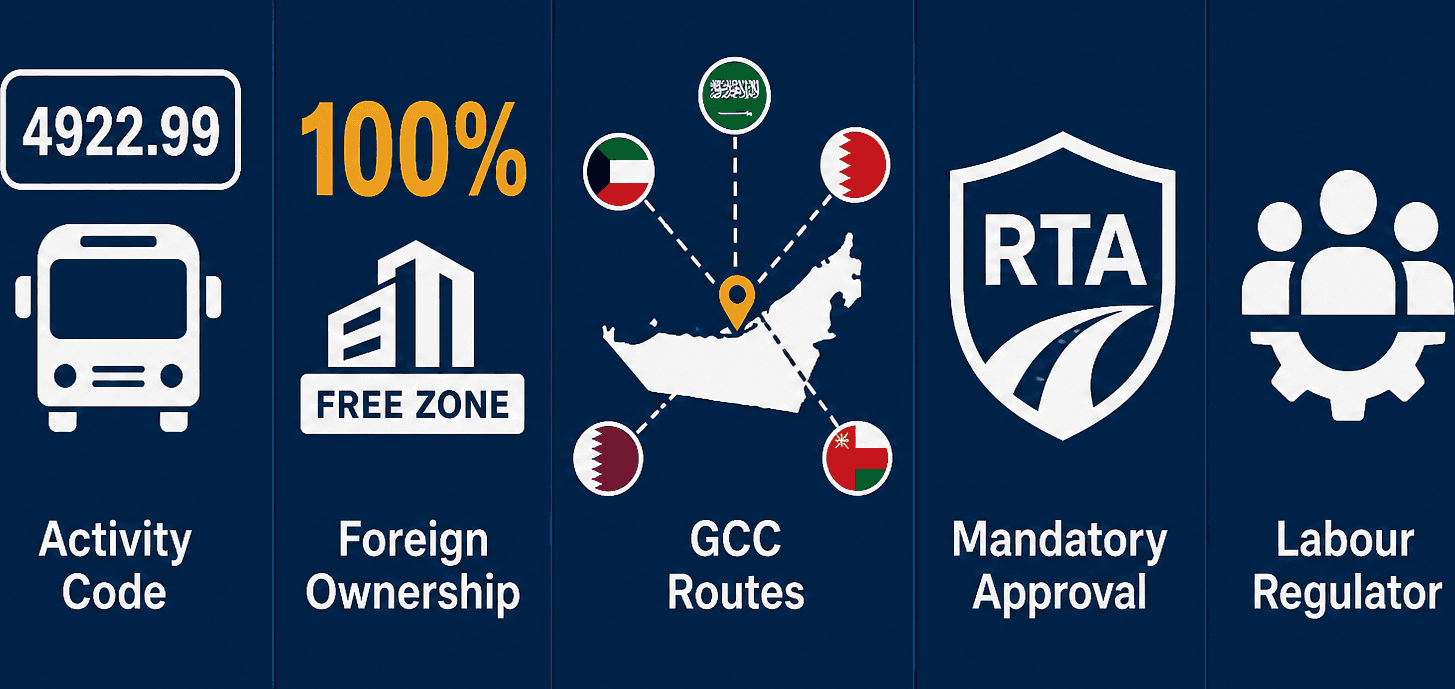
This code covers scheduled and charter passenger bus transport across borders, connecting Dubai to GCC countries like Oman, Saudi Arabia, and Qatar. It applies to fleet owners, transport managers, and ticketing operators involved in cross-border mobility.
Check Eligibility and Ownership Rules
UAE nationals, GCC nationals, and foreign investors can apply, though ownership structures vary by jurisdiction. Free zones allow full foreign ownership, while mainland setups may need a local agent or Emirati partner.
Secure a Valid Trade Licence
Operating legally requires a trade licence specifically listing activity code 4922.99. Without it, no commercial cross-border transport service can begin.
Obtain RTA Route Authorisation
The Road and Transport Authority must approve routes, schedules, and vehicle standards before international services can launch. This includes fleet roadworthiness checks and driver licensing endorsed for cross-border travel.
Meet Cross-Border Regulatory Approvals
Beyond RTA clearance, operators may need additional sign-off from transport ministries in destination countries. Each international corridor requires its own dedicated route permit.
Comply with MOHRE Labour Standards
Employing drivers and staff means following Ministry of Human Resources and Emiratisation regulations throughout the business's operation. This ensures lawful employment practices for the workforce.
Consider Free Zone Setup Options
Dubai South Business Hub Free Zone offers a viable base for launching this activity with full foreign ownership. It provides an alternative to mainland licensing requirements for international transport operators.
Dubai's strategic position as a cross-border transit hub makes it one of the most commercially viable locations in the region to launch an international buses service business. With well-established road corridors connecting the UAE to GCC neighbours and beyond, the demand for reliable, scheduled, and charter cross-border passenger transport continues to grow. This guide covers everything you need to know about activity code 4922.99 — from what it legally permits to licensing, regulatory approvals, and setup options including Dubai South Business Hub Free Zone.
📊 Key Facts at a Glance
Activity Code: 4922.99 — International Buses Service
Licence Type: Commercial / Transport
Mandatory External Approval: Road and Transport Authority (RTA), Dubai
Ownership Options: 100% foreign ownership available in free zones
Key Regulator for Labour: Ministry of Human Resources and Emiratisation (MOHRE)
VAT Applicability: Subject to Federal Tax Authority thresholds
What Is the International Buses Service Activity (Code 4922.99)?
Activity code 4922.99 covers the operation of scheduled and charter passenger transport by road across international routes. In the Dubai context, this primarily refers to cross-border bus services connecting the UAE to GCC countries — such as Oman, Saudi Arabia, Qatar, Kuwait, and Bahrain — as well as potentially broader international corridors.
This activity is distinct from local or intercity transport within the UAE. The defining scope is international routing, meaning operators are authorised to carry passengers across national borders by road. The activity is relevant to a range of business profiles, including fleet owners, transport management companies, ticketing and booking operators, and logistics groups that include passenger mobility in their service portfolio. You can explore the full list of business activities in Dubai to compare related transport and logistics classifications.
Who Can Conduct This Activity?
UAE nationals, GCC nationals, and foreign investors are eligible to apply, subject to applicable ownership structures and jurisdiction rules.
Free zone entities may operate with full foreign ownership, subject to the rules of the specific free zone authority.
Mainland setups under the Department of Economy and Tourism (DET) may require a local service agent or a UAE national partner depending on the legal form chosen.
Licensing and Regulatory Requirements in Dubai
A valid trade licence listing activity code 4922.99 is the foundational legal requirement for operating an international buses service in Dubai. Without this licence, no commercial passenger transport activity can lawfully commence. However, the trade licence alone is not sufficient — operators must also satisfy sector-specific regulatory requirements before vehicles can operate on public roads.
Road and Transport Authority (RTA) approval is mandatory for any vehicle-based passenger transport operation in Dubai. This applies equally to international route operators. Compliance with MOHRE labour regulations for driver and staff employment is also a legal obligation throughout the operational lifecycle of the business.
Role of the Road and Transport Authority (RTA)
The RTA governs all public and commercial road transport in Dubai, including international bus services. Before commencing cross-border passenger services, operators must obtain RTA route authorisation. This involves demonstrating that proposed routes, schedules, and vehicle standards meet the authority's requirements. Specifically:
Fleet vehicles must meet RTA safety, emissions, and roadworthiness standards before they are approved for commercial use.
Drivers operating internationally require appropriate UAE licensing endorsed for cross-border travel.
Route permits must be secured for each international corridor in which the operator intends to run services.
Additional approvals may be required from transport authorities in destination countries — for example, the relevant ministry in Oman or Saudi Arabia — for cross-border routes entering those jurisdictions.
Business Setup Options: Mainland vs Free Zone
Choosing the right jurisdiction is one of the most consequential decisions when setting up an international buses service business in Dubai. Both mainland and free zone structures offer distinct advantages depending on your operational model.
A mainland licence issued by Dubai's Department of Economy and Tourism allows direct operations across Dubai and the UAE without restrictions on client geography or route origin. This is often the preferred structure for operators who intend to physically run buses on UAE roads from day one. If you want to start your business in Dubai with full operational flexibility on the mainland, engaging a local business setup specialist is advisable.
Free zone setup, by contrast, offers full foreign ownership, simplified incorporation processes, and a tax-efficient corporate environment. However, free zone companies conducting physical transport operations on UAE public roads typically require a mainland branch or specific RTA-issued permits to do so legally.
Why Consider Dubai South Business Hub Free Zone?
Dubai South Business Hub Free Zone is a practical option for transport-related businesses, particularly those involved in fleet management, transport administration, holding structures, or route planning. Located within Dubai South — a master-planned development purpose-built for aviation, logistics, and mobility sectors — the free zone offers:
100% foreign ownership with streamlined licence issuance
Proximity to Al Maktoum International Airport and major road networks serving international corridors
Suitability for holding companies and transport management functions
Access to UAE residency visa packages tied to your company licence
Use the business setup cost calculator to get an indicative figure for your Dubai South Business Hub Free Zone licence before committing to a structure.
Key Operational and Compliance Considerations
Beyond licensing and RTA approvals, running an international buses service business in Dubai involves several ongoing compliance obligations:
Fleet insurance: Comprehensive insurance covering international routes and passenger liability is essential and typically required before RTA route permits are issued.
Cross-border coordination: Operations across GCC borders require coordination with the relevant transport ministries and border authorities of each destination country.
VAT registration: Depending on your annual revenue, VAT registration with the Federal Tax Authority may be mandatory. Transport services have specific VAT treatment under UAE law — consult a qualified tax adviser for guidance.
Labour compliance: Employment of drivers and operational staff must comply with UAE Labour Law administered by MOHRE, covering contracts, working hours, and end-of-service entitlements.
Visa and residency: Employee visa and residency requirements are governed by the Identity and Citizenship Authority (ICP).
Commercial and Market Factors
The GCC ground transport sector is experiencing growing demand for affordable, reliable cross-border passenger services, driven by tourism, labour mobility, and trade. The competitive landscape includes established regional operators, making service quality, route coverage, and scheduling reliability key differentiators for new entrants. The Dubai Chamber of Commerce provides networking opportunities and market intelligence resources that can support new transport businesses in identifying commercial partners and understanding sector dynamics.
Steps to Register Your International Buses Service Business in Dubai
Choose your jurisdiction: Decide between a mainland DET licence or a free zone licence such as Dubai South Business Hub Free Zone, based on your operational model and ownership preferences.
Reserve your trade name:Check your business name availability and reserve a compliant trade name with your chosen authority.
Select activity code 4922.99: Ensure the international buses service activity is correctly listed on your licence application.
Submit incorporation documents: Provide the required documentation — including passport copies, business plan, and shareholder details — and obtain your trade licence.
Apply for RTA approvals: Submit route permit applications, vehicle registration requests, and driver licensing documentation to the RTA.
Secure insurance and hire staff: Arrange fleet and passenger liability insurance, recruit qualified drivers, and fulfil all visa and labour requirements before commencing operations.
Conclusion
Launching an international buses service business in Dubai under activity code 4922.99 requires a valid trade licence, mandatory RTA approvals, and careful attention to cross-border regulatory compliance — all within a market that offers strong regional connectivity and sustained commercial demand. Whether you opt for a mainland structure or a free zone licence, getting the foundational steps right will determine how smoothly your operation scales across GCC routes. Contact Dubai South Business Hub Free Zone today to explore how to structure and licence your international buses service business efficiently.
References
MOHRE labour regulations (mohre.gov.ae)
Federal Tax Authority (tax.gov.ae)
Identity and Citizenship Authority (ICP) (icp.gov.ae)
Dubai Chamber of Commerce (dubaichamber.com)
Frequently Asked Questions