Trade Between Russia and the UAE: License and Routes
Trade Between Russia and the UAE: License and Routes
UAE Neutrality Keeps Trade Routes Open
The UAE has not joined Western sanctions regimes, meaning correspondent banking and shipping lanes remain accessible for compliant Russian-origin businesses. This neutrality is the single biggest structural advantage for Russian founders routing trade through Dubai.
DSBH Licenses Are Fast and Affordable
Dubai South Business Hub free zone licenses are issued in just 3–7 working days, with starting costs from AED 12,500. The proximity to Al Maktoum cargo infrastructure makes DSBH especially practical for goods-based trade operations.
Free Zone Companies Protect Your Assets
A DSBH free zone entity acts as the legal counterparty for international contracts, insulating both personal assets and your Russian corporate structure from direct cross-border risk. It can hold multi-currency accounts, sign export and import contracts, and apply for UAE Certificates of Origin.
Qualifying Income Is Taxed at Zero Percent
Under Federal Decree-Law No. 47 of 2022, qualifying free zone income is subject to a 0% corporate tax rate. The Federal Tax Authority VAT registration threshold sits at AED 375,000, giving smaller operations room to scale before VAT obligations apply.
Choose the Right License for Your Trade Type
A general trading license covers physical goods such as commodities, manufactured products, and consumer goods, while a services license suits consultancy or logistics management activities. Matching your license activities to your actual trade flows is a Federal Tax Authority requirement.
Jebel Ali Anchors the Logistics Corridor
Jebel Ali Port ranks as the 9th busiest container port globally, according to DP World 2025 data, providing Russian founders with reliable onward shipping to Asia, Africa, and Europe. Combined with Al Maktoum cargo infrastructure, the UAE offers one of the most connected logistics hubs in the world.
Bilateral Trade Has Surpassed USD 9 Billion
Russia-UAE bilateral trade exceeded USD 9 billion annually as of 2026, according to the Dubai Chamber, confirming the corridor is well-established and commercially significant. A UAE-Russia bilateral investment treaty adds a further legal layer protecting assets held through a UAE entity.
In 2026, bilateral trade between Russia and the UAE has surpassed USD 9 billion annually (Dubai Chamber, 2026). The UAE has not joined Western sanctions regimes. DSBH free zone licenses issue in 3–7 working days. Licenses start from AED 12,500. The Federal Tax Authority (FTA) VAT threshold sits at AED 375,000. Qualifying free zone income is taxed at 0% under Federal Decree-Law No. 47 of 2022. Jebel Ali Port ranks as the 9th busiest container port globally (DP World, 2025).
This article shows Russian founders exactly how to structure trade between Russia and the UAE through a Dubai South Business Hub (DSBH) free zone company, covering the right license, the regulated authorities you must engage, the customs and logistics infrastructure at Al Maktoum and Jebel Ali, and the tax obligations on both sides of the corridor. If you're also considering a full move, the Russia relocation and company setup guide covers that in detail.
What Is Trade Between Russia and the UAE and Why It Matters for Russian Founders
Trade between Russia and the UAE refers to the cross-border exchange of goods, services, and capital flowing through a UAE-registered entity, typically a free zone company, that can legally invoice, import, export, and hold foreign currency outside the Russian banking system while remaining fully compliant in both jurisdictions.
Why the UAE Is the Preferred Corridor for Russian Trade
The UAE's neutrality on Western sanctions keeps correspondent banking and shipping routes open for compliant Russian-origin business. That's the single biggest structural advantage. Dubai's free zones add 100% foreign ownership, full profit repatriation, and multi-currency invoicing, all critical when you're managing rouble and dirham flows simultaneously. The UAE-Russia bilateral investment treaty also provides a legal framework protecting assets held through a UAE entity.
A Moscow-based commodities trader, for example, can redirect aluminium and fertiliser exports through a DSBH free zone entity, invoice in USD, and settle through a UAE corporate account, avoiding the correspondent banking blocks that would apply to a direct Russia-to-buyer route. With USD 9 billion-plus in bilateral trade volume recorded in 2026 (Dubai Chamber, 2026), the scale of the opportunity is real. DSBH sits among the UAE's 40-plus free zones and is one of the closest to Al Maktoum cargo infrastructure.
The Role of a Free Zone Entity in the Russia-UAE Trade Structure
A free zone company acts as the legal counterparty for international contracts. It insulates your personal assets and your Russian corporate structure from the risks of direct cross-border dealing. The entity holds multi-currency bank accounts, signs export and import contracts, and can apply for UAE Certificates of Origin, all in its own name.
Under ISIC Rev.4, a trading entity is classified under Section G (Wholesale and Retail Trade) or Section H (Transportation and Storage), depending on whether you're moving goods or managing logistics. A founder exporting Russian timber to Southeast Asia, for instance, structures the deal so the DSBH entity is the seller of record, issues the invoice in USD, and the buyer pays into a UAE corporate account, the Russian company stays as the manufacturer and supplier. Founders considering setting up alongside a full relocation will find the same entity supports both purposes.
Setting Up Your DSBH Company for Russia-UAE Trade
To trade between Russia and the UAE through a DSBH free zone company, you need a trade license with the correct import/export activities, a UAE corporate bank account, and registration with the Federal Tax Authority (FTA). Setup takes 3–7 working days and licenses start from AED 12,500.
Choosing the Right License and Business Activities
A general trading license covers physical goods, commodities, manufactured products, consumer goods. A services license suits consultancy or logistics management. The FTA requires that your license activities match your actual invoiced transactions. Mismatches trigger compliance reviews, so precision here matters.
DSBH allows founders to select multiple activities on a single license, which is particularly useful when the trade flow includes both goods and related services. A founder trading Russian steel billets and providing quality-inspection consultancy can list both 'General Trading' and 'Business Consultancy' on one DSBH license, rather than maintaining two separate entities. Check the full range of business activities available at DSBH before you apply.
Documents and Authorities You Must Engage
The General Directorate of Residency and Foreigners Affairs (GDRFA) issues entry permits and residency visas tied to your license. You can't sponsor employees without an active GDRFA-linked establishment card. The Identity and Citizenship Authority (ICP) manages Emirates ID issuance, you and any sponsored staff must complete ICP biometrics before the Emirates ID (EID) is issued (ICP, 2025).
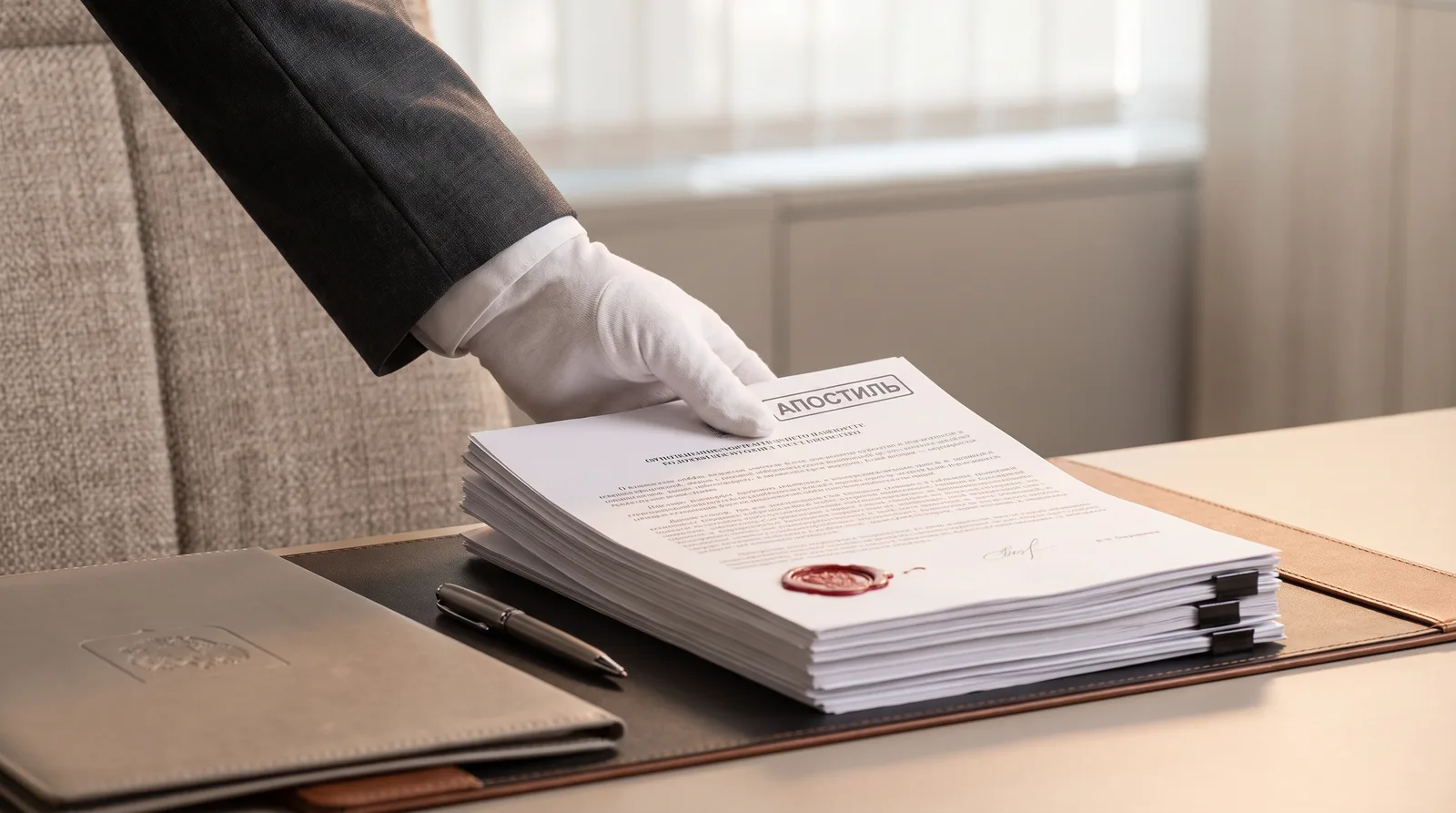
Documents originating in Russia require apostille under the 1992 Hague Convention accession. That includes your passport and any incorporation documents if you're transferring an existing structure. The FTA VAT registration threshold is AED 375,000 in taxable supplies, trading companies often cross this quickly, so register proactively. A typical sequence: arrive in Dubai on a tourist visa, complete the DSBH license in week one, receive the establishment card, apply through GDRFA for a three-year investor visa, then attend ICP biometrics to collect the Emirates ID. The whole process typically runs four to six weeks. For business support with government transactions, DSBH's PRO services cover most of these touchpoints.
Step-by-Step Guide to Structuring Russia-UAE Trade Through DSBH
Structure Russia-UAE trade through DSBH in five steps: (1) select your license and activities, (2) incorporate and open a UAE corporate bank account, (3) register with the FTA, (4) appoint a freight forwarder near Al Maktoum or Jebel Ali, and (5) file a CFC notification with Russia's Federal Tax Service if required.
Step 1: Incorporate and Activate the Trade License
Submit your passport copy, address proof, and business plan to DSBH. Approval and license issuance typically takes 3–7 working days. DSBH staff can cross-reference UAE Customs HS codes against your activity list, so if you're importing metals under a specific commodity code, the activity description on your license needs to match. The establishment card you receive at the end of this step is the document UAE Customs and banks require before anything else moves forward.
In practice, a founder who submits documents on a Monday can have the license and establishment card by Thursday, with the bank account application submitted by Friday of the same week. Use the business setup cost calculator to model your total outlay before you start.
Step 2: Open a Corporate Bank Account and Register with the FTA
UAE banks require the establishment card, trade license, passport, and a clear source-of-funds explanation. Russian-origin funds need documentation of the originating transaction, be prepared to show the commercial context. The Federal Tax Authority (FTA) issues a Tax Registration Number (TRN) for VAT purposes. Under Federal Decree-Law No. 47 of 2022, qualifying free zone income is taxed at 0% provided the entity meets the Qualifying Free Zone Person (QFZP) criteria (UAE Federal Tax Authority, 2022).
The UAE corporate account is the operational core of the russia dubai trade route. A DSBH trading entity receiving USD payments from a European buyer for Russian-origin goods invoiced through the UAE entity uses the corporate account as the settlement point, and the FTA TRN appears on all UAE-issued invoices.
Step 3: Notify Russia's Federal Tax Service of Your CFC Status
Russia's Federal Tax Service (FTS) requires Russian tax residents who control a foreign company to file a Controlled Foreign Company (CFC) notification annually. The threshold is direct ownership above 25%, or above 10% if Russian residents collectively hold more than 50%. Failure to file exposes the founder to Russian fines regardless of UAE compliance.
A Russian tax resident who owns 100% of a DSBH trading entity must file a CFC notification with the FTS each year, even if the entity pays 0% UAE corporate tax under Federal Decree-Law No. 47 of 2022. A qualified Russian tax adviser should assess whether an exemption applies, the active business exemption is the most commonly used carve-out for trading entities.
Tax Position for Russian Founders Trading Between Russia and the UAE
Under Federal Decree-Law No. 47 of 2022, qualifying free zone income is taxed at 0% in the UAE. Russian founders must separately comply with Russia's CFC rules by notifying the Federal Tax Service. The two regimes are independent, UAE compliance does not substitute for Russian CFC obligations.
UAE Corporate Tax Under Federal Decree-Law No. 47 of 2022
Federal Decree-Law No. 47 of 2022 introduced a 9% corporate tax on taxable income above AED 375,000. Qualifying Free Zone Persons (QFZPs) retain a 0% rate on qualifying income. A DSBH trading entity qualifies as a QFZP if it maintains adequate economic substance, doesn't elect to be treated as a mainland entity, and derives income from qualifying activities, which include trading with non-UAE parties (UAE Ministry of Finance, 2022).
On the VAT side, 5% applies to UAE-domestic supplies and 0% applies to exports. A DSBH entity exporting chemical products to a Russian buyer charges 0% UAE VAT on the export invoice. The same entity selling to a UAE-based distributor charges 5% VAT. Worth flagging: these are not optional treatments, they're statutory positions that follow the nature of the supply.
Russia's CFC Rules and What They Mean for Your DSBH Entity
The FTS applies CFC rules to foreign entities controlled by Russian tax residents. Profit of the foreign entity may be attributed to the Russian founder and taxed in Russia if certain exemptions don't apply. The active business exemption is the most commonly used carve-out: the DSBH entity must derive less than 20% of its income from passive sources (dividends, royalties, interest) to qualify.
Founders who have relocated to Dubai and obtained UAE tax residency may be able to exit Russian tax residency entirely, removing the CFC obligation. A founder who moved to Dubai in Q1, obtained UAE tax residency through a DSBH visa, and formally ceased Russian tax residency by year-end is no longer subject to FTS CFC rules for the following fiscal year, but the transition year requires careful handling with both a UAE and a Russian adviser.
Customs and Logistics Near Al Maktoum and Jebel Ali for Russia-UAE Trade Routes
DSBH sits adjacent to Al Maktoum International Airport and within 15 km of Jebel Ali Port, the largest port in the Middle East. These two gateways handle the bulk of air and sea cargo on Russia-UAE trade routes, giving DSBH entities direct access to bonded warehousing, re-export facilities, and multimodal connections.
Al Maktoum International Airport: Air Freight on the Russia-UAE Corridor
Al Maktoum International Airport (DWC) is the dedicated cargo airport for Dubai South, handling time-sensitive and high-value freight, electronics, pharmaceuticals, precision equipment. Cargo arriving from Russia via Moscow Domodedovo or re-routed through Central Asian hubs clears UAE Customs at DWC before transfer to DSBH bonded warehouses. The ICP controls entry of goods documentation at the point of import; the FTA monitors VAT on imported goods above the de minimis threshold.
A DSBH entity importing Russian-manufactured industrial sensors, for example, routes the shipment through DWC air freight, clears UAE Customs using the establishment card and commercial invoice, and holds stock in a bonded DSBH warehouse before re-exporting to Gulf buyers. DWC's adjacency to the DSBH free zone boundary is a genuine operational advantage, transit from airside to bonded storage is measured in minutes, not hours.
Jebel Ali Port: Sea Freight and the Russia-UAE Trade Route
Jebel Ali Port, operated by DP World, is the largest port in the Middle East and the 9th busiest container port globally (DP World, 2025). It handles the majority of sea-freight volumes on the russia dubai trade route. Russian exports, metals, timber, chemicals, fertilisers, typically arrive via Caspian feeder routes, Iranian transit ports, or Black Sea origins re-routed through Turkish hubs.
DSBH entities use Dubai Trade, the UAE Customs electronic platform, to file import and export declarations. The establishment card and trade license are the key documents for customs clearance. A DSBH trading entity importing Russian fertilisers files an import declaration on the Dubai Trade portal, pays 0% customs duty on goods stored inside the free zone for re-export, and stores the consignment in a free zone warehouse before shipping to an Indian buyer. For a full breakdown of trading license activities, see the trading business license in Dubai page.
Key Facts: Russia-UAE Trade Route Compared by Entry Point and Cargo Type
Russian founders choosing between air and sea freight for UAE trade should match the cargo type to the entry point: Al Maktoum suits high-value, time-sensitive goods; Jebel Ali suits bulk commodities and container freight. Both entry points connect directly to DSBH free zone bonded warehousing and re-export facilities.
Comparison Table: Al Maktoum vs. Jebel Ali for Russia-UAE Cargo
Both entry points use Dubai Trade for electronic customs declarations, and DSBH entities have establishment-card-based access to both facilities. A founder comparing routes for a mixed shipment of electronics and bulk chemicals would typically split the cargo: electronics via DWC air freight for speed, chemicals via Jebel Ali sea freight for cost efficiency.
Al Maktoum Airport vs. Jebel Ali Port: Russia-UAE Cargo Route Comparison
Feature | Al Maktoum International Airport (DWC) | Jebel Ali Port (DP World) |
|---|---|---|
Best cargo type | High-value, time-sensitive goods: electronics, pharmaceuticals, precision equipment | Bulk commodities and container freight: metals, fertilisers, timber, chemicals |
Typical transit time from Russia | 1–3 days via Central Asian hub connections or direct Domodedovo routing | 10–20 days from Black Sea or Caspian origins via feeder or Turkish hub routes |
Customs declaration platform | Dubai Trade electronic portal; ICP governs goods documentation at import | Dubai Trade electronic portal; DP World terminal systems integrated with UAE Customs |
Bonded warehouse access | Direct transfer to DSBH bonded warehouses adjacent to DWC airside boundary |
References
trade-between-russia-and-the-uae