Do Indian Founders Pay Tax Twice on Dubai Profits: Setup Cost, Route and Timeline

Topic Summary
What Is do indian founders pay tax twice on dubai profits and Why It Matters
Do indian founders pay tax twice on dubai profits? Not automatically. The UAE taxes company profits under Federal Decree-Law No. 47 of 2022 via the Federal Tax Authority (FTA), while India taxes worldwide income of residents. Double taxation is avoidable through residency planning and the India-UAE CEPA (Comprehensive Economic Partnership Agreement), but only with correct structuring.
How Indian Home-Country Tax Rules Actually Apply
How Indian Home-Country Tax Rules Actually Apply
Setup Route: Company, Residency and Documents Step by Step
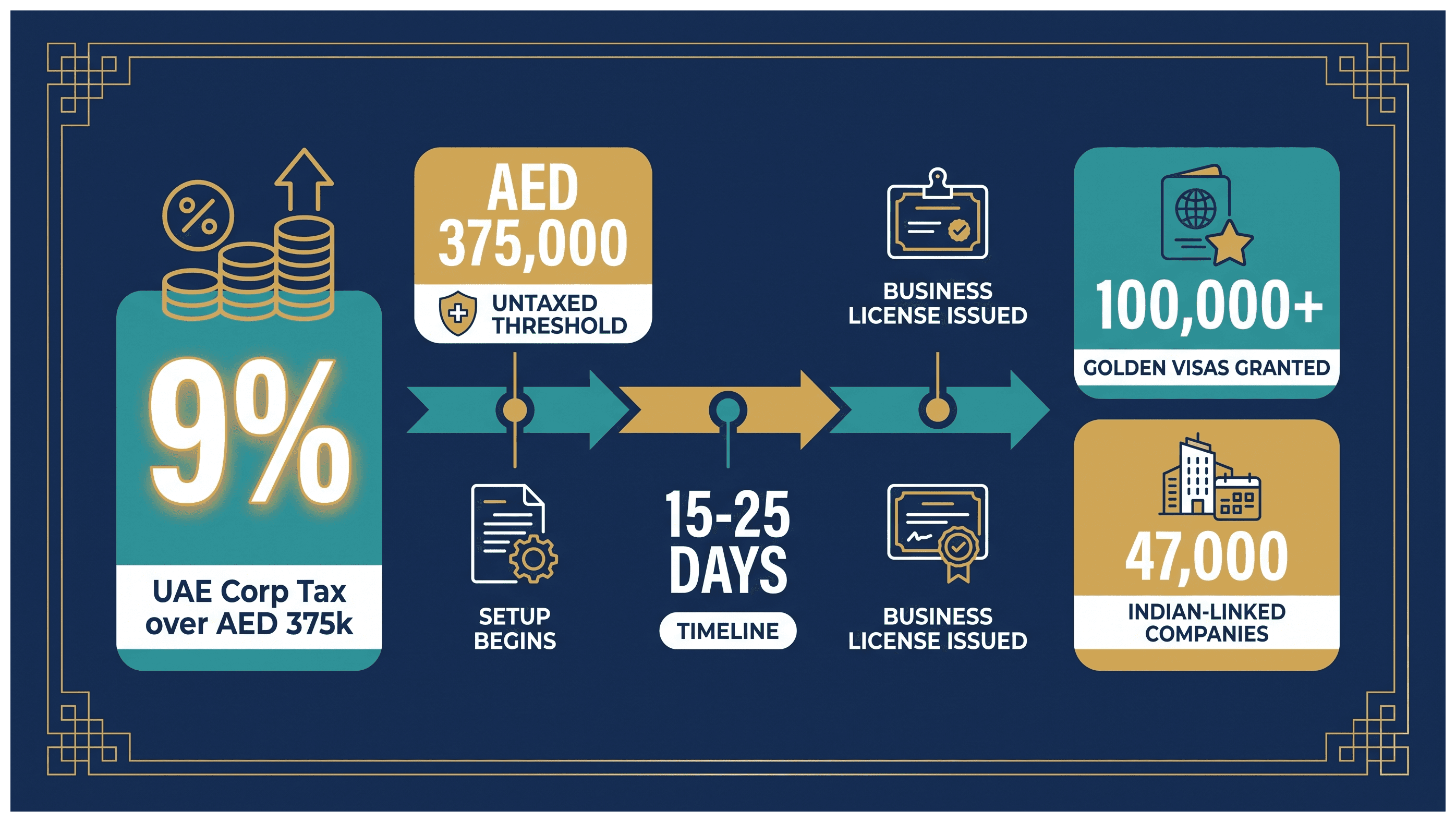
Setting up a Dubai company from India follows five ordered steps: choose activity and license type, reserve trade name, submit ICP (Federal Authority for Identity, Citizenship, Customs and Port Security) paperwork, complete GDRFA (General Directorate of Residency and Foreigners Affairs) medical and Emirates ID processing, then open a bank account. Most founders complete the full route in 15 to 25 working days.
Setup Cost and Timeline Founders Should Expect
A Dubai South Business Hub license package typically ranges by activity and visa count, with residency processing adding 15 to 25 working days. Founders should budget for license fees, Emirates ID processing, medical testing, and bank account setup separately rather than assuming one bundled cost.
Common Mistakes Indian Founders Make With Dubai Profits
Common mistakes include assuming UAE profits are automatically untaxed in India, ignoring RBI LRS remittance limits, delaying Emirates ID renewal, and skipping specialist tax advice before repatriating funds. Each mistake can trigger penalties in India or compliance issues in the UAE.
How Dubai South Business Hub Helps Indian Founders Set Up Cleanly
Dubai South Business Hub offers free zone trade licenses bundled with residency visa packages, guiding Indian founders through ICP, GDRFA and Emirates ID steps without touching unrelated services. This keeps the setup route straightforward and reduces the risk of compliance gaps on both sides.
In 2026, over 100,000 Golden Visas have been issued across the UAE, and a growing share go to Indian founders opening companies in Dubai [1]. About 9% is the corporate tax rate above AED 375,000 profit under Federal Decree-Law No. 47 of 2022 [2]. Roughly 47,000 new Indian-linked companies registered with Dubai Chamber membership in recent years [3]. Setup typically runs 15 to 25 working days. License fees vary by activity and visa count. Do indian founders pay tax twice on dubai profits? Not automatically, and this piece breaks down exactly why, then walks you through the real setup route with a Dubai South Business Hub license.
What Is do indian founders pay tax twice on dubai profits and Why It Matters
Do indian founders pay tax twice on dubai profits? Not automatically. The UAE taxes company profits under Federal Decree-Law No. 47 of 2022 via the Federal Tax Authority (FTA), while India taxes worldwide income of residents. Double taxation is avoidable through residency planning and the India-UAE CEPA (Comprehensive Economic Partnership Agreement), but only with correct structuring.
UAE Corporate Tax Basics Under Federal Decree-Law No. 47 of 2022
The FTA administers UAE corporate tax filings and registration for all licensed entities. Companies pay 9% on profit above AED 375,000, with the first slice untaxed. A Dubai South Business Hub trading company earning AED 500,000 profit pays 9% only on AED 125,000 of that amount. Free zone entities can still qualify for different treatment depending on activity and qualifying income, so don't assume one blanket rule fits every license.
Why the 'Double Tax' Question Comes Up
Founders often assume Dubai profits sit outside any tax net twice over. That's a mistake worth flagging early.
India's residency rules can pull worldwide income into scope.
Splitting time between cities doesn't automatically change status.
We never claim the UAE is tax free; it's low-tax under specific thresholds.
A founder splitting time between Mumbai and Dubai may still count as an Indian tax resident, and that single fact changes everything downstream.
How Indian Home-Country Tax Rules Actually Apply
The Income Tax Department taxes Indian residents on global income, so Dubai profits can be reportable in India unless you qualify as a non-resident. The India-UAE CEPA and RBI Liberalised Remittance Scheme (LRS) rules govern remittances and outward investment, and specialist tax advice is essential before assuming any exemption applies.
Residency Status Decides Everything
The Income Tax Department applies days-in-India thresholds to decide residency status each financial year. Non-resident status can shield foreign profits from Indian tax entirely. The RBI's LRS caps outward remittance for individuals at a fixed annual limit, separate from company-level funding rules.
A founder spending under 120 days in India annually may retain non-resident status, but this depends on total global income and prior-year presence too, so it's not a single-number test.
Where the India-UAE CEPA Helps
CEPA reduces certain trade and business friction between the two countries. It is not a tax treaty replacement.
Always confirm status with a chartered accountant.
State the rule first, then get specialist advice.
An exporter using CEPA preferential terms still files separately for tax purposes.
Does moving to Dubai automatically stop Indian tax liability?
No. Moving to Dubai from India only changes tax exposure once you meet non-resident thresholds. Company incorporation alone doesn't shift personal residency status.
Setup Route: Company, Residency and Documents Step by Step
Setting up a Dubai company from India follows five ordered steps: choose activity and license type, reserve trade name, submit ICP (Federal Authority for Identity, Citizenship, Customs and Port Security) paperwork, complete GDRFA (General Directorate of Residency and Foreigners Affairs) medical and Emirates ID processing, then open a bank account. Most founders complete the full route in 15 to 25 working days.
Step 1: Pick Activity and License
Match your business activity to the correct license category.
Free zone trade licenses fit most first-time founders well.
Confirm the activity list before you apply.
Use the business activities list to shortlist your category.
An IT consultant, for instance, registers under an ICT-focused license category rather than a general trading one.
Step 2: Submit ICP and GDRFA Paperwork
ICP handles entry permit and visa issuance.
GDRFA manages residency status changes locally.
A medical test is required before Emirates ID issuance.
A founder typically submits passport copies and license documents to ICP within days of incorporation.
UAE vs India Tax and Setup Key Facts
Feature | UAE (Dubai) | India |
|---|---|---|
Corporate tax rate | 9% above AED 375,000 profit | Slab rates apply to worldwide resident income |
Regulator | Federal Tax Authority (FTA) | Income Tax Department |
Residency proof | Emirates ID | PAN and residency days count |
Remittance rule | No cap on company profit repatriation | RBI LRS caps individual remittance annually |
Setup timeline | 15 to 25 working days | Variable domestic registration timelines |
Trade framework | CEPA preferential terms for qualifying trade | Standard domestic tax filing |
Step 3: Bank Account and Emirates ID
Emirates ID finalises your residency status once GDRFA processing completes. Bank account opening depends on license type and shareholder KYC (Know Your Customer) checks, which vary by bank. Budget realistic time for compliance reviews rather than assuming a same-week turnaround.
A trading company owner typically opens a UAE business account once the Emirates ID is issued, usually within the 15 to 25 working day window.
Setup Cost and Timeline Founders Should Expect
A Dubai South Business Hub license package typically ranges by activity and visa count, with residency processing adding 15 to 25 working days. Founders should budget for license fees, Emirates ID processing, medical testing, and bank account setup separately rather than assuming one bundled cost.
What Drives the Total Cost
License type and number of visas requested.
Office space or flexi-desk requirement per activity.
Bank account and compliance costs, which vary by bank.
A two-visa package costs more than a single-visa license, mainly due to Emirates ID and medical fees stacking up per person. You can run the numbers on the cost calculator before committing.
Realistic Timeline Milestones
License issuance often happens within days once documents clear review. Visa stamping adds separate processing time on top of that. Bank onboarding is usually the longest step in the whole chain, so plan around it rather than the license date.
A founder planning a six-week runway from license to a functioning bank account is being realistic, not pessimistic.
Common Mistakes Indian Founders Make With Dubai Profits
Common mistakes include assuming UAE profits are automatically untaxed in India, ignoring RBI LRS remittance limits, delaying Emirates ID renewal, and skipping specialist tax advice before repatriating funds. Each mistake can trigger penalties in India or compliance issues in the UAE.
Assuming Automatic Tax Exemption
Residency status must be actively maintained, not assumed.
The Income Tax Department can reassess worldwide income later.
Documentation trails matter heavily during audits.
One founder assumed non-resident status without tracking days in India, and that gap triggered a reassessment years later.
Overlooking RBI LRS Limits
Annual remittance caps apply to individuals under the RBI's LRS, separate from company-level funding rules. A founder funding a Dubai company personally hits the LRS ceiling faster than expected, especially when combining license fees, office costs, and personal transfers in one year. Bank compliance checks can also delay transfers near the cap.
How Dubai South Business Hub Helps Indian Founders Set Up Cleanly
Dubai South Business Hub offers free zone trade licenses bundled with residency visa packages, guiding Indian founders through ICP, GDRFA and Emirates ID steps without touching unrelated services. This keeps the setup route straightforward and reduces the risk of compliance gaps on both sides.
Bundled License and Residency Packages
One provider manages license and visa steps together, cutting the back-and-forth between agencies that trips up first-time founders. A founder moving from Bengaluru can use one point of contact for license, ICP and GDRFA steps instead of chasing three separate offices.
Ongoing Banking and Taxation Support
Guidance on FTA registration where applicable.
Coordination with local banks for account opening.
Referral to tax specialists for India-side questions.
A founder often gets introduced to a UAE bank partner right after license issuance, which shortens the usual wait.
So, do indian founders pay tax twice on dubai profits? Only if residency and reporting rules are mismanaged on the India side. With correct structuring, the FTA and Income Tax Department rules can coexist cleanly, and the setup itself doesn't need to be complicated.
Talk to the Banking and Taxation Support team to set up or buy a license the right way, and check residency services for the visa side of things.
References
Frequently Asked Questions