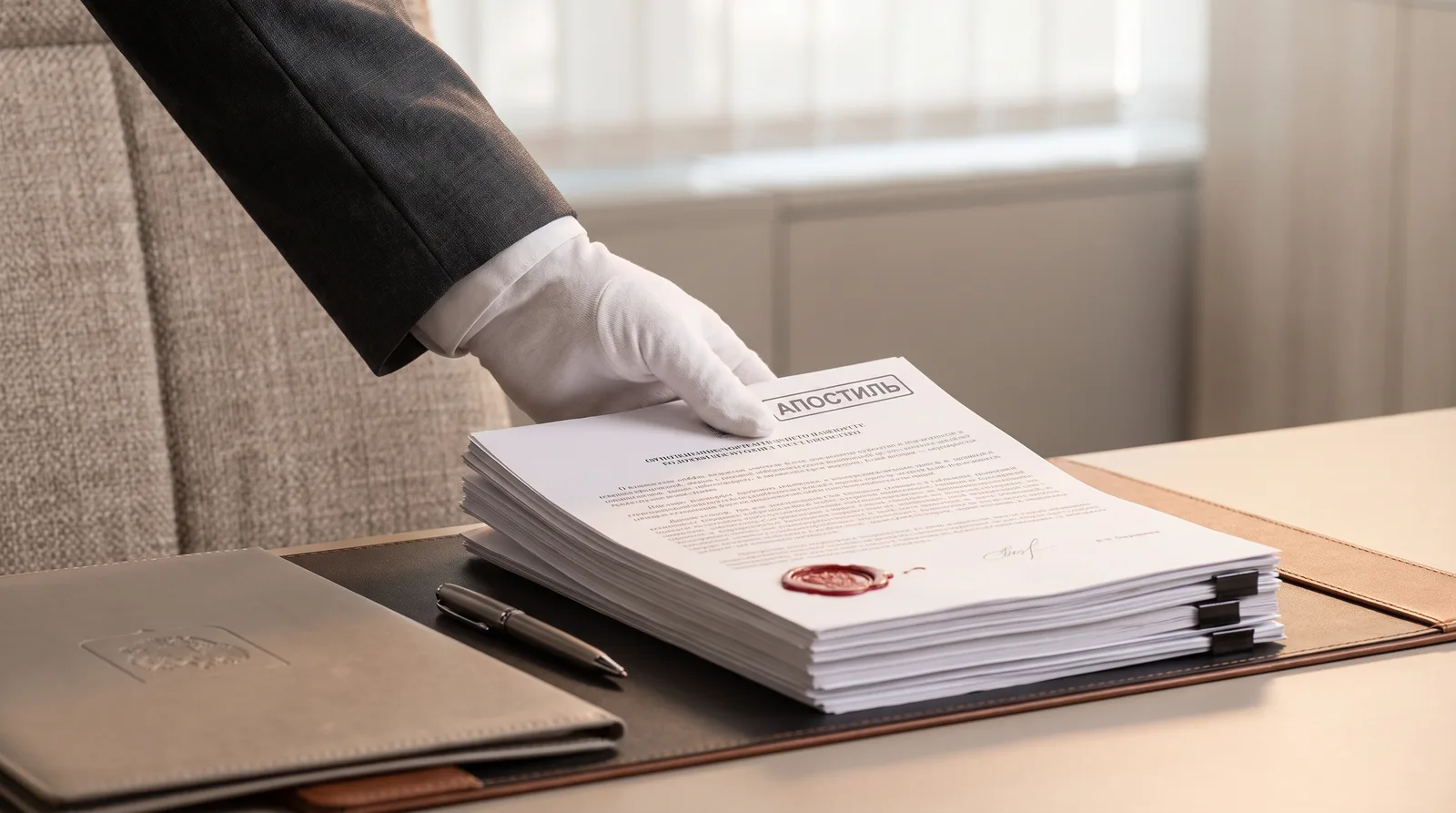
Documents to Set Up a Dubai Company from Russia: Legalisation Checklist

Topic Summary
What Documents to Set Up a Dubai Company from Russia Actually Means
Documents to set up a Dubai company from Russia are the personal identity papers, corporate records, and source-of-funds evidence that a free zone authority requires from a Russian applicant. Most must carry an apostille issued by a competent Russian authority, then be translated into Arabic or English by a certified translator before submission.
Key Facts: Russian Document Requirements for Dubai Company Setup
Russian founders need a valid passport, apostilled criminal background certificate, source-of-funds evidence, and, if using an existing Russian company, an apostilled extract from the Unified State Register of Legal Entities. All documents must be translated into English or Arabic by a certified translator before submission to the free zone authority.
Step-by-Step Legalisation Checklist for Documents to Set Up a Dubai Company from Russia
The legalisation checklist for documents to set up a Dubai company from Russia runs seven steps: gather originals, notarise in Russia, obtain an apostille from the relevant ministry, commission a certified English or Arabic translation, submit to the free zone, apply for your Emirates ID via ICP, and register for UAE corporate tax with the Federal Tax Authority (FTA) if applicable.
Residency Visa and Emirates ID After Company Formation
Once your DSBH trade license is issued, you apply for a UAE investor residency visa through the General Directorate of Residency and Foreigners Affairs (GDRFA), then register your biometrics with the Identity and Citizenship and Ports and Borders Authority (ICP) to receive your Emirates ID, the mandatory national identity card for all UAE residents.
Corporate Tax and CFC Obligations Russian Founders Must Know
UAE corporate tax on qualifying free zone income is 0% under Federal Decree-Law No. 47 of 2022. Russian founders must also account for Russia's Controlled Foreign Company (CFC) rules, administered by the Federal Tax Service of Russia (FNS), which require disclosure of foreign entities where a Russian tax resident holds more than 25%, or 10% in a group where Russian tax residents collectively hold more than 50%.
Source-of-Funds and Compliance Documents: What Banks Require
UAE banks conduct enhanced due diligence on Russian-origin applicants under Central Bank of UAE AML guidelines. You'll need a six-month bank statement from your primary Russian bank, a notarised source-of-funds declaration, and documentation of the business activity generating your income, salary slips, dividend certificates, or sale-of-asset agreements as applicable.
In 2026, Russian nationals represent one of the fastest-growing founder cohorts in Dubai free zones, with the UAE receiving over USD 4 billion in Russian-origin capital flows since 2022 (World Bank, 2024). The single most common delay isn't licensing. It's arriving without correctly legalised documents. Russia joined the Hague Apostille Convention in 1992, meaning most public documents need only an apostille stamp, not full consular legalisation. DSBH trade licenses start from AED 12,500 (DSBH, 2024) and are issued in three to seven working days once documentation is complete. Personal income tax in the UAE is 0% (u.ae, 2024). Criminal background apostilles from Russian regional justice departments typically take five to ten business days to obtain.
This guide gives you the exact documents to set up a Dubai company from Russia, explains whether each one needs an apostille or a full legalisation chain, and shows you how Dubai South Business Hub Free Zone (DSBH) gets Russian founders across the line fast.
What Documents to Set Up a Dubai Company from Russia Actually Means
Documents to set up a Dubai company from Russia are the personal identity papers, corporate records, and source-of-funds evidence that a free zone authority requires from a Russian applicant. Most must carry an apostille issued by a competent Russian authority, then be translated into Arabic or English by a certified translator before submission.
Why Legalisation Is a Prerequisite, Not a Formality
The UAE does not automatically recognise foreign public documents. Every Russian state-issued document must pass through a defined authentication chain before a free zone or government authority accepts it. This isn't bureaucratic caution, it's a hard legal requirement that applies to every applicant, regardless of nationality.
Russia joined the Hague Apostille Convention in 1992, which means most personal documents (birth certificates, criminal records, diplomas) need only an apostille stamp from the relevant Russian ministry or notarial chamber. No embassy legalisation is required. That's a genuine time-saver compared to the full consular chain.
Corporate documents, the extract from the Unified State Register of Legal Entities, the company charter, and director resolutions, follow the same apostille route, but with one extra step: they must be notarially certified in Russia before the apostille is affixed. A Moscow-based founder submitting a company charter, for example, must first have the charter notarised by a Russian notary, then have the notary's signature apostilled by the regional justice department. Two steps, not one.
Apostille vs. Full Legalisation: Which Path Applies
Because both Russia and the UAE recognise the Hague Convention, the apostille route is sufficient for most documents. Full consular legalisation (Russian MFA, then UAE embassy, then UAE MFA) is rarely needed for standard incorporation documents.
Exceptions exist. Documents issued by private bodies, a Sberbank account statement, for instance, are not public records. They need notarisation and potentially UAE Ministry of Foreign Affairs attestation, not a simple apostille. The distinction matters: get it wrong and your submission is rejected on day one.
Always confirm the current requirement with DSBH's PRO services team before travelling. UAE authority requirements can be updated outside legislative cycles, and a phone call saves a return trip.
Russian Document Types: Legalisation Route and Translation Requirement
Document | Legalisation Route | Translation Required? |
|---|---|---|
Passport | Notarised copy only; no apostille on the passport itself | Certified English translation required |
Criminal background certificate | Apostille from regional justice department | Certified translation required |
USRLE extract (EGRUL) | Notarise, then apostille via Federal Tax Service of Russia (FNS) | Certified translation required |
Company charter (ustav) | Notarise, then apostille via notarial chamber or regional justice | Certified translation required |
Bank statement (private bank) | Notarised translation; UAE MFA attestation may be required; no apostille route | Certified translation required |
Source-of-wealth declaration | Notarised in Russia; no apostille needed | Certified translation required |
Key Facts: Russian Document Requirements for Dubai Company Setup
Russian founders need a valid passport, apostilled criminal background certificate, source-of-funds evidence, and, if using an existing Russian company, an apostilled extract from the Unified State Register of Legal Entities. All documents must be translated into English or Arabic by a certified translator before submission to the free zone authority.
What the Dubai Company Documents Russia Checklist Covers
To set up a Dubai company from Russia, your document pack splits into two categories: personal identity documents and corporate records. Personal documents are required for every founder, regardless of whether you're incorporating as an individual or through an existing Russian entity. Corporate documents are only needed if you're registering a branch or using an existing Russian LLC as the shareholder.
Valid passport with at least six months' validity, notarised copy, no apostille on the passport itself
Criminal background certificate (справка о несудимости), apostilled by the regional justice department
Proof of address, utility bill or bank statement, no older than three months, with notarised translation
Source-of-wealth declaration, notarised in Russia, certified translation required
If using a Russian entity: apostilled USRLE extract, apostilled company charter, apostilled board resolution
Important Considerations When Gathering Dubai Company Documents from Russia
Document validity windows are strict. Address proof older than three months is rejected outright.
Each apostille stamp covers only the document it's affixed to, a single apostille does not cover a bundle of documents.
DSBH's PRO team handles submission coordination with UAE authorities, reducing the risk of rejection due to formatting errors. That's a meaningful advantage for first-time filers.
Translation must be certified by an accredited legal translator, machine-translated documents are not accepted.
Confirm accepted document formats with DSBH before you travel, as processing standards are updated periodically (ICP, 2025).
Step-by-Step Legalisation Checklist for Documents to Set Up a Dubai Company from Russia
The legalisation checklist for documents to set up a Dubai company from Russia runs seven steps: gather originals, notarise in Russia, obtain an apostille from the relevant ministry, commission a certified English or Arabic translation, submit to the free zone, apply for your Emirates ID via ICP, and register for UAE corporate tax with the Federal Tax Authority (FTA) if applicable.
Step 1: Compile Your Personal Document Package
Valid passport with at least six months' validity, submit a notarised copy; no apostille is needed on the passport itself.
Criminal background certificate (справка о несудимости) from the Russian Ministry of Internal Affairs, this must carry an apostille from your regional justice department.
Proof of residential address, a utility bill or bank statement no older than three months; obtain a notarised translation if the document is in Russian.
Passport-size photographs meeting UAE specifications: white background, 35×45 mm.
A St. Petersburg founder, for example, can request their criminal background certificate online via Gosuslugi, collect the paper original, then take it to the St. Petersburg Justice Department for the apostille stamp. The full process typically takes five to ten business days, plan accordingly before booking your flight.
Step 2: Prepare Corporate Documents If Using an Existing Russian Entity
USRLE extract (EGRUL), notarise the document, then apostille it via the Federal Tax Service of Russia (FNS), which maintains the register.
Company charter (ustav), notarised copy, then apostille from the regional notarial chamber or justice department.
Board resolution authorising UAE company formation, notarised in Russia, apostilled, then translated into English.
If individual shareholders appear in the USRLE extract, include notarised passport copies for each one.
A Moscow LLC expanding to Dubai submits three documents with three separate apostille stamps: the USRLE extract (apostilled by the FNS regional office), the charter (apostilled by the Moscow Notarial Chamber), and the director resolution. Each stamp covers only its own document.
Step 3: Commission Certified Translations and Submit to DSBH
All apostilled documents must be accompanied by a certified English or Arabic translation, DSBH's business support team can coordinate accredited legal translation in Dubai.
Submit the complete package (passport copy, apostilled criminal record, translated corporate documents, source-of-funds evidence) to the DSBH licensing desk.
DSBH issues the trade license in three to seven working days once documentation is complete; license packages start from AED 12,500 (DSBH, 2024).
After license issuance, move immediately to the Emirates ID and investor visa application stage.
In practice: a founder submits documents on Monday, the DSBH PRO team verifies and lodges with the free zone authority by Wednesday, and the license is issued by Friday of the same week.
Residency Visa and Emirates ID After Company Formation
Once your DSBH trade license is issued, you apply for a UAE investor residency visa through the General Directorate of Residency and Foreigners Affairs (GDRFA), then register your biometrics with the Identity and Citizenship and Ports and Borders Authority (ICP) to receive your Emirates ID, the mandatory national identity card for all UAE residents.
Investor Visa Application via GDRFA
The GDRFA processes investor visa applications linked to a licensed free zone entity. Your DSBH trade license is the anchor document, without it, there's no visa application to file. Required at this stage: original passport, passport-size photos, and a copy of the trade license.
DSBH's residency services team coordinates the GDRFA submission, the mandatory medical fitness test, and the Emirates ID application as a bundled service. Processing time for the investor visa runs approximately five to ten working days after medical clearance. A founder who enters Dubai on a tourist visa can apply for a status change to investor visa through GDRFA, DSBH files the application, the founder attends the medical test, and the visa is stamped within a week.
Emirates ID Registration Through ICP
The ICP issues the Emirates ID, a mandatory smart card required to open a UAE bank account, sign leases, and access government services. Biometric registration (fingerprints and iris scan) is conducted at an ICP-approved typing centre; the card is typically ready within five working days of biometric submission.
Worth flagging: without an Emirates ID, a founder cannot open a UAE corporate bank account. It's a hard prerequisite for every major banking institution in the country. The Emirates ID number also becomes your primary identifier for all subsequent UAE government interactions, including FTA corporate tax registration.
How long does the investor visa process take after company formation?
After your DSBH trade license is issued, the investor visa typically takes five to ten working days from GDRFA submission to passport stamping, subject to medical clearance. The Emirates ID from ICP follows within five working days of biometric registration, making the total post-licensing timeline roughly two to three weeks.
Corporate Tax and CFC Obligations Russian Founders Must Know
UAE corporate tax on qualifying free zone income is 0% under Federal Decree-Law No. 47 of 2022. Russian founders must also account for Russia's Controlled Foreign Company (CFC) rules, administered by the Federal Tax Service of Russia (FNS), which require disclosure of foreign entities where a Russian tax resident holds more than 25%, or 10% in a group where Russian tax residents collectively hold more than 50%.
UAE Corporate Tax: What the 0% Rate Covers
Federal Decree-Law No. 47 of 2022 introduced UAE corporate tax at 9% on taxable income above AED 375,000. Qualifying free zone income, income from transactions with other free zone entities or from permitted activities, remains taxed at 0%. The FTA requires all UAE companies, including free zone entities, to register and file annual returns regardless of whether any tax is owed.
A Russian-owned trading company at DSBH that transacts exclusively with other free zone entities qualifies for the 0% qualifying income rate, but still must register with the FTA and file a nil return annually. Personal income tax in the UAE remains at 0% (u.ae, 2024). Use the business setup cost calculator at DSBH to model your full cost of entry.
Russia's CFC Rules: Disclosure Obligations That Travel with You
The FNS enforces CFC rules under Russian Tax Code Chapter 3.4. A Russian tax resident who controls a foreign entity must notify the FNS and, in some cases, include the foreign entity's undistributed profits in their Russian taxable income. The notification threshold is ownership above 25%, or above 10% in a company where Russian tax residents collectively hold more than 50%.
A Russian founder who holds 100% of a DSBH company and has not changed their Russian tax residency remains a CFC-obligated person. They must file a CFC notification with the FNS within the prescribed deadline. Founders who relocate to the UAE and establish genuine UAE tax residency may reduce CFC exposure, but this requires careful structuring and independent legal advice, not assumptions.
Source-of-Funds and Compliance Documents: What Banks Require
UAE banks conduct enhanced due diligence on Russian-origin applicants under Central Bank of UAE AML guidelines. You'll need a six-month bank statement from your primary Russian bank, a notarised source-of-funds declaration, and documentation of the business activity generating your income, salary slips, dividend certificates, or sale-of-asset agreements as applicable.
Documents That Satisfy UAE Bank Due Diligence
Six-month bank statement from a recognised Russian bank, translated into English and notarised, Sberbank, Tinkoff (T-Bank), and Alfa-Bank statements are widely recognised by UAE banking compliance teams.
Source-of-wealth letter: a signed, notarised declaration explaining the origin of the funds being used to capitalise the UAE company.
If funds originate from a Russian business, include the apostilled USRLE extract and audited financial statements (последний баланс).
A founder capitalising their DSBH company with personal savings provides six months of T-Bank statements, a notarised source-of-wealth letter, and their Russian employment contract. The bank's compliance team accepts the package and opens the account within two weeks. DSBH's banking and taxation guidance service helps founders prepare a compliant document pack before approaching UAE banks, improving first-submission approval rates.
Russian Founder Document Pack: Key Numbers at a Glance
A quick-reference visual for the key timelines, fees, and thresholds Russian founders need when gathering documents to set up a Dubai company from Russia.
5–10 business days: time to obtain a criminal background certificate apostille from a Russian regional justice department
AED 12,500: DSBH trade license starting price (DSBH, 2024)
3–7 working days: DSBH license issuance timeline from complete document submission
25%: CFC notification threshold under Russian Tax Code Chapter 3.4
0%: UAE corporate tax rate on qualifying free zone income under Federal Decree-Law No. 47 of 2022
6 months: bank statement window required for UAE AML due diligence
References
Frequently Asked Questions