Does Setting Up in Dubai Change Your French Tax Position

Topic Summary
License Alone Doesn't Change Residency
Setting up a Dubai company doesn't automatically shift your French tax residency, which the DGFiP determines based on domicile, family ties, and time spent in France rather than trade licenses.
Corporate Tax vs Personal Tax Tracks
The FTA's 9% corporate tax rate and 0% qualifying income band apply to your UAE entity, but your personal French tax obligations run on a completely separate track.
Exit Tax Still Applies
Founders holding significant shareholdings face French exit tax on unrealized capital gains the moment they transfer tax domicile abroad, even without selling shares.
Filing Obligations Don't Disappear
You must file a departure tax return the year you relocate, and double tax treaty provisions between France and the UAE only reduce, not eliminate, these obligations.
Required Documents for Relocation
Beyond your trade license, you'll need an ICP-issued entry permit, a GDRFA-stamped residence visa, and an Emirates ID to properly establish UAE residency.
Keeping Ties to France Is Risky
Maintaining a French apartment, spouse, or school-age children in France often keeps founders classified as French tax residents regardless of their intentions.
Avoid Common Structuring Mistakes
French founders frequently assume a UAE structure alone provides tax planning benefits, when specialist cross-border advice is essential to confirm actual exposure and obligations.
In 2026, French founders make up a rising share of new UAE free zone registrations, yet most still owe French tax the year they relocate [1]. Dubai's corporate tax rate sits at 9% above AED 375,000 in profit, with a 0% band on qualifying income under Federal Decree-Law No. 47 of 2022 [2]. That's a big draw. But does setting up in Dubai change your French tax position automatically? Not really, and that's the part founders miss. Your French tax residency depends on domicile facts tracked by the DGFiP (Direction Générale des Finances Publiques), not on holding a UAE trade license. This guide walks through what actually shifts, what doesn't, and how to register your Dubai company for French founders correctly the first time.
What Is Does Setting Up in Dubai Change Your French Tax Position and Why It Matters
Registering a company in Dubai does not automatically change your French tax position. Your French tax residency is governed by DGFiP rules on domicile, income source, and days spent in France, not by holding a UAE trade license under Federal Decree-Law No. 47 of 2022.
How the FTA Defines Corporate Tax Residency
The FTA (Federal Tax Authority) administers UAE corporate tax under Federal Decree-Law No. 47 of 2022, which took effect for financial years starting on or after 1 June 2023 [2]. A company licensed through Dubai South Business Hub can qualify as a UAE tax resident entity once it meets substance requirements. Qualifying free zone income may benefit from a 0% rate, but that's a corporate matter. Your personal residency status in France runs on a completely separate track.
Take a Paris-based marketing consultant who opens a DSBH company and keeps billing French clients from her Paris flat. She still owes personal tax in France, because her center of vital interests, family, and main home stayed there. The license changed her corporate structure, not her domicile.
Why Company Formation Alone Isn't Enough
A license doesn't sever French tax ties by itself.
France looks at your actual center of economic interests, not your registered address abroad.
Specialist cross-border advice is essential before relying on a UAE structure for tax planning.
Founders who keep a French apartment, spouse, or school-age kids in France often stay tax resident regardless of intent.
How France Still Taxes You After You Leave
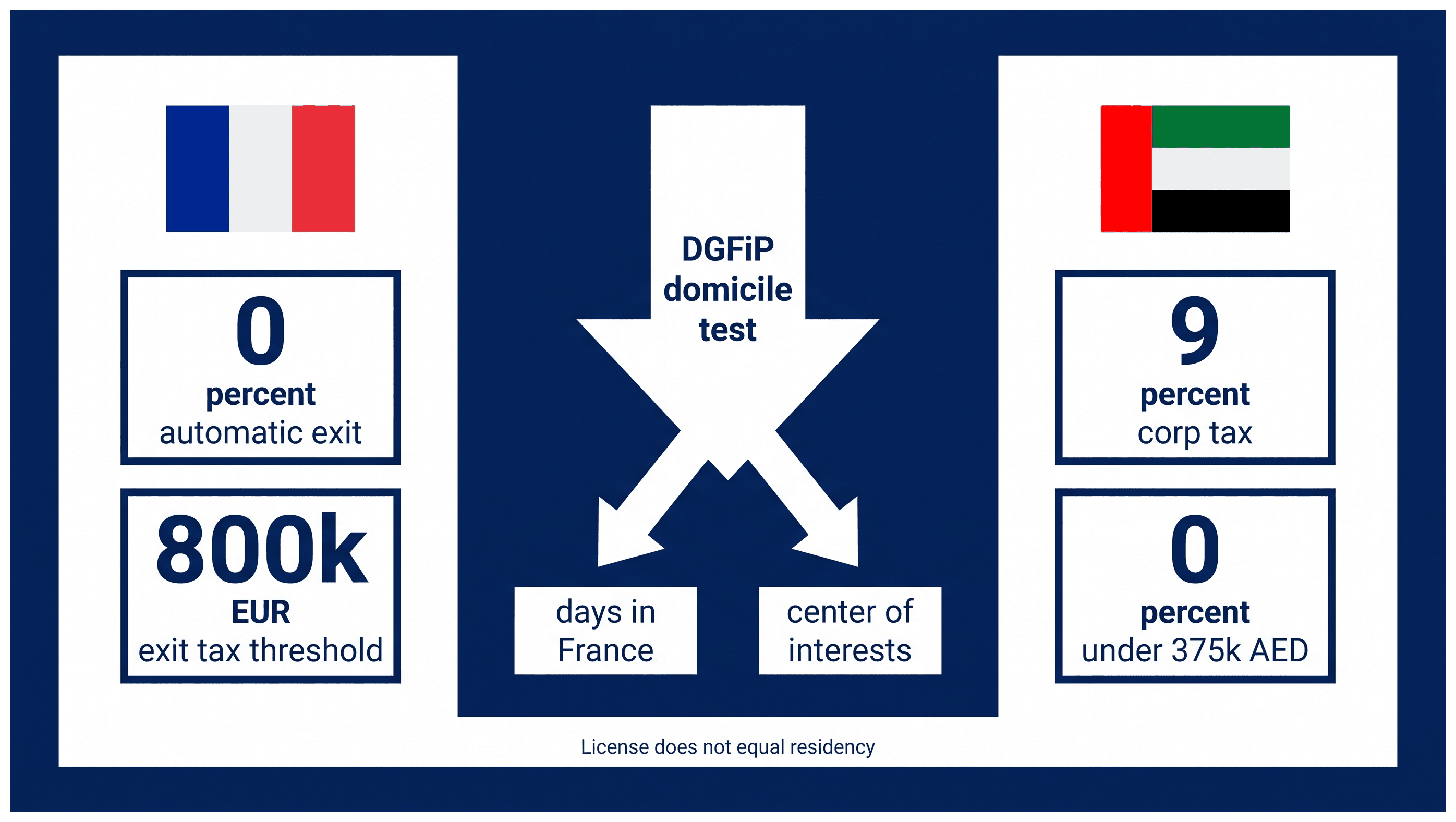
The DGFiP applies French exit tax on unrealized capital gains for shareholders who transfer tax domicile abroad while holding qualifying securities above set thresholds. Relocating to Dubai doesn't waive this rule, and founders with equity stakes should confirm exposure before filing their departure.
The French Exit Tax Trigger Points
Exit tax applies to substantial shareholdings, generally when you hold at least 50% of a company's profit rights or your securities exceed roughly EUR 800,000 in value at the point of departure [3]. It's triggered the moment you transfer tax domicile out of France, not when you actually sell the shares. Deferral options exist automatically for moves within the EU or EEA, but a move to the UAE doesn't get that same automatic treatment. Consider a founder holding 30% of a French SAS (Société par Actions Simplifiée) who relocates to Dubai. She has to declare the unrealized gain on her departure return, even though she hasn't sold a single share.
Reporting Obligations to the DGFiP
A departure tax return is required in the year you relocate.
Foreign income and assets may still need declaring during a transition period.
Double tax treaty provisions between France and the UAE can reduce, but not eliminate, obligations.
Missing the filing deadline risks penalties and interest from the DGFiP.
Documents and Approvals You Need Before Relocating
Before your Dubai company for French founders can sponsor residency, you'll need an ICP-issued entry permit, a GDRFA-stamped residence visa, and an Emirates ID. These sit alongside your trade license and are separate from any French tax filings you still owe.
ICP Entry Permit and Status Change
The ICP (Federal Authority for Identity, Citizenship, Customs and Port Security) handles entry permit approvals.
A license activates your eligibility for a residency-linked visa.
Status change can often be completed onshore, without leaving the UAE.
GDRFA Residence Visa Stamping
The GDRFA (General Directorate of Residency and Foreigners Affairs) finalizes your residence visa stamp in the passport. You'll book a medical fitness test and complete biometrics as standard steps. Visa validity is usually tied to the license package you choose, typically two or three years.
Emirates ID Application
The Emirates ID is mandatory for banking, telecoms, and daily transactions.
Application runs alongside the visa stamping process.
The card is required proof when opening a UAE bank account, a step covered under residency services.
Steps to Register Your Dubai Company Cleanly
Registering business setup in Dubai from France cleanly involves five ordered moves: pick your activity, reserve a trade name, submit ICP paperwork, secure your license, then apply for the GDRFA visa. Following this order avoids delays and keeps your DGFiP filing timeline clear.
Step 1: Choose Your Business Activity
Match your activity to an approved category via the business activities list.
Confirm whether professional, trading, or ICT licensing applies to your work.
Activity choice affects which extra approvals you'll need later.
Step 2: Reserve Your Trade Name
Run a check company name search before submitting documents.
Avoid restricted words under UAE naming conventions.
Reserve the name early to lock it during processing.
Step 3: Submit ICP and Apply for the License
File the ICP entry permit application.
Pay license fees and receive your DSBH trade license.
Budget upfront with a dubai free zone company setup cost estimate.
Step 4: Complete GDRFA Visa and Emirates ID
Book your medical fitness test.
Complete biometrics for the Emirates ID.
Receive your residence visa stamp.
France vs UAE Tax Position Comparison
Feature | Remaining French Tax Resident | Genuinely Relocated to Dubai |
|---|---|---|
Corporate tax rate applicable | French corporate tax up to 25% on company profits | 9% above AED 375,000, 0% on qualifying free zone income |
Personal income tax exposure in France | Full progressive personal tax on worldwide income | Personal tax exposure ends once domicile is formally transferred |
Exit tax filing requirement | Not applicable, no departure triggered | Required in year of relocation if shareholding thresholds met |
Residency visa and Emirates ID status | None needed, stays French resident | GDRFA visa and Emirates ID required for legal residence |
DGFiP annual reporting obligation | Full annual French tax return owed | Limited to French-source income only, if any remains |
Dubai Free Zone French Founders: What Changes and What Doesn't
For Dubai free zone French founders, corporate structure changes: you gain UAE tax residency eligibility and a 0% qualifying income regime. Personal French obligations, exit tax exposure, and reporting duties to the DGFiP remain until you formally sever French tax domicile.
What Changes With a License
Corporate tax treatment shifts under UAE law once your company is registered.
You gain access to banking and residency pathways tied to the license.
Operating costs are generally lower than mainland alternatives.
What Stays the Same in France
French property and family ties can preserve your domicile status even after you've moved. Exit tax liabilities remain until properly declared and closed out with the DGFiP. And any ongoing French-source income, rental property, consulting fees from French clients, still gets taxed by France regardless of where your company sits.
Is a UAE company worth it if you keep French clients?
Yes, often. Corporate tax savings can be real. But personal French tax stays owed on French-source income until you formally relocate your domicile.
Common Mistakes French Founders Make With Dubai Tax Planning
The most frequent error is assuming a Dubai license instantly ends French tax obligations. Founders also underestimate exit tax timing, delay updating their DGFiP filing status, and skip specialist review of double tax treaty provisions before moving assets or shares.
Assuming Automatic Non-Residency
Domicile facts, not company location, decide French residency.
Family and property ties in France can override intent to leave.
A UAE license is not proof of relocation on its own.
Skipping Specialist Cross-Border Advice
Tax treaties between France and the UAE affect double taxation relief, but they're not automatic. A specialist can time your exit tax filing correctly, and skipping that step risks penalties from the DGFiP down the line. Worth flagging: this is one area where a generic accountant often isn't enough. You want someone who's handled French departure returns specifically.
So, does setting up in Dubai change your French tax position? Your corporate footprint shifts, gaining access to a 9% corporate rate with 0% on qualifying income, but personal French tax status only changes once domicile facts and DGFiP filings genuinely follow. Company formation and personal relocation are two separate processes, and treating them as one is where most founders get tripped up.
Follow up with specialist Banking and Taxation Support to set up or buy a license the right way, and review the full picture on Moving to Dubai from France before you file anything with the DGFiP.
References
Frequently Asked Questions