Does Setting Up in Dubai Change Your UK Tax Position

Topic Summary
What Is Does Setting Up in Dubai Change Your UK Tax Position and Why It Matters
Setting up in Dubai doesn't automatically change your UK tax position. Your obligations to HMRC hinge on residency status under the SRT, not on where your company is incorporated. Company formation and personal tax residency are legally separate matters for British founders.
How the SRT Test Decides Your UK Tax Status
How the SRT Test Decides Your UK Tax Status
What UAE Tax Rules Mean for Your Company
The UAE's Federal Decree-Law No. 47 of 2022 introduced federal corporate tax, administered by the Federal Tax Authority, the FTA. Free zone companies can access preferential rates on qualifying income, but this governs the company, not your personal UK obligations.
Steps to Set Up Cleanly With DSBH
Setting up cleanly involves choosing a license activity, submitting ICP-linked registration, applying for GDRFA entry permits, completing an Emirates ID biometric appointment, and opening a corporate bank account. Most founders complete the full cycle within 4 to 6 weeks.
Comparing UK and UAE Tax Positions Side by Side
A side-by-side view shows the UK taxes worldwide income for residents while the UAE applies limited corporate tax with no personal income tax. Founders must still satisfy HMRC's SRT test to shift their personal residency status legally.
Common Mistakes British Founders Make When Relocating
Common mistakes include miscounting UK days, assuming company incorporation ends UK liability, delaying Emirates ID renewal, and skipping specialist tax advice. Each error can trigger unexpected HMRC scrutiny or lapsed UAE residency status.
In 2026, over 100,000 Golden Visas have been issued across the UAE [1], and thousands of those holders are British founders asking one question first. Does setting up in Dubai change your UK tax position? Roughly 9% is the UAE's standard corporate tax rate above AED 375,000 profit [2]. The SRT test counts UK days each tax year, not company paperwork. Around 5% is the UAE's flat VAT rate on most supplies [2]. HMRC still taxes UK residents on worldwide income regardless of where a business is licensed. This guide explains, honestly, whether does setting up in Dubai change your UK tax position, how HMRC's Statutory Residence Test (SRT) applies, and how to register a Dubai South Business Hub (DSBH) company without tripping residency wires.
What Is Does Setting Up in Dubai Change Your UK Tax Position and Why It Matters
Setting up in Dubai doesn't automatically change your UK tax position. Your obligations to HMRC hinge on residency status under the SRT, not on where your company is incorporated. Company formation and personal tax residency are legally separate matters for British founders.
Company Location vs Personal Residency
Incorporating a Dubai company doesn't shift your tax home. HMRC looks at where you actually live, work, and keep ties, not where your license sits. Directors can remain fully UK tax resident despite owning a UAE company outright.
Take a London-based consultant who registers a DSBH company but keeps living in Surrey. She stays fully UK tax resident, files self-assessment as usual, and her Dubai entity changes nothing about her personal HMRC bill. That's worth flagging early, because it surprises a lot of founders.
Why Founders Get This Wrong
Assuming a Dubai license equals tax-free status personally
Confusing corporate tax exposure with personal tax exposure
Ignoring days-count rules until it's too late
Believing intent to relocate is enough without physical presence
How the SRT Test Decides Your UK Tax Status
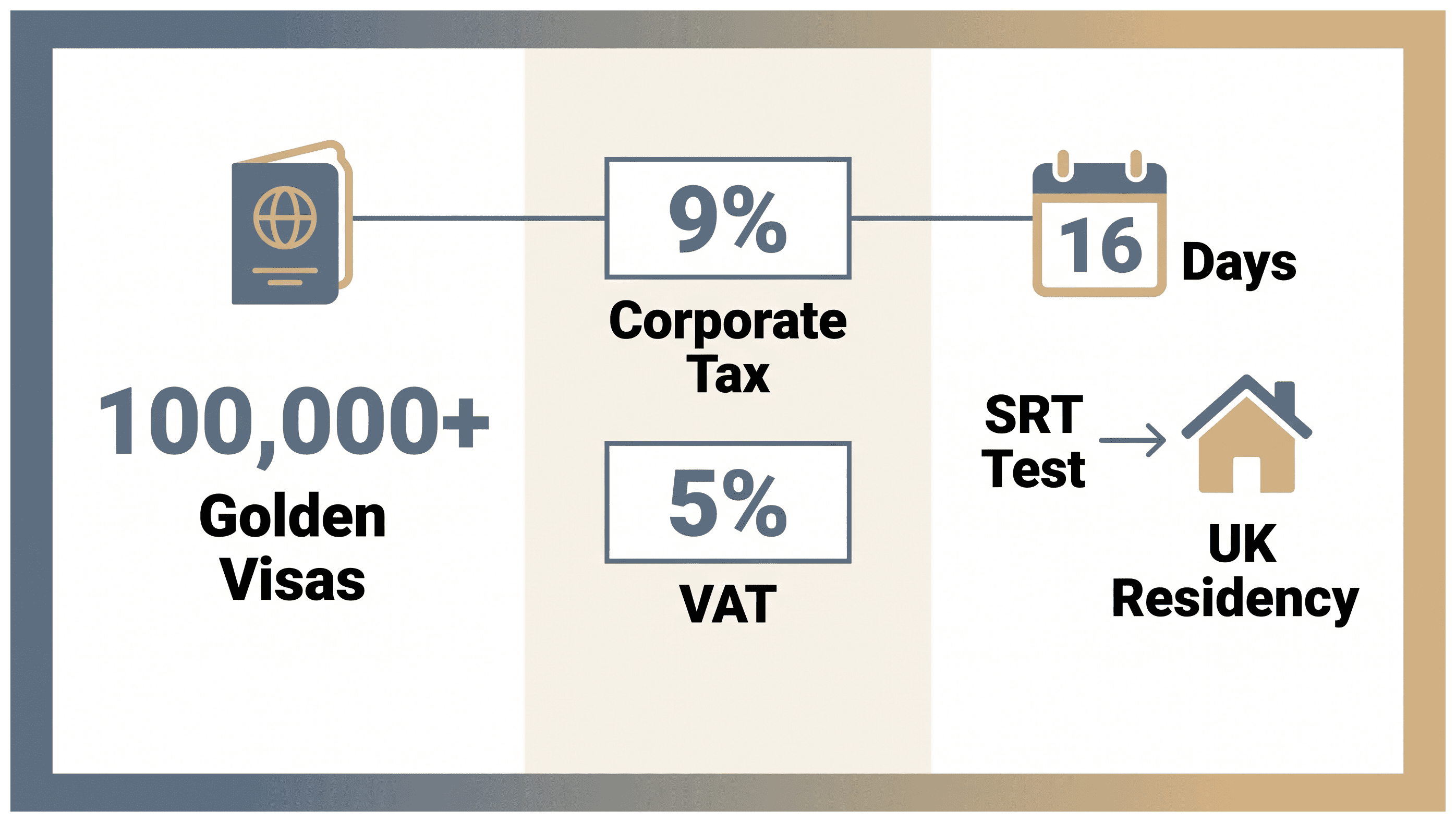
HMRC's Statutory Residence Test, the SRT, counts UK days, ties, and work patterns to decide residency each tax year. Spend fewer than 16 days in the UK with no ties, or meet the sufficient overseas work test, and you may become non-resident regardless of your Dubai company.
Day-Counting Rules Explained
Automatic overseas tests use strict day thresholds
Automatic UK tests can override your stated intent
Sufficient ties test covers borderline, split-time cases
Family, accommodation, and work ties all count
A founder splitting time 5 months in the UK and 7 months in Dubai has to track ties carefully: family location, available accommodation, and prior-year residence history all feed into the calculation.
Is Setting Up a Dubai Company Enough to Become Non-UK Resident?
No. Non-residence depends on physical day counts and ties under the SRT, not company ownership. You can hold a Dubai license and still be fully UK tax resident if you spend most of the year in Britain.
When Specialist Advice Becomes Essential
Split-year treatment gets complicated fast, especially during the year you actually move. Overlap years, where you're partly resident under both systems, need careful handling. Always confirm your status with a qualified UK tax adviser before relying on general guidance like this (see u.ae for official UAE residency context).
What UAE Tax Rules Mean for Your Company
The UAE's Federal Decree-Law No. 47 of 2022 introduced federal corporate tax, administered by the Federal Tax Authority, the FTA. Free zone companies can access preferential rates on qualifying income, but this governs the company, not your personal UK obligations.
Corporate Tax Basics Under Federal Decree-Law No. 47 of 2022
Standard 9% rate applies above AED 375,000 net profit
Qualifying free zone income can access a 0% rate
FTA registration and annual filing are mandatory
Non-compliance triggers penalties under FTA guidance
VAT and Ongoing Compliance
The UAE applies a flat 5% VAT on most taxable supplies (Federal Tax Authority, 2024). Record-keeping expectations are strict: invoices, ledgers, and filings must be retained for FTA review. None of this interacts directly with your UK reporting duties, since HMRC and the FTA operate as entirely separate systems. Founders often bring in Banking and Taxation Support to keep both sides aligned.
Steps to Set Up Cleanly With DSBH
Setting up cleanly involves choosing a license activity, submitting ICP-linked registration, applying for GDRFA entry permits, completing an Emirates ID biometric appointment, and opening a corporate bank account. Most founders complete the full cycle within 4 to 6 weeks.
Step 1: Choose Your License Activity
Match your activity to genuine business function
Review permitted activities before applying
Check overlaps with related activity codes
Step 2: Register With ICP and GDRFA
The ICP (Federal Authority for Identity, Citizenship, Customs and Port Security) handles federal identity registration
The GDRFA (General Directorate of Residency and Foreigners Affairs) processes residency entry permits for founders
Timelines depend on document completeness
Step 3: Complete Emirates ID and Banking
Biometric appointments typically open within days
Corporate account opening ties to license activation
Bring attested documents to avoid delays
A British e-commerce founder cleared his Emirates ID biometrics within four days of license issuance, then opened a corporate account two weeks later. Use the Cost Calculator to plan fees, and check Residency Services for visa timelines.
UK vs UAE Tax Position Key Facts
Feature | United Kingdom | United Arab Emirates |
|---|---|---|
Personal income tax on worldwide income | Taxed on worldwide income if UK resident under SRT | No personal income tax levied on individuals |
Corporate tax rate and thresholds | 25% main rate above £250,000 profit | 9% above AED 375,000 net profit |
Residency test used | Statutory Residence Test (SRT), day and ties based | Entry permit and Emirates ID linked residency |
VAT rate applied | 20% standard VAT rate | 5% flat VAT rate |
Governing authority | HMRC (Her Majesty's Revenue and Customs) | FTA (Federal Tax Authority) |
Comparing UK and UAE Tax Positions Side by Side
A side-by-side view shows the UK taxes worldwide income for residents while the UAE applies limited corporate tax with no personal income tax. Founders must still satisfy HMRC's SRT test to shift their personal residency status legally.
Where the Two Systems Diverge
Personal income tax treatment differs sharply between the two jurisdictions. Corporate tax thresholds and rates also compare differently, with the UAE's 9% band sitting well below the UK's 25% main rate (Ministry of Finance UAE, 2024). Reporting obligations to HMRC remain entirely separate from any UAE filings you complete.
Important Considerations
Does setting up in Dubai change your UK tax position on its own? No.
Track UK days from day one of relocation
Keep separate ledgers for UAE and UK filings
Common Mistakes British Founders Make When Relocating
Common mistakes include miscounting UK days, assuming company incorporation ends UK liability, delaying Emirates ID renewal, and skipping specialist tax advice. Each error can trigger unexpected HMRC scrutiny or lapsed UAE residency status.
Documentation and Residency Gaps
Letting Emirates ID lapse during travel
Missing GDRFA renewal windows
Not aligning UK exit paperwork with UAE entry timing
Forgetting to notify HMRC of departure via form P85
Advice Every Founder Should Get First
Consult a UK tax specialist before relocating, not after. Confirm your SRT status annually, not just once at the start. Keep UAE and UK filings aligned across tax years, and revisit the Moving to Dubai from United Kingdom guide for the fuller relocation picture, including timelines from the GDRFA and ICP.
So, does setting up in Dubai change your UK tax position? Not automatically. Your personal HMRC status depends on the SRT test, while your company sits under UAE's FTA rules and Federal Decree-Law No. 47 of 2022. Getting the two systems straight, rather than assuming one cancels the other, is what keeps founders out of trouble. Speak with our Banking and Taxation Support team to set up or buy a license the right way.
References
Frequently Asked Questions