French E-commerce Sellers Opening a Dubai Entity: Company Options, Cost and Timing

Topic Summary
What Is French E-commerce Sellers Opening a Dubai Entity and Why It Matters
French e-commerce sellers opening a Dubai entity means registering a free zone company to trade, warehouse, and re-export goods through UAE logistics hubs. It gives founders a legal base for customs clearance, supplier consolidation, and shipping into the UAE, GCC, and re-export markets beyond France.
Company Options for Business Setup in Dubai from France
Company Options for Business Setup in Dubai from France
Trade, Warehousing and Logistics Near Al Maktoum and Jebel Ali
French e-commerce sellers benefit from warehousing near Al Maktoum airport and Jebel Ali port, which shortens transit for both air and sea freight. Bonded storage lets goods sit duty-suspended until re-exported, cutting upfront customs cost for sellers moving stock onward from the UAE.
Numbered Steps to Open Your Dubai Entity from France
Opening a Dubai entity from France follows five steps: choose your license activity, reserve a trade name, submit incorporation documents, secure a warehouse or trading address, then apply for residency and Emirates ID. Most founders complete licensing within days, with residency following shortly after.
Residency and Identity Steps After Your Dubai Entity Is Live
After incorporation, founders apply for residency through the ICP, clear entry formalities with the GDRFA, and complete an Emirates ID application. These steps confirm legal residency status and are required before opening bank accounts or signing warehouse leases under the new Dubai entity.
Understanding Costs and Tax Obligations for French E-commerce Sellers Opening a Dubai Entity
Costs for opening a Dubai entity include license fees, warehouse or office rent, and residency processing charges. Federal Decree-Law No. 47 of 2022 sets corporate tax rules founders must register for with the FTA (Federal Tax Authority), and total setup cost varies by activity scope and warehouse size.
What French Founders Must Settle at Home Before Relocating
Before relocating, French founders should confirm their DGFiP (Direction Générale des Finances Publiques) filing status and check whether the French exit tax applies to shares or business assets held in France. Settling these obligations early avoids penalties and keeps the Dubai entity's paperwork clean during residency processing.
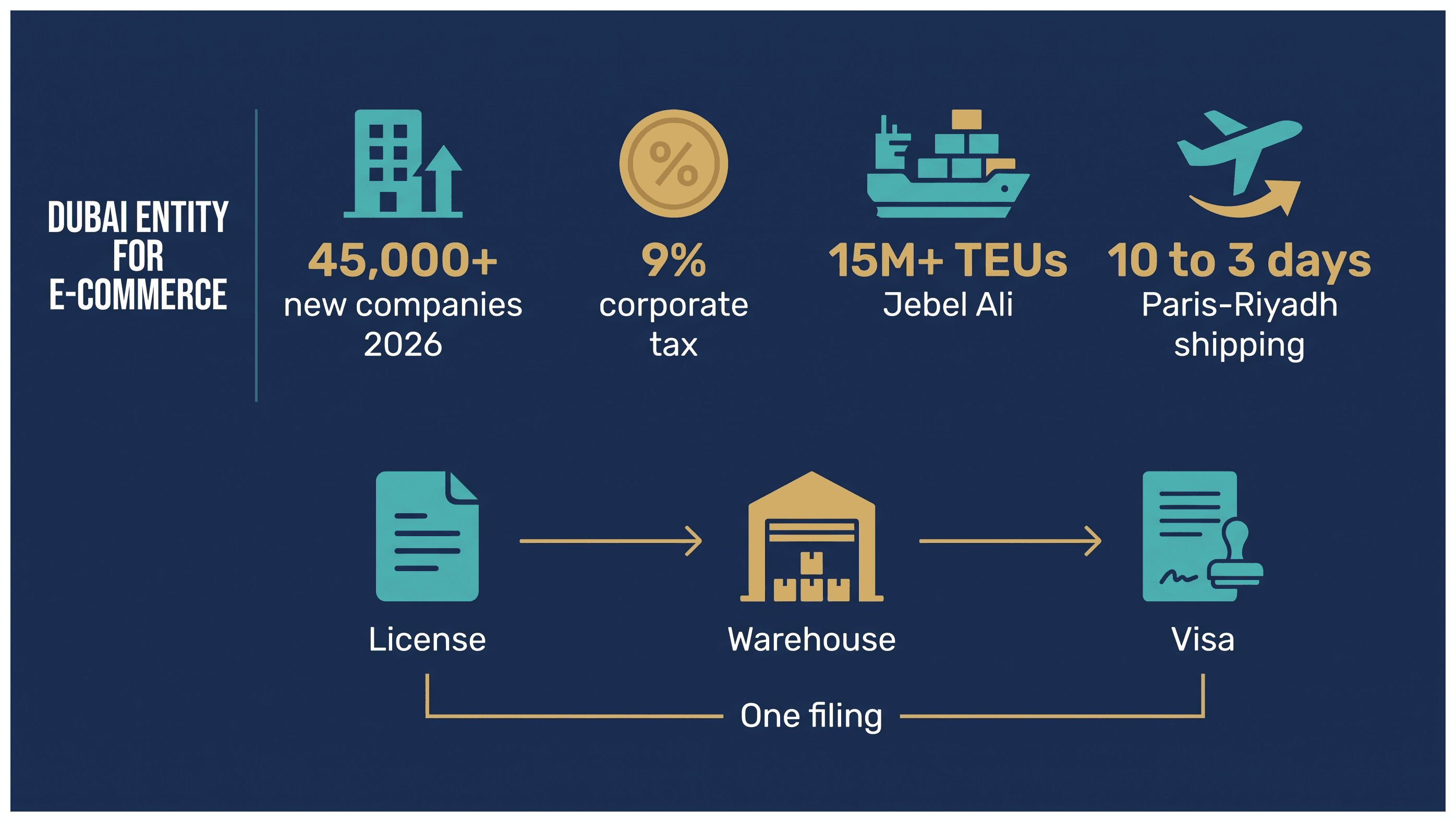
In 2026, over 45,000 new companies registered across the UAE [1], and a rising share came from French e-commerce founders choosing Gulf trade routes over pure domestic competition in France. That's roughly 3,750 new registrations a month, many tied to logistics and re-export activity. French e-commerce sellers opening a Dubai entity now cite duty-suspended storage, faster air freight, and predictable tax rules as reasons to move. Corporate tax sits at 9% above AED 375,000 profit under Federal Decree-Law No. 47 of 2022 [2]. Jebel Ali port moved over 15 million TEUs in recent years [3]. Al Maktoum airport's cargo terminal keeps expanding. For a French founder shipping skincare, homeware, or fashion, that's a shorter supply chain than routing everything through a French 3PL.
What Is French E-commerce Sellers Opening a Dubai Entity and Why It Matters
French e-commerce sellers opening a Dubai entity means registering a free zone company to trade, warehouse, and re-export goods through UAE logistics hubs. It gives founders a legal base for customs clearance, supplier consolidation, and shipping into the UAE, GCC, and re-export markets beyond France.
Why French Founders Choose Dubai for Trade
Proximity to Al Maktoum and Jebel Ali gives faster re-export routes than shipping out of France. A free zone structure lets French sellers hold stock in Dubai without creating a French VAT footprint on that inventory. Federal Decree-Law No. 47 of 2022 sets a corporate tax rate founders can actually plan around, rather than guessing at future French rate changes.
Picture a Paris-based skincare seller who shifted fulfillment from a French third-party logistics provider to a bonded warehouse near Jebel Ali. Shipping times to Riyadh and Doha dropped from ten days to under three. That's the kind of margin improvement French e-commerce sellers opening a Dubai entity are chasing.
How a DSBH Company Fits E-commerce Trade
License scope covers general trading and storage-linked activities under one trading license in dubai
Setup pairs a trade license with warehouse access near the logistics corridor
Founders can add residency visas tied to the same license
One incorporation file covers company, warehouse booking, and visa quota
A Lyon-based founder bundled her license, warehouse slot, and residency visa into one setup package rather than juggling three separate applications. That's the practical version of business setup in Dubai from France: fewer moving parts, one filing timeline.
Company Options for Business Setup in Dubai from France
French founders opening a Dubai entity for e-commerce typically choose a free zone company licensed for trading, general trading, or logistics support. Each option determines whether goods can be warehoused, re-exported, or sold within the UAE mainland, and shapes customs paperwork and cost.
Trading and General Trading Licenses
General trading covers multiple product categories under one license
Single-activity trading suits sellers with a narrow catalogue
Choice affects customs codes filed at import
Upgrading later is possible but requires re-filing activity codes
A cosmetics seller started with a single-activity license, then upgraded to general trading once she added a second product line (supplements). That upgrade meant new customs codes, not a whole new company.
Matching License Activity to Your Product Category
Activity codes must match what's declared at customs, full stop. Mismatched activities can delay shipment clearance at Jebel Ali or Al Maktoum. Founders should review business activities before filing, not after their first container is already in transit.
A homeware brand confirmed its activity codes weeks before its first Jebel Ali container arrived. That small step avoided a customs hold that competitors without matching paperwork often hit.
Trade, Warehousing and Logistics Near Al Maktoum and Jebel Ali
French e-commerce sellers benefit from warehousing near Al Maktoum airport and Jebel Ali port, which shortens transit for both air and sea freight. Bonded storage lets goods sit duty-suspended until re-exported, cutting upfront customs cost for sellers moving stock onward from the UAE.
Bonded Warehousing and Re-export Basics
Bonded storage defers duty until goods leave or enter the local market
Re-export status must be declared at customs filing
Storage near the port corridor cuts inland transit time
DP World manages much of the bonded infrastructure around Jebel Ali [4]
A fashion brand stored EU-sourced stock duty-suspended before shipping onward to Saudi buyers, avoiding double duty exposure entirely.
Key Facts for French Founders Opening a Dubai Entity
Feature | Step | Typical Timing / Detail |
|---|---|---|
Trade license | Choose activity, file documents | A few working days |
Warehouse booking | Book near Jebel Ali corridor | Separate from office lease |
Residency | ICP then GDRFA | Sequential, not parallel |
Emirates ID | Biometrics, medical test | Issued after residency stamp |
Corporate tax | Register with the FTA | Required under Federal Decree-Law No. 47 of 2022 |
Air Freight via Al Maktoum vs Sea Freight via Jebel Ali
Air freight suits high-value, low-volume French exports like jewelry or watches. Sea freight through Jebel Ali suits bulkier, lower-margin goods such as furniture or homeware. DP World's tracking infrastructure supports both routes for e-commerce sellers monitoring inventory in transit.
Numbered Steps to Open Your Dubai Entity from France
Opening a Dubai entity from France follows five steps: choose your license activity, reserve a trade name, submit incorporation documents, secure a warehouse or trading address, then apply for residency and Emirates ID. Most founders complete licensing within days, with residency following shortly after.
Step 1: Select Activity and Reserve a Trade Name
Match activity to your product category
Reserve name before submitting documents, use check company name tools first
Confirm activity aligns with future customs filings
Step 2: Submit Incorporation Documents
Passport and address proof required
Shareholder details filed with the free zone authority
Notarized French ID documents uploaded through the portal
Step 3: Secure Warehouse or Office Address
Address ties license to a physical or flexi-desk location
Warehouse slots booked separately from office lease
Founders often book a flexi-desk plus a shared warehouse bay
Step 4: Apply for Residency and Emirates ID
ICP (Federal Authority for Identity, Citizenship, Customs and Port Security) processes the residency file
GDRFA (General Directorate of Residency and Foreigners Affairs) handles entry permit and status change
Emirates ID issued after medical test and biometrics
One founder completed biometrics within a week of license issuance, then had her bank account open days later. Learn more via u.ae, the federal government portal.
Residency and Identity Steps After Your Dubai Entity Is Live
After incorporation, founders apply for residency through the ICP, clear entry formalities with the GDRFA, and complete an Emirates ID application. These steps confirm legal residency status and are required before opening bank accounts or signing warehouse leases under the new Dubai entity.
ICP and GDRFA Roles Explained
The ICP manages the federal residency file first. The GDRFA then handles Dubai-specific entry status and stamping. Both steps run in sequence, not parallel, so plan your travel dates around that order rather than assuming simultaneous processing.
How long does Emirates ID issuance take after residency approval?
Biometrics and a medical test come first. The Emirates ID card issues shortly after the residency stamp clears. Most founders receive it within one to two weeks and use it immediately for banking.
Biometrics and medical test required first
Card issued after residency stamp
ID needed for bank account and lease signing
For guidance on document handling during this stage, see business support UAE services.
Understanding Costs and Tax Obligations for French E-commerce Sellers Opening a Dubai Entity
Costs for opening a Dubai entity include license fees, warehouse or office rent, and residency processing charges. Federal Decree-Law No. 47 of 2022 sets corporate tax rules founders must register for with the FTA (Federal Tax Authority), and total setup cost varies by activity scope and warehouse size.
License, Warehouse and Visa Cost Breakdown
License fees depend on how many activities you register. Warehouse cost scales with storage volume, not license type. Visa cost is charged per person, not per license, so a two-founder team pays proportionally more than a solo operator. A single-activity license usually costs less upfront than general trading, but the gap narrows once you factor in warehouse rent and visa quota.
Registering for Corporate Tax with the FTA
Registration required under Federal Decree-Law No. 47 of 2022
FTA portal handles filing and registration Federal Tax Authority
Deadlines vary by license issue date
One founder registered for corporate tax within three months of license issuance, well ahead of her first filing deadline. Run your own numbers on the business setup cost in dubai calculator before committing to a license tier.
What French Founders Must Settle at Home Before Relocating
Before relocating, French founders should confirm their DGFiP (Direction Générale des Finances Publiques) filing status and check whether the French exit tax applies to shares or business assets held in France. Settling these obligations early avoids penalties and keeps the Dubai entity's paperwork clean during residency processing.
DGFiP Filing Before Departure
Confirm your tax residency status change with the DGFiP before you leave. A final French return may still be required for the year of departure. Coordinate that filing timeline with your Dubai license issue date so nothing overlaps awkwardly.
Understanding the French Exit Tax
Applies to certain shareholdings above set thresholds
Deferral options exist depending on destination country
Consult a French tax adviser before transferring shares
One founder holding French company shares sought exit tax deferral before relocating, working with a French adviser to time the transfer correctly. Read more on moving to Dubai from France for the fuller relocation picture, including housing and schooling.
French e-commerce sellers opening a Dubai entity gain a trade and re-export base near Al Maktoum and Jebel Ali, with clear licensing, residency, and tax steps once DGFiP and French exit tax matters are settled at home. The path is fairly linear once you know the order: activity selection, incorporation, warehouse booking, then residency through ICP and GDRFA. Explore business activities or run the numbers on the cost calculator to set up or buy your license.
References
Frequently Asked Questions