Golden Visa Route for British Business Owners: What to Prepare and What It Costs

Topic Summary
What Is the Golden Visa Route and Why It Matters
The golden visa route for british business owners lets UK founders secure long-term UAE residency by owning a qualifying Dubai company. It runs under Federal Decree-Law No. 47 of 2022, with the Federal Tax Authority (FTA) overseeing tax registration and the Federal Authority for Identity, Citizenship, Customs and Port Security (ICP) handling residency issuance tied to company ownership.
Who Qualifies for the Golden Visa Through a Dubai Company
Who Qualifies for the Golden Visa Through a Dubai Company
Documents and Steps to Prepare Before You Apply
Preparation involves company incorporation papers, share certificates, passport copies, and proof of address, followed by GDRFA entry permit processing, medical fitness testing, Emirates ID biometrics, and final visa stamping. Each stage depends on the previous one clearing correctly.
Costs to Budget for the Golden Visa Route
Costs stack across four areas: company license fees, visa application and stamping charges, medical testing, and Emirates ID issuance. Total spend varies by free zone and activity, so British founders should budget for both setup and renewal cycles rather than a single upfront fee.
What UK Tax Rules Mean for Your Golden Visa Plan
Moving to Dubai doesn't automatically end your UK tax obligations. HMRC applies the Statutory Residence Test (SRT) to determine residency status based on day counts and ties to the UK, so founders must track time spent in each country carefully to avoid dual liability.
Common Mistakes British Founders Make on This Route
The most frequent errors include underestimating share capital thresholds, missing medical test deadlines, ignoring HMRC's SRT day-count rules, and choosing a license activity that doesn't match long-term visa plans. Each mistake causes delays measured in weeks, not days.
In 2026, over 100,000 Golden Visas have been issued across the UAE, and a growing share go to British founders who built eligibility through company ownership rather than property purchases (u.ae, 2025). That's a real shift from the old assumption that you need a villa or a seven-figure bank deposit. The golden visa route for british business owners now runs squarely through licensing, share capital, and paperwork accuracy. This guide covers who qualifies, what the FTA, ICP, and GDRFA each check, what it costs in 2026, and how HMRC's SRT test fits into your relocation timeline.
What Is the Golden Visa Route and Why It Matters
The golden visa route for british business owners lets UK founders secure long-term UAE residency by owning a qualifying Dubai company. It runs under Federal Decree-Law No. 47 of 2022, with the Federal Tax Authority (FTA) overseeing tax registration and the Federal Authority for Identity, Citizenship, Customs and Port Security (ICP) handling residency issuance tied to company ownership.
The Legal Basis Behind the Visa
Federal Decree-Law No. 47 of 2022 sets the corporate tax and business framework that underpins eligibility for the golden visa route for british business owners. The ICP issues the residency permit itself, once your company file clears review. The General Directorate of Residency and Foreign Affairs (GDRFA) handles your entry permit and any status adjustment while you're inside Dubai.
Picture a UK founder registering a consultancy license through a professional services license. Once the FTA confirms tax registration, the ICP moves the visa file forward. Over 100,000 Golden Visas have been issued UAE-wide as this ownership-based pathway has matured (u.ae, 2025).
Why British Founders Choose This Route
It avoids large property purchases as an entry ticket.
Residency ties directly to an active company license, not a static asset.
It suits founders relocating actual operations, not just parking capital.
A London-based e-commerce owner shifting warehousing to Dubai fits this profile well.
Who Qualifies for the Golden Visa Through a Dubai Company
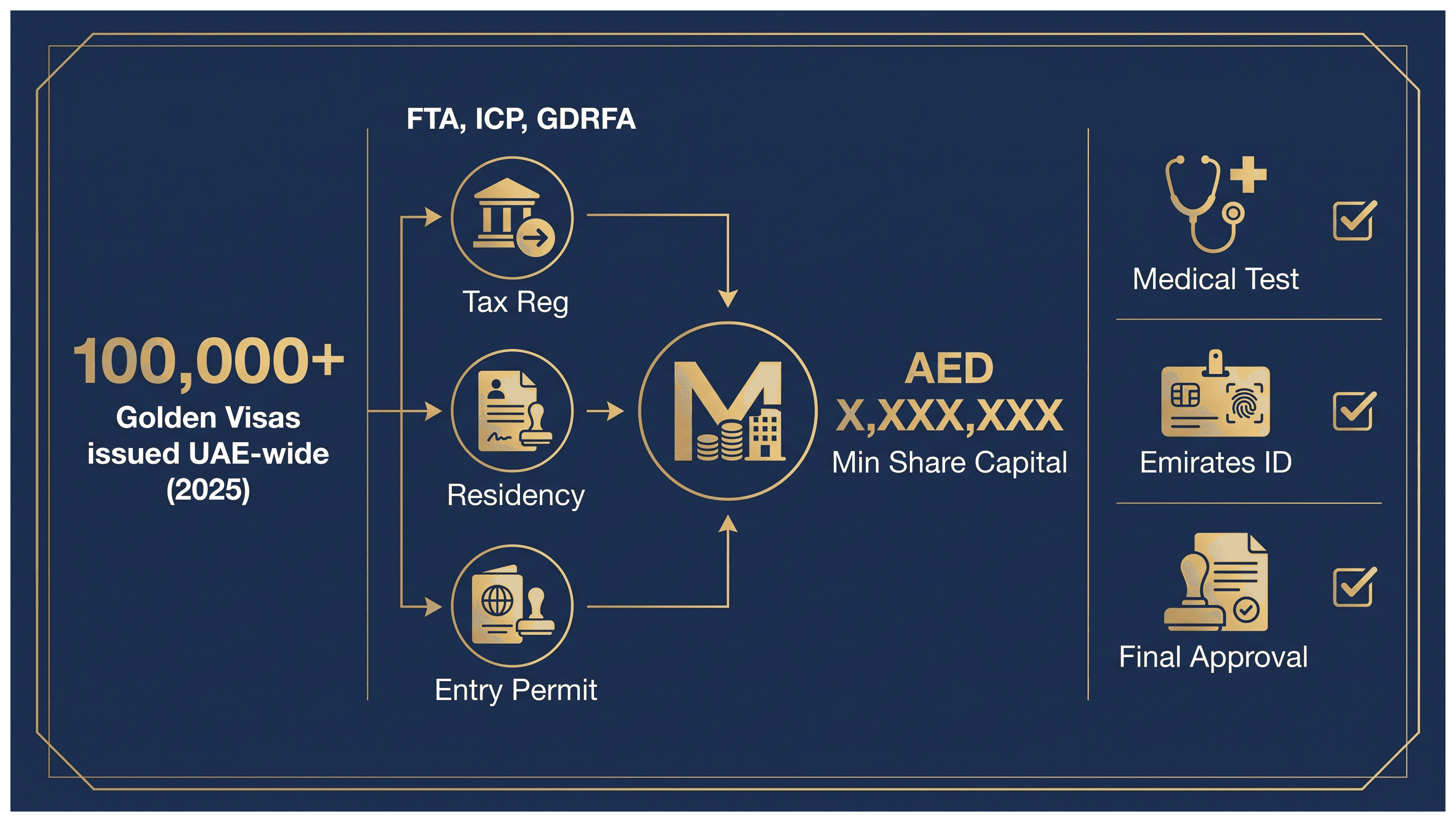
Eligibility centres on company ownership value, sector, and investment thresholds set by the ICP. British founders typically qualify by holding shares in a qualifying free zone company for british founders that meets minimum capital or activity criteria, rather than through employment or property alone.
Ownership and Capital Thresholds
ICP sets minimum share value benchmarks for eligibility.
Sole ownership and partnership structures both qualify differently.
Free zone licensing choice affects which activities count.
A trading company owner can meet the threshold through paid-up capital alone.
Golden Visa Requirements at a Glance
Feature | Requirement | Detail |
|---|---|---|
Company incorporation with qualifying share capital | Meet ICP's minimum share value | Confirmed at license issuance stage |
GDRFA entry permit or status adjustment | Valid entry or in-country status | Processed before medical test booking |
Medical fitness test | Blood test and chest X-ray | Completed at an approved centre |
Emirates ID biometric capture | Fingerprints and photo on file | Booked via a typing centre |
ICP final residency approval | Complete file review | Ends with passport stamping |
Sector and Activity Considerations
Some business activities carry stronger approval pathways than others, and your choice matters early. A professional license usually needs lighter documentation than a general trading license, so an ICT consultancy owner may move through review faster than a founder importing physical goods. Your free zone choice also shapes which activities you can legally run under one license, so check the business activities list before you commit to a structure.
Documents and Steps to Prepare Before You Apply
Preparation involves company incorporation papers, share certificates, passport copies, and proof of address, followed by GDRFA entry permit processing, medical fitness testing, Emirates ID biometrics, and final visa stamping. Each stage depends on the previous one clearing correctly.
Step 1: Incorporate Your Qualifying Company
Choose your activity and license type before reserving a trade name.
Confirm your share capital meets visa thresholds in advance.
Finalise your memorandum of association and license issuance.
Check trade name availability through a company name search before submission.
Step 2: Submit to GDRFA and ICP
Request an entry permit through GDRFA if you're outside the UAE.
Apply for status adjustment if you're already inside on a tourist entry.
Wait for ICP to review your company and ownership file.
A founder switching from tourist entry to residency status follows this exact path.
Step 3: Medical Test and Emirates ID
Complete the mandatory medical fitness screening.
Attend biometric capture for your Emirates ID.
Receive final visa stamping in your passport.
How long does the golden visa process take for British founders?
Most files move from incorporation to final stamping within four to eight weeks. Delays usually trace back to incomplete share capital documents or missed medical test slots, not the ICP review itself.
Costs to Budget for the Golden Visa Route
Costs stack across four areas: company license fees, visa application and stamping charges, medical testing, and Emirates ID issuance. Total spend varies by free zone and activity, so British founders should budget for both setup and renewal cycles rather than a single upfront fee.
1. Company License and Registration Fees
License cost varies by free zone and chosen activity.
Trade name reservation carries its own separate charge.
Annual renewal is a recurring obligation, not a one-off.
Use the business setup cost calculator to model your specific activity before committing to a package.
2. Visa Processing and Stamping Charges
An entry permit fee applies if you're applying from the UK.
A status change fee applies if you're already inside the UAE.
A stamping fee applies per passport, per visa cycle.
3. Medical Testing and Emirates ID
Health screening carries a mandatory fixed cost.
Emirates ID issuance has its own separate fee.
Typing centres charge a service fee for form submission.
4. Ongoing Renewal Budgeting
Your license renews on an annual cycle.
Your visa needs renewal ahead of its expiry date.
Budget a buffer if you plan to add dependent visas later.
What UK Tax Rules Mean for Your Golden Visa Plan
Moving to Dubai doesn't automatically end your UK tax obligations. HMRC applies the Statutory Residence Test (SRT) to determine residency status based on day counts and ties to the UK, so founders must track time spent in each country carefully to avoid dual liability.
How the SRT Test Works
Day-count thresholds sit at the core of the SRT test, and HMRC also weighs your family, work, and property ties to the UK. A founder relocating mid-year can use split-year treatment, but only if the day counts line up correctly against HMRC's rules. Get this wrong, and you could end up taxed in both countries for the same year.
Coordinating Company Structure With Tax Timing
Align your incorporation date with UK tax year planning.
Keep clear records of UK versus UAE days throughout the year.
Talk to a tax adviser before assuming you've become non-resident.
Founders setting up accounts through banking and taxation services often find this coordination easier once records are centralised from day one.
Common Mistakes British Founders Make on This Route
The most frequent errors include underestimating share capital thresholds, missing medical test deadlines, ignoring HMRC's SRT day-count rules, and choosing a license activity that doesn't match long-term visa plans. Each mistake causes delays measured in weeks, not days.
Underestimating Capital Requirements
Founders assume minimum license capital automatically qualifies for residency.
Many skip verifying thresholds with ICP before filing.
Some pick an activity that doesn't match their intended visa category.
Ignoring UK Tax Timing
Founders fail to track SRT day counts closely enough.
Some assume relocation alone ends HMRC liability.
Few coordinate license start dates with UK tax year boundaries.
The golden visa route for british business owners rewards founders who prepare documents, capital, and UK tax timing together rather than treating them separately. Get your license activity right, verify your capital threshold with the ICP early, and keep your SRT day count clean from the first month you set foot in Dubai.
Follow the process in order: incorporate first, file with GDRFA and ICP second, then handle your medical test and Emirates ID last. Talk to our Residency Services team to set up or buy a license and start your Golden Visa file correctly. If you're still weighing your move, our Moving to Dubai from United Kingdom guide covers the wider relocation picture.
References
Frequently Asked Questions