Indian Exporters Using Dubai as a Re-Export Base: Setup Cost, Route and Timeline

Topic Summary
Setting Up a DSBH Company as an Indian Founder
Setting Up a DSBH Company as an Indian Founder
Understanding Customs, VAT and Compliance for Re-Export Activity
Understanding Customs, VAT and Compliance for Re-Export Activity
Steps to Launch Your Re-Export Route Through Dubai South
Launching a re-export route through Dubai South Business Hub follows four practical steps beyond the paperwork itself. Most founders move from application to first shipment within four to six weeks.
Managing Money Flow Between India and Dubai
Indian founders funding a Dubai company for Indian founders must work within the Reserve Bank of India's Liberalised Remittance Scheme (LRS) annual cap and report foreign income to the Income Tax Department. Profits repatriated to India stay taxable there, so clean invoicing between both jurisdictions matters.
Key Benefits of a Dubai Free Zone Indian Trading Company
A Dubai free zone Indian trading company gains full foreign ownership, streamlined customs near two major cargo hubs, and access to CEPA tariff advantages. Combined with residency tied to the license, founders manage sourcing, storage and re-export logistics from a single base.
Costs and Timeline Indian Founders Should Expect
Setting up a Dubai South Business Hub re-export company typically starts near AED 12,500 for the license, with visa and warehousing costs added separately. Most founders clear registration, customs setup and first shipment within four to six weeks from application.
Indian exporters using Dubai as a re-export base means routing goods through a Dubai South Business Hub trading company, storing them near Jebel Ali or Al Maktoum, then re-shipping to third markets. This structure uses UAE logistics, the India-UAE CEPA, and streamlined customs to cut transit time and cost.
Why Dubai Sits Between India and the World
Dubai sits almost equidistant from major Asian, African and European ports, which is exactly why so many Indian exporters using Dubai as a re-export base pick it over shipping direct. A Mumbai-based textile exporter, for instance, might store bulk fabric near Jebel Ali before splitting shipments to East Africa and Gulf buyers, avoiding two separate long-haul sailings. Dubai's re-export tradition goes back decades, and cargo throughput near Jebel Ali and Al Maktoum keeps growing (DP World, 2025).
How the India-UAE CEPA Changes the Math
The India-UAE Comprehensive Economic Partnership Agreement, or CEPA, reshapes the cost equation for Indian exporters using Dubai as a re-export base:
Zero or reduced tariffs on many product categories moving between India and the UAE.
Faster customs clearance for CEPA-eligible shipments.
Lower landed cost when goods move onward from Dubai.
Gems and jewellery re-exporters gain notably from CEPA tariff cuts.
Setting Up a DSBH Company as an Indian Founder
Setting up a Dubai South Business Hub (DSBH) company for re-export involves choosing a trading license, registering with the Federal Authority for Identity, Citizenship, Customs and Port Security (ICP), applying for General Directorate of Residency and Foreigners Affairs (GDRFA) residency, and obtaining an Emirates ID. Most founders complete formation and visa issuance within 10 to 15 working days.
Choosing the Right Trading License
A general trading license covers multiple product lines, which suits an electronics importer moving several categories at once. A commodity-specific license fits founders focused on one product family, like machinery parts. Match your activity code to the goods you'll actually re-export through a trading license, since warehousing needs often follow license scope.
Registration With ICP and GDRFA
ICP handles federal identity and residency records nationwide.
GDRFA processes entry permits and visa stamping in Dubai.
Emirates ID gets issued once medical tests and biometrics clear.
One founder completed GDRFA visa stamping within a week of license issuance.
Documents Indian Founders Commonly Need
Passport copies plus passport-size photos.
Proof of UAE and India address.
Bank reference letters from your Indian bank.
Attested trade or educational certificates, where relevant.
Understanding Customs, VAT and Compliance for Re-Export Activity
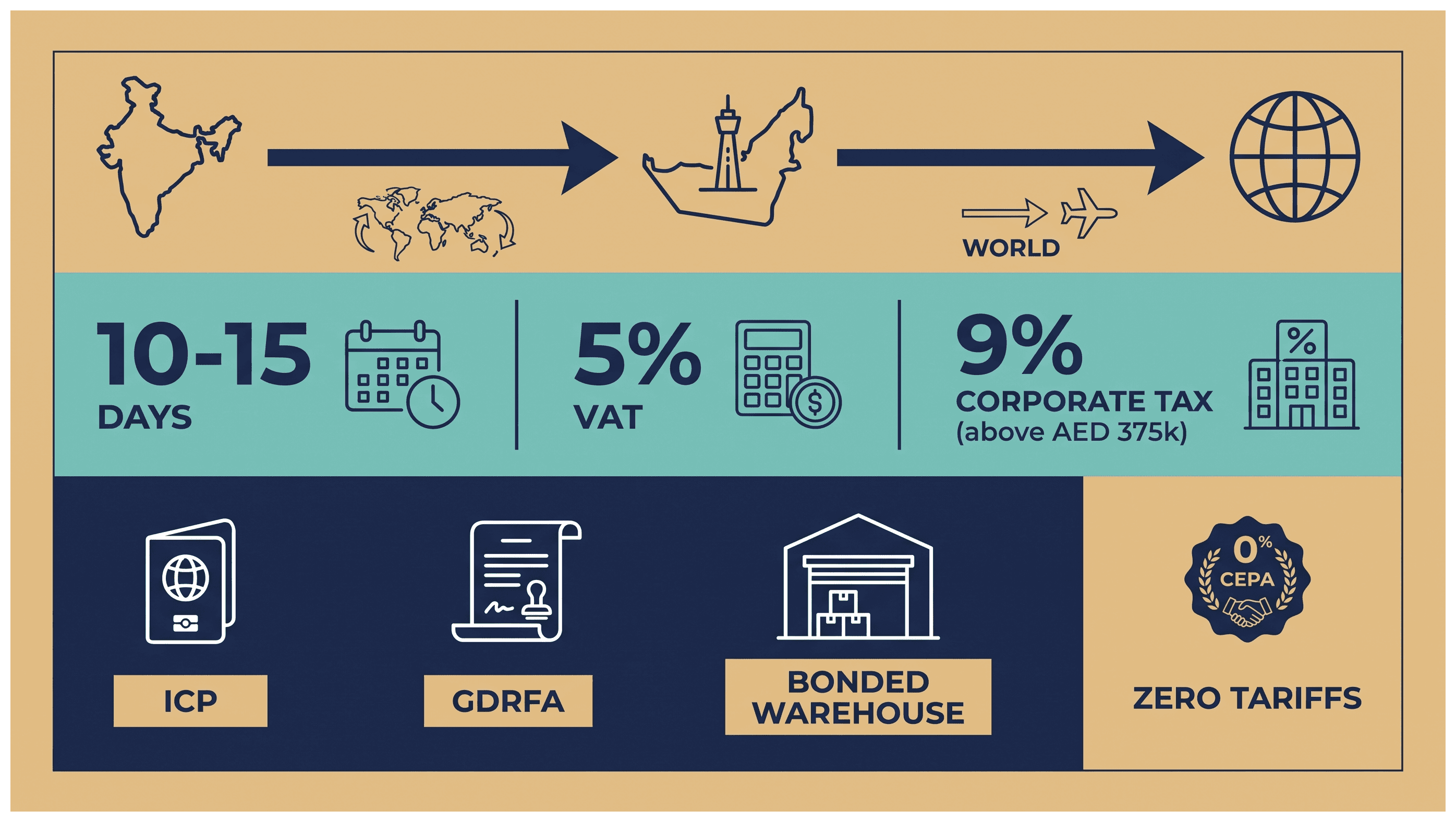
Re-export activity in Dubai runs under Federal Decree-Law No. 47 of 2022 for corporate tax and Federal Tax Authority (FTA) rules for VAT. Goods bonded for re-export typically avoid import duty, though founders must keep proper documentation to claim exemptions and satisfy customs reporting.
VAT and Corporate Tax Basics
Standard VAT sits at 5% unless goods qualify for zero-rating on export. Corporate tax applies at 9% above AED 375,000 in annual profit under Federal Decree-Law No. 47 of 2022. A trading company usually files VAT returns quarterly with the FTA, and missing a filing window triggers penalties fast.
Bonded Warehousing and Duty Suspension
Customs bonded zones near Jebel Ali and Al Maktoum let goods sit in transit without triggering import duty. Machinery parts headed to Africa, for example, often clear India, land in a bonded warehouse, then move out under a re-export certificate. Keep your paperwork clean here (Dubai Trade, 2025), because customs audits do happen.
Is Setting Up a Re-Export Company in Dubai Worth It for Indian Founders?
Yes, for most trading founders. CEPA tariff cuts plus bonded warehousing near two cargo hubs beat routing everything through India alone.
Steps to Launch Your Re-Export Route Through Dubai South
Launching a re-export route through Dubai South Business Hub follows four practical steps beyond the paperwork itself. Most founders move from application to first shipment within four to six weeks.
Step 1: Select a Trading Activity Code
Match the code to your actual re-export goods.
Confirm the goods qualify for CEPA benefits.
Check if warehousing size assumptions still fit.
Step 2: Apply for the License and Visa
Submit ICP and GDRFA paperwork together.
Book Emirates ID biometrics early.
Open your corporate bank account in parallel.
Step 3: Register With Dubai Customs
Create a customs code tied to your trade license.
Set up a re-export declaration workflow.
Assign a broker if you lack in-house staff.
Step 4: Arrange Warehousing and Logistics
Compare storage near the Al Maktoum airport cargo terminal.
Assess sea-air combinations using nearby port access.
Lock in rates before peak shipping season.
Managing Money Flow Between India and Dubai
Indian founders funding a Dubai company for Indian founders must work within the Reserve Bank of India's Liberalised Remittance Scheme (LRS) annual cap and report foreign income to the Income Tax Department. Profits repatriated to India stay taxable there, so clean invoicing between both jurisdictions matters.
Dubai South Business Hub Re-Export Setup: Key Facts at a Glance
Feature | Requirement | Detail |
|---|---|---|
License cost | Starting license fee | Near AED 12,500 |
Corporate tax | Applies above threshold | 9% above AED 375,000 profit |
VAT | Standard rate under FTA | 5%, zero-rated exports possible |
Registration timeline | License plus visa combined | 10 to 15 working days |
Key authorities | Identity, residency, tax | ICP, GDRFA, FTA |
Logistics hubs | Nearby cargo access | Al Maktoum, Jebel Ali |
Staying Within RBI LRS Limits
India's LRS caps how much an individual can remit abroad each financial year. Some founders split initial capital across two remittance cycles to stay compliant and avoid bank queries. Banks will ask for a purpose declaration and Form A2 before releasing funds.
Reporting Foreign Income to the Income Tax Department
Foreign assets and income must be disclosed in your Indian tax return under the Schedule FA requirement. Double taxation avoidance provisions between India and the UAE help, but only if you keep records straight from day one.
Key Benefits of a Dubai Free Zone Indian Trading Company
A Dubai free zone Indian trading company gains full foreign ownership, streamlined customs near two major cargo hubs, and access to CEPA tariff advantages. Combined with residency tied to the license, founders manage sourcing, storage and re-export logistics from a single base.
Full Ownership and Simplified Licensing
No local partner required under the free zone structure.
Renewal cycles tie directly to your license category.
Residency visas attach to the license itself.
Proximity to Cargo Infrastructure
Short trucking distance to Jebel Ali port operations.
Direct air cargo access through Al Maktoum.
A pharma re-exporter cut transit time by consolidating shipments near Al Maktoum.
Costs and Timeline Indian Founders Should Expect
Setting up a Dubai South Business Hub re-export company typically starts near AED 12,500 for the license, with visa and warehousing costs added separately. Most founders clear registration, customs setup and first shipment within four to six weeks from application.
Breaking Down the Setup Cost
The license fee covers registration itself, while visa costs and Emirates ID fees sit on top. Warehouse rental swings quite a bit depending on size and proximity to Al Maktoum or Jebel Ali. A mainland setup, by comparison, often runs higher and slower on foreign ownership terms, which is exactly why founders check a cost calculator before committing capital.
Realistic Week-by-Week Timeline
Week 1-2: license and activity approval.
Week 3-4: visa, Emirates ID, bank account.
Week 5-6: customs registration and first shipment.
Indian exporters using Dubai as a re-export base gain a compliant, fast route to global markets when they pair a Dubai South Business Hub license with proper customs and remittance planning. Getting the activity code, warehousing choice and RBI compliance right from the start saves weeks of rework later. If you're weighing whether Indian exporters using Dubai as a re-export base makes sense for your product line, start by reviewing business activities and running the cost calculator to set up or buy a license today. For founders relocating themselves alongside the company, the Moving to Dubai from India guide covers the residency side in more depth, and business support services can handle the PRO work while you focus on sourcing.
References
Frequently Asked Questions