Indian Manufacturers Setting Up a Dubai Sales Arm: Setup Cost, Route and Timeline

Topic Summary
What Is a Dubai Sales Arm for Indian Manufacturers and Why It Matters
A Dubai sales arm is a free zone company that lets an Indian manufacturer invoice, warehouse, and re-export goods without shifting production. It runs under Federal Decree-Law No. 47 of 2022 (Decree-Law No. 47), gives access to global logistics via Jebel Ali, and speeds up GCC and African market entry under India-UAE CEPA terms.
Choosing the Trade or Re-Export Route Near the Logistics Hub
Choosing the Trade or Re-Export Route Near the Logistics Hub
Setup Cost and Timeline for Indian Manufacturers Setting Up a Dubai Sales Arm
A free zone trading license for an Indian manufacturer's Dubai sales arm typically takes two to four weeks and includes license fees, a warehousing or flexi-desk option, and visa allocations. Costs scale with warehouse size, number of visas, and activity count on the license.
Tax and Compliance Rules Indian Manufacturers Must Know
Decree-Law No. 47 sets a 9% corporate tax above AED 375,000 in taxable profit, plus 5% VAT registration once turnover crosses the threshold under Federal Tax Authority (FTA) rules. Indian manufacturers must register for both taxes even when operating from a free zone.
Steps to Launch Your Dubai Sales Arm From India
Launching a Dubai sales arm involves choosing an activity, reserving a trade name, submitting shareholder documents, securing warehousing, registering for customs, and applying for residency visas . Most Indian manufacturers complete this sequence over two to four weeks.
Handling India-Side Compliance and Fund Transfers
Indian founders funding a Dubai sales arm must follow the Reserve Bank of India's Liberalised Remittance Scheme (RBI LRS) limits and report overseas investment to the Income Tax Department. India-UAE CEPA can reduce import duties on eligible re-exported goods, making compliance planning essential before the first transfer.
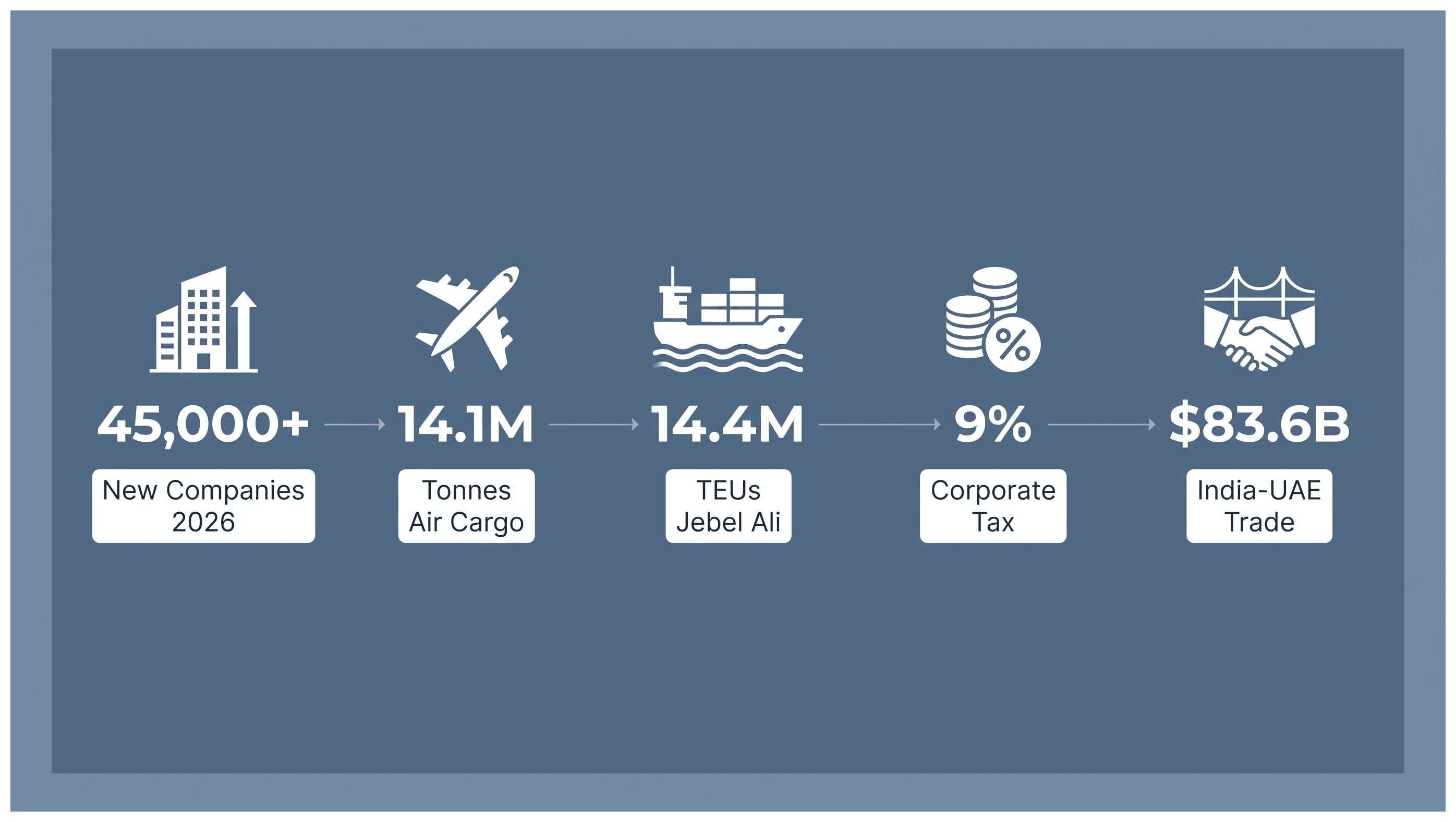
In 2026, over 45,000 new companies registered across the UAE [1], and Indian manufacturers make up one of the fastest-growing groups opening a re-export or sales base here. Dubai handled 14.1 million tonnes of air cargo in 2023 [2]. Jebel Ali port moved 14.4 million TEUs the same year [3]. Corporate tax sits at 9% above AED 375,000 [4]. VAT registration kicks in at AED 375,000 turnover [4]. India-UAE trade crossed USD 83.6 billion in FY2023-24 [3]. That's the backdrop for indian manufacturers setting up a dubai sales arm today.
This guide walks Indian founders through indian manufacturers setting up a dubai sales arm: the trade and re-export route, license and activity choices, warehousing near Al Maktoum and Jebel Ali, customs steps, real costs, and India-side compliance you can't skip.
What Is a Dubai Sales Arm for Indian Manufacturers and Why It Matters
A Dubai sales arm is a free zone company that lets an Indian manufacturer invoice, warehouse, and re-export goods without shifting production. It runs under Federal Decree-Law No. 47 of 2022 (Decree-Law No. 47), gives access to global logistics via Jebel Ali, and speeds up GCC and African market entry under India-UAE CEPA terms.
How a Sales Arm Differs From a Branch Office
A branch office ties liability back to the Indian parent. A free zone company, by contrast, stands as its own legal entity. Take a Ludhiana auto-parts maker: instead of registering a branch abroad, they set up a DSBH trading entity with full ownership and independent bank accounts. That separation matters if a shipment dispute ever lands in a UAE court.
Why Founders Choose Trade or Re-Export Structures
Faster invoicing to GCC buyers, often same week
Bonded warehousing cuts duty exposure on re-exports
India-UAE CEPA lowers tariffs on eligible HS codes
Re-exporting textiles to East Africa via Jebel Ali saves transit time
Trade License vs General Trading License for a Dubai Sales Arm
Feature | Trading License | General Trading License |
|---|---|---|
Product scope | Single product category, e.g. auto parts | Multiple unrelated product lines allowed |
Typical cost range | Lower annual license fee | Higher fee, broader activity list |
Warehousing fit | Fits a single-commodity warehouse | Suits mixed-SKU bonded storage |
Re-export suitability | Good for one manufacturing line | Better for diversified export portfolios |
Visa allocation | Standard quota tied to office size | Higher quota with larger warehouse lease |
Choosing the Trade or Re-Export Route Near the Logistics Hub
Indian manufacturers usually pick a trading or general trading license, paired with warehousing near Al Maktoum and Jebel Ali, to store, consolidate, and re-export goods efficiently. This route suits companies shipping to GCC, Africa, and CIS markets without duplicating manufacturing overseas.
Trading and General Trading Activity Codes
Single-product trading fits one manufactured category
General trading covers a wider product mix
A Gujarat pharma packaging manufacturer often picks general trading to add e-commerce distribution later
Warehousing Near Al Maktoum and Jebel Ali
Al Maktoum International handles growing air cargo volumes each year (Dubai Airports, 2024). Jebel Ali port, run by DP World, connects sea freight to over 150 destinations. Storing electronics components in bonded warehouses before re-shipping to Oman avoids paying import duty twice.
Customs Registration and Documentation
Register a customs code through Dubai Trade
Classify goods using correct HS codes
File a certificate of origin for CEPA rates on auto components
Setup Cost and Timeline for Indian Manufacturers Setting Up a Dubai Sales Arm
A free zone trading license for an Indian manufacturer's Dubai sales arm typically takes two to four weeks and includes license fees, a warehousing or flexi-desk option, and visa allocations. Costs scale with warehouse size, number of visas, and activity count on the license.
What Drives the Total Cost
License package and number of activities chosen
Warehouse or storage unit size
Visa quota per shareholder or staff member
A small flexi-desk trading setup costs far less than a full warehouse unit
Typical Application Sequence
Reserve trade name and get initial approval
Pick activity and pay license fees
Lease warehouse and get customs code
How long does business setup in Dubai from India take?
Most Indian manufacturers finish setup in two to four weeks. That covers name reservation, license issuance, warehouse lease, and customs registration together.
Tax and Compliance Rules Indian Manufacturers Must Know
Decree-Law No. 47 sets a 9% corporate tax above AED 375,000 in taxable profit, plus 5% VAT registration once turnover crosses the threshold under Federal Tax Authority (FTA) rules. Indian manufacturers must register for both taxes even when operating from a free zone.
Corporate Tax Registration With the FTA
The 9% rate applies only above AED 375,000 profit. Free zone companies keep qualifying income exempt if conditions under Decree-Law No. 47 are met. Annual filing with the FTA stays mandatory regardless.
VAT and Customs Duty Considerations
5% VAT registration at AED 375,000 turnover
Re-export exemptions apply on bonded goods
Import duty deferral available in designated zones
Steps to Launch Your Dubai Sales Arm From India
Launching a Dubai sales arm involves choosing an activity, reserving a trade name, submitting shareholder documents, securing warehousing, registering for customs, and applying for residency visas. Most Indian manufacturers complete this sequence over two to four weeks.
Step 1: Select License Type and Activity
Match activity to your manufactured goods
Confirm re-export eligibility upfront
Pick single or general trading scope
A leather goods manufacturer, for instance, often picks a general trading activity to cover accessories and packaging together. Browse the full list of business activities before you file.
Step 2: Submit Shareholder Documents
Passport copies and Indian incorporation certificate
Board resolution naming a UAE representative
Notarized copies where required
Step 3: Secure Warehousing and Customs Code
Lease space near Jebel Ali or Al Maktoum
Register your customs code via Dubai Trade
Book a 2,000 sq ft warehouse ahead of your first container
Step 4: Apply for Visas Through ICP and GDRFA
Entry permit issued via the Federal Authority for Identity, Citizenship, Customs and Port Security (ICP)
Medical test and Emirates ID through the General Directorate of Residency and Foreigners Affairs (GDRFA)
A founder and sales manager can both secure residency within one license
Need help with the paperwork? Dubai South's business support team handles ICP and GDRFA filings for founders relocating from India.
Handling India-Side Compliance and Fund Transfers
Indian founders funding a Dubai sales arm must follow the Reserve Bank of India's Liberalised Remittance Scheme (RBI LRS) limits and report overseas investment to the Income Tax Department. India-UAE CEPA can reduce import duties on eligible re-exported goods, making compliance planning essential before the first transfer.
RBI LRS Limits for Outbound Investment
RBI LRS caps annual remittance per individual. A promoter remitting seed capital reports it through an authorized dealer bank. Companies instead use the overseas direct investment route, which carries separate filing steps.
Income Tax Department Reporting Obligations
Disclose foreign assets in your annual ITR
Apply transfer pricing rules on intercompany sales
Claim relief under the India-UAE double taxation treaty
Using India-UAE CEPA for Lower Tariffs
Preferential duty rates apply on eligible HS codes
Certificate of origin proves eligibility at customs
Textile exporters often claim reduced tariffs under CEPA
Indian manufacturers setting up a Dubai sales arm gain a compliant, logistics-ready base near Al Maktoum and Jebel Ali, backed by clear tax rules under Decree-Law No. 47 and CEPA tariff advantages. If you're planning your move from India, start by reviewing our guide on moving to Dubai from India, then explore business activities or run the numbers on our cost calculator to set up or buy your license today.
References
Frequently Asked Questions