Indian Startups Raising From Gulf Investors Through Dubai

Topic Summary
What Is Indian Startups Raising From Gulf Investors Through Dubai and Why It Matters
Indian startups raising from Gulf investors through Dubai means founders set up a Dubai free zone company as the investment holding vehicle, letting Gulf investors fund the venture while founders stay compliant with Indian outbound investment and tax rules on both sides of the border.
Dubai Company for Indian Founders: Setup Basics
Dubai Company for Indian Founders: Setup Basics
Home Rules Indian Founders Cannot Ignore
Indian founders moving capital to a Dubai entity must route funds through RBI's Liberalised Remittance Scheme (LRS), report the foreign holding to the Income Tax Department, and can use the India-UAE Comprehensive Economic Partnership Agreement (CEPA) to reduce friction on services trade and double taxation exposure.
Steps to Move Capital Compliantly From India to Dubai
Moving capital compliantly involves four practical steps: register the Dubai entity, open a UAE bank account, remit funds via RBI LRS through an authorised dealer, and disclose the holding to India's tax authority while reconciling the investor's inbound wire against your share register.
How Dubai South Business Hub Sets Up Your Holding Structure
Dubai South Business Hub Free Zone handles license issuance, ICP-linked visa processing, GDRFA entry permits, and Emirates ID applications for founders, giving Indian entrepreneurs a single point of contact for the entire holding-company setup before investor funds land.
Compliance Rules Every Indian Founder Must Know
Federal Decree-Law No. 47 of 2022 governs UAE corporate tax and applies to Dubai holding entities once profit thresholds are crossed, while the Federal Tax Authority (FTA) sets filing deadlines and registration rules that founders must follow alongside Indian disclosure obligations.
In 2026, over $600 million has flowed from Gulf-based investors into Indian-founded startups routed through Dubai holding structures, according to Magnitt data [1]. That's not a rounding error. Indian startups raising from Gulf investors through Dubai has become a real, repeatable playbook, not a one-off workaround. This guide breaks down how indian startups raising from gulf investors through dubai actually works: the structure, the home-country rules, and the setup steps. You'll leave knowing exactly what documents you need, what RBI limits apply, and how a Dubai free zone entity turns into an investable vehicle for Gulf capital.
What Is Indian Startups Raising From Gulf Investors Through Dubai and Why It Matters
Indian startups raising from Gulf investors through Dubai means founders set up a Dubai free zone company as the investment holding vehicle, letting Gulf investors fund the venture while founders stay compliant with Indian outbound investment and tax rules on both sides of the border.
Why Founders Choose a Dubai Holding Structure
Gulf family offices and sovereign-linked funds sit close by, geographically and culturally. A three-hour flight beats a nine-hour one, and Dubai's business day overlaps with both Mumbai and Riyadh working hours. That overlap matters when you're closing a term sheet on a tight timeline. Picture a Bangalore SaaS founder who incorporates a Dubai South Business Hub entity specifically to receive a term sheet from a Riyadh family office. The Dubai company becomes the neutral cap table, sidestepping direct India-to-Saudi wire complications. This is exactly why indian startups raising from gulf investors through dubai keeps growing as a structure of choice.
Who This Route Suits
Early-stage founders courting Gulf angel investors
Startups planning GCC market expansion
Founders wanting rupee-to-dirham capital flexibility
Teams needing a Dubai company for indian founders as an investor-friendly wrapper
Dubai Company for Indian Founders: Setup Basics
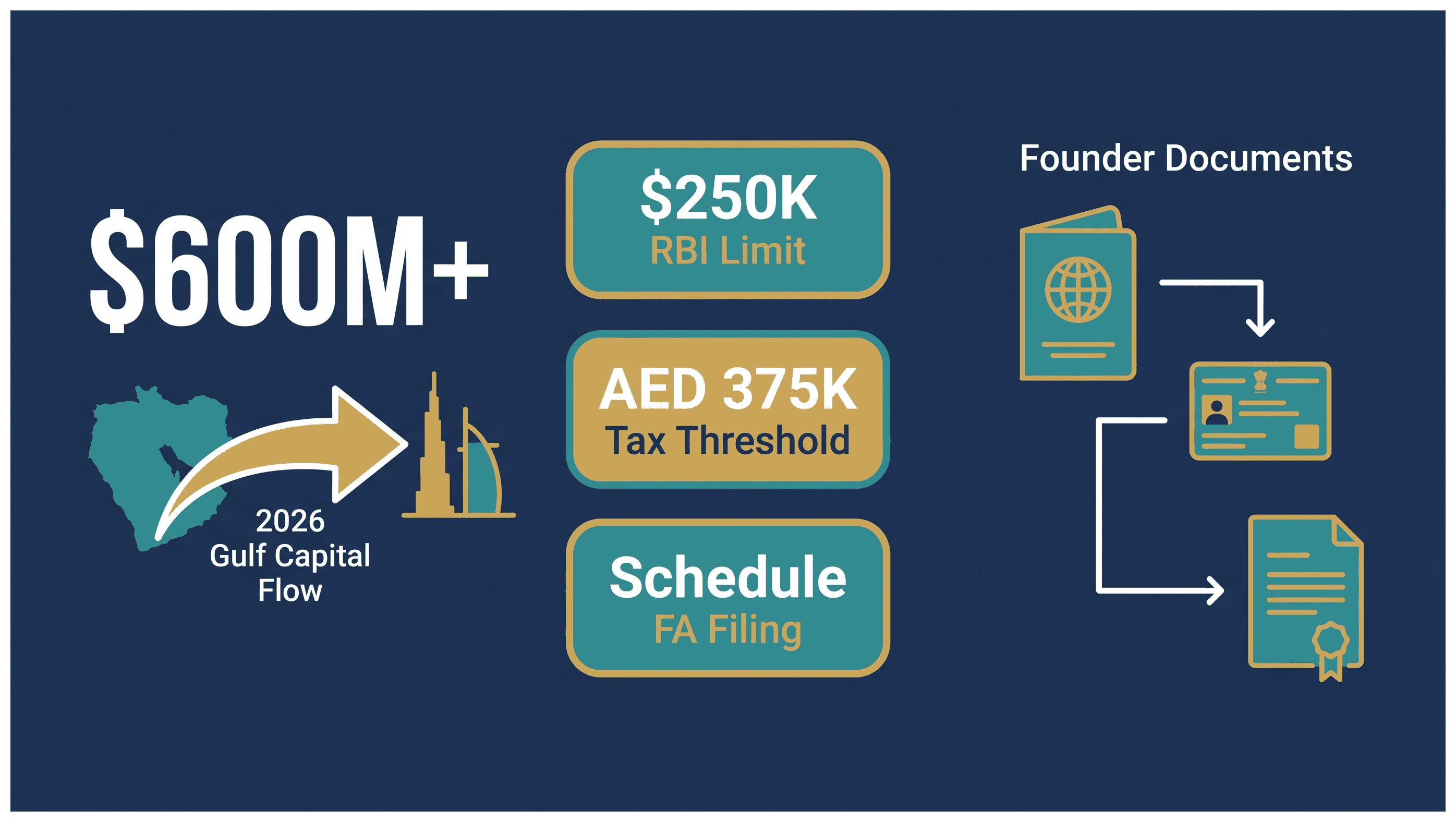
A dubai company for indian founders typically starts with a free zone license, an Emirates ID-linked visa, and a corporate bank account. Founders retain full ownership, and the entity becomes the vehicle Gulf investors wire funds into once documentation clears.
Choosing the Right License Category
Trading, professional, and technology licenses each map to different investor expectations. An ICT-focused founder typically picks a technology company license to match a fintech investor's due diligence checklist. Pick the wrong category, and you'll be re-filing paperwork mid-raise.
Key Facts: Indian Founders Raising Through a Dubai Entity
Feature | Requirement | Governing Body/Rule |
|---|---|---|
Outbound remittance limit | USD 250,000 per financial year per individual | RBI Liberalised Remittance Scheme |
Foreign asset disclosure | Schedule FA filing with annual tax return | Income Tax Department |
Corporate tax registration | Register once profit crosses AED 375,000 | FTA under Federal Decree-Law No. 47 of 2022 |
Visa file processing | Open company immigration establishment card | ICP |
Entry permit issuance | Status change from visit visa to residence | GDRFA |
Biometric ID | In-person biometrics appointment | Emirates ID |
Documents Indian Founders Need
Passport and existing visa copies
Indian PAN card and any incorporation certificate
Proof of residential address
Bank reference letter from your Indian bank
Home Rules Indian Founders Cannot Ignore
Indian founders moving capital to a Dubai entity must route funds through RBI's Liberalised Remittance Scheme (LRS), report the foreign holding to the Income Tax Department, and can use the India-UAE Comprehensive Economic Partnership Agreement (CEPA) to reduce friction on services trade and double taxation exposure.
RBI LRS Limits and Reporting
The RBI LRS annual cap sits at USD 250,000 per individual per financial year, covering equity investment abroad under the correct purpose code. Your authorised dealer bank will ask for Form A2 and a declaration on end-use. Miss this paperwork, and your remittance simply won't clear.
Income Tax Department Disclosure Requirements
A founder discloses UAE shareholding in their Indian income tax return under Schedule FA to stay compliant. This applies regardless of your residency status once you hold shares in a foreign company. Dividends received may trigger double taxation exposure unless relief is claimed properly.
How the India-UAE CEPA Helps
The India-UAE CEPA, in force since 2022, cuts tariff friction and eases cross-border professional mobility for consulting and tech exports. For a founder billing Gulf clients from a Dubai entity, that translates into fewer withholding disputes and smoother invoicing.
Is business setup in Dubai from India worth the compliance overhead?
Yes, for founders raising Gulf capital. The compliance load is manageable with an authorised dealer bank and a good CA. It's far lighter than most founders assume.
Steps to Move Capital Compliantly From India to Dubai
Moving capital compliantly involves four practical steps: register the Dubai entity, open a UAE bank account, remit funds via RBI LRS through an authorised dealer, and disclose the holding to India's tax authority while reconciling the investor's inbound wire against your share register.
Step 1: Register the Dubai Free Zone Entity
Pick a license activity matching your business model
Submit founder KYC documents for verification
Receive your trade license and establishment card
Step 2: Open a Corporate Bank Account
Bank runs due diligence on your shareholding structure
Emirates ID gets linked for signatories
Multi-currency accounts get set up for AED and USD
Step 3: Remit Funds Under RBI LRS
Complete authorised dealer bank paperwork
Declare the correct purpose code
Time remittance against investor payment terms
Step 4: Disclose and Reconcile
File Schedule FA with your Indian tax return
Reconcile your share register with the inbound wire
Keep an audit trail for both jurisdictions
How Dubai South Business Hub Sets Up Your Holding Structure
Dubai South Business Hub Free Zone handles license issuance, ICP-linked visa processing, GDRFA entry permits, and Emirates ID applications for founders, giving Indian entrepreneurs a single point of contact for the entire holding-company setup before investor funds land.
Visa and Residency Processing
The ICP opens your company's immigration file first. From there, ICP [2] coordinates with GDRFA for entry permit issuance, and your Emirates ID appointment gets scheduled for biometrics. You can check available trade name options before you even finalize the activity list.
Ongoing Support After Incorporation
Renewal reminders keep your license active, banking partners stay coordinated on documentation updates, and PRO services handle government filings so you're not chasing paperwork mid-raise. Use the cost calculator to estimate your total setup and renewal budget upfront.
Compliance Rules Every Indian Founder Must Know
Federal Decree-Law No. 47 of 2022 governs UAE corporate tax and applies to Dubai holding entities once profit thresholds are crossed, while the Federal Tax Authority (FTA) sets filing deadlines and registration rules that founders must follow alongside Indian disclosure obligations.
Corporate Tax Registration With the FTA
Registration deadlines under Federal Decree-Law No. 47 of 2022 depend on your license issue date. Profits above AED 375,000 face a 9% rate, per the Federal Tax Authority [3]. Keep clean books; record-keeping obligations apply even below the threshold.
Avoiding Dual Compliance Gaps
A founder misses an FTA deadline while focused on an Indian tax filing, triggering a late-registration penalty. Cross-check your UAE and Indian fiscal years early, and get auditors in both countries talking to each other, not just to you.
Indian startups raising from Gulf investors through Dubai succeed when founders treat the Dubai entity as a compliant bridge, not a workaround, respecting RBI LRS limits, Income Tax Department disclosures, and FTA corporate tax rules from day one. Get this right, and Gulf capital moves faster than most India-only rounds ever do. If you're still weighing whether this fits your business model, our guide on moving to Dubai from India covers the broader relocation picture. Follow the compliance sequence above, keep your paperwork tight on both sides, and talk to Dubai South Business Hub's Banking and Taxation Support team to set up or buy a license before your next investor call.
References
Frequently Asked Questions