Indian Traders Opening a Dubai Warehouse Operation: Setup Cost, Route and Timeline

Topic Summary
What Is Indian Traders Opening a Dubai Warehouse Operation and Why It Matters
Indian traders opening a Dubai warehouse operation typically register a trade or re-export license with a UAE free zone, lease warehouse space near Al Maktoum or Jebel Ali, and route goods through Dubai's customs and logistics network to reach Africa, GCC and European buyers efficiently.
Why Indian Traders Are Choosing Dubai for Warehousing
Why Indian Traders Are Choosing Dubai for Warehousing
Licensing, Tax Registration and Customs Codes You Will Need
Indian founders need a trade license with the correct commercial activity code, VAT registration with the FTA (Federal Tax Authority) if turnover crosses the threshold, and a customs code from Dubai Trade to move goods through Jebel Ali or Al Maktoum. Federal Decree-Law No. 47 of 2022 governs corporate tax obligations.
Steps to Launch Your Warehouse Operation in Order
Setting up a Dubai warehouse operation follows six ordered steps: choose a trade activity, register your company, secure warehouse space, apply for customs codes, arrange visas and Emirates ID, then open a bank account and start operations. Each step typically takes days, not months.
Visas, Emirates ID and Residency for Your Warehouse Team
Warehouse staff need residency visas processed through ICP and GDRFA, followed by Emirates ID issuance. Indian founders relocating typically bundle their own investor visa with the company license, then add employee visas as warehouse operations scale up.
Money Rules Back Home: RBI LRS and Indian Tax Compliance
Indian founders funding a Dubai warehouse operation must stay within RBI's (Reserve Bank of India) Liberalised Remittance Scheme limits and report foreign assets to the Income Tax Department under Indian disclosure rules. Working with a chartered accountant familiar with cross-border filings avoids compliance gaps on both sides.
Setup Cost and Timeline You Should Budget For
A Dubai warehouse operation for Indian traders typically involves license fees, warehouse rent, customs registration and visa costs, spread across four to six weeks from application to operational readiness. Costs vary by warehouse size and number of visas requested.
In 2024, Dubai issued over 55,000 new commercial licenses, and a growing share belong to Indian traders opening a Dubai warehouse operation for re-export trade (Dubai Chamber of Commerce, 2024) [1]. That's not a coincidence. India-UAE trade crossed a milestone under the CEPA agreement, and Dubai's port and airport network makes it the natural midpoint between Indian suppliers and buyers in Africa, the GCC and Europe. This guide walks you through the license, the activity codes, customs setup, warehousing near Al Maktoum and Jebel Ali, and the realistic cost and timeline for launching your operation through a Dubai South Business Hub (DSBH) company.
What Is Indian Traders Opening a Dubai Warehouse Operation and Why It Matters
Indian traders opening a Dubai warehouse operation typically register a trade or re-export license with a UAE free zone, lease warehouse space near Al Maktoum or Jebel Ali, and route goods through Dubai's customs and logistics network to reach Africa, GCC and European buyers efficiently.
Trade and Re-Export as a Business Model
Here's the model in plain terms: you buy from India, store the goods in Dubai, then re-ship globally. No manufacturing required, just smart storage and logistics. It works especially well for textiles, electronics and packaged foodstuffs.
Take an Ahmedabad textile exporter. She stores bulk cotton fabric in a warehouse near Jebel Ali, then re-ships pallets to buyers across East and West Africa within days rather than weeks. That's the whole point of Indian traders opening a Dubai warehouse operation: cut transit time without setting up a factory.
Why Location Near Al Maktoum and Jebel Ali Matters
Proximity to Al Maktoum International Airport speeds up air freight for high-value electronics.
Jebel Ali Port access handles bulk sea cargo at scale.
Shorter last-mile transit cuts your logistics cost per shipment.
Combined air-sea access lets you split shipments by urgency.
Why Indian Traders Are Choosing Dubai for Warehousing
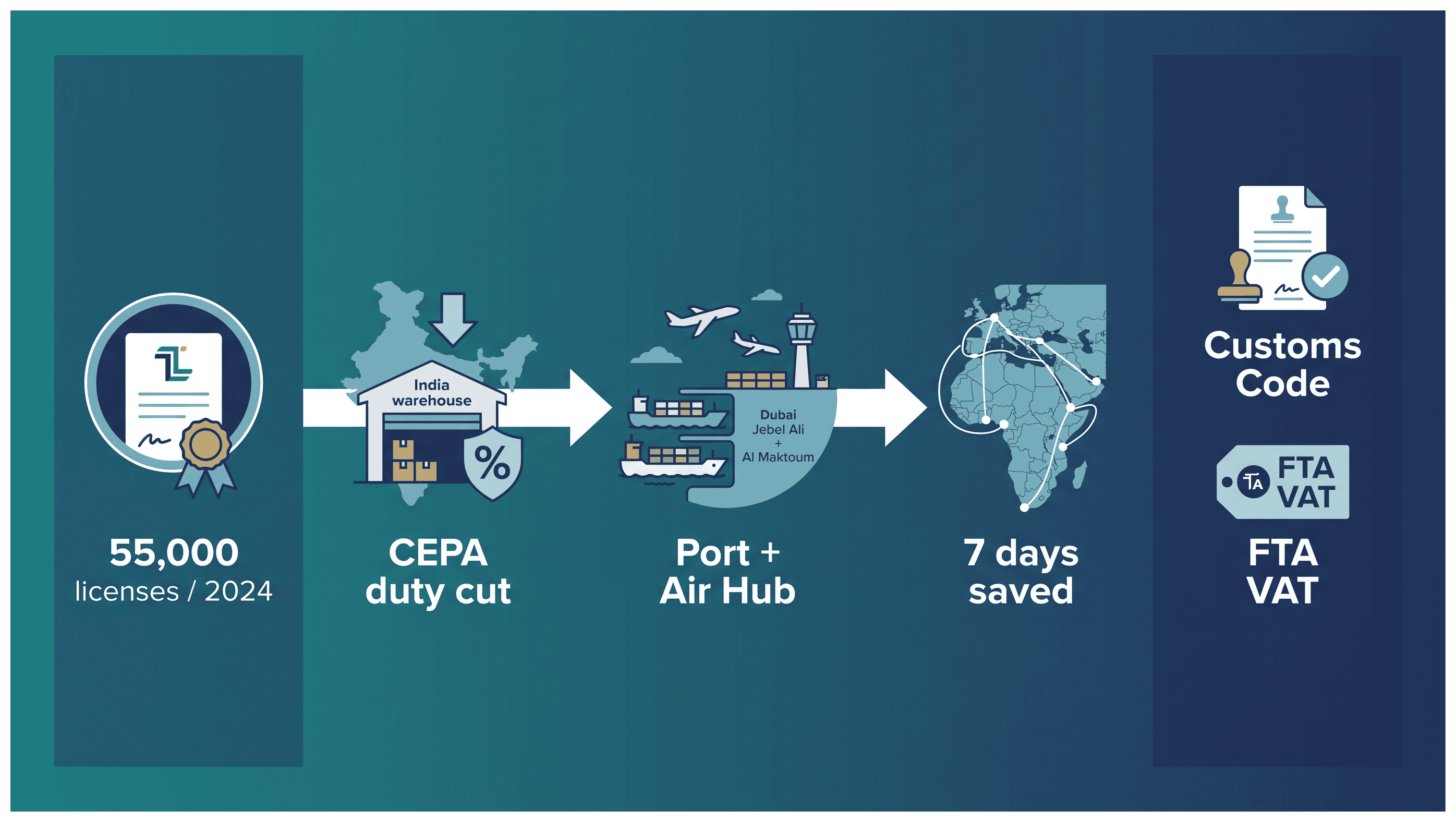
Dubai offers Indian traders duty advantages under the India-UAE CEPA, streamlined re-export customs codes, and warehouse space near major ports and airports. This combination shortens transit time to Africa, Europe and the GCC compared to shipping directly out of Indian ports.
Tariff Advantages Under the India-UAE CEPA
The Comprehensive Economic Partnership Agreement between India and the UAE reduces duties on many traded categories and speeds up documentation for CEPA-eligible goods. That's a real incentive for Indian exporters to route shipments through Dubai rather than direct to buyer markets.
Access to Re-Export Markets
Dubai functions as a hub reaching Africa and CIS states quickly.
Established freight corridors mean predictable transit windows.
UAE banking convenience simplifies currency handling for regional trade.
A Mumbai electronics trader, for instance, re-exports consumer goods to East Africa via a Dubai warehouse, saving roughly a week of transit versus shipping direct from Nhava Sheva port.
Key Facts for Indian Traders Opening a Dubai Warehouse Operation
Feature | Requirement | Details |
|---|---|---|
Trade license activity code matched to goods type | General trading or specific commodity code | Chosen from the business activities list before filing |
VAT/corporate tax registration with the FTA | Mandatory once turnover threshold met | Governed by Federal Decree-Law No. 47 of 2022 |
Customs code via Dubai Trade portal | Linked to warehouse location | Needed for every cross-border shipment |
Warehouse lease near Al Maktoum or Jebel Ali | Sized to inventory turnover | Rent scales with square footage and location |
ICP and GDRFA visa processing for staff | Entry permit then status change | Followed by Emirates ID issuance |
RBI LRS compliance for outward remittance | Annual ceiling per individual | Bank documentation required for transfers |
Licensing, Tax Registration and Customs Codes You Will Need
Indian founders need a trade license with the correct commercial activity code, VAT registration with the FTA (Federal Tax Authority) if turnover crosses the threshold, and a customs code from Dubai Trade to move goods through Jebel Ali or Al Maktoum. Federal Decree-Law No. 47 of 2022 governs corporate tax obligations.
Choosing the Right Trade Activity Code
General trading covers a broad mix of goods, while specific commodity codes suit traders focused on one category, textiles or electronics, for example. Match your activity to your warehouse and customs needs before applying, since changing it later means extra paperwork. Review business activities options before you file.
VAT and Corporate Tax Registration With the FTA
The FTA handles both VAT and corporate tax filings. Federal Decree-Law No. 47 of 2022 sets the corporate tax framework, applying a 9% rate above a set profit threshold. Plan your registration timeline early, since delays here hold up your bank account opening.
Setting Up a Customs Code for Import-Export
Register your customs code through the Dubai Trade portal [2].
Link the code directly to your warehouse address.
Prepare invoices, packing lists and certificates of origin.
Submit CEPA documentation for reduced-duty categories.
Is a Dubai free zone worth it for Indian re-export traders?
Yes, for most Indian traders it's worth it. CEPA duty savings, port proximity and a fast license process cut both cost and delivery time compared to shipping straight from India.
Steps to Launch Your Warehouse Operation in Order
Setting up a Dubai warehouse operation follows six ordered steps: choose a trade activity, register your company, secure warehouse space, apply for customs codes, arrange visas and Emirates ID, then open a bank account and start operations. Each step typically takes days, not months.
Step 1: Select Your Trade Activity and Company Structure
Pick re-export or general trading as your primary activity.
Decide on shareholding structure with your co-founders.
Confirm activity matches your target warehouse size.
Step 2: Register the Company and Reserve the License
Submit documents for your trade license through DSBH.
Use a company name check before filing.
Confirm shareholder passports and Emirates ID copies where needed.
Step 3: Lease Warehouse Space Near Al Maktoum or Jebel Ali
Compare warehouse size against projected inventory turnover.
Factor in proximity to your primary shipping mode, air or sea.
Check ceiling height and loading bay access for pallets.
Step 4: Apply for Customs Codes and Visas
Register your customs code via Dubai Trade.
Apply for ICP (Federal Authority for Identity, Citizenship, Customs and Port Security) and GDRFA (General Directorate of Residency and Foreigners Affairs) approvals for staff.
Bundle your own investor visa with the company license filing.
Visas, Emirates ID and Residency for Your Warehouse Team
Warehouse staff need residency visas processed through ICP and GDRFA, followed by Emirates ID issuance. Indian founders relocating typically bundle their own investor visa with the company license, then add employee visas as warehouse operations scale up.
Investor Visa Linked to Your License
Your founder visa ties directly to company formation and renews on the same cycle as your license. That means one renewal date to track, not two separate systems running on different clocks. Read more on residency services before you apply.
Emirates ID and Entry Permit Process
ICP approves entry permits before arrival in the UAE.
GDRFA manages status change and passport stamping on landing.
Emirates ID is required for banking and residency renewal.
Money Rules Back Home: RBI LRS and Indian Tax Compliance
Indian founders funding a Dubai warehouse operation must stay within RBI's (Reserve Bank of India) Liberalised Remittance Scheme limits and report foreign assets to the Income Tax Department under Indian disclosure rules. Working with a chartered accountant familiar with cross-border filings avoids compliance gaps on both sides.
Staying Within RBI LRS Remittance Limits
The RBI LRS caps annual outward remittance per individual, and banks require Form A2 plus purpose declarations for every transfer. Founders sending equity capital to their DSBH company should check current LRS ceilings with their bank before wiring funds.
Reporting Foreign Holdings to the Income Tax Department
Schedule FA in your Indian income tax return discloses foreign company shares and bank accounts. Coordinate the Indian financial year (April to March) with the UAE fiscal year your company reports on, since mismatched dates cause reporting headaches later.
Setup Cost and Timeline You Should Budget For
A Dubai warehouse operation for Indian traders typically involves license fees, warehouse rent, customs registration and visa costs, spread across four to six weeks from application to operational readiness. Costs vary by warehouse size and number of visas requested.
Breaking Down the Cost Components
License and registration fees form your base setup cost.
Warehouse lease scales with square footage near Al Maktoum or Jebel Ali.
Visa and Emirates ID processing add per-employee charges.
Customs registration is a one-time cost per company.
Run the exact numbers on the cost calculator before committing to a warehouse size.
Realistic Timeline From Application to Launch
Week 1-2: license and trade name approval.
Week 3-4: warehouse lease signed and customs code active.
Week 5-6: visas processed, Emirates ID issued, bank account open.
Indian traders opening a Dubai warehouse operation gain access to CEPA tariff benefits, ports near Al Maktoum and Jebel Ali, and a straightforward license and customs route when the steps are followed in order. If you're relocating from India, start with the Moving to Dubai from India guide for the full residency picture. Review available business activities or run the numbers on the cost calculator to plan your license and warehouse budget.
References
Frequently Asked Questions