Moving a French Company's Operations to Dubai: Company Options, Cost and Timing

Topic Summary
What Is Moving a French Company's Operations to Dubai and Why It Matters
Moving a french company's operations to dubai means either relocating the whole entity, opening a branch, or launching a new free zone company that runs alongside your French business. Founders choose this route for lower corporate tax exposure, faster market access to the Gulf, and a straightforward residency path tied to the license.
Company Options for Dubai Company for French Founders
Company Options for Dubai Company for French Founders
Understanding Tax Rules Before Moving a French Company's Operations to Dubai
Federal Decree-Law No. 47 of 2022 introduced a 9% federal corporate tax on UAE mainland profits above the small business threshold, administered by the Federal Tax Authority (FTA). Many qualifying free zone companies keep preferential treatment on qualifying income, but nothing in the UAE system is described as fully tax free.
Steps to Set Up Your Dubai Company Structure
Setting up typically follows six steps: check the trade name, choose your license activity, submit incorporation documents, register with the ICP for immigration approval, complete GDRFA medical and visa formalities, then apply for the Emirates ID. Most founders complete the full sequence within two to four weeks.
What Happens to Your French Company Back Home
If you're deemed a French tax resident transferring assets abroad, the DGFiP (Direction Générale des Finances Publiques) can apply the French exit tax on unrealized gains above certain thresholds. Founders keeping a dormant French entity should still file annual accounts and confirm residency status before relocating operations to Dubai.
Cost and Timing When Moving a French Company's Operations to Dubai
Free zone license packages, visa fees, and office costs vary by activity and headcount, so founders should run exact figures through a cost calculator before booking flights. Most straightforward setups, from name check to Emirates ID, complete within two to four weeks.
In 2026, over 40 free zones operate across the UAE, giving French founders more structuring choices than almost any other jurisdiction they could relocate to [1]. The 9% federal corporate tax under Federal Decree-Law No. 47 of 2022 now applies to mainland profits above the small business threshold [2]. Emirates ID processing typically finishes within days of a completed medical and biometrics appointment. GDRFA handles entry permits alongside ICP's establishment card approvals. Dubai Chamber of Commerce reported over 55,000 new member companies registered in the emirate during 2023 [3]. This guide explains what moving a french company's operations to dubai actually involves: the structuring options, licensing steps, realistic costs, timing, and what stays behind in France.
What Is Moving a French Company's Operations to Dubai and Why It Matters
Moving a french company's operations to dubai means either relocating the whole entity, opening a branch, or launching a new free zone company that runs alongside your French business. Founders choose this route for lower corporate tax exposure, faster market access to the Gulf, and a straightforward residency path tied to the license.
Full Relocation vs Parallel Structure
Some founders close their French entity entirely once the Dubai company is licensed. Others keep it dormant, filing minimal accounts while new revenue routes through the Gulf structure. A Lyon-based SaaS founder kept her French SARL for existing clients while opening a Dubai South Business Hub Free Zone company to invoice new Gulf contracts. Most founders start with a parallel structure precisely because it limits risk while they test demand.
Who This Route Suits
Founders billing GCC or international clients directly
Consultants running remote-first teams across time zones
Investors wanting a UAE holding vehicle for regional assets
Agencies serving Gulf retail and hospitality sectors
Free Zone Company vs Branch Office: Key Facts for French Founders
Feature | Free Zone Company | Branch of French Entity |
|---|---|---|
Ownership structure | 100% foreign owned, independent entity | Fully owned by the French parent |
Setup speed | Single-authority process, often 2-4 weeks | Slower, needs parent company legalization |
Link to French parent | None, standalone legal person | Directly tied, shares liabilities |
Corporate tax treatment | May qualify for preferential rate on qualifying income | Taxed under standard 9% rules like mainland entities |
Visa eligibility | Visa quota tied directly to license package | Depends on branch license and sponsor rules |
Typical use case | New GCC-facing operations, consultants, tech founders | Founders not ready to separate from the French entity |
Company Options for Dubai Company for French Founders
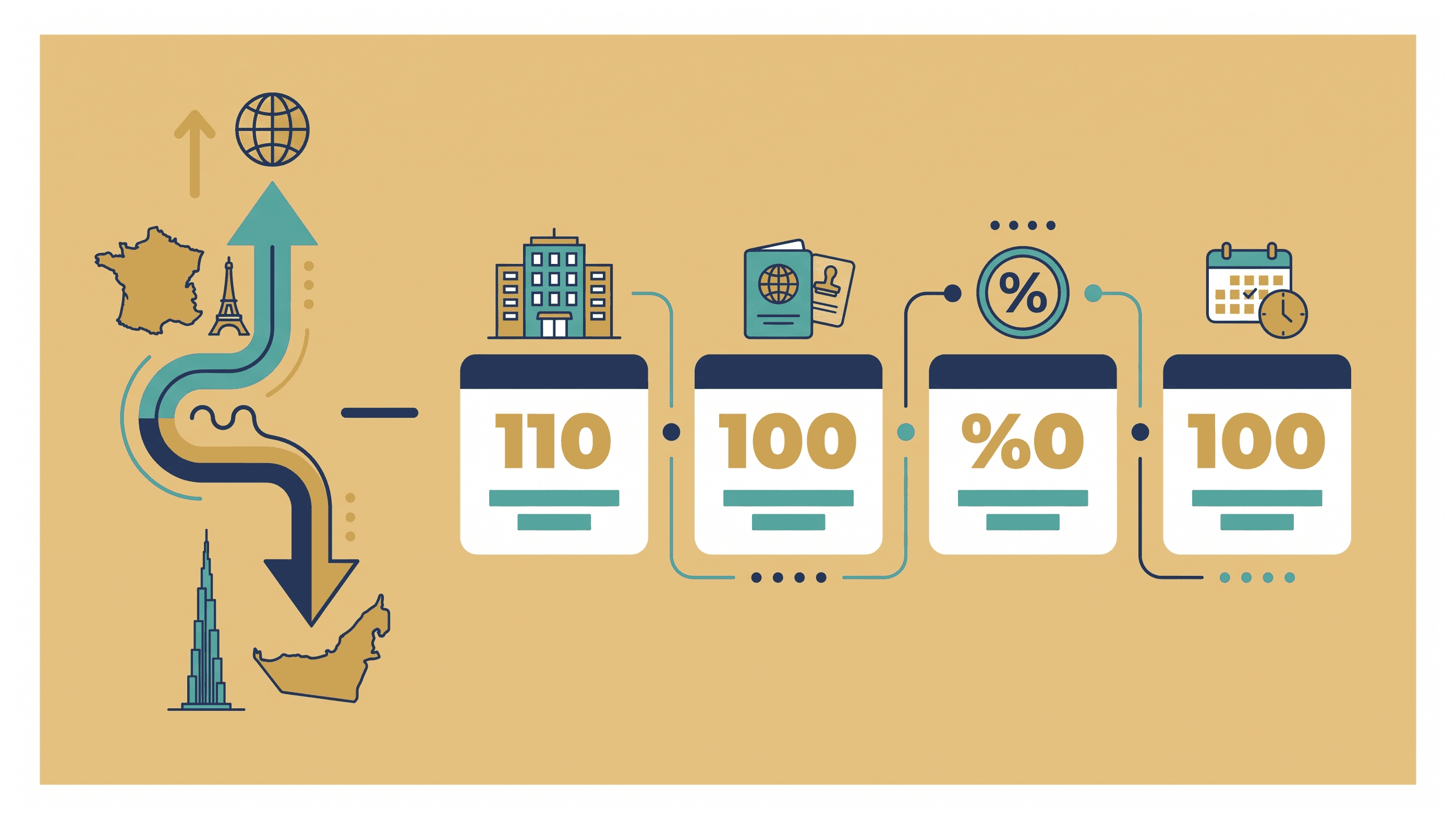
French founders relocating typically choose between a free zone company with 100% foreign ownership, a mainland LLC for direct UAE market access, or a branch of the existing French entity. Free zones are the fastest and most common route because setup and licensing are handled through a single authority.
Free Zone Company Formation
Full foreign ownership, no local shareholder required
One authority manages license, visa quota and lease
Fits trading, consulting, tech and services activities well
Branch of a French Entity
A branch keeps the legal link to your parent company in Paris or wherever it's registered. This suits founders not ready to fully separate structures yet. Documentation differs from a fresh company: you'll need notarized parent company documents, a board resolution, and often an Arabic translation before submission.
Choosing an Activity and Trade Name
Match your French business activity to a UAE license category
Run a trade name availability search before applying
Review business activities lists for trading, professional, ICT or real estate categories
Understanding Tax Rules Before Moving a French Company's Operations to Dubai
Federal Decree-Law No. 47 of 2022 introduced a 9% federal corporate tax on UAE mainland profits above the small business threshold, administered by the Federal Tax Authority (FTA). Many qualifying free zone companies keep preferential treatment on qualifying income, but nothing in the UAE system is described as fully tax free.
Corporate Tax Basics Under Federal Decree-Law No. 47 of 2022
The standard rate sits at 9% above the small business relief threshold. The FTA administers registration, filing, and enforcement (FTA, 2024). Free zone entities must still register with the FTA even if they expect to qualify for preferential treatment.
How Qualifying Free Zone Status Works
Meet substance and income conditions to keep preferential treatment
Stay under de minimis limits on non-qualifying revenue
Matters most if you bill both UAE mainland and international clients
Is business setup in Dubai from France worth the tax planning effort?
Yes, if your revenue is GCC or export-facing. The 9% rate still beats many EU corporate rates, and free zone qualifying income can reduce exposure further.
Steps to Set Up Your Dubai Company Structure
Setting up typically follows six steps: check the trade name, choose your license activity, submit incorporation documents, register with the ICP for immigration approval, complete GDRFA medical and visa formalities, then apply for the Emirates ID. Most founders complete the full sequence within two to four weeks.
Step 1: Reserve Your Trade Name and Activity
Run a name availability check before drafting anything
Match your activity to the correct license category
Gather passport copies and company documents from France
Step 2: Submit Incorporation Paperwork
The free zone authority reviews your file and issues initial approval, usually within a few working days. You'll need a lease or flexi-desk agreement before the license is issued. Once approved, license issuance follows within days rather than weeks.
Step 3: Handle ICP, GDRFA and Emirates ID Formalities
ICP (Federal Authority for Identity, Citizenship, Customs and Port Security) processes the establishment card and visa quota
GDRFA (General Directorate of Residency and Foreigners Affairs) handles the entry permit and status change (GDRFA, 2025)
Emirates ID issued after medical tests and biometrics
A French founder relocating with two staff typically finishes all four visa-linked steps within 10 business days of license issuance.
What Happens to Your French Company Back Home
If you're deemed a French tax resident transferring assets abroad, the DGFiP (Direction Générale des Finances Publiques) can apply the French exit tax on unrealized gains above certain thresholds. Founders keeping a dormant French entity should still file annual accounts and confirm residency status before relocating operations to Dubai.
French Exit Tax Considerations
This mostly applies to significant shareholdings when you relocate personal tax residency, not just the company. The DGFiP assesses your residency status and how assets were transferred. Planning ahead with a French accountant avoids surprise liabilities later.
Keeping the French Entity Compliant
File dormant accounts if the SAS or SARL stays open
Coordinate closely with a French accountant during the transition period
Decide early whether to liquidate fully or keep both entities running
Cost and Timing When Moving a French Company's Operations to Dubai
Free zone license packages, visa fees, and office costs vary by activity and headcount, so founders should run exact figures through a cost calculator before booking flights. Most straightforward setups, from name check to Emirates ID, complete within two to four weeks.
What Drives Your License Cost
Activity type and how many visas you need
Whether you need a physical office or a flexi-desk
Renewal fees you'll need to budget for in year two
Realistic Setup Timeline
Week one covers your name check and activity selection. Weeks two and three handle license issuance and the immigration file with ICP. By week four you'll usually have your Emirates ID and be ready to open a bank account through banking and taxation services. Startup and scale-up activity across the region has kept climbing, with regional investment data reported by Magnitt showing continued founder interest in Gulf relocation (Magnitt, 2024).
Moving a french company's operations to dubai comes down to picking the right structure, understanding federal corporate tax under Federal Decree-Law No. 47 of 2022, handling ICP, GDRFA and Emirates ID steps in order, and settling DGFiP obligations back home. None of this is complicated once you know the sequence, but it does require attention to detail on both sides of the relationship, in France and in Dubai. Read the fuller picture in our guide to moving to Dubai from France, then talk to Business Support to map your structure, and run your numbers through the Cost Calculator before you commit.
References
Frequently Asked Questions