Moving a German Company's Operations to Dubai: Which License, What Cost, How Long

Topic Summary
What Is Moving a German Company's Operations to Dubai and Why It Matters
Moving a German company's operations to Dubai means either fully relocating your business or running a Dubai entity alongside your German one. Founders choose this route for lower corporate tax rates, faster market access to the Gulf, and a free zone structure that keeps ownership and profit repatriation flexible.
Which License Fits a German Company Moving Operations to Dubai
Which License Fits a German Company Moving Operations to Dubai
Understanding Costs, Taxes and Compliance for German Founders
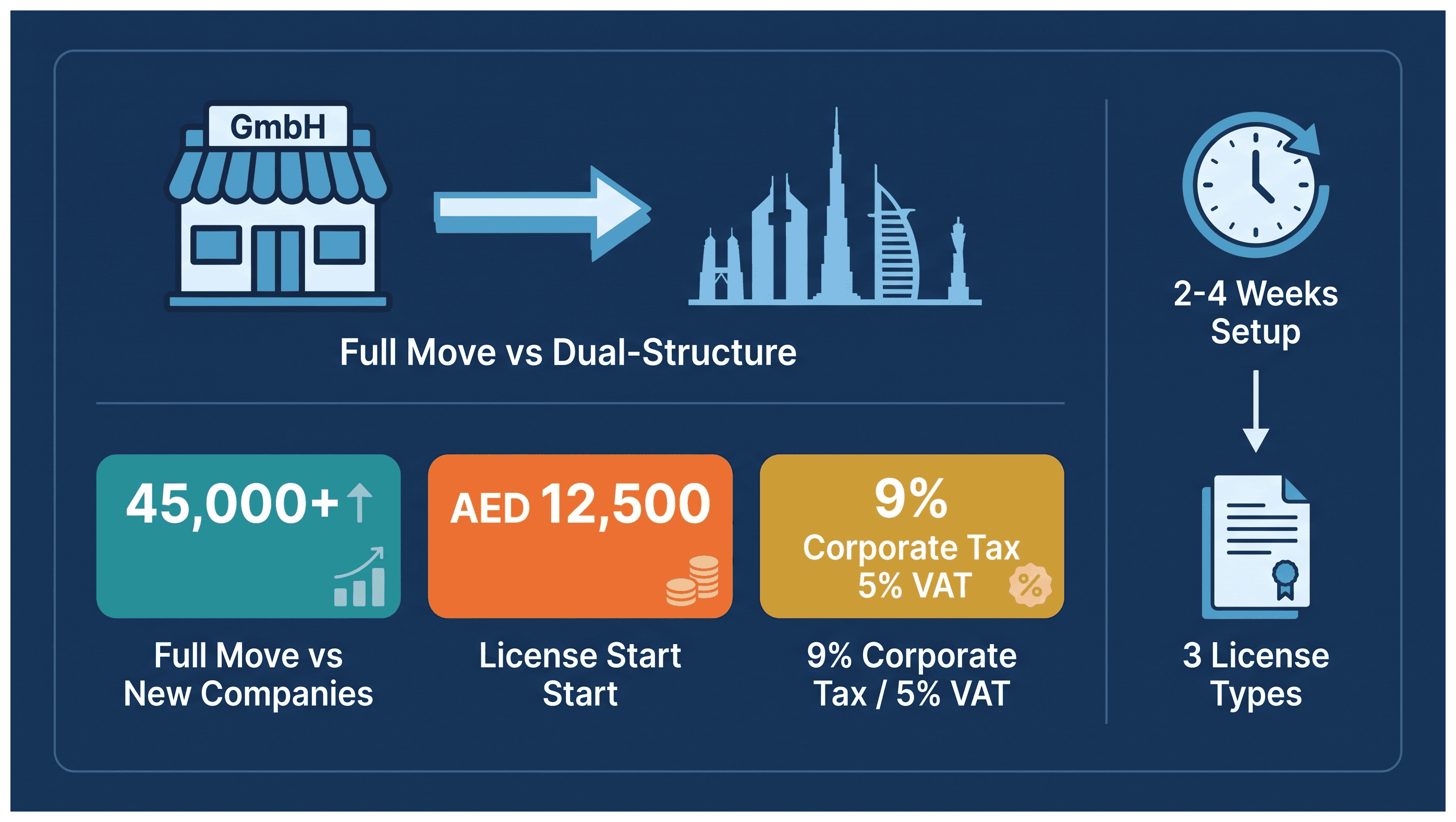
Free zone license packages typically start around AED 12,500 to 15,000 [2], plus visa and office costs. Federal Decree-Law No. 47 of 2022 sets a 9% corporate tax above AED 375,000 profit, and the FTA (Federal Tax Authority) administers VAT at 5% once turnover crosses that same threshold [3].
Steps to Relocate or Run Your Business Alongside the German Entity
Relocating involves five core steps: reserve a trade name, choose your license activity, submit documents to the free zone authority, apply for residency through GDRFA (General Directorate of Residency and Foreigners Affairs), and collect your Emirates ID. Most German founders complete the process in two to four weeks.
German Tax Obligations Before You Relocate
Before relocating, notify the Finanzamt (German tax office) of your change in residency and check whether German exit tax applies to shareholdings above certain thresholds. Founders keeping a dual-structure must still file annual GmbH returns even while operating a Dubai entity in parallel.
Key Facts German Founders Should Compare Before Choosing a Structure
German founders comparing structures should weigh license cost, setup time, tax exposure, and visa allowance side by side. A free zone company offers full foreign ownership, fast setup, and clear activity-based licensing, making it the practical starting point for most relocating German businesses.
In 2026, over 45,000 new companies registered across the UAE, and German founders make up a growing slice of that figure as EU tax pressure builds [1]. Free zone license packages start near AED 12,500 [2]. Corporate tax sits at 9% above AED 375,000 profit [3]. VAT kicks in at 5% [3]. Setup often takes two to four weeks [4]. Moving a German company's operations to Dubai isn't a single-path decision, and this guide breaks down the license options, real costs, and the German-side paperwork you can't skip.
What Is Moving a German Company's Operations to Dubai and Why It Matters
Moving a German company's operations to Dubai means either fully relocating your business or running a Dubai entity alongside your German one. Founders choose this route for lower corporate tax rates, faster market access to the Gulf, and a free zone structure that keeps ownership and profit repatriation flexible.
Full Relocation vs Dual-Structure Operations
Full relocation shuts down German operations entirely: you deregister the GmbH (a German limited liability company), transfer contracts, and move your tax residency. Dual-structure keeps a German GmbH active alongside a Dubai free zone company, which is common among founders who still invoice EU clients.
A Munich SaaS founder kept the GmbH open purely for EU invoicing while routing delivery and hiring through a Dubai South free zone company. That split let the business keep German VAT compliance clean while gaining Gulf market access through starting a company locally.
Why German Founders Choose Dubai Now
German trade tax plus corporate tax can exceed 30% combined in many municipalities.
Dubai sits within a four-hour flight of most Gulf markets, useful for logistics and trade firms.
Free zone registration usually needs no local Emirati partner for the license types covered here.
Which License Fits a German Company Moving Operations to Dubai
Trading, professional, and ICT (information and communication technology) licenses cover most German companies relocating to Dubai. A trading license suits import-export and product businesses, a professional license fits consultants and service providers, and an ICT license suits software and tech firms in a Dubai free zone German setup.
Trading Licenses for Product-Based Companies
A trading license covers import, export, and distribution activities, including goods classed under wholesale trade groups. German machinery and equipment exporters often pick this route because it lets them stock, re-export, and invoice regional buyers from one Dubai base.
Professional and ICT Licenses for Service Firms
Consultancy, engineering, and advisory work fall under a professional license.
Software and digital firms fit an ICT license category instead.
Your chosen activity affects visa quota and office size requirements.
A Stuttgart engineering consultancy picked a professional license so it could bill Gulf infrastructure clients directly, without routing invoices back through Germany. Full details on activity codes sit on our business activities page.
Understanding Costs, Taxes and Compliance for German Founders
Free zone license packages typically start around AED 12,500 to 15,000 [2], plus visa and office costs. Federal Decree-Law No. 47 of 2022 sets a 9% corporate tax above AED 375,000 profit, and the FTA (Federal Tax Authority) administers VAT at 5% once turnover crosses that same threshold [3].
License, Visa and Office Cost Breakdown
Entry-tier license packages usually bundle one or two visas; each added visa costs extra on top of the base fee. A flexi-desk arrangement is cheaper than a dedicated office and suits most consultancies and trading firms in their first year. Run exact figures through the cost calculator before committing to a package.
Corporate Tax and VAT Under Federal Decree-Law No. 47 of 2022
Federal Decree-Law No. 47 of 2022 governs corporate tax nationwide, setting the 9% rate above AED 375,000 in annual profit. Below that threshold, profit isn't taxed federally. VAT registration becomes mandatory once taxable turnover passes AED 375,000, administered by the FTA [3].
How much does it cost to set up a company in Dubai from Germany?
Entry-tier free zone packages start near AED 12,500. Add visa costs and office fees. Most German founders budget AED 20,000 to 30,000 for the first year, all in.
Steps to Relocate or Run Your Business Alongside the German Entity
Relocating involves five core steps: reserve a trade name, choose your license activity, submit documents to the free zone authority, apply for residency through GDRFA (General Directorate of Residency and Foreigners Affairs), and collect your Emirates ID. Most German founders complete the process in two to four weeks.
Step 1: Reserve Your Trade Name and Pick a License
Run a check on our name check tool first.
Select trading, professional, or ICT activity.
Confirm your activity matches your actual business plan.
Step 2: Submit Documents and Register the Company
The free zone authority reviews passport copies and shareholder documents.
ICP (Federal Authority for Identity, Citizenship, Customs and Port Security) processes entry permits.
Notarised German documents may need translation and attestation.
Step 3: Apply for Residency and Emirates ID
GDRFA handles residency visa stamping.
Emirates ID follows medical and biometric checks.
Most founders finish within two to four weeks.
Need help with document attestation or PRO work? Our business support team handles the paperwork end to end.
Comparison of Relocation vs Dual-Structure Setup for German Founders
Feature | Full Relocation | Dual-Structure Operation |
|---|---|---|
German GmbH status | Closed, no ongoing German filings | Retained, keeps EU client relationships intact |
Setup time | 2-4 weeks for Dubai side, plus GmbH wind-down | 2-4 weeks, no wind-down delay |
License cost | AED 12,500-15,000 entry tier, one-off transition cost | AED 12,500-15,000 entry tier, plus ongoing GmbH accounting fees |
Corporate tax exposure | 9% above AED 375,000 profit, only in UAE | 9% in UAE plus German corporate tax on GmbH profit |
German tax filing | None after deregistration | Annual GmbH returns required indefinitely |
German Tax Obligations Before You Relocate
Before relocating, notify the Finanzamt (German tax office) of your change in residency and check whether German exit tax applies to shareholdings above certain thresholds. Founders keeping a dual-structure must still file annual GmbH returns even while operating a Dubai entity in parallel.
Notifying the Finanzamt of Your Move
Individuals leaving Germany must inform the Finanzamt of their deregistration date. Founders running a dual-structure keep filing GmbH returns yearly, even from Dubai. Miss this step and you risk penalties on unreported German-source income.
When German Exit Tax Applies
Exit tax generally triggers on significant private shareholdings.
Get tax advice before any share transfer.
Timing your move can reduce exposure.
A Frankfurt investor restructured shareholding a full year before relocating, specifically to manage exit tax exposure ahead of the move. That kind of lead time matters when share values are high.
Key Facts German Founders Should Compare Before Choosing a Structure
German founders comparing structures should weigh license cost, setup time, tax exposure, and visa allowance side by side. A free zone company offers full foreign ownership, fast setup, and clear activity-based licensing, making it the practical starting point for most relocating German businesses.
Comparing License Cost, Setup Time and Tax Exposure
Entry-tier packages start near AED 12,500; mid-tier packages add more visas.
Setup runs two to four weeks for most license types.
Corporate tax stays at 0% below AED 375,000 profit, then 9% above it.
Important Considerations
Business setup in Dubai from Germany needs a clear activity match before you apply.
Open a corporate bank account early through our banking and taxation service.
A Cologne retail brand ran both a name check and cost estimate before submitting its license application, cutting delays in half.
Moving a German company's operations to Dubai comes down to picking the right license, budgeting realistically for setup and tax, and handling German exit tax obligations before you go. Whether you're closing the GmbH entirely or running both entities side by side, the paperwork rewards founders who plan the sequence in advance rather than improvising once they land.
Talk to our business support team or run the numbers on the cost calculator before you start your company.
References
Frequently Asked Questions