Moving a South African Company's Operations to Dubai
Topic Summary
What Is Moving a South African Company's Operations to Dubai
Moving a South African company's operations to Dubai means either relocating your entity entirely or setting up a parallel free zone company while keeping your South African business active. Most founders choose the parallel route to preserve local contracts while gaining a UAE trading presence.
Understanding Dubai's Tax Rules for South African Founders
Understanding Dubai's Tax Rules for South African Founders
Step-by-Step Guide to Relocating Your Operations
Relocating operations involves choosing an activity, reserving a trade name, applying through the ICP (Federal Authority for Identity, Citizenship, Customs and Port Security) for entry permits, completing GDRFA (General Directorate of Residency and Foreigners Affairs) medical and biometric steps, and collecting your Emirates ID. Most founders finish licensing and visa steps within two to four weeks.
Handling Your South African Tax and Exchange Control Obligations
South African founders must still report worldwide income to SARS (South African Revenue Service) and comply with SARB (South African Reserve Bank) exchange control rules when moving capital offshore. Using your annual foreign investment allowance and clearance processes correctly avoids penalties while funding your Dubai company.
Free Zone Costs and Licensing Options Compared
Free zone license packages typically start near AED 12,500, covering trade license, registration, and a limited visa allocation. Costs rise with activity count, office space, and visa quota, so founders should compare packages against their exact operational needs. Run the numbers on the dubai free zone company setup cost tool before committing.
Common Mistakes South African Founders Make When Relocating
Founders often underestimate SARB clearance timelines, pick mismatched business activities, skip name checks before applying, and delay Emirates ID processing. Planning each step against realistic timelines prevents costly delays during the relocation of moving a South African company's operations to Dubai.
In 2026, over 45,000 new companies registered across the UAE, and South African founders rank among the fastest-growing groups making the move [1]. Dubai's 9% corporate tax kicks in above AED 375,000 profit [2]. VAT sits at 5% for most taxable supplies [3]. Setup typically takes 2 to 4 weeks. The FTA, ICP, and GDRFA each play a distinct role. Emirates ID issuance closes out the residency file. This guide walks South African founders through structuring, licensing, cost, tax obligations on both sides, and the exact steps for moving a south african company's operations to Dubai.
What Is Moving a South African Company's Operations to Dubai
Moving a South African company's operations to Dubai means either relocating your entity entirely or setting up a parallel free zone company while keeping your South African business active. Most founders choose the parallel route to preserve local contracts while gaining a UAE trading presence.
Full Relocation vs Running Both Entities
Full relocation shuts down South African trading activity and moves everything to a UAE license. That's a big step, and most founders aren't ready for it on day one. Running both entities lets you keep South African payroll, local client contracts, and banking relationships intact while your Dubai company handles international invoicing and new growth.
A Johannesburg fintech founder we've worked with kept her South African entity for local payroll while opening a Dubai free zone company for international clients. She billed offshore customers through the UAE entity and kept her South African team paid through the existing structure, avoiding a messy transition.
Why Free Zone Structures Fit South African Founders
100% foreign ownership under free zone rules, no local partner needed.
Faster setup timelines than mainland licensing routes.
Well suited to trading, consulting, and technology activities.
Visa allocation tied directly to your license package.
Understanding Dubai's Tax Rules for South African Founders
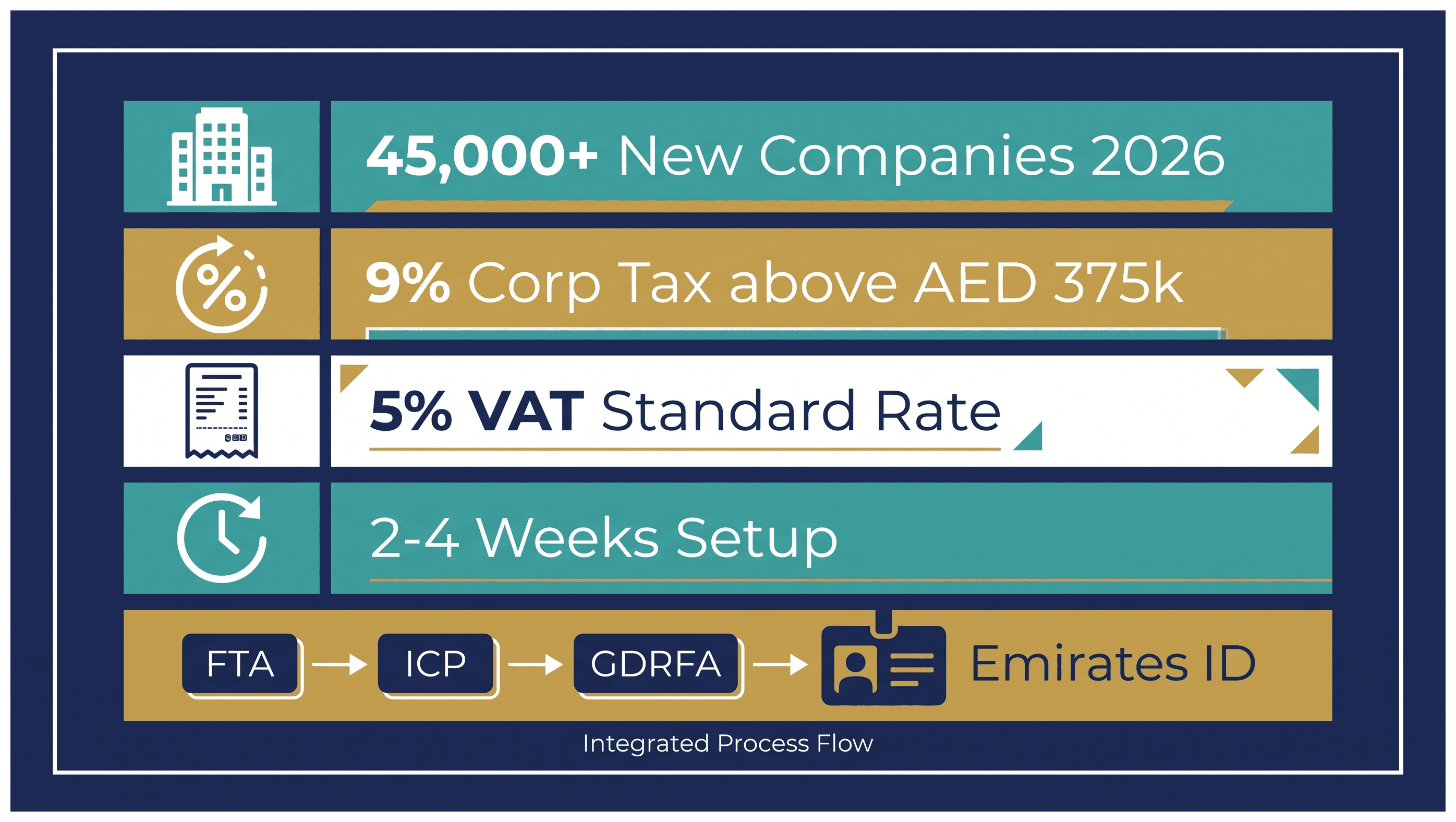
The Federal Tax Authority (FTA) oversees corporate tax and VAT under Federal Decree-Law No. 47 of 2022, applying 9% corporate tax above AED 375,000 profit and 5% VAT above the registration threshold. Free zone entities may qualify for reduced rates on qualifying income.
Corporate Tax Basics Under the Decree-Law
Federal Decree-Law No. 47 of 2022 sets the framework. Profit above AED 375,000 is taxed at 9%. Below that threshold, it's 0%. Qualifying free zone income, under specific conditions set by the FTA, can keep preferential treatment even as revenue grows.
VAT Registration Thresholds
5% VAT applies once turnover crosses the mandatory registration threshold.
The FTA manages registration, filing, and audits.
Goods moved within designated free zones get specific VAT treatment.
Late registration triggers penalties, so file early.
Is a Dubai Free Zone Company Worth It for a South African Consultant?
Yes, if you bill international clients. You get 100% ownership, fast licensing, and access to UAE banking. Combined with reduced tax exposure on qualifying income, it often beats staying purely South African for cross-border work.
Step-by-Step Guide to Relocating Your Operations
Relocating operations involves choosing an activity, reserving a trade name, applying through the ICP (Federal Authority for Identity, Citizenship, Customs and Port Security) for entry permits, completing GDRFA (General Directorate of Residency and Foreigners Affairs) medical and biometric steps, and collecting your Emirates ID. Most founders finish licensing and visa steps within two to four weeks.
Step 1: Choose Your Activity and Reserve a Name
Match your activity list to your existing South African business scope.
Reserve your trade name before applying for a license.
Confirm the activity fits free zone licensing rules.
Run a check company name search before committing.
Step 2: Apply Through ICP and GDRFA
ICP handles your entry permit and residency file approval.
GDRFA manages status change, medical test, and biometrics.
Emirates ID gets issued after medical clearance.
Keep passport copies and photos ready for both stages.
Step 3: Open Your Corporate Bank Account
Banks require your trade license and Emirates ID copies before opening an account. South African founders often need to show proof of source of funds, given SARB's exchange control interest in outbound capital. Account setup timelines vary by bank, so budget a few extra weeks here.
Handling Your South African Tax and Exchange Control Obligations
South African founders must still report worldwide income to SARS (South African Revenue Service) and comply with SARB (South African Reserve Bank) exchange control rules when moving capital offshore. Using your annual foreign investment allowance and clearance processes correctly avoids penalties while funding your Dubai company.
Key Facts: Moving a South African Company's Operations to Dubai
Feature | Requirement | Detail |
|---|---|---|
Starting free zone license cost | AED 12,500 | Covers trade license, registration, and limited visa allocation |
Corporate tax | 9% above AED 375,000 profit | Governed by Federal Decree-Law No. 47 of 2022 |
VAT | 5% above threshold | Managed by the FTA, mandatory registration triggers filing |
Typical setup time | 2-4 weeks | Covers license, ICP, and GDRFA steps combined |
Key SA compliance | SARS reporting and SARB clearance | Worldwide income disclosure plus exchange control approval |
Key UAE bodies | FTA, ICP, GDRFA | Handle tax, entry permits, and residency status respectively |
SARS Reporting Requirements
Tax residents report worldwide income to SARS.
Foreign company ownership must be disclosed.
Double tax treaty relief may reduce exposure.
Late disclosure risks penalties and interest.
SARB Exchange Control Clearance
SARB governs offshore capital transfers from South Africa. Your annual foreign investment allowance sets a limit before you need formal clearance. A Cape Town founder we advised used her annual allowance plus SARB clearance to fund her Dubai free zone share capital, avoiding delays that would've pushed her launch back a month.
Free Zone Costs and Licensing Options Compared
Free zone license packages typically start near AED 12,500, covering trade license, registration, and a limited visa allocation. Costs rise with activity count, office space, and visa quota, so founders should compare packages against their exact operational needs. Run the numbers on the dubai free zone company setup cost tool before committing.
What Drives License Cost Up or Down
Number of business activities selected affects total fees.
Each additional visa adds to the package cost.
Office or flexi-desk requirements change pricing tiers.
Consulting and trading license dubai activities carry different fee structures.
Comparing Package Tiers
Entry-level packages suit solo consultants who just need a trade license and one visa. Mid-tier packages support small trading teams needing two or three visas plus extra activities. Higher tiers bundle more visas, more activities, and dedicated office space, which matters once you're hiring locally rather than running remote.
Common Mistakes South African Founders Make When Relocating
Founders often underestimate SARB clearance timelines, pick mismatched business activities, skip name checks before applying, and delay Emirates ID processing. Planning each step against realistic timelines prevents costly delays during the relocation of moving a South African company's operations to Dubai.
Underestimating SARB Timelines
Clearance can take longer than founders expect.
Start SARB paperwork weeks before you need funds.
Delays here stall funding of your new UAE entity.
Bank compliance teams may ask follow-up questions mid-process.
Choosing the Wrong Activity Code
Mismatched activity codes limit banking and licensing options.
Review your activity list carefully before applying.
Correcting it later costs both time and fees.
Get it right with a proper list of business activities in dubai review upfront.
Moving a South African company's operations to Dubai comes down to picking the right structure, understanding tax obligations under the FTA and SARS, and following the ICP and GDRFA steps carefully. Get the sequencing right and you'll be trading through your new entity within a month.
Talk to our business support UAE team or run the numbers on the business setup cost in dubai calculator to set up or buy your license.
References
Dubai Chamber of Commerce, 2025. Dubai Chamber of Commerce
Federal Tax Authority, 2025. Federal Tax Authority
Federal Authority for Identity, Citizenship, Customs and Port Security, 2025. ICP
Ministry of Finance, 2025. Ministry of Finance
Dubai Department of Economy and Tourism, 2025. Department of Economy and Tourism
Frequently Asked Questions